Sauerkraut Benefits: What the Evidence Shows
What sauerkraut is
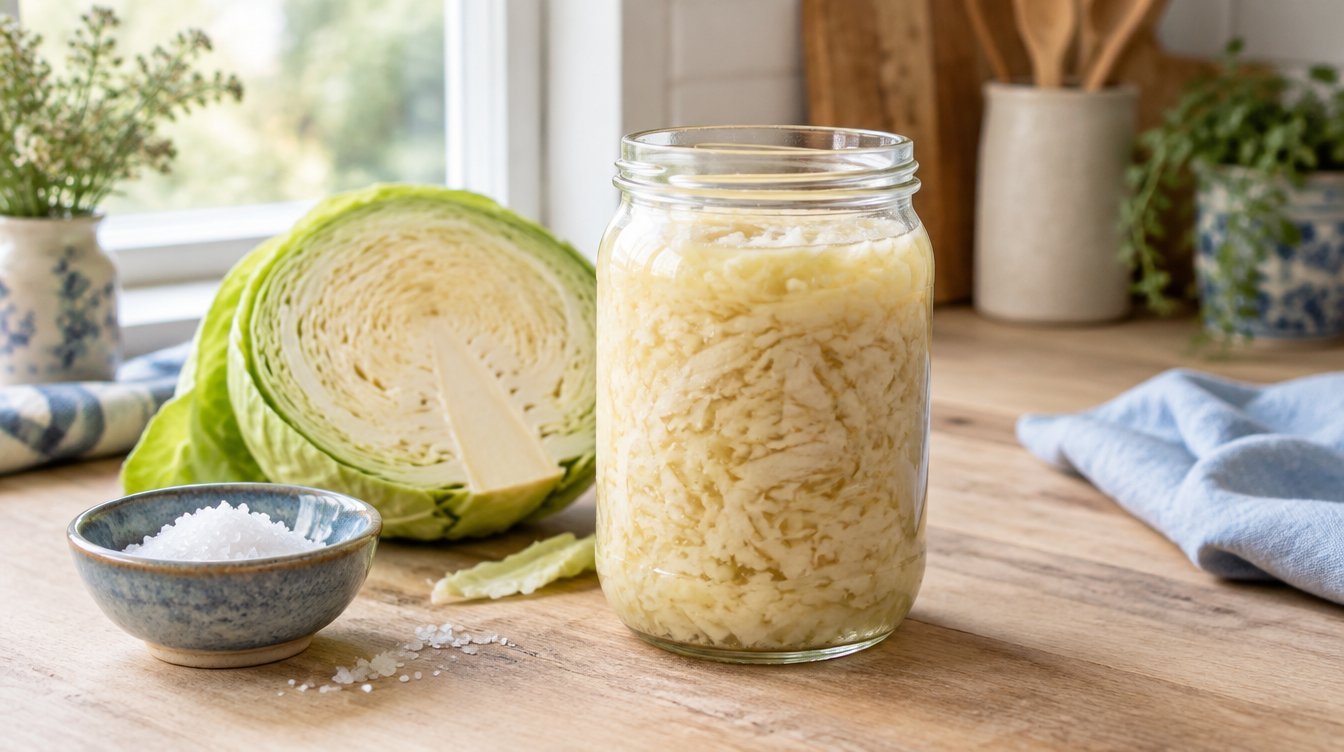
Sauerkraut is shredded cabbage fermented in its own salty juice. Nothing else is required. The salt pulls water out of the cabbage, and bacteria that already live on the leaves turn its sugars into lactic acid, which gives sauerkraut its sour taste and keeps it from spoiling.
The bacteria work in shifts. A 2018 study in PLoS One that cultured bacteria from four sauerkraut batches found that about half of the isolates were Lactobacillus species and a third were Leuconostoc. A few of the Lactobacillus strains looked promising as probiotics in lab tests, but that work was done in dishes, not in people.
At home, the National Center for Home Food Preservation recommends fermenting at 70 to 75°F, where kraut is fully fermented in about 3 to 4 weeks. Below 60°F it may not ferment at all, and above 75°F it can turn soft.
What is in a serving
Sauerkraut is mostly water and cabbage, so it is very low in calories. The numbers below come from USDA FoodData Central for canned sauerkraut (solids and liquids). A half cup is 71 grams, half of USDA’s 142-gram cup.
| Nutrient | Per 1/2 cup (71 g) | Per 100 g |
|---|---|---|
| Calories | 13 | 19 |
| Fiber | 2.1 g | 2.9 g |
| Vitamin C | 10.4 mg | 14.7 mg |
| Vitamin K | 9.2 mcg | 13 mcg |
| Iron | 1.0 mg | 1.5 mg |
| Potassium | 121 mg | 170 mg |
| Sodium | 469 mg | 661 mg |
The fiber and vitamin C are useful but modest. The sodium is the number that stands out, and we come back to it below. Homemade and refrigerated brands vary, so check the Nutrition Facts label on the jar you buy.
Sauerkraut benefits: what the research shows
Sauerkraut has a big reputation and a small research base. Only a handful of human trials have tested sauerkraut itself. Here is what they found.
Gut bacteria
The largest trial so far, published in Microbiome in 2025, had 87 healthy adults in Germany eat fresh or pasteurized sauerkraut daily for 4 weeks each, with washout periods in between. Some individual bacterial species shifted, and the changes were larger after the pasteurized version. Only pasteurized sauerkraut raised short-chain fatty acids in the blood. The authors concluded that a healthy gut microbiome is “rather resilient” to short-term diet changes.
Digestive symptoms
A 2018 pilot study gave 34 Norwegian adults with irritable bowel syndrome either pasteurized or unpasteurized sauerkraut every day for 6 weeks. Symptom scores improved in both groups, with no difference between them, and gut bacteria changed in both. The study had no group that skipped sauerkraut, and the authors called it underpowered, so it cannot show that sauerkraut caused the improvement.
Blood pressure and inflammation
The same German team reported other results from its 87-person trial in a 2026 paper. People ate 100 grams a day. Both fresh and pasteurized sauerkraut were linked with a small drop in systolic blood pressure. Markers of gut barrier function (“leaky gut”) did not change, and the authors found no appreciable whole-body benefit over 4 weeks in healthy people.
Fermented foods as a group
Much of the buzz comes from a 2021 Stanford trial in Cell. Thirty-six healthy adults were randomly assigned to a high-fiber diet or a diet high in fermented foods. In the fermented group, gut microbial diversity rose and levels of 19 inflammatory proteins fell. The foods were yogurt, kefir, fermented cottage cheese, kimchi and other fermented vegetables, vegetable brine drinks and kombucha, so the results apply to the mix, not to sauerkraut alone.
Plant compounds
Cabbage contains glucosinolates, sulfur compounds that break down into other substances. In a 2016 lab study, glucosinolates were gone by day 7 of fermentation, replaced by compounds such as ascorbigen and indole-3-carbinol, which peaked around days 5 to 9 and partly declined during cold storage. This is food chemistry. It does not show any health effect in people.
Do the live bacteria matter?
Raw, refrigerated sauerkraut contains live bacteria. Shelf-stable canned kraut has been heat-treated, and some jarred “sauerkraut” is made with vinegar rather than fermentation. Harvard Health suggests looking for the words “naturally fermented” on the label if you want live cultures. Our guide to whether canned sauerkraut has probiotics covers the label details.
Oddly, the human trials so far do not show that live bacteria are what make the difference. Pasteurized and unpasteurized sauerkraut produced similar symptom changes in the IBS pilot and similar blood pressure changes in the German trial. The researchers suggest fiber and other compounds made during fermentation may matter as much as the bacteria. That is still an open question.
Downsides to keep in mind
- Sodium. The Daily Value for sodium is less than 2,300 mg a day, and the FDA considers 20% DV or more per serving high. A half cup of canned sauerkraut, at about 469 mg, is right at that line. If you watch your salt, use a forkful as a condiment rather than a side dish, or rinse it briefly.
- Tyramine. Mayo Clinic lists sauerkraut among fermented foods that can be high in tyramine. People who take MAOI antidepressants may need to limit it, so ask your prescriber.
- Getting used to it. If you rarely eat fermented foods, start with a tablespoon or two and see how your stomach handles it before eating more.
How to add sauerkraut to your meals
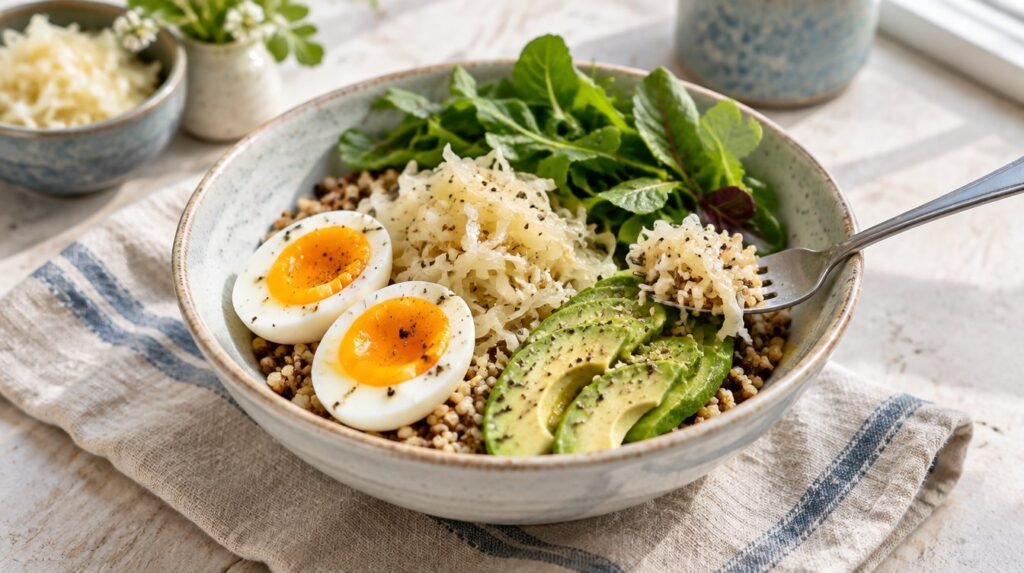
You do not need much. The German trial used 100 grams a day, a little under half a cup, and most people use less as a topping.
- Keep it cool. Add raw sauerkraut after cooking, since heat kills live bacteria.
- Use it as a condiment. Pile a forkful on eggs, grain bowls, sandwiches, sausages or baked potatoes.
- Mix your ferments. Rotating sauerkraut with yogurt, kefir and kimchi is closer to the variety used in the Stanford trial.
- Make your own. Cabbage and salt at 70 to 75°F, kept under the brine, is all it takes. Follow a tested recipe such as the one from the National Center for Home Food Preservation.
For more ideas, see how to eat sauerkraut for gut health and the best time to eat sauerkraut. If you want to compare it with other options, our list of fermented foods for gut health is a good next stop.
Related topics
- How to Eat Sauerkraut for Gut Health: simple ways to work it into meals.
- Does Canned Sauerkraut Have Probiotics?: what heat treatment does to live cultures.
- Is Kimchi Good for Gut Health?: the evidence on sauerkraut’s spicy cousin.
- Do Pickles Have Probiotics?: fermented versus vinegar pickles.
- Probiotic Foods: other foods that can contain live cultures.
- Kefir Benefits: what research shows for fermented milk.
Sources
- Sauerkraut, canned, solids and liquids (FDC ID 169279) (USDA FoodData Central)
- Sauerkraut (National Center for Home Food Preservation, University of Georgia)
- Touret T, et al. Putative probiotic lactic acid bacteria isolated from sauerkraut fermentations (PLoS One, 2018)
- Schropp N, et al. The impact of regular sauerkraut consumption on the human gut microbiota: a crossover intervention trial (Microbiome, 2025)
- Nielsen ES, et al. Lacto-fermented sauerkraut improves symptoms in IBS patients independent of product pasteurisation – a pilot study (Food & Function, 2018)
- Schropp N, et al. Fermented foods and inflammation: a crossover intervention trial with fresh and pasteurized sauerkraut (European Journal of Clinical Nutrition, 2026)
- Wastyk HC, et al. Gut-microbiota-targeted diets modulate human immune status (Cell, 2021)
- Fermented-food diet increases microbiome diversity, decreases inflammatory proteins, study finds (Stanford Medicine, 2021)
- Palani K, et al. Influence of fermentation on glucosinolates and glucobrassicin degradation products in sauerkraut (Food Chemistry, 2016)
- Fermented foods can add depth to your diet (Harvard Health Publishing)
- Sodium in Your Diet (U.S. Food and Drug Administration)
- MAOIs and diet: Is it necessary to restrict tyramine? (Mayo Clinic)