Do Pickles Have Probiotics? What the Evidence Says
The verdict: only fermented, unpasteurized pickles have live bacteria
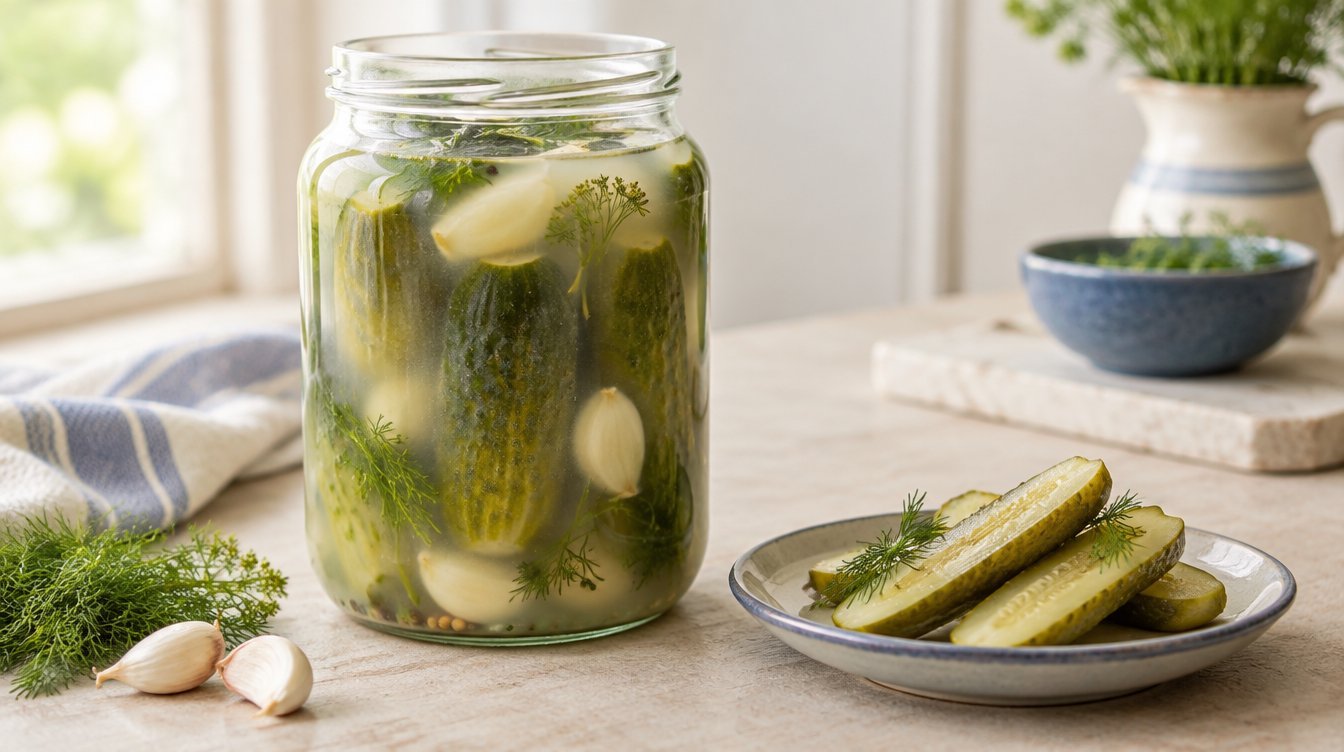
Some pickles have live bacteria, but most don’t. Pickles made by lactic acid fermentation in salt brine, and never heated afterward, carry live lactic acid bacteria. The shelf-stable jars in the center aisle are usually vinegar pickles that have been pasteurized, so they have no live cultures.
Even a live-culture pickle isn’t a probiotic in the strict sense. Its bacteria are a mix that hasn’t been tested in people for a specific benefit, and research on pickles themselves is thin.
What the research shows
Two different products share one name
A fermented pickle starts as cucumbers in a salt brine. Bacteria already on the cucumbers, mainly lactobacilli such as Lactiplantibacillus plantarum, Lactiplantibacillus pentosus and Levilactobacillus brevis, turn the cucumber sugars into lactic acid. In a 2022 lab study from USDA and NC State researchers, cucumber fermentations ended at an average pH of about 3.2 across 391 batches, and acid from the native lactobacilli helped keep other bacteria from growing.
Quick or “fresh-pack” pickles skip fermentation. They are acidified with vinegar, and shelf-stable jars are then pasteurized. USDA Agricultural Research Service describes this heat step for dill, bread-and-butter, sweet and kosher pickles sold on store shelves.
The International Scientific Association for Probiotics and Prebiotics (ISAPP) consensus on fermented foods sorts them clearly: non-heated fermented vegetables have live microbes, heat-treated or pasteurized ones don’t, and vegetables pickled in vinegar without fermentation aren’t fermented foods at all.
Live bacteria are not the same as probiotics
A probiotic, by the definition backed in an 2014 expert consensus statement, is a live microorganism given in amounts shown to provide a health benefit. The ISAPP panel says “fermented food” and “probiotic” can’t be used interchangeably, and expects that most fermented foods sold today don’t qualify as probiotic foods because their microbes are undefined and vary in number.
The NIH Office of Dietary Supplements lists pickles among fermented foods but cautions that not all of them contain probiotics with proven benefits. A fermented pickle gives you live lactic acid bacteria, not a studied strain at a known dose. For foods with studied strains, see our guide to probiotic foods.
Human research on pickles is limited
Pickles have had less research attention than fermented dairy, kimchi or kombucha. A 2019 review of fermented vegetables and drinks concluded that more human dietary intervention studies are needed before health claims can be made. The ISAPP panel lists at least one randomized trial each for kimchi and sauerkraut; we did not find one for cucumber pickles.
The closest evidence is indirect. In a 17-week randomized study of 36 healthy adults at Stanford, a high-fermented-food diet (yogurt, kefir, kombucha, fermented vegetables and vegetable brine drinks) raised gut microbiome diversity and lowered several inflammatory markers. It was small and used a mix of foods, so it can’t show what pickles alone do. See also fermented foods for gut health.
Caveats to keep in mind
- Sodium adds up fast. USDA FoodData Central lists 809 mg of sodium per 100 grams of dill pickle. That is about 280 mg in a small 35-gram spear and about 1,090 mg in one large 4-inch pickle, close to half of the FDA Daily Value of less than 2,300 mg a day. The FDA counts 20% of the Daily Value or more per serving as high.
- Cold doesn’t always mean fermented. Some refrigerated pickles are vinegar pickles kept cold instead of heated. USDA ARS treats refrigerated-style pickles as their own category, separate from fermented ones.
- Canning ends the live bacteria. The National Center for Home Food Preservation recommends canning fermented pickles for long storage, either in a boiling-water canner or held at 180 to 185°F for 30 minutes. That heat makes them a heat-treated fermented food in the ISAPP sense, with no live microbes left.
- Some people should ask a doctor first. NCCIH notes that the risk of harm from live microbes is higher in people with severe illness or a weakened immune system. This is general information, not medical advice.
How to choose pickles with live bacteria
- Start in the refrigerated case. Unpasteurized fermented pickles must stay cold.
- Read the front label. Look for “fermented,” “naturally fermented,” “lacto-fermented” or “live cultures.” Refrigeration alone isn’t proof.
- Read the ingredients. Expect cucumbers, water, salt, garlic, dill and spices. Vinegar near the top often means a quick pickle, though some fermented recipes add a little, so the label wording matters more.
- Skip “pasteurized.” A pasteurized or room-temperature jar has no live cultures.
- Check sodium per serving on the Nutrition Facts panel, the same way you would for sauerkraut.
Making lacto-fermented pickles at home
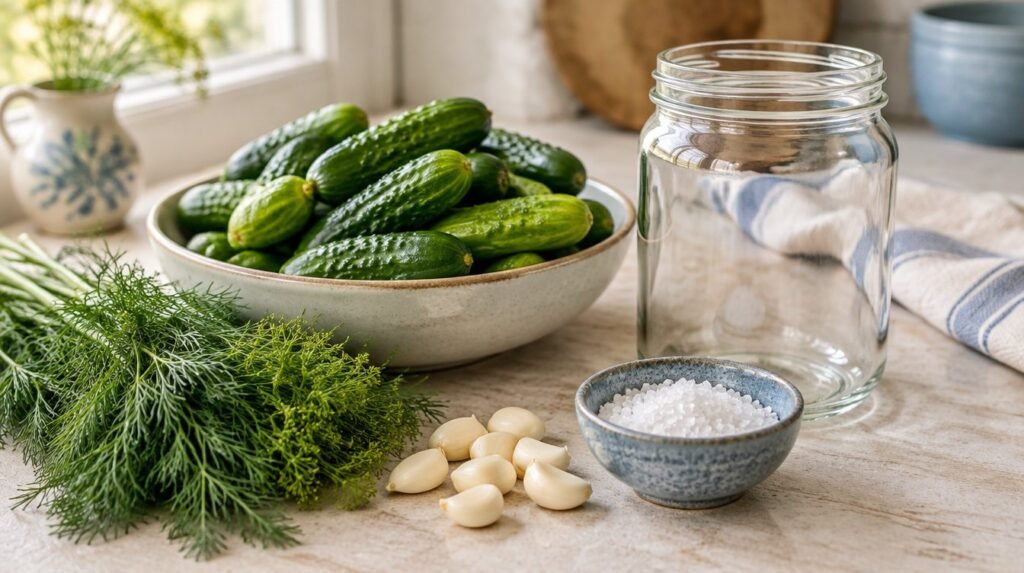
Home fermentation gets you live bacteria if you refrigerate the pickles instead of canning them. The NCHFP dill pickle recipe uses, per gallon of container: 4 pounds of 4-inch pickling cucumbers, 2 tablespoons of dill seed or 4 to 5 heads of fresh dill, and a brine of 1/2 cup salt, 1/4 cup of 5% vinegar and 8 cups of water.
- Use canning or pickling salt. University of Minnesota Extension says it should be iodine-free, and to use the amount the recipe calls for.
- Keep the cucumbers fully under the brine, with 1 to 2 inches of brine on top, using a weight if needed (UMN).
- Use food-grade glass, ceramic or plastic, not metal, which reacts with the acid (UMN).
- Ferment at 70 to 75°F for about 3 to 4 weeks. At 55 to 65°F it takes 5 to 6 weeks, and above 80°F pickles turn too soft (NCHFP).
- Check several times a week and remove any surface scum or mold promptly (NCHFP).
- Discard pickles that turn soft or slimy or smell bad (NCHFP).
- Fully fermented pickles keep in the refrigerator for about 4 to 6 months if scum and mold are removed regularly (NCHFP).
Stick to a tested recipe’s salt and acid amounts. For other dairy-free ferments, see non-dairy probiotics.
Frequently asked questions
Do refrigerated pickles always have probiotics?
No. Some refrigerated pickles are vinegar pickles kept cold, so look for “fermented” or “live cultures” on the label as well.
Does pickle juice have live bacteria?
Brine from an unpasteurized fermented pickle carries the same live bacteria as the pickles. Vinegar brine from a shelf-stable, pasteurized jar does not.
Do sweet or bread-and-butter pickles have probiotics?
Shelf-stable sweet and bread-and-butter pickles are pasteurized, so they have no live cultures (USDA ARS).
Are fermented pickles good for gut health?
They add live lactic acid bacteria to your diet, but no human trials have tested pickles alone, and they are high in sodium.
Related topics
- Probiotic Foods: which foods carry live cultures and which carry studied strains.
- Fermented Foods for Gut Health: the research on fermented foods as a group.
- Does Canned Sauerkraut Have Probiotics?: the same heat question for cabbage.
- Does All Yogurt Have Probiotics?: how yogurt labels show live cultures.
- Non Dairy Probiotics: live-culture options without milk.
- Best Foods for Gut Health: where fermented foods fit in a whole diet.
Sources
- Marco ML, et al. The International Scientific Association for Probiotics and Prebiotics (ISAPP) consensus statement on fermented foods (Nature Reviews Gastroenterology & Hepatology, 2021)
- Hill C, et al. Expert consensus document: The International Scientific Association for Probiotics and Prebiotics consensus statement on the scope and appropriate use of the term probiotic (Nature Reviews Gastroenterology & Hepatology, 2014)
- Rothwell MAR, et al. Growth of ɣ-Proteobacteria in Low Salt Cucumber Fermentation Is Prevented by Lactobacilli and the Cover Brine Ingredients (Microbiology Spectrum, 2022)
- Lavefve L, et al. Microbial Ecology of Fermented Vegetables and Non-Alcoholic Drinks and Current Knowledge on Their Impact on Human Health (Advances in Food and Nutrition Research, 2019)
- Wastyk HC, et al. Gut-microbiota-targeted diets modulate human immune status (Cell, 2021)
- A Lab That Keeps Us All Out of a Pickle (USDA Agricultural Research Service, AgResearch Magazine, 2014)
- Dill Pickles (fermented) (National Center for Home Food Preservation, University of Georgia)
- Preserving food at home: Fermentation (University of Minnesota Extension)
- Pickles, cucumber, dill or kosher dill (FDC ID 168558) (USDA FoodData Central)
- Sodium in Your Diet (U.S. Food and Drug Administration)
- Probiotics: Fact Sheet for Consumers (NIH Office of Dietary Supplements)
- Probiotics: Usefulness and Safety (National Center for Complementary and Integrative Health)
This article is for general information and is not medical advice. Talk to your doctor or a registered dietitian before changing your diet, supplements or medication, especially if you have a health condition.