Non-Dairy Probiotics: A Buyer’s Guide
What non-dairy probiotics are
Non-dairy probiotics are live microbes you get without milk: from fermented plant foods that still contain live cultures, or from probiotic supplements made without milk ingredients. Probiotics, strictly, are live microorganisms that provide a health benefit when taken in sufficient amounts (NIH Office of Dietary Supplements).
Many fermented foods carry live microbes that have not been proven to be probiotics. An expert panel stressed that “fermented food” and “probiotic” are not interchangeable terms (Marco, 2021). Both can be part of a dairy-free diet; they just make different promises.
Ultimate Gut is published by Ultimate Health Solutions, which sells a yogurt maker, probiotic capsules and an inulin fiber supplement. None of the products reviewed here are ours, and these brands don’t pay us.
Why it matters for gut health
The Dietary Guidelines for Americans, 2025-2030 say vegetables, fruits, fermented foods such as sauerkraut, kimchi, kefir and miso, and high-fiber foods support a diverse microbiome, which may be beneficial for health (Dietary Guidelines). In a 17-week randomized study with 18 healthy adults per group, a diet high in fermented foods steadily increased gut microbiota diversity and lowered inflammatory markers (Wastyk, 2021).
If you avoid dairy, the job is to find foods that still carry live microbes and supplements that are truly free of milk. For people with a milk allergy this is a safety question, not just a preference: probiotic products can contain hidden milk proteins (Martín-Muñoz, 2012).
Non-dairy food sources of live cultures
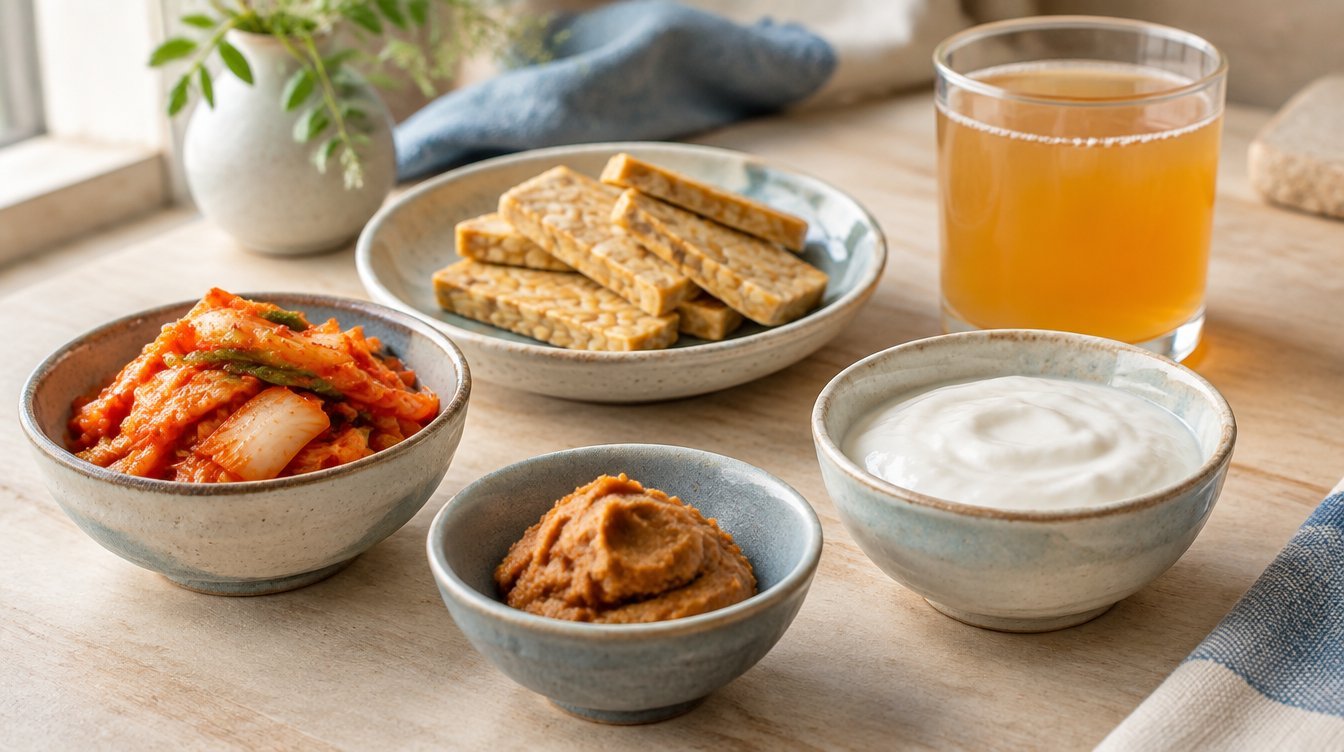
Not every fermented food still has live microbes when you eat it. Baking, canning and other processing after fermentation can kill them; ISAPP gives canned sauerkraut and sourdough bread as examples (ISAPP). Use this table when you shop.
| Food | Live cultures? | What to look for on the label |
|---|---|---|
| Sauerkraut | Yes if raw; no if canned | Refrigerated jar or bag; “raw,” “unpasteurized” or “live cultures” |
| Kimchi | Usually, when fresh | Refrigerated; “live cultures”; check the ingredients if you are vegan |
| Tempeh | Yes before cooking, but it is usually cooked | Treat it as a fermented protein food rather than a source of live microbes |
| Miso | Often | “Unpasteurized” and refrigerated; stir into soup after it comes off the boil |
| Kombucha | Most do | “Raw” or “live cultures”; sugar per bottle |
| Water kefir | Yes | Named cultures; the allergen statement, since some versions use whey |
| Plant-based yogurt | Only if cultures are added and not killed | Named cultures or “live and active cultures”; added sugars; calcium |
ISAPP lists tempeh, miso, kimchi and other fermented vegetables, and most kombuchas among foods that keep their fermentation microbes, and it advises looking for “contains live cultures” or contacting the maker when a label is silent (ISAPP; ISAPP). Heat after fermentation kills those microbes the way baking does in bread, so cooked tempeh and boiled miso soup lose most of them. For more on sauerkraut, see does canned sauerkraut have probiotics.
What the research says about the main options
- Kombucha: A systematic review found just one study reporting human health results (Kapp, 2019). NIH notes that kombucha, sauerkraut and miso contain live cultures but do not typically contain proven probiotic microorganisms (ODS). Our kombucha guide covers what to look for.
- Water kefir: Its grains carry Lactobacillus casei/paracasei, other lactobacilli, a Bifidobacterium species and yeasts (Laureys, 2014). In a 14-day before-and-after study, 40 healthy adults drank 200 mL of homemade water kefir daily; their gut bacteria shifted, 32% reported gas and 24% bloating, and the authors said causality cannot be established (de Mel, 2026). Demineralized whey can be used in water kefir production (Bozkir, 2024), so read the label.
- Plant-based yogurt: A survey of 249 non-dairy yogurt alternatives found half had high sugar levels and only 45% were fortified to at least 10% of the Daily Value for calcium (Craig and Brothers, 2021). The industry Live & Active Cultures seal is described for yogurt and cultured dairy products (IDFA), so on plant-based products, look for named cultures instead. See our Kite Hill almond yogurt article for one example.
How to check a dairy-free probiotic supplement
- Find the allergen statement. Milk is one of nine major food allergens. It must be named in the ingredient list, such as “whey (milk),” or in a “Contains” statement, and the FDA enforces this on dietary supplements too (FDA).
- Read the other ingredients. Watch for milk, whey, casein, caseinate, lactose and milk powder. Federal rules even let a food labeled “nondairy” contain caseinate, a milk protein, as long as its source is identified (21 CFR 101.4).
- Weigh “may contain milk” warnings. These advisory statements are voluntary (FDA), so a label without one is not proof of zero cross-contact.
- Do not rely on a claim alone. When researchers in Spain tested 11 probiotic products, they detected cow’s milk proteins in 10, while only eight labels mentioned lactose, lactic acid or milk (Martín-Muñoz, 2012). With a milk allergy, ask the manufacturer and your allergist.
- Check the CFU count at expiration. Choose products that list CFU at the end of shelf life, not at manufacture (ODS).
- Look for strain names. Effects can be specific to a strain, so the label should give genus, species and a strain code (ODS).
Under federal law, the FDA is not authorized to approve dietary supplements for safety and effectiveness before they are marketed (FDA). The risk of harmful effects from probiotics is greater in people with severe illnesses or weakened immune systems, and serious infections have been reported in premature infants (NCCIH). Fungal blood infections linked to probiotics have often involved patients with a central venous catheter (ODS). If you are pregnant, ill or immunocompromised, talk to your health care provider first. For plant-based picks, see vegan gut health supplements.
Making non-dairy probiotic yogurt at home
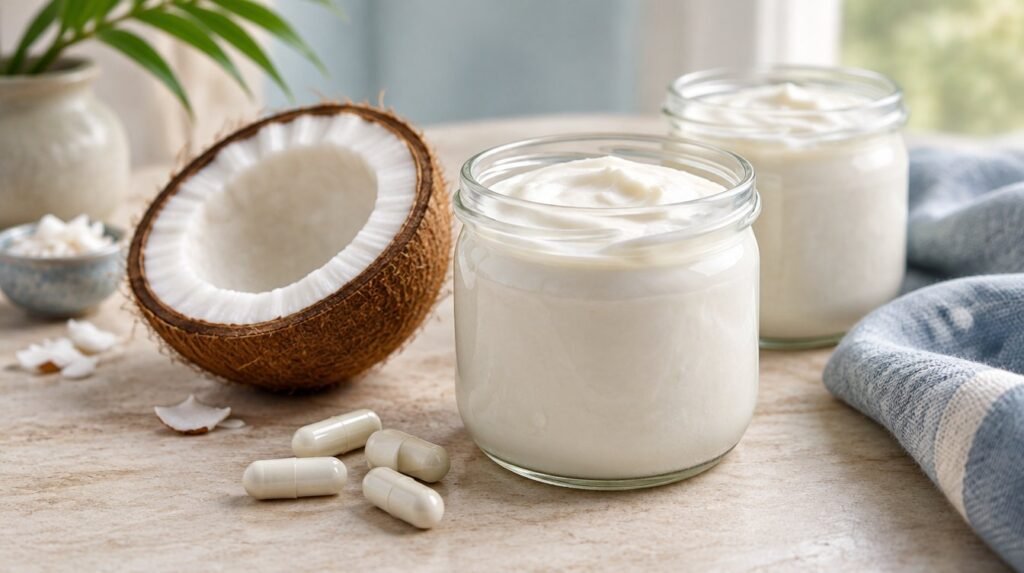
You can culture coconut milk with the contents of a dairy-free probiotic capsule. Results vary with the strain, the coconut milk and the temperature, and a home batch has no measured CFU count, so treat it as a fermented food.
- Check the capsule label for milk ingredients and the allergen statement, as above.
- Wash your hands and use clean jars and utensils; unclean equipment is one cause of thin, off-tasting homemade yogurt (University of Illinois Extension).
- Warm the coconut milk to the fermentation temperature your culture calls for, then stir in the capsule contents.
- Keep it at that temperature for the time the culture’s instructions give, until it smells pleasantly sour.
- Refrigerate it at 40°F or lower (University of Illinois Extension). Expect a softer set than dairy yogurt, and throw out any batch that smells or looks wrong.
Our coconut yogurt guide covers the full method.
Related topics
- Coconut Yogurt: a full dairy-free yogurt method.
- Probiotic Foods: dairy and non-dairy foods with live cultures.
- Vegan Gut Health Supplements: supplements made without animal ingredients.
- Fermented Foods for Gut Health: the research on fermented foods.
Sources
- Probiotics: Fact Sheet for Consumers (NIH Office of Dietary Supplements)
- Marco ML, et al. The International Scientific Association for Probiotics and Prebiotics (ISAPP) consensus statement on fermented foods (Nature Reviews Gastroenterology & Hepatology, 2021)
- Dietary Guidelines for Americans, 2025-2030 (U.S. Departments of Agriculture and Health and Human Services)
- Wastyk HC, et al. Gut-microbiota-targeted diets modulate human immune status (Cell, 2021)
- Martín-Muñoz MF, et al. Anaphylactic reaction to probiotics. Cow’s milk and hen’s egg allergens in probiotic compounds (Pediatric Allergy and Immunology, 2012)
- Probiotics vs. Fermented Foods (International Scientific Association for Probiotics and Prebiotics)
- What are fermented foods? (International Scientific Association for Probiotics and Prebiotics)
- Kapp JM, Sumner W. Kombucha: a systematic review of the empirical evidence of human health benefit (Annals of Epidemiology, 2019)
- Probiotics: Fact Sheet for Health Professionals (NIH Office of Dietary Supplements)
- Laureys D, De Vuyst L. Microbial species diversity, community dynamics, and metabolite kinetics of water kefir fermentation (Applied and Environmental Microbiology, 2014)
- de Mel R, et al. Changes in gut microbiota composition following water kefir consumption in healthy adults (Scientific Reports, 2026)
- Bozkir E, et al. Challenges in water kefir production and limitations in human consumption: A comprehensive review of current knowledge (Heliyon, 2024)
- Craig WJ, Brothers CJ. Nutritional Content and Health Profile of Non-Dairy Plant-Based Yogurt Alternatives (Nutrients, 2021)
- Live & Active Cultures Seal (International Dairy Foods Association)
- Food Allergies (U.S. Food and Drug Administration)
- 21 CFR 101.4 Food; designation of ingredients (Electronic Code of Federal Regulations)
- Information for Consumers on Using Dietary Supplements (U.S. Food and Drug Administration)
- Probiotics: Usefulness and Safety (National Center for Complementary and Integrative Health)
- Making Yogurt at Home (University of Illinois Extension, 2024)
This article is for general information and is not medical advice. Talk to your doctor or a registered dietitian before changing your diet, supplements or medication, especially if you have a health condition.