Probiotic Foods: A Buyer’s Guide
What Probiotic Foods Are, and What They Are Not
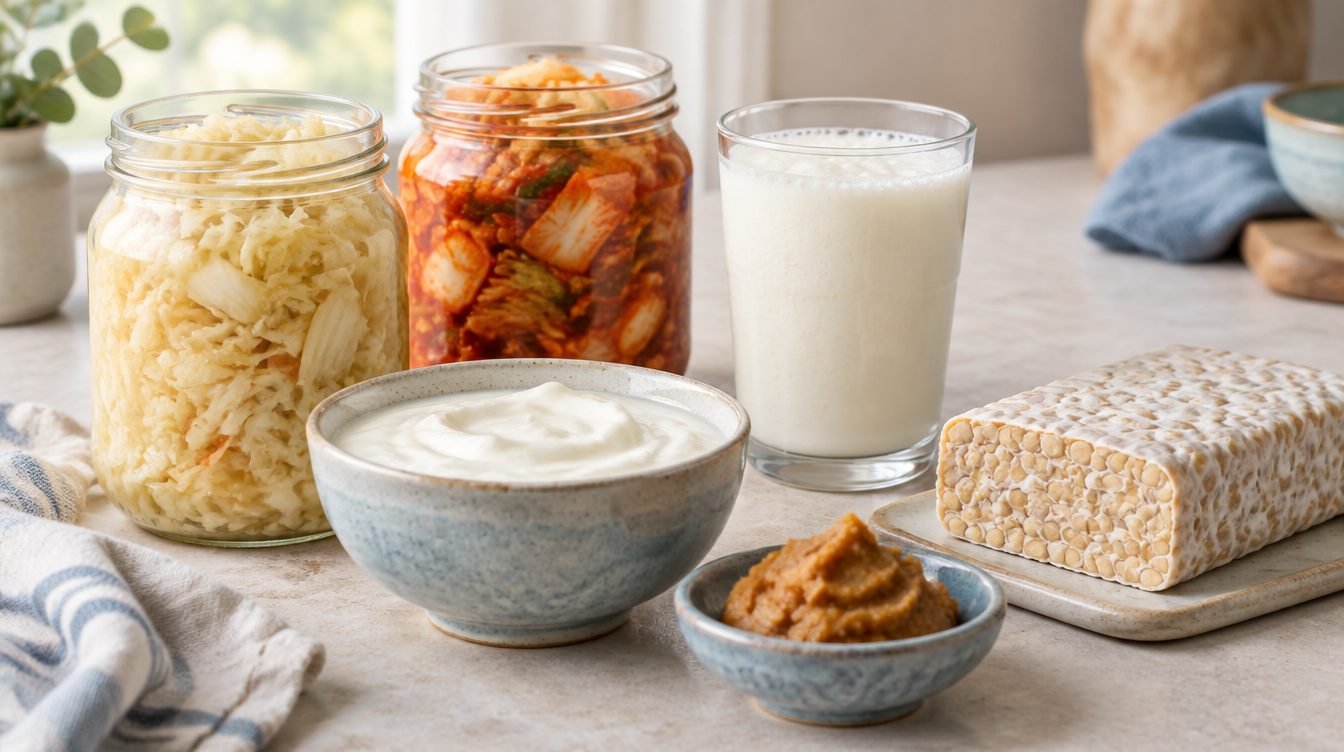
Probiotic foods, in everyday use, are foods that contain live microbes when you eat them, such as yogurt, kefir and unpasteurized sauerkraut. Scientists use a narrower definition, and the difference changes how you read labels.
The International Scientific Association for Probiotics and Prebiotics (ISAPP) says a probiotic must be a defined strain with at least one randomized controlled trial showing a health benefit. Fermented foods have no such requirement, and they do not even have to contain living microbes when eaten. ISAPP suggests “live and active cultures” as more accurate wording for most of them.
An ISAPP expert panel defines fermented foods as foods made through desired microbial growth and enzymatic conversions of food components. So a food sold as a probiotic food is not always a probiotic in the scientific sense, and some fermented foods have no live microbes at all.
Why Probiotic Foods Matter for Gut Health
Foods with live cultures add microbes to your gut. In a Stanford randomized trial of 36 healthy adults, a 10-week diet high in fermented foods such as yogurt, kefir, kimchi and kombucha increased microbial diversity and lowered 19 inflammatory proteins in the blood. It was a small trial in healthy people, published in Cell in 2021.
Live counts vary widely. A 2018 review of fermented foods reported roughly 100,000 to 1 billion lactic acid bacteria per gram in cultured dairy, about 10 million to 100 million per gram in Korean kimchi, and anywhere from about 100 to 10 million per gram in miso. Fresher products generally had higher counts.
Which Foods Usually Contain Live Cultures
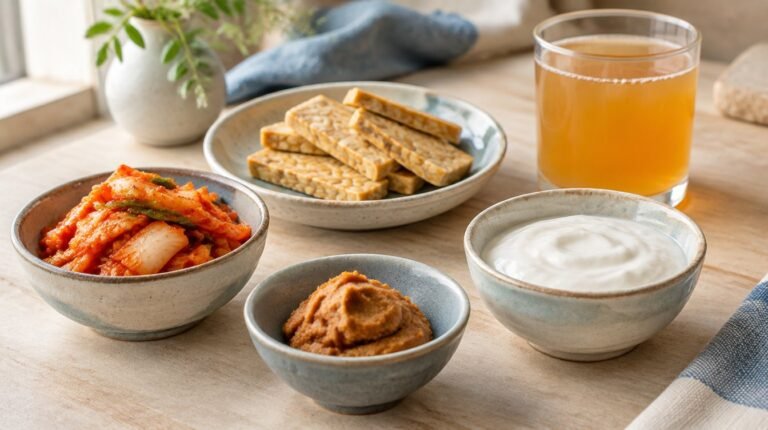
The table is based mainly on ISAPP guidance on probiotics and fermented foods. Individual products differ, so the label always has the final word.
| Food | Usually live cultures? | What to check |
|---|---|---|
| Yogurt | Yes, unless heat-treated after culturing | “Live and active cultures” wording or seal |
| Kefir | Yes | Sold refrigerated; cultures listed |
| Sauerkraut, refrigerated and unpasteurized | Yes | Refrigerated case; “unpasteurized” or “raw” |
| Sauerkraut, canned or shelf-stable | No | Shelf-stable usually means heat-treated |
| Kimchi | Yes | Refrigerated; check the date |
| Pickles fermented in salt brine, refrigerated | Yes | Labeled fermented, sold refrigerated, no vinegar in the ingredients |
| Shelf-stable pickles in vinegar | No | Vinegar pickles are usually not fermented |
| Miso | Often | Refrigerated; “unpasteurized” if stated |
| Tempeh | Rarely by the time you eat it | Usually cooked before eating |
| Kombucha | Most do | Refrigerated; unpasteurized |
| Most cheeses | Often, with lower counts in long-aged cheese | Raw-milk cheese carries pregnancy cautions |
| Sourdough bread | No | Baking kills the microbes |
| Soy sauce, vinegar, wine, most beer | No | Heat-treated or filtered |
Notes on the gray areas
Vinegar pickles are a different product, not a weaker version of fermented ones. The National Center for Home Food Preservation explains that fresh-pack or quick-process pickles are covered with vinegar and are not fermented, while regular dill pickles and sauerkraut ferment and cure for about three weeks.
ISAPP lists tempeh and miso among fermented foods that can contain live microbes. Tempeh is nearly always cooked before eating, though, and heat is what removes live microbes from baked and heat-treated fermented foods. For miso, stir it into soup after the pot comes off the heat rather than boiling it.
Most kombuchas contain live microbes, per ISAPP, but the Rezac review found few published data on microbe levels in retail products. Kombucha also keeps fermenting in the bottle, and the Alcohol and Tobacco Tax and Trade Bureau notes that alcohol content can rise to 0.5% or more after bottling. Our guide to the best kombucha for gut health covers brands.
Label Words to Look For
- “Contains live and active cultures”: on yogurt, the federal yogurt standard allows this phrase only with at least 10 million colony-forming units per gram at manufacture. Yogurt treated after culturing to kill its microbes must say “does not contain live and active cultures.”
- The Live and Active Cultures seal: the International Dairy Foods Association seal requires at least 100 million cultures per gram at the time of manufacture.
- “Refrigerated” or “keep refrigerated”: fermented vegetables sold at room temperature have usually been heat-treated.
- “Unpasteurized” or “raw”: on fermented vegetables, this signals no heat treatment after fermentation. See the safety notes below.
- Named strains: ISAPP advises looking for the genus, species and strain designation, such as a Bifidobacterium animalis subsp. lactis strain code. A strain name, plus the amount studied, is what links a product to research.
- Counts through the best-by date: ISAPP says live probiotic levels should be guaranteed through the best-by date, not just at manufacture.
Also check added sugar, especially on flavored yogurt, kefir and kombucha. For specific products, see the best yogurt for probiotics and the best kefir brands.
How to Store Probiotic Foods

- Keep them cold. Store refrigerated fermented foods in the refrigerator as the label directs. Our guide to yogurt storage temperature gives specifics.
- Buy fresh and use by the date. The Rezac review found fresher products generally had higher live counts.
- Keep kombucha refrigerated. Continued fermentation in the bottle is what can raise its alcohol content.
- Add heat-sensitive foods last. Stir miso or a spoonful of yogurt into warm dishes off the heat.
Safety Notes
This section is general information, not medical advice. The National Center for Complementary and Integrative Health says serious side effects from probiotics may be more likely in people with underlying health conditions, and that premature infants given probiotics are at risk of severe, potentially fatal infections. ISAPP advises talking with a doctor first if you have an immune disorder, a serious illness or short bowel, or before giving products to a young infant.
During pregnancy, FoodSafety.gov advises choosing only pasteurized milk and milk products, including yogurt, and avoiding cheese made from raw milk. The FDA notes that Listeria, a key concern in pregnancy, can grow at refrigerator temperatures. FoodSafety.gov does not address unpasteurized fermented vegetables or kombucha specifically, so ask your prenatal care provider.
Make Your Own
Homemade yogurt is one of the simplest probiotic foods for gut health to make, because you choose the culture, skip added sugar and eat it fresh. The cultures stay alive as long as you do not heat the yogurt after it ferments. Start with how to make yogurt at home and our yogurt starter guide.
Are all fermented foods probiotic?
No; ISAPP says most fermented foods do not meet the definition of a probiotic, which requires a defined strain with a documented health benefit (ISAPP).
Does sourdough bread have live cultures?
No; baking kills the microbes, so sourdough is a fermented food without live cultures by the time you eat it.
Do vinegar pickles contain probiotics?
Usually not; fresh-pack pickles made with vinegar are not fermented, so look for refrigerated pickles fermented in salt brine instead.
Related topics
- Fermented Foods for Gut Health: what the research shows.
- Best Foods for Gut Health: fermented foods compared with fiber-rich plants.
- Gut Health Diet Plan: how to fit fermented foods into each day.
- Best Yogurt for Probiotics: store-bought options compared.
- Lactobacillus reuteri: How to Culture It at Home: a named-strain project.
- How Long Does Homemade Yogurt Last?: storage times.
Sources
- Do fermented foods contain probiotics? (International Scientific Association for Probiotics and Prebiotics)
- Marco ML, et al. The ISAPP consensus statement on fermented foods (Nature Reviews Gastroenterology & Hepatology, 2021)
- Probiotics vs. fermented foods (infographic) (International Scientific Association for Probiotics and Prebiotics)
- Fermented-food diet increases microbiome diversity, decreases inflammatory proteins, study finds (Stanford Medicine, 2021)
- Wastyk HC, et al. Gut-microbiota-targeted diets modulate human immune status (Cell, 2021)
- Rezac S, et al. Fermented foods as a dietary source of live organisms (Frontiers in Microbiology, 2018)
- General information on pickling (National Center for Home Food Preservation, University of Georgia)
- Kombucha: general requirements (Alcohol and Tobacco Tax and Trade Bureau)
- 21 CFR 131.200 Yogurt (Electronic Code of Federal Regulations)
- Live and Active Cultures Seal (International Dairy Foods Association)
- 5 things to know about probiotics (National Center for Complementary and Integrative Health, NIH)
- People at risk: pregnant women (FoodSafety.gov)
- Preventing listeriosis in pregnant Hispanic women in the U.S.: community educator’s guide (U.S. Food and Drug Administration, 2016)
This article is for general information and is not medical advice. Talk to your doctor or a registered dietitian before changing your diet, supplements or medication, especially if you have a health condition.