Best Probiotic for Women: Compared (2026)
Best Probiotic for Women: Our Picks
Women do not need a special probiotic for gut health. The strains with the best digestive research work the same way regardless of sex, and none of the major sources we used, including the NIH Office of Dietary Supplements, recommend a women-only formula for digestion. Where women’s products differ is vaginal health, so we picked by need and by the strain with the most human research for it.
- Vaginal health (bacterial vaginosis support): Lactobacillus rhamnosus GR-1 plus Lactobacillus reuteri RC-14, found in Fem-Dophilus 1 Billion CFU and RepHresh Pro-B. Evidence is mixed, and these products do not replace diagnosis and treatment.
- Lactobacillus crispatus: the most promising trial used a vaginal product with strain CTV-05 (Lactin-V), not an oral supplement. Oral blends with other L. crispatus strains have no published trials we could find.
- Urinary tract infections (UTIs): evidence is weak, so we make no product pick.
- Digestive health, including during antibiotics: the same strains as for anyone, Saccharomyces boulardii CNCM I-745 (Florastor) or L. rhamnosus GG (Culturelle Digestive Daily).
- Pregnancy: talk to your doctor before starting any probiotic.
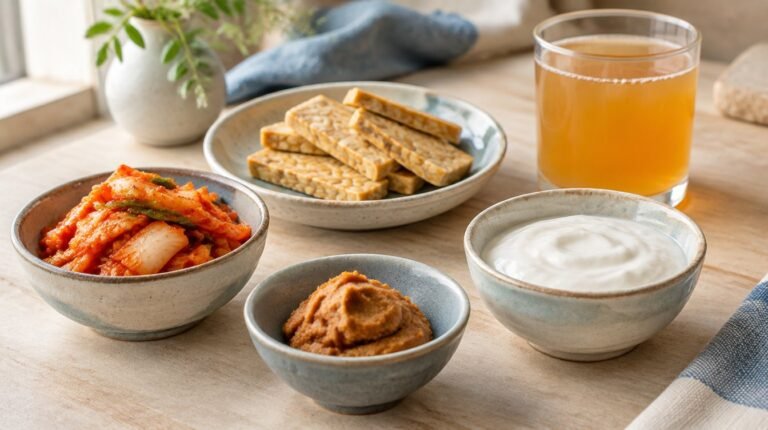
- Everyday gut health: food first, with yogurt and kefir as part of a varied diet.
Ultimate Gut is published by Ultimate Health Solutions, which sells a yogurt maker, probiotic capsules and an inulin fiber supplement. None of the products reviewed here are ours, and these brands don’t pay us.
Many probiotics are sold as dietary supplements, and the FDA is not authorized to approve dietary supplements for safety and effectiveness before they are marketed. This article is general information, not medical advice.
Probiotics for Women Compared
Each row comes from the brand’s own product page or Supplement Facts panel, plus published research on the named strains. Labels checked October 2026.
| Product | Strain(s) on label | CFU per serving | Studied for | Storage |
|---|---|---|---|---|
| Jarrow Fem-Dophilus 1 Billion CFU | Lacticaseibacillus rhamnosus GR-1, Limosilactobacillus reuteri RC-14 | 1 billion CFU per capsule (minimum at time of consumption, within best-by date); 1 capsule | Vaginal microbiota and bacterial vaginosis (mixed evidence) | Room temperature, below 77°F; refrigeration extends shelf life |
| RepHresh Pro-B | L. rhamnosus GR-1, L. reuteri RC-14 | 5 billion per serving; 1 capsule daily | Vaginal microbiota and bacterial vaginosis (mixed evidence) | Not stated on brand page |
| Jarrow Fem-Dophilus Advanced 10 Billion CFU | L. crispatus LBV88, L. gasseri LBV150N, L. plantarum UALp-05, L. rhamnosus LBV96, L. jensenii LBV116, Bifidobacterium lactis BB-12 | 10 billion CFU per capsule (minimum at time of consumption); 1 capsule | No published trial of this blend found | Cool, dry place; shelf-stable |
| Culturelle Digestive Daily Probiotic Capsules | Lactobacillus rhamnosus GG | 10 billion CFU per capsule; 1 capsule daily | Antibiotic-associated diarrhea | No refrigeration; cool, dry place |
| Florastor Dual Action Probiotic Supplement | Saccharomyces boulardii CNCM I-745 | 250 mg per capsule (measured in mg, not CFU); serving is 2 capsules | Antibiotic-associated diarrhea | Room temperature; do not refrigerate |
Labels now use newer genus names for some lactobacilli, so Lacticaseibacillus rhamnosus GR-1 on one label and L. rhamnosus GR-1 on another refer to the same strain. The strain code (GR-1, RC-14, GG) is what to match against the research. As the ODS notes, a higher CFU count does not make a product more effective on its own.
When a women’s health probiotic is marketed for “vaginal and urinary health” or “feminine balance,” look past the front of the box. Check whether the Supplement Facts panel lists strain codes, whether those codes match published trials, and whether the trials used a capsule you swallow or a vaginal product. A long list of strains without codes tells you little about what the research supports.
How Each Probiotic Stacks Up
Fem-Dophilus 1 Billion CFU: GR-1 and RC-14 at a lower dose
GR-1 and RC-14 are the most studied pair for vaginal health. In a 2006 trial of 125 premenopausal women with bacterial vaginosis (BV) in Nigeria, all took the antibiotic metronidazole for a week. Those also given GR-1 and RC-14 (1 billion of each, twice daily for 30 days) had BV resolve far more often by day 30 than those given placebo: 88% versus 40% of the 106 women who returned.
A larger 2013 trial in Croatia gave 544 women with vaginal infections either capsules with the same two strains or placebo for 6 weeks. Balanced vaginal microbes returned in 61.5% of the probiotic group versus 26.9% on placebo, and the gap held 6 weeks later. Fem-Dophilus 1 Billion lists the same two strains at 1 billion CFU per capsule, which is lower than the daily amount in the 2006 trial.
The brand states its count as a minimum at time of consumption within the best-by date, which is the kind of guarantee the ODS suggests looking for. Jarrow says the capsules do not need refrigeration but should stay below 77°F.
RepHresh Pro-B: GR-1 and RC-14 at 5 billion
RepHresh Pro-B lists the same two strains at 5 billion per daily capsule, closer to the daily amounts used in the trials above. The brand page does not say whether that count holds to the end of shelf life, and it gives no storage directions. RepHresh’s FAQ advises anyone pregnant or breastfeeding to consult a health care provider before use.
What GR-1 and RC-14 research does not show
The results are not uniform. In a UK trial in pregnancy, 304 women took GR-1 and RC-14 (2.5 billion CFU of each daily) or placebo from early pregnancy. Among the 238 analyzed, BV rates at 18 to 20 weeks did not differ (15% probiotic versus 9% placebo), and the probiotic did not change the vaginal microbes.
So the positive trials mostly involved women who already had BV, often alongside an antibiotic, while the prevention trial in pregnancy found no effect. These products may help some women keep a healthier vaginal balance, but they are not a substitute for a diagnosis and prescribed treatment.
Fem-Dophilus Advanced: an L. crispatus blend without its own trials
L. crispatus has the most promising recent trial of any vaginal species. In a 2020 phase 2b trial, 228 women who had just finished metronidazole gel for BV used a vaginal L. crispatus CTV-05 product (Lactin-V) or placebo for 11 weeks. BV came back by week 12 in 30% of the Lactin-V group versus 45% on placebo.
That was a vaginal product with a specific strain, not a capsule you swallow. Fem-Dophilus Advanced contains a different strain, L. crispatus LBV88, in an oral blend of six strains at 10 billion CFU. We found no published human trial of LBV88 in a PubMed search, so we cannot say how this blend compares. It is shelf-stable and the brand guarantees the count at time of consumption.
Culturelle and Florastor: for digestive use, same as anyone
For digestion, women can choose from the same evidence as everyone else. A meta-analysis of 21 trials (4,780 people) found S. boulardii cut antibiotic-associated diarrhea from 18.7% to 8.5%. A meta-analysis of LGG (12 trials, 1,499 people) found a clear benefit in children, with less certain results in adults. The AGA 2020 guidelines also suggest S. boulardii for people on antibiotics to help prevent C. difficile infection, a conditional recommendation based on low-quality evidence.
This matters because BV and UTIs are often treated with antibiotics, the setting where these strains were studied. If yeast infections are the concern, a Cochrane review of 10 trials (1,656 women) found probiotics added to antifungal drugs helped more women’s symptoms clear in the short term, but not at one or three months, and the evidence was low to very low quality.
Probiotics and UTIs: The Evidence Is Weak
A Cochrane review of 9 studies (735 people) found no significant reduction in repeat UTIs with probiotics compared with placebo, and most studies were small with a high risk of bias. NCCIH summarizes the same review as finding no evidence that probiotics prevent UTIs.
The most promising signal again came from vaginal L. crispatus. In a phase 2 trial of 100 women with repeat UTIs, 15% using Lactin-V had another UTI versus 27% on placebo, but that difference was not statistically significant. We make no product pick for UTIs. If you have UTI symptoms, see a provider; the CDC lists fever, chills and back or side pain as signs of a kidney infection.
Pregnancy and Other Reasons to Check With a Doctor
Probiotics are unlikely to harm healthy people, and side effects are usually minor, the ODS says. Serious infections have been reported mostly in people who were severely ill or immunocompromised, and risk is higher for people in intensive care or with a central venous catheter.
NCCIH advises talking with your health care provider before taking a probiotic supplement, and notes that some products have contained microbes not listed on the label. If you are pregnant, ask your doctor first. The CDC says treating BV during pregnancy is very important because BV is linked with preterm birth and low birth weight, so a probiotic should never stand in for care.
When to See a Doctor
Probiotics are not a way to diagnose or manage symptoms on your own. Per the CDC and CDC UTI guidance, see a health care provider if you have:
- Thin white or gray vaginal discharge, a strong fish-like odor, or vaginal pain, itching or burning.
- Pain or burning when you urinate, frequent urination, or blood in your urine.
- Fever, chills, or lower back or side pain, which can mean a kidney infection.
- Any of these symptoms while pregnant.
The CDC notes that BV is treated with antibiotics from a provider and that treatment lowers the risk of other sexually transmitted infections.
Food First for Gut Health

For everyday gut health, the ODS says there are no official recommendations for probiotic use in healthy people, and yogurt and other fermented foods can supply live microbes, though not all of them have proven benefits. Our guides to the best yogurt for probiotics and best kefir brands compare labels, and fermented foods for gut health covers other options. Gut health supplements for women are optional, not required.
How We Compared
We compared only what manufacturers publish and what human research says about the named strains. We did not buy, take or analyze any product. Our criteria, in order:
- Strain match: the label names the exact strain code used in human trials (for example GR-1 and RC-14), not just the species.
- Evidence for the need: randomized trials, Cochrane reviews, AGA guidelines and NIH fact sheets, weighted by size, design and the quality ratings reviewers gave.
- Route and population: whether the research used an oral capsule or a vaginal product, and in which women.
- Dose: whether the label amount is in the range used in studies.
- Viability claim: whether the brand guarantees the count through the best-by date or only at manufacture.
- Practical details: storage and serving size.
Labels can tell you the strains, the amount and how to store the product. They cannot tell you how many cells are alive after months on a shelf, or whether the product will behave like the one in a study. The ODS suggests choosing products that list CFU at the end of shelf life. All labels were checked on brand pages in October 2026, and formulas can change.
Related Topics
- Best Probiotic: picks by need for digestion, travel and IBS.
- Happy V Probiotics: a closer look at another women’s brand.
- Probiotic Foods: which foods carry live cultures.
- Lactobacillus reuteri: what this species is and how strains differ.
Sources
- Probiotics: Fact Sheet for Health Professionals (NIH Office of Dietary Supplements)
- Probiotics: Fact Sheet for Consumers (NIH Office of Dietary Supplements)
- Probiotics: Usefulness and Safety (National Center for Complementary and Integrative Health)
- Information for Consumers on Using Dietary Supplements (U.S. Food and Drug Administration)
- Su GL, et al. AGA Clinical Practice Guidelines on the Role of Probiotics in the Management of Gastrointestinal Disorders (Gastroenterology, 2020)
- Anukam K, et al. Augmentation of antimicrobial metronidazole therapy of bacterial vaginosis with oral probiotic Lactobacillus rhamnosus GR-1 and Lactobacillus reuteri RC-14 (Microbes and Infection, 2006)
- Vujic G, et al. Efficacy of orally applied probiotic capsules for bacterial vaginosis and other vaginal infections (European Journal of Obstetrics & Gynecology and Reproductive Biology, 2013)
- Husain S, et al. Effects of oral probiotic supplements on vaginal microbiota during pregnancy (BJOG, 2020)
- Cohen CR, et al. Randomized Trial of Lactin-V to Prevent Recurrence of Bacterial Vaginosis (New England Journal of Medicine, 2020)
- Schwenger EM, et al. Probiotics for preventing urinary tract infections in adults and children (Cochrane Database of Systematic Reviews, 2015)
- Stapleton AE, et al. Randomized, placebo-controlled phase 2 trial of a Lactobacillus crispatus probiotic given intravaginally for prevention of recurrent urinary tract infection (Clinical Infectious Diseases, 2011)
- Xie HY, et al. Probiotics for vulvovaginal candidiasis in non-pregnant women (Cochrane Database of Systematic Reviews, 2017)
- Szajewska H, et al. Systematic review with meta-analysis: Saccharomyces boulardii in the prevention of antibiotic-associated diarrhoea (Alimentary Pharmacology & Therapeutics, 2015)
- Szajewska H, et al. Systematic review with meta-analysis: Lactobacillus rhamnosus GG in the prevention of antibiotic-associated diarrhoea in children and adults (Alimentary Pharmacology & Therapeutics, 2015)
- About Bacterial Vaginosis (BV) (Centers for Disease Control and Prevention)
- Urinary Tract Infection Basics (Centers for Disease Control and Prevention)
- Fem-Dophilus 1 Billion CFU Women’s Probiotic (Jarrow Formulas product page, label checked October 2026)
- Fem-Dophilus Advanced 10 Billion CFU (Jarrow Formulas product page, label checked October 2026)
- Pro-B Oral Probiotic Supplement (RepHresh product page, label checked October 2026)
- Frequently Asked Questions (RepHresh)
- Culturelle Digestive Daily Probiotic Capsules (Culturelle product page, label checked October 2026)
- Florastor Dual Action Probiotic Supplement (Florastor product page, label checked October 2026)
This article is for general information and is not medical advice. Talk to your doctor or a registered dietitian before changing your diet, supplements or medication, especially if you have a health condition.