Best Supplements for Gut Health and Weight Loss: Compared (2026)
Gut health and weight loss supplements: Our picks
No supplement does much on its own for weight. In pooled analyses of the gut-focused options below, average losses were mostly about 1 to 2 pounds more than placebo, and some analyses found no effect at all. The NIH Office of Dietary Supplements says healthy eating, fewer calories and more activity remain the basis of lasting weight loss. With that in mind, here is how the main options rank by human evidence:
- Food first (best overall): fiber-rich plants plus yogurt, kefir and other fermented foods. Cheapest, safest, and good for the gut whether or not the scale moves.
- Best fiber for fullness and regularity: psyllium husk, such as Metamucil or Konsyl Daily Psyllium Fiber. Weight results conflict.
- Best-studied prebiotic for weight: chicory inulin-type fructans, with a modest average effect in a 2024 meta-analysis.
- Best-studied probiotic strains: Lactobacillus gasseri SBT2055 and BNR17. The benefit is tied to those exact strains.
- Most promising, least proven: Akkermansia muciniphila, such as Pendulum Akkermansia. One small human trial so far.
- Mixed evidence, use with care: glucomannan (konjac fiber), such as NOW Glucomannan 575 mg.
Ultimate Gut is published by Ultimate Health Solutions, which sells a yogurt maker, probiotic capsules and an inulin fiber supplement. None of the products reviewed here are ours, and these brands don’t pay us.
Side-by-side comparison
| Option | Best human evidence for weight | Average effect | Gut angle | Main caution |
|---|---|---|---|---|
| Food first (fiber + fermented foods) | Diet trials; fiber keeps you fuller | Varies with the whole diet | Fermented-food diet raised microbiome diversity in one trial | Add fiber slowly |
| Psyllium husk | Two meta-analyses that disagree | From no change to about 4.6 lb | Gel-forming fiber for regularity | Separate from medicines by 2 hours |
| Chicory inulin | Meta-analysis of 32 trials (2024) | About 2.1 lb | Feeds gut bacteria (prebiotic) | Gas and bloating at first |
| L. gasseri SBT2055 or BNR17 | Single 12-week trials per strain | About 2.4 lb (SBT2055) | Probiotic strain | Must match the strain code |
| Akkermansia muciniphila | One pilot trial, 32 completers | Not statistically significant | Gut lining research | Product differs from trial |
| Glucomannan | Mixed trials and reviews | From none to about 1.7 lb | Soluble fiber | Choking risk without water |
Pound figures are converted from the kilogram results in each study and are averages; individual results vary.
How each supplement stacks up
Food first: fiber and fermented foods
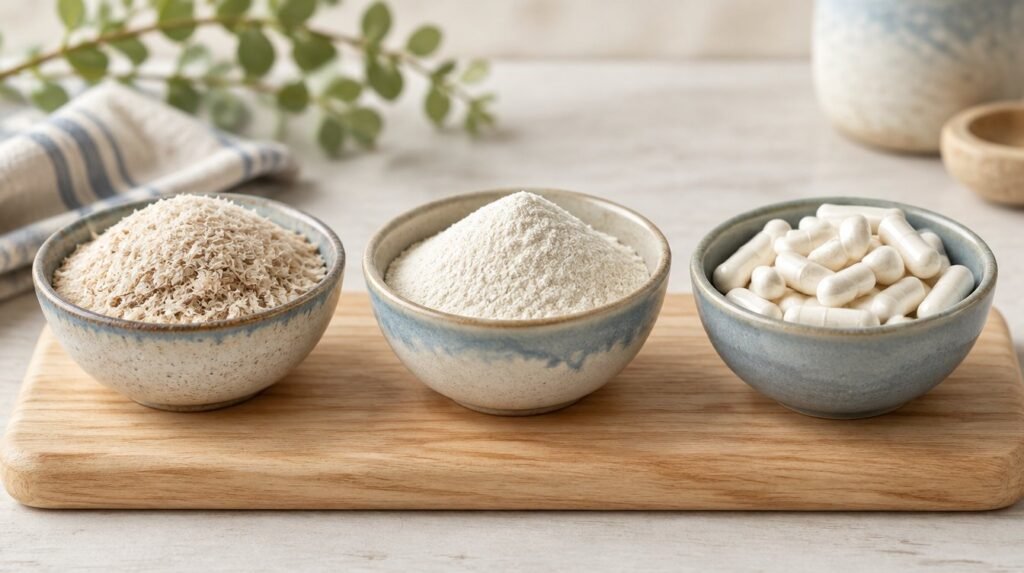
High-fiber foods tend to be more filling and lower in calories for their volume, and Mayo Clinic notes that whole foods are generally better than fiber supplements. Its daily targets are 25 grams for women 50 or younger and 38 grams for men 50 or younger.
For the gut, a 2021 trial randomly assigned 36 healthy adults to a high-fiber or a high-fermented-food diet. The group eating more fermented foods had a steady rise in microbiome diversity and lower inflammatory markers. Weight loss was not the goal of that study. Our guides to eating yogurt for weight loss and kimchi and weight loss cover the food side in more detail.
Psyllium husk
Psyllium is a soluble fiber that forms a gel in water. The weight evidence conflicts. A 2020 meta-analysis of 22 trials found no significant effect on weight, BMI or waist size. A 2023 meta-analysis of six trials with 354 people with overweight or obesity found about 2.1 kg (4.6 lb) more weight loss when psyllium was taken just before meals for several months. The 2023 authors work for Procter & Gamble, which makes Metamucil.
Metamucil Original Coarse (unflavored): the brand page lists 2.4 grams of soluble fiber per serving and advises taking it at least 2 hours before or after other medicines. It says to stop and ask a doctor if constipation lasts more than 7 days or rectal bleeding occurs.
Konsyl Daily Psyllium Fiber: the brand page lists one ingredient, powdered psyllium husk, in a 6-gram scoop, labels it sugar free, and lists 5 grams of fiber per stick-pack serving. The page also carries a California Proposition 65 warning for lead. Labels were checked in October 2026; we did not find a price with a serving count on either page, so price is left out. See our fiber supplement guide for more options.
Chicory inulin
Inulin-type fructans are prebiotic fibers that gut bacteria ferment. A 2024 meta-analysis of 32 trials found chicory inulin reduced body weight by about 0.97 kg (2.1 lb) more than placebo, with small drops in BMI, fat mass and waist size. Results varied a lot between trials, and two of the authors work for BENEO, a company that makes chicory fructans.
Inulin can cause gas and bloating, especially at first; Mayo Clinic advises adding fiber slowly over a few weeks and drinking plenty of water. We sell an inulin powder, so we have not named or ranked any inulin brand here.
Lactobacillus gasseri SBT2055 and BNR17
Across probiotics as a group, effects are small. A 2018 meta-analysis of 15 trials with 957 people with overweight or obesity found about 0.6 kg (1.3 lb) more weight loss than placebo over 3 to 12 weeks. The ODS calls later results small and of questionable clinical significance, and says effects likely depend on strain, dose and duration.
Two L. gasseri strains have the most specific data. In a 2010 Japanese trial, 87 adults with higher belly fat drank fermented milk with SBT2055 for 12 weeks. Visceral fat fell 4.6% and weight about 1.1 kg (2.4 lb) from baseline, while the control group did not change significantly. The researchers worked for the company that owns the strain. In a 2018 Korean trial of 90 adults, a high dose of BNR17 for 12 weeks reduced visceral fat compared with placebo.
Strain matters. A label that just says “L. gasseri” without one of these codes is not the strain that was tested. We could not confirm either strain on a widely sold US product page, so we have not named one. The NIH ODS says probiotic labels should list genus, species and strain. Read more in our best probiotic for weight loss guide.
Akkermansia muciniphila
Akkermansia is a gut bacterium that tends to be lower in people with obesity. In the first human pilot trial, published in 2019, 40 adults with overweight or obesity and insulin resistance enrolled and 32 finished. A pasteurized form at 10 billion bacteria a day for three months improved insulin sensitivity. Weight fell about 2.3 kg versus placebo, but that difference was not statistically significant.
Pendulum Akkermansia: the product page lists 100 million AFU per capsule and a price of $54, without a serving count. Pendulum says its product contains live Akkermansia, unlike the pasteurized form in the pilot trial, and makes no clinical trial claims for this stand-alone product. Its label unit differs from the trial’s count, but the amount looks far smaller than the dose tested. Labels were checked in October 2026. Our Pendulum review covers the brand’s other products.
Glucomannan
Glucomannan is a soluble fiber from konjac root. The ODS calls the results inconsistent: a 2015 review of six trials with 293 people found no significant effect, while an older analysis of 14 studies found about 0.79 kg (1.7 lb) more loss than placebo. Tablets were linked to blocked esophagus cases in Australia in the 1980s; powders and capsules were not.
NOW Glucomannan 575 mg: the brand page lists 1,725 mg of glucomannan from konjac root per 3-capsule serving and 60 servings for $23.99, about $0.40 per serving. It says to take it with at least 8 ounces of water 30 to 45 minutes before a meal, and warns it may swell in the throat without enough liquid. Labels and price were checked in October 2026.
What to skip or treat with caution
- Green tea extract: Concentrated extracts have been tied to liver injury in case reports and raised liver enzymes in a large trial, according to the ODS. The ODS reports no adverse effects from drinking green tea as a beverage.
- Guar gum: A meta-analysis of 11 trials found no meaningful weight effect, and the authors concluded the risks outweigh the benefits (ODS).
- Berberine: A 2026 meta-analysis of 23 trials found an average weight drop of about 0.88 kg (1.9 lb), and the authors flagged weak reporting and blinding in the trials. NCCIH warns berberine can harm newborns and that goldenseal, a berberine source, can change how the body handles many medicines.
- “Flat belly” and “detox” claims: No human trials support these promises for any supplement on this list.
Who should check with a doctor first
Supplements are not approved by the FDA for safety or effectiveness before they are sold. NCCIH advises talking with a health care provider before starting a probiotic, and says the risk of harm is greater for people who are seriously ill or have weakened immune systems. The ODS notes that some serious infections occurred in very sick patients, including some with central venous catheters. If you are pregnant or breastfeeding, ask first too.
The ODS also advises people with high blood pressure, diabetes, or liver or heart disease to talk with a provider before trying weight-loss supplements. Fiber supplements can affect how some medicines are absorbed, so space them apart as the label directs.
When to see a doctor
This article is general information, not medical advice. See a doctor if you lose weight without trying: Mayo Clinic flags losing more than 5% of your weight over 6 to 12 months. Get seen urgently for blood in your stool, belly pain that suddenly gets much worse, or diarrhea or vomiting that lasts more than a few days, as the NHS advises.
If weight is affecting your health, a doctor can also discuss prescription options. The NIDDK says these may be considered for adults with a BMI of 30 or more, or 27 or more with weight-related problems such as high blood pressure or type 2 diabetes.
How we compared
- Human evidence first: we ranked by randomized trials and meta-analyses in people, not animal or lab studies.
- Size of the effect: we report the average difference versus placebo, converted to pounds.
- Strain and dose match: we checked whether products contain the exact strain, form and amount used in research.
- Safety signals: we used NIH, FDA and Mayo Clinic guidance on side effects and interactions.
- Label transparency: we read each brand’s own product page in October 2026 and used only what it publishes. We did not buy, take or test any product.
Labels can tell you the ingredient, amount and, for probiotics, the strain. They cannot tell you whether the product works for you, and probiotic counts can fall over time, according to the ODS. A trial on one strain or form does not prove a different product works.
Frequently asked questions
Can a probiotic make you lose weight?
In trials, probiotics were linked with only small average losses, around 1 pound more than placebo, and results depend on the strain (Borgeraas 2018).
Is fiber or a probiotic better for weight?
Fiber has more consistent evidence for fullness and regularity, and food sources are the safest way to get it.
How long should I try a supplement?
Many of the trials here lasted about 12 weeks, so if nothing has changed by then, talk with your doctor about whether to continue.
Related topics
- Best Probiotic for Weight Loss: a closer look at probiotic strains.
- Gut Health Supplements: the wider supplement landscape.
- Gut Health Diet Plan: a food-first approach.
- Best Foods for Gut Health: fiber and fermented foods to start with.
- Kefir Benefits: What the Evidence Shows: a fermented drink with trial data.
Sources
- Dietary Supplements for Weight Loss: Fact Sheet for Health Professionals (NIH Office of Dietary Supplements)
- Probiotics: Fact Sheet for Consumers (NIH Office of Dietary Supplements)
- Probiotics: Fact Sheet for Health Professionals (NIH Office of Dietary Supplements)
- Probiotics: Usefulness and Safety (National Center for Complementary and Integrative Health)
- Goldenseal (National Center for Complementary and Integrative Health)
- Questions and Answers on Dietary Supplements (US Food and Drug Administration)
- Dietary fiber: Essential for a healthy diet (Mayo Clinic)
- Unexplained weight loss: When to see a doctor (Mayo Clinic)
- Prescription Medications to Treat Overweight & Obesity (NIDDK)
- Stomach ache (NHS)
- Wastyk HC, et al. Gut-microbiota-targeted diets modulate human immune status (Cell, 2021)
- Darooghegi Mofrad M, et al. The effects of psyllium supplementation on body weight, body mass index and waist circumference in adults: A systematic review and dose-response meta-analysis (Critical Reviews in Food Science and Nutrition, 2020)
- Gibb RD, et al. Psyllium is a natural nonfermented gel-forming fiber that is effective for weight loss: A comprehensive review and meta-analysis (Journal of the American Association of Nurse Practitioners, 2023)
- Reimer RA, et al. The effects of chicory inulin-type fructans supplementation on weight management outcomes: systematic review, meta-analysis, and meta-regression (American Journal of Clinical Nutrition, 2024)
- Borgeraas H, et al. Effects of probiotics on body weight, body mass index, fat mass and fat percentage in subjects with overweight or obesity: a systematic review and meta-analysis (Obesity Reviews, 2018)
- Kadooka Y, et al. Regulation of abdominal adiposity by probiotics (Lactobacillus gasseri SBT2055) in adults with obese tendencies in a randomized controlled trial (European Journal of Clinical Nutrition, 2010)
- Kim J, et al. Lactobacillus gasseri BNR17 Supplementation Reduces the Visceral Fat Accumulation and Waist Circumference in Obese Adults (Journal of Medicinal Food, 2018)
- Depommier C, et al. Supplementation with Akkermansia muciniphila in overweight and obese human volunteers: a proof-of-concept exploratory study (Nature Medicine, 2019)
- Elahi Vahed I, et al. The effect of berberine on obesity indices: a systematic review and meta-analysis (International Journal of Obesity, 2026)
- Metamucil Original Coarse Powder Fiber Supplement product page (Procter & Gamble, checked October 2026)
- Konsyl Daily Psyllium Fiber product page (Konsyl Pharmaceuticals, checked October 2026)
- Pendulum Akkermansia product page (Pendulum, checked October 2026)
- Can You Buy an Akkermansia muciniphila Probiotic Supplement? (Pendulum, checked October 2026)
- Glucomannan 575 mg Veg Capsules product page (NOW Foods, checked October 2026)
This article is for general information and is not medical advice. Talk to your doctor or a registered dietitian before changing your diet, supplements or medication, especially if you have a health condition.