Gut Health Diet Plan: A Practical Guide
What a Gut Health Diet Plan Is
A gut health diet plan is an everyday eating pattern built to feed the microbes in your digestive tract. In practice it means many different fiber-rich plants, fermented foods most days, and fewer highly processed foods and added sugars. It is not a cleanse, a detox or a short-term fix.
Federal guidance now supports this approach. The Dietary Guidelines for Americans, 2025-2030 say vegetables, fruits, fermented foods and high-fiber foods “support a diverse microbiome, which may be beneficial for health.”
Why It Matters for Gut Health
Fiber you cannot digest becomes food for bacteria in your colon, as Harvard T.H. Chan School of Public Health explains. A 2018 meta-analysis of 64 trials in 2,099 healthy adults found that fiber interventions increased Bifidobacterium and Lactobacillus, although overall microbial diversity did not change.
Fermented foods work differently. In a Stanford randomized trial of 36 healthy adults, a 10-week diet high in fermented foods increased microbial diversity and lowered 19 inflammatory proteins, while diversity in the high-fiber group stayed stable on average. The trial was small and published in Cell in 2021, so it needs confirmation in larger groups.
What the Mediterranean pattern adds
The Mediterranean diet is the best-studied eating pattern that fits these principles. Mayo Clinic describes it as mostly vegetables, fruits, whole grains, beans, nuts and seeds, with extra virgin olive oil as the main fat, fish two to three times a week, and limited red meat and added sugar.
In the NU-AGE study, 612 older adults in five European countries followed a Mediterranean-style diet for one year. Closer adherence was associated with microbiome changes linked to less frailty and lower inflammatory markers. These were associations in older adults, not proof that the diet caused the changes.
The Core Principles
1. Aim for about 30 different plant foods a week
The 30-plant idea comes from the American Gut Project, a citizen-science study with 11,336 participants published in mSystems in 2018. People who ate more than 30 plant types a week had more diverse gut microbes than those who ate 10 or fewer, whatever their diet style.
That comparison involved only 41 and 44 people and was observational, so treat 30 as a useful target, not a proven threshold. Count each different vegetable, fruit, grain, legume, nut or seed once per week.
2. Eat fermented foods most days
Plain yogurt or kefir with live cultures, refrigerated sauerkraut or kimchi, and miso are easy daily options. Not every fermented food still contains live microbes; ISAPP notes that sourdough bread and soy sauce are processed in ways that kill them. Our probiotic foods buyer’s guide explains what to look for, and fermented foods for gut health covers the research.
3. Build meals around fiber
Mayo Clinic cites daily fiber targets of 25 grams for women 50 and younger, 21 grams for women over 50, 38 grams for men 50 and younger and 30 grams for men over 50. Beans, lentils, whole grains, vegetables, fruit, nuts and seeds get you there. See how they compare in our guide to the best foods for gut health.
4. Limit ultra-processed foods and added sugar
The Dietary Guidelines advise avoiding highly processed packaged, prepared and ready-to-eat foods that are salty or sweet. They also say no amount of added sugar is recommended and that one meal should contain no more than 10 grams of it. Our list of the worst foods for gut health covers common culprits.
Sample 3-Day Gut Health Menu
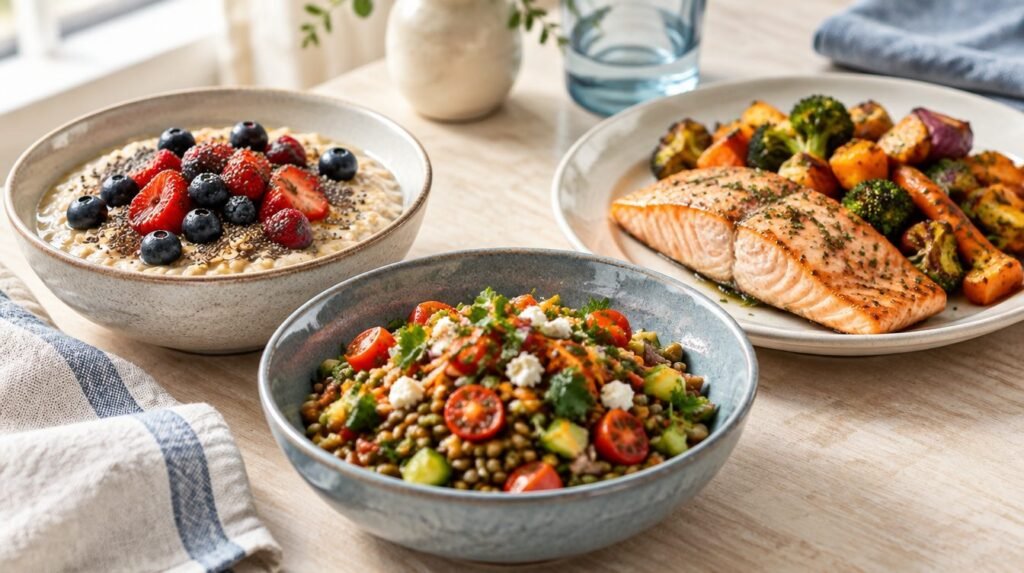
This menu shows how the principles fit together across about 35 different plants. It is a template, so adjust portions to your appetite and needs.
Day 1
- Breakfast: oatmeal with raspberries and chia seeds, plus a glass of plain kefir.
- Lunch: lentil soup with leeks and carrots, with a side of refrigerated sauerkraut.
- Snack: kiwi and a small handful of almonds.
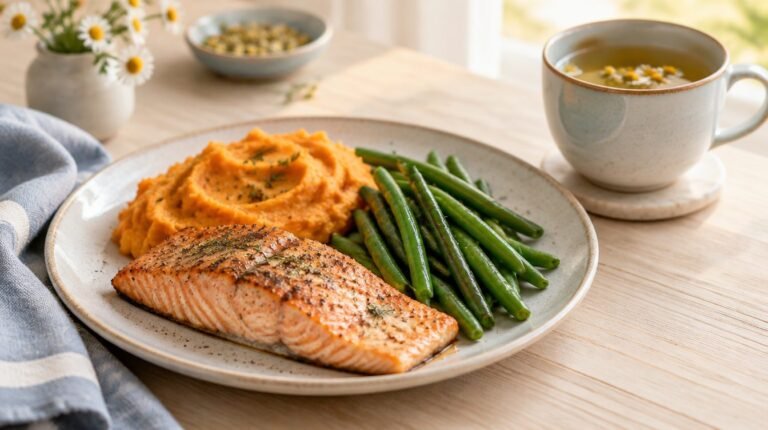
- Dinner: baked salmon, roasted Brussels sprouts, and barley tossed with olive oil and garlic.
Day 2
- Breakfast: plain yogurt with banana, pumpkin seeds and walnuts. More ideas: Greek yogurt breakfast.
- Lunch: chickpea and quinoa salad with arugula, tomatoes, cucumber and olive oil.
- Snack: a pear.
- Dinner: tofu stir-fry with broccoli and onions over brown rice, a bowl of miso soup (stir the miso in after the pot comes off the heat), and kimchi on the side.
Day 3
- Breakfast: whole-wheat toast with avocado and eggs, plus blackberries.
- Lunch: black bean and sweet potato bowl with salsa and a spoonful of plain yogurt.
- Snack: hummus with carrot and bell pepper sticks.
- Dinner: whole-wheat pasta with green peas, asparagus, garlic and olive oil, and a green salad.
- Dessert: plain yogurt with unsweetened cocoa powder and berries.
To stretch this into seven days, repeat the structure and swap in new plants: different beans, another whole grain, a new vegetable, a seasonal fruit. Keep one fermented food in each day.
How to Increase Fiber Without Discomfort
- Go slowly. Mayo Clinic advises adding fiber over a few weeks. For people with IBS, the National Institute of Diabetes and Digestive and Kidney Diseases (NIDDK) suggests increasing by 2 to 3 grams a day.
- Drink enough fluids. Fiber works best when it absorbs water, per Mayo Clinic, and Harvard notes that more fluids can reduce bloating and cramping.
- Start small with gassy foods. Harvard warns that a sudden high intake of prebiotic foods such as garlic, onions and leeks can increase gas. Begin with small portions of these and of beans.
- Spread fiber across the day. A little at each meal is easier to tolerate than one very large serving.
Caveats: IBS, IBD and Other Conditions
This article is general information, not medical advice. A plan like this one is built for healthy adults, and some conditions need a tailored approach.
With IBS, some high-fiber foods can trigger symptoms. NIDDK says a doctor may suggest a low FODMAP diet for a few weeks and may recommend working with a dietitian. Harvard notes that people with IBS may be sensitive to inulin-type fibers found in onions, chicory root and asparagus. Our guide to a diet for a sensitive stomach has gentler options.
With inflammatory bowel disease such as Crohn’s disease, NIDDK advises talking with your doctor about an eating plan and keeping a food diary to spot foods linked to symptoms. If you are pregnant, FoodSafety.gov advises choosing only pasteurized milk and milk products, including yogurt.
What is the best diet for gut health?
The best-studied pattern is Mediterranean-style eating: mostly plants, whole grains, beans, nuts and olive oil, with limited red meat and added sugar (Mayo Clinic).
How long does it take a gut health diet to work?
In the Stanford trial, microbial diversity rose steadily over a 10-week fermented-food diet, but results vary by person and that trial was small.
Is the microbiome diet the same as a gut health diet plan?
The terms are often used loosely; this plan follows published principles (fiber variety, fermented foods, fewer ultra-processed foods) rather than a branded program.
Related topics
- Best Foods for Gut Health: how each food group compares.
- Probiotic Foods: which fermented foods still have live cultures.
- Fermented Foods for Gut Health: what the research shows.
- Worst Foods for Gut Health: what to limit.
- How to Make Yogurt at Home: a low-sugar daily fermented food.
Sources
- Dietary Guidelines for Americans, 2025-2030 (U.S. Department of Agriculture and U.S. Department of Health and Human Services, 2026)
- The microbiome (The Nutrition Source, Harvard T.H. Chan School of Public Health)
- So D, et al. Dietary fiber intervention on gut microbiota composition in healthy adults: a systematic review and meta-analysis (American Journal of Clinical Nutrition, 2018)
- Fermented-food diet increases microbiome diversity, decreases inflammatory proteins, study finds (Stanford Medicine, 2021)
- Wastyk HC, et al. Gut-microbiota-targeted diets modulate human immune status (Cell, 2021)
- Mediterranean diet for heart health (Mayo Clinic)
- Ghosh TS, et al. Mediterranean diet intervention alters the gut microbiome in older people reducing frailty and improving health status: the NU-AGE 1-year dietary intervention across five European countries (Gut, 2020)
- What’s in your gut? (news release on McDonald D, et al., mSystems, 2018) (University of California San Diego, 2018)
- What are fermented foods? (International Scientific Association for Probiotics and Prebiotics)
- Dietary fiber: Essential for a healthy diet (Mayo Clinic)
- Eating, diet, and nutrition for irritable bowel syndrome (National Institute of Diabetes and Digestive and Kidney Diseases)
- Fiber (The Nutrition Source, Harvard T.H. Chan School of Public Health)
- Eating, diet, and nutrition for Crohn’s disease (National Institute of Diabetes and Digestive and Kidney Diseases)
- People at risk: pregnant women (FoodSafety.gov)