How Long Does Homemade Yogurt Last? The Complete Answer
How long does homemade yogurt last?
Homemade yogurt kept in the refrigerator at or below 40°F (4°C) is best eaten within 14 days, according to University of Illinois Extension. Frozen at 0°F (−18°C), it keeps good quality for 1 to 2 months. Never leave it at room temperature for more than 2 hours, or 1 hour above 90°F (32°C).
No federal storage chart gives a figure for homemade yogurt specifically. The FoodSafety.gov cold food storage chart does not list yogurt at all, so the refrigerator time above comes from university extension guides written for home yogurt makers.
What affects how long homemade yogurt keeps
Published times for homemade yogurt vary. University of Illinois Extension says to eat it within 14 days, while guides from the University of Alaska Fairbanks and Washington State University Extension give about 10 to 21 days at 40°F (4°C) or lower. Kansas State University’s general storage chart lists yogurt at 7 to 10 days.
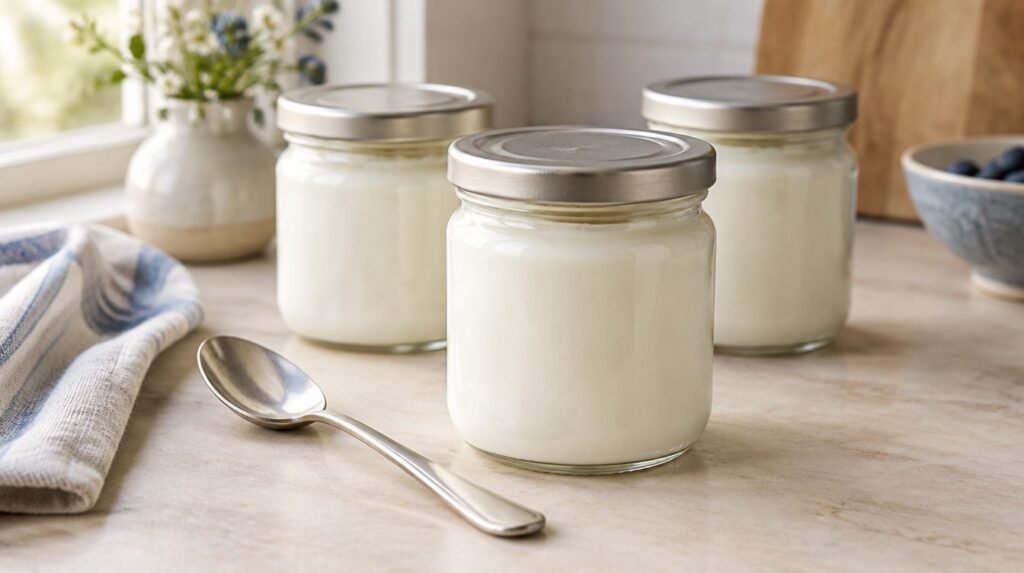
Finishing a batch within two weeks matches the Illinois guidance; for the most cautious figure, aim for 7 to 10 days.
| Where you store it | How long | Source |
|---|---|---|
| Refrigerator, 40°F (4°C) or below | Within 14 days (published range: 7 to 21 days) | Illinois Extension, UAF, WSU, K-State |
| Freezer, 0°F (−18°C) or below | 1 to 2 months for best quality; frozen food kept continuously at 0°F stays safe indefinitely | K-State, NDSU, FoodSafety.gov |
| Counter or room temperature | 2 hours at most; 1 hour above 90°F (32°C) | USDA FSIS |
Factors that shorten or extend shelf life
- Milk freshness. Illinois Extension lists milk that wasn’t fresh as a cause of off-flavors. UAF advises using commercially pasteurized milk, or pasteurizing raw milk first.
- Clean equipment. Unclean equipment also causes off-flavors (Illinois). UAF recommends washing tools in hot detergent water, rinsing well and air drying.
- How fast it was chilled. Illinois says to refrigerate yogurt once it has gelled, and UAF notes that rapid cooling stops acid development. Over-incubating makes it more tart and pushes out whey (UAF); see how long to incubate yogurt.
- Starter quality. A starter that isn’t fresh can cause off-flavors (Illinois), and a poor culture can cause setting problems (UAF). UAF says to discard any batch that fails to set, since that may signal a bad culture or unwanted microorganisms.
- Add-ins. UAF notes that additions to yogurt may reduce its shelf life. Store it plain and add fruit or sweeteners when you serve it.
- Whey separation is normal. Some liquid on top is natural; UAF calls this syneresis. NDSU Extension says you can stir it back in.
- Sourness builds over time. Illinois explains that continued bacterial activity can make yogurt taste increasingly sour, which is why it recommends prompt chilling. An acidic smell is normal for fresh yogurt (UAF); judge safety by the signs below, not by tang alone.
Food safety: signs of spoilage and when to throw it out
Signs your yogurt has gone bad
Throw out yogurt that shows any of these signs. When in doubt, throw it out.
- Mold or any visible growth. UAF says to discard yogurt with visible signs of microbial growth. Mold is often fuzzy, and its spores give it color (USDA FSIS).
- Pink, red, orange or other unusual color. Food scientists describe pink or red discoloration as a relatively common spoilage defect in dairy products, and traced red slime on freshly opened yogurt to a yeast (Di Renzo et al., 2023). Treat orange or any other unexpected color the same way.
- Off smells. Fresh yogurt smells acidic, and UAF says to discard yogurt with any other odor. If you see mold, don’t sniff it; USDA FSIS warns this can cause respiratory trouble.
- Fizzing, bubbles or a domed lid. In a study of yeast-spoiled yogurt, gas produced bubbles and swelled the containers (Wrent et al., 2015).
- Unusual clumpy texture. NDSU Extension lists this as a reason to discard.
Why mold means the whole container goes
USDA FSIS says to discard yogurt and sour cream with mold rather than scooping it off. Foods with high moisture can be contaminated below the surface, and moldy foods may also have bacteria growing along with the mold.
After you throw it out, FSIS advises cleaning the spot in the refrigerator where the food was stored.
How long a batch works as a starter
If you plan to culture your next batch from this one, Illinois Extension says to use it within 5 to 7 days of making it, because fresher starter has more active bacteria. UAF suggests saving 1 cup per gallon of milk or ¼ cup per quart, sealed in a clean, airtight container in the fridge. Set it aside before you start eating from the batch.
Starters weaken over time. WSU Extension advises switching to fresh starter every 5 to 6 batches, and UAF recommends a fresh culture if quality slips. The yogurt starter guide covers your options.
Storage tips
- Keep your fridge at 40°F (4°C) or below, and check it with an appliance thermometer (USDA FSIS).
- Store yogurt covered or in airtight containers (USDA FSIS).
- Divide a large batch into smaller, shallow containers so it reaches 40°F (4°C) faster (USDA FSIS).
- Use a clean spoon each time you serve, and keep containers and equipment clean (UAF).
- Glass jars or containers with tight-fitting lids work well, because they are easy to wash thoroughly in hot, soapy water between batches.
- Label each container with the date it was made to track the eating and starter windows.
- If you freeze yogurt, expect it to separate or change texture after thawing (K-State, NDSU).
Related topics
- Yogurt Temperature: What You Need to Know: The right temperatures for making and storing yogurt.
- How to Make Yogurt at Home: A Step-by-Step Guide: A step-by-step method for your first batch.
- How Long to Incubate Yogurt?: How incubation time affects tartness, texture and whey.
- Yogurt Starter: What You Need to Know: Choosing, saving and refreshing a culture.
- Homemade Greek Yogurt: What You Need to Know: Straining yogurt into a thicker style.
- Homemade Yogurt: What You Need to Know: The basics of making yogurt at home.
Sources
- University of Illinois Extension, Making Yogurt at Home (Best Practice Guide, 2024)
- University of Alaska Fairbanks Cooperative Extension Service, Making Yogurt at Home (FNH-00062, reviewed 2024)
- Washington State University Extension, Yogurt Made Simple (FS173E, 2015)
- Kansas State University Research and Extension, Safe Food Storage: The Refrigerator and Freezer (MF3130)
- NDSU Extension, How Long Can You Keep Yogurt? (Food Wise, 2016)
- FoodSafety.gov, Cold Food Storage Chart
- USDA Food Safety and Inspection Service, How Temperatures Affect Food
- USDA Food Safety and Inspection Service, Molds on Food: Are They Dangerous?
- USDA Food Safety and Inspection Service, Leftovers and Food Safety
- Di Renzo T, et al. Shotgun proteomics for the identification of yeasts responsible for pink/red discoloration in commercial dairy products. Food Research International, 2023
- Wrent P, et al. Assessment of the Factors Contributing to the Growth or Spoilage of Meyerozyma guilliermondii in Organic Yogurt. Microorganisms, 2015