

How Is Greek Yogurt Made? Explained
How is Greek yogurt made?
How is Greek yogurt made? It starts as ordinary yogurt, milk fermented by live cultures until it sets. Much of the liquid whey is then removed, traditionally by straining through cloth and in large dairies mainly with centrifuges or membrane filters. Some “Greek-style” yogurts skip draining and are thickened with added milk protein or stabilizers.
First, make yogurt
Most Greek yogurt begins as regular yogurt: milk that is heat-treated, cooled, inoculated with Streptococcus thermophilus and Lactobacillus delbrueckii subsp. bulgaricus, and fermented until the acid sets it into a gel. In one 2022 Greek yogurt study, milk incubated at 109°F (43°C) reached pH 4.6 in about 4 hours.
Straining through cloth
The original method is to hang yogurt in cloth bags and let the whey drip out. One review puts drainage at about 15 to 20 hours below 50°F (10°C) and calls the method slow and labor intensive.
Centrifugal separators
In modern plants, yogurt is typically cultured in large tanks, stirred and then concentrated, according to the University of Wisconsin–Madison’s Center for Dairy Research. A mechanical separator, used only after culturing, spins the yogurt and splits it by density into a heavy, protein-rich phase that becomes Greek yogurt and a lighter, watery phase that leaves as whey.
Ultrafiltration
Ultrafiltration pushes the product across a fine membrane that holds back protein while water and part of the lactose and minerals pass through. It can be used on finished yogurt or on milk before fermentation. In a 2018 pilot-scale study, both routes gave Greek-style yogurt with about 10% protein, but no lactic acid was detected in the liquid filtered from milk, while the liquid filtered from yogurt was acidic.
Greek-style: adding protein or thickeners
The other route skips draining. Makers raise the protein before fermentation with dairy ingredients such as milk protein concentrate or whey protein concentrate, often combined with some concentration, and some add stabilizers such as gelatin, starch or pectin.
US rules allow both. The federal yogurt standard permits “other safe and suitable milk-derived ingredients” to raise milk solids, as well as stabilizers. In its 2021 update, FDA noted that thicker Greek-style yogurt had become as popular as regular yogurt and said these ingredients let makers reach a desired protein content before culturing.
Acid whey: what’s left over
Straining, separating and filtering yogurt all leave a by-product called acid whey: 2 to 3 kg for every 1 kg of Greek strained yogurt. That means only about a quarter to a third of the yogurt that goes in comes out as Greek yogurt. The same paper puts acid whey at a pH of 3.5 to 4.5, with 3.4% to 5% lactose, up to about 1.4% lactic acid and well under 1% protein. Because of its high biological oxygen demand, it cannot be discharged to surface water, and its low protein limits its use as food or feed.
New York made about 70% of US Greek yogurt in 2012. Its Department of Environmental Conservation lists the ways acid whey is managed: animal feed, spreading on cropland as fertilizer, anaerobic digestion, wastewater treatment and nutritional supplements. Adding protein, or ultrafiltering milk before fermentation, are two ways to produce less of it.
Why the method matters for gut health and nutrition
Removing whey concentrates some nutrients and drains others away. Heat-treated whey proteins coagulate during fermentation, so acid whey contains essentially none of them and the protein stays in the yogurt. Water and lactose leave. Calcium is the notable loss: in milk it is mostly bound to casein, but it dissolves at about pH 5.3, so yogurt concentrated after culturing loses calcium with the whey. Ultrafiltering milk before culturing keeps more calcium, which at high levels can make yogurt taste chalky.
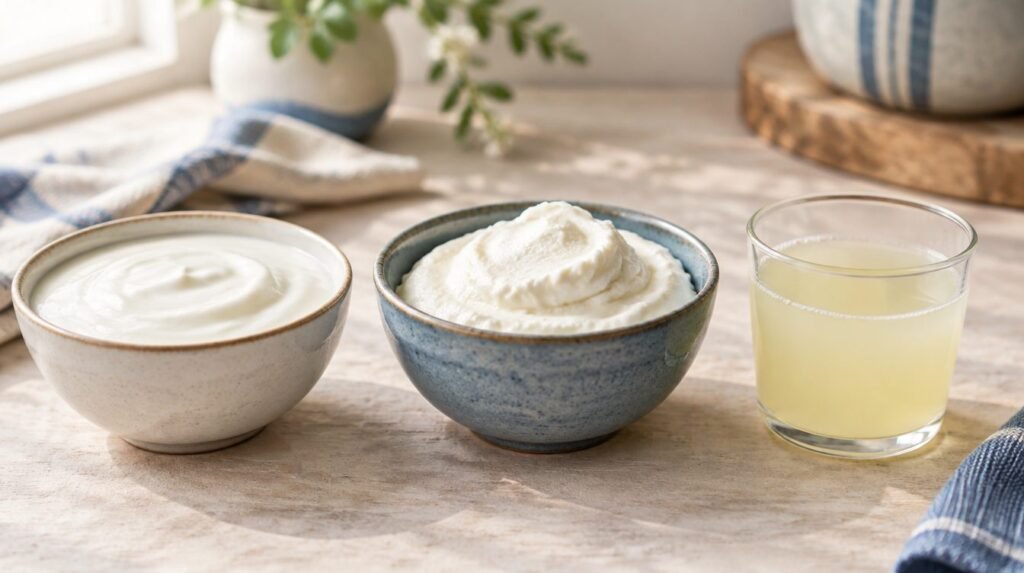
USDA figures for plain nonfat Greek yogurt and plain nonfat regular yogurt, scaled to a 6-ounce (170 g) serving, show the trade-off:
| Per 170 g (6 oz) | Plain nonfat Greek | Plain nonfat regular |
|---|---|---|
| Protein | 17.3 g | 9.7 g |
| Total sugars | 5.5 g | 13.1 g |
| Calcium | 187 mg | 338 mg |
| Potassium | 240 mg | 434 mg |
The Greek yogurt has nearly twice the protein, less than half the sugar and about 45% less calcium and potassium. Individual products vary, and fortified Greek-style yogurts may not follow this pattern. For the health research, see Is Greek Yogurt Good for You?
Lactose
Because lactose drains off with the whey, strained Greek yogurt has less of it: USDA lists 2.5 g per 100 g of plain nonfat Greek yogurt. That is lower, not lactose-free. The NIDDK says yogurt is lower in lactose than other milk products and that some people with lactose intolerance find it easier to tolerate.
Live cultures
Straining and separating happen after fermentation, when the cultures are already in the yogurt. In a 2022 lab study, Greek yogurt still held more than 100 million lactic acid bacteria per gram after centrifuging. In a 2018 study of Greek-style yogurt, every sample kept at least 10 million L. bulgaricus and 100 million S. thermophilus per gram. What reaches you depends on later processing: under the federal standard, yogurt heat-treated after culturing must say “does not contain live and active cultures.”
Reading the label and straining at home
How to tell how a Greek yogurt was made
In the US, the word “Greek” on the label won’t tell you. The federal yogurt standard doesn’t mention Greek or strained yogurt at all. In Greece, straining is what defines the product, and Greek law requires at least 5.6% protein from cow’s or goat’s milk (8% from sheep’s milk). In the UK, the Court of Appeal ruled in 2014 that only yogurt made in Greece by traditional methods without additives could be described there as “Greek yoghurt.”
So read the back of the pot:
- Ingredients. Strained yogurt needs only milk or cream and cultures. Milk protein concentrate, whey protein concentrate, nonfat dry milk or ultrafiltered milk point to protein added or concentrated before culturing.
- Thickeners. Pectin, gelatin or starch means the texture was built partly with stabilizers.
- Nutrition Facts. USDA averages for plain Greek yogurt are about 15 to 17 g of protein per 6 ounces (whole milk to nonfat). High protein with calcium well below regular yogurt fits straining; high protein with calcium close to regular yogurt may point to fortification or milk filtered before culturing.
- Cultures. Look for “contains live and active cultures,” which requires at least 10 million colony-forming units per gram at manufacture.
Making Greek yogurt at home
At home, straining is the practical method. Ultimate Health Solutions, the company that publishes this site, recommends straining plain yogurt in the refrigerator and checking it every hour until it is as thick as you like; expect roughly half the starting volume. Keep the refrigerator at 40°F (4°C) or below. The drained whey can be used like buttermilk in baking, marinades, dressings or smoothies. Step-by-step instructions are in How to Make Greek Yogurt.
More on Greek yogurt
- Is Greek Yogurt Good for You? What the Evidence Says: what the research says about protein, cultures and sugar.
- Greek Yogurt with Probiotics: A Buyer’s Guide: reading culture and probiotic claims.
- Homemade Greek Yogurt: What You Need to Know: why people strain their own.
- Greek Yogurt Recipes You Can Make at Home: everyday uses for thick yogurt.
- Greek Yogurt Dip Recipes You Can Make at Home: dips that need a thick texture.
Sources
- Karastamatis S, Zoidou E, Moatsou G, Moschopoulou E. Effect of modified manufacturing conditions on the composition of Greek strained yogurt and the quantity and composition of generated acid whey. Foods. 2022;11(24):3953.
- Paredes Valencia A, Doyen A, Benoit S, Margni M, Pouliot Y. Effect of ultrafiltration of milk prior to fermentation on mass balance and process efficiency in Greek-style yogurt manufacture. Foods. 2018;7(9):144.
- Wilbanks D. Yogurt Monograph Series: Concentrating Yogurt. Center for Dairy Research, University of Wisconsin–Madison. Dairy Pipeline, Winter 2024.
- Lange I, Mleko S, Tomczyńska-Mleko M, Polischuk G, Janas P, Ozimek L. Technology and factors influencing Greek-style yogurt: a review. Ukrainian Food Journal. 2020;9(1).
- Gyawali R, Ibrahim SA. Addition of pectin and whey protein concentrate minimises the generation of acid whey in Greek-style yogurt. Journal of Dairy Research. 2018;85(2):238–242.
- Yang SY, Yoon KS. Effect of probiotic lactic acid bacteria (LAB) on the quality and safety of Greek yogurt. Foods. 2022;11(23):3799.
- Electronic Code of Federal Regulations. 21 CFR 131.200, Yogurt.
- U.S. Food and Drug Administration. Milk and Cream Products and Yogurt Products; Final Rule. Federal Register. June 11, 2021.
- Brick Court Chambers. Court of Appeal protects “Greek yoghurt” product name in passing off claim. January 2014.
- New York State Department of Environmental Conservation. Whey Management for Agriculture.
- USDA FoodData Central. Yogurt, Greek, plain, nonfat (FDC ID 170894), SR Legacy.
- USDA FoodData Central. Yogurt, plain, skim milk (FDC ID 170887), SR Legacy.
- USDA FoodData Central. Yogurt, Greek, plain, whole milk (FDC ID 171304), SR Legacy.
- National Institute of Diabetes and Digestive and Kidney Diseases (NIH). Eating, Diet, & Nutrition for Lactose Intolerance.
- FoodSafety.gov (U.S. Department of Health and Human Services). 4 Steps to Food Safety.
- The Ultimate Yogurt Guide (eBook), Ultimate Health Solutions, publisher of this site


