Greek Yogurt with Probiotics: A Buyer’s Guide
Greek yogurt with probiotics: what the label can tell you
Greek yogurt with probiotics is usually ordinary strained yogurt that still holds its live cultures, sometimes with extra species added. To check, look for “contains live and active cultures” or the Live & Active Cultures seal, then read the culture list. A true probiotic is named to the strain and backed by evidence; few Greek yogurt labels go that far.
Live cultures and probiotics aren’t the same thing
Every US yogurt is made with two cultures, Lactobacillus delbrueckii subsp. bulgaricus and Streptococcus thermophilus, and may contain others (21 CFR 131.200). That standard never uses the word “probiotic”; on cultures, it regulates only the live-cultures wording.
The International Scientific Association for Probiotics and Prebiotics (ISAPP) defines probiotics as live microorganisms that provide a health benefit when given in adequate amounts. Its panel advised calling fermented foods with undefined cultures “containing live and active cultures,” not probiotic, and reserving “contains probiotics” for enough of well-defined strains, citing Health Canada’s benchmark of 1 billion CFU per serving for certain well-studied species (Hill et al., 2014).
What straining does and doesn’t do to cultures
Straining, centrifuging or filtering happens after fermentation, once the cultures have grown (see How Is Greek Yogurt Made?). Lab studies suggest plenty survive: in a 2022 study, centrifuged Greek yogurt held more than 100 million lactic acid bacteria per gram, and batches made with added probiotic strains stayed above 10 million per gram through 21 days at 39°F (4°C).
Straining doesn’t add cultures, and it isn’t what decides whether they’re alive when you eat them. Heat does: yogurt may be treated after culturing to inactivate its microorganisms, and must then say “does not contain live and active cultures” next to its name on the front label (21 CFR 131.200). So does time: in a 2006 test of 58 North Carolina yogurts claiming bifidobacteria, counts ranged from zero to about 300,000 per milliliter and began falling after three weeks in the refrigerator (Ibrahim and Carr). That study is old, and products may have changed.
Why live cultures matter for gut health
Yogurt is one of the few fermented foods with substantial human research, including more than 20 randomized trials of yogurt and cultured milk, though much of the evidence is observational (ISAPP fermented foods consensus, 2021). The best-established benefit depends on live cultures: European regulators approved a claim that live yogurt cultures improve lactose digestion, through the lactase the bacteria make. FDA’s 2021 yogurt rule notes that the reported benefits of yogurt cultures are lost or reduced by heat treatment after culturing.

In a small 2021 Stanford trial of 36 adults, a 10-week diet high in fermented foods such as yogurt, kefir and kimchi raised microbiome diversity and lowered 19 inflammatory proteins (Stanford Medicine), but it didn’t test Greek yogurt alone.
Added probiotics are a separate question. Their effects can be strain-specific, and not every fermented food with live cultures contains probiotics (NIH Office of Dietary Supplements); often it’s still unknown which probiotics help (NCCIH). Dose matters too: in a 2017 survey of probiotic foods sold in Canada, most held about 1 billion CFU per serving, while trials of the same strains used up to 25 times as much. ISAPP advises asking a physician before giving probiotics to infants or to people with weakened immune systems or serious illness.
How to read a Greek yogurt label for live and probiotic cultures
| Label wording | What it tells you | What it doesn’t |
|---|---|---|
| “Contains live and active cultures” | At least 10 million CFU per gram at manufacture, with a reasonable expectation of 1 million per gram through shelf life (21 CFR 131.200) | Anything about added probiotics: the count uses a method for yogurt’s characteristic cultures, and FDA set none for others (2021 rule) |
| Live & Active Cultures seal | At least 100 million cultures per gram at manufacture (IDFA) | It’s voluntary; yogurt without it may still have live cultures |
| “Does not contain live and active cultures” | Treated after culturing to inactivate its microorganisms | Skip it if live cultures matter to you |
| Species list, such as L. acidophilus, Bifidus, L. casei | Which cultures were added | The strain or how many survive; “Bifidus” names only the group Bifidobacterium |
| Strain code, such as B. animalis subsp. lactis DN-173 010 | The exact strain, which you can look up (ODS) | Whether a serving matches the studied dose |
| “Billions” or a CFU figure | How many cultures the maker claims | Whether that’s at manufacture or end of shelf life |
Strain codes are worth finding: in ISAPP’s summary of a survey of probiotic products sold around Washington, DC, foods that disclosed a strain were likely to have evidence of a health benefit. Names may look unfamiliar, too. Since 2020, L. casei and L. rhamnosus belong to Lacticaseibacillus and L. reuteri to Limosilactobacillus, while L. acidophilus and L. bulgaricus kept their names; “L.” still works as the abbreviation (ISAPP).
Three real labels
Brand websites checked in October 2026 show the range. FAGE Total 5% lists “live active yogurt cultures”: the standard two plus L. acidophilus, Bifidus and L. casei, with no strain codes or count. Oikos Triple Zero Plain lists the two standard cultures; its product page has no live-cultures statement, so check the tub. Stonyfield’s whole-milk plain yogurt, a regular yogurt, names one strain, Bifidobacterium BB-12, and claims “billions” without a number. For more products, see Best Yogurt for Probiotics.
A quick label checklist
- Front panel: no “does not contain live and active cultures.”
- Live cultures: “contains live and active cultures,” the seal, or both.
- Culture list: species beyond the standard two, if probiotics are your goal.
- Strain codes: letters or numbers after the species name.
- Count: ideally one that holds through the “best by” date, as ISAPP recommends.
- Added Sugars: 0 g on plain; milk’s own sugar doesn’t count as added.
- Date and storage: pick the latest date and keep it at 40°F (4°C) or below.
Making Greek yogurt at home with cultures you choose
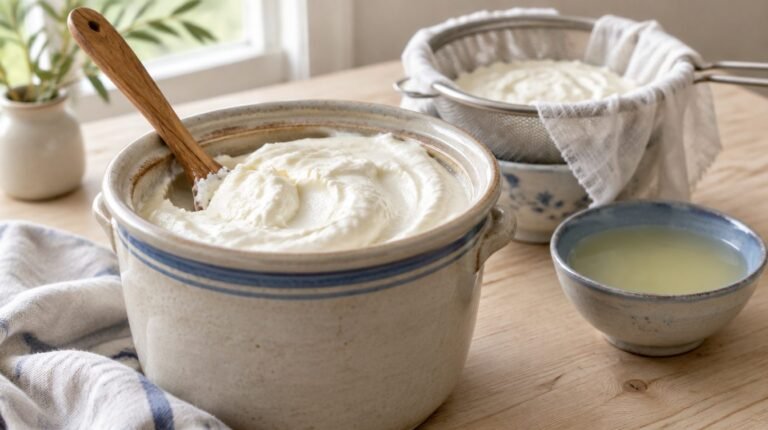
Homemade yogurt lets you pick the culture. The National Center for Home Food Preservation uses plain yogurt labeled with live cultures as the starter, incubates at 110°F ± 5°F (43°C ± 3°C), and lists L. acidophilus and Bifidobacterium bifidum as optional extra cultures. Ultimate Health Solutions, the company that publishes this site, also recommends single-species capsule starters in 24-hour ferments: 99°F (37°C) for L. reuteri, 109°F (43°C) for L. gasseri, 118°F (48°C) for B. coagulans and 106°F (41°C) for a three-species blend, with 2 tablespoons of chicory inulin per quart (see our yogurt starter guide). Without the two standard cultures, the result is a cultured milk, not “yogurt” under US rules.
To make it Greek, strain the finished batch in the refrigerator; the company recommends checking every hour and expecting about half the starting volume (full steps in How to Make Greek Yogurt). A homemade batch has no measured count, and strain research used particular products and doses, so treat it as a fermented food with live cultures, not a measured probiotic dose. Discard any batch that fails to set or smells off, or shows mold.
More on Greek yogurt
- Best Yogurt for Probiotics: seven products compared on their culture labels.
- Is Greek Yogurt Good for You? What the Evidence Says: protein, sugar and the research.
- How Is Greek Yogurt Made? Explained: straining, separators and added protein.
- Homemade Greek Yogurt: What You Need to Know: how it compares with store-bought.
- Greek Yogurt Recipes You Can Make at Home: everyday uses for plain.
Sources
- 21 CFR 131.200 Yogurt, Electronic Code of Federal Regulations (National Archives)
- Milk and Cream Products and Yogurt Products; Final Rule (June 11, 2021), U.S. Food and Drug Administration, Federal Register via GovInfo
- Live & Active Cultures Seal, International Dairy Foods Association
- Hill C, et al. The International Scientific Association for Probiotics and Prebiotics consensus statement on the scope and appropriate use of the term probiotic (2014), Nature Reviews Gastroenterology & Hepatology
- Marco ML, et al. The International Scientific Association for Probiotics and Prebiotics (ISAPP) consensus statement on fermented foods (2021), Nature Reviews Gastroenterology & Hepatology
- Sanders ME. Decoding a Probiotic Product Label (2022, updated 2025), International Scientific Association for Probiotics and Prebiotics
- Probiotics: A Consumer Guide for Making Smart Choices, International Scientific Association for Probiotics and Prebiotics
- Sanders ME, Lebeer S. New names for important probiotic Lactobacillus species (2020, updated 2025), International Scientific Association for Probiotics and Prebiotics
- Probiotics: Fact Sheet for Health Professionals, NIH Office of Dietary Supplements
- Probiotics: What You Need To Know, National Center for Complementary and Integrative Health (NIH)
- Scourboutakos MJ, et al. Mismatch between Probiotic Benefits in Trials versus Food Products (2017), Nutrients
- Yang SY, Yoon KS. Effect of Probiotic Lactic Acid Bacteria (LAB) on the Quality and Safety of Greek Yogurt (2022), Foods
- Ibrahim SA, Carr JP. Viability of bifidobacteria in commercial yogurt products in North Carolina during refrigerated storage (2006), International Journal of Dairy Technology (abstract record, North Carolina A&T State University)
- Wastyk HC, et al. Gut-microbiota-targeted diets modulate human immune status (2021), Cell, via PubMed
- Fermented-food diet increases microbiome diversity, decreases inflammatory proteins, study finds (2021), Stanford Medicine
- FAGE Total 5%, FAGE USA
- Plain Oikos Triple Zero High Protein Nonfat Greek Yogurt 32 oz, Oikos (Danone North America)
- Organic Whole Milk Probiotic Yogurt, Plain, 32 oz., Stonyfield Farm
- Added Sugars on the Nutrition Facts Label, U.S. Food and Drug Administration
- 4 Steps to Food Safety, FoodSafety.gov (U.S. Department of Health and Human Services)
- Nummer BA. Fermenting Yogurt at Home (2002), National Center for Home Food Preservation (reprint hosted by UC Food Safety, UC Davis)
- Cascio J, Dinstel RR. Making Yogurt at Home (FNH-00062), University of Alaska Fairbanks Cooperative Extension Service
- Molds on Food: Are They Dangerous?, USDA Food Safety and Inspection Service
- The Ultimate Yogurt Guide (eBook), Ultimate Health Solutions, publisher of this site