Homemade Greek Yogurt: What You Need to Know
What is homemade Greek yogurt?
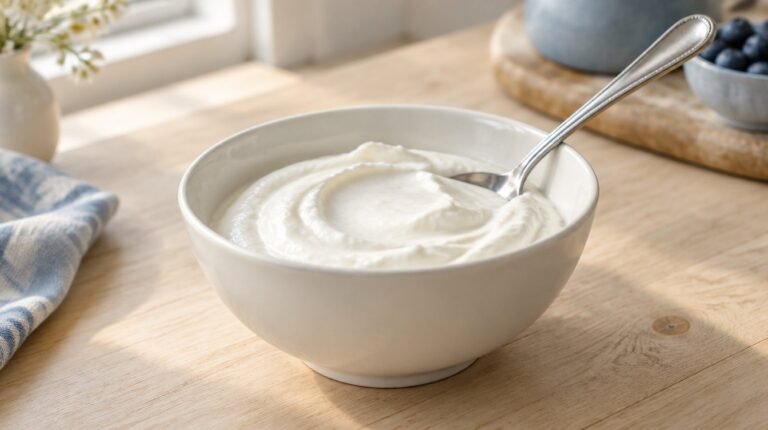
Homemade Greek yogurt is plain yogurt you strain at home, in the refrigerator, until enough liquid whey drains away to leave it thick. It needs no thickeners or added protein, usually costs less per cup than store-bought when you start from milk, and lets you choose the milk, the culture and the thickness.
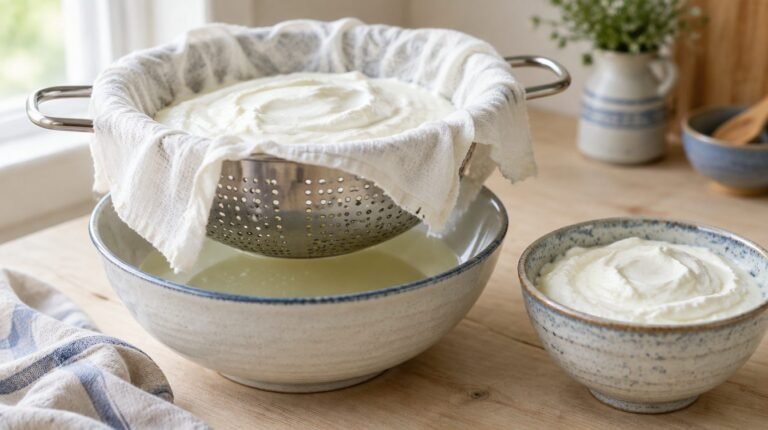
Greek yogurt is yogurt with part of its whey removed (Karastamatis et al., 2022). University of Illinois Extension suggests 2 to 4 hours of draining for Greek-style yogurt and 8 to 24 hours for yogurt cheese, which Washington State University Extension’s Yogurt Made Simple also calls labneh. Dairies may also use centrifuges, filters or added protein (see How Is Greek Yogurt Made? Explained); at home, straining is the whole method.
Homemade vs store-bought at a glance
| Feature | Homemade | Store-bought |
|---|---|---|
| Cultures | Your choice; alive when chilled, count unknown | Varies; heat-treated yogurt must say it has no live and active cultures |
| Protein per 100 g | About 6 g if whole-milk yogurt is strained to half (our estimate) | 9.0 g (whole milk) to 10.2 g (nonfat), USDA |
| Yield | About 2 cups per quart of yogurt | 1 kg of Greek yogurt leaves 2 to 3 kg of whey |
| Cost per cup | About 55 to 80 cents in whole milk | About $1.38 (average advertised price) |
Cultures and thickeners
Store-bought yogurt may be heat-treated after culturing, which inactivates the cultures, and must then say “does not contain live and active cultures” (21 CFR 131.200). Homemade yogurt never is, and straining comes after fermentation: in a 2022 lab study, Greek yogurt still held more than 100 million lactic acid bacteria per gram after its whey was removed. Your own batch’s count is unknown without testing.
The same standard allows stabilizers and milk-derived ingredients that raise solids, which FDA says help makers reach a desired protein content in Greek-style yogurt. Homemade relies on straining alone; if you strain store-bought yogurt, WSU Extension advises avoiding added gelatin, vegetable gum or food starch, which keep the whey from separating.
Protein, calcium and lactose
Protein mostly stays behind, since acid whey holds only about 0.4 to 0.7% (Karastamatis et al.). USDA lists 3.47 g of protein per 100 g in plain whole-milk yogurt and 9.0 g in plain whole-milk Greek yogurt. By our arithmetic, straining to half the weight gives roughly 6 g; reaching 9 g means straining down to about a third.
Calcium dissolves as yogurt acidifies and leaves with the whey (University of Wisconsin–Madison): USDA lists 121 mg per 100 g in plain whole-milk yogurt against 100 mg in whole-milk Greek. Lactose drains away too, since acid whey is about 3.5% lactose (Karastamatis et al.), and USDA lists 3.24 g of total sugars per 100 g of plain nonfat Greek yogurt against 7.68 g for regular plain nonfat.
Yield and cost per cup
Ultimate Health Solutions, the company that publishes this site, recommends expecting roughly half the starting volume, about 2 cups per quart. Industrial straining removes 2 to 3 kg of whey per kg of Greek yogurt (Karastamatis et al.), leaving a quarter to a third.
A quart of milk makes about a quart of yogurt (Illinois Extension). At the Bureau of Labor Statistics average of $4.23 a gallon for whole milk in August 2026, that quart costs about $1.06, or roughly 55 cents per cup of Greek yogurt strained to half (80 cents strained to a third). USDA’s survey of grocery dairy ads for October 9, 2026, averaged $5.51 for a 32-ounce tub (about 4 cups) of Greek yogurt, about $1.38 a cup, and $2.97 for regular yogurt. Strained to half, that regular tub costs about $1.49 a cup, so the savings come from making the yogurt, not straining a bought tub. Starter, equipment and electricity are extra.
Why make homemade Greek yogurt, and what it means for gut health
Most reasons come down to control: a short ingredient list; no sugar beyond the milk’s own, which the FDA does not count as added sugar; your choice of starter, from plain yogurt with live cultures to a culture with named strains; and a thickness anywhere from spoonable to a yogurt cheese that WSU suggests in place of cream cheese or sour cream. Made from milk, it also costs less, and the whey becomes a cooking ingredient.
What the evidence supports
Live cultures do not make a food a probiotic. The International Scientific Association for Probiotics and Prebiotics (ISAPP) reserves that word for defined strains with evidence of a health benefit and suggests “live and active cultures” for foods with undefined microbes, which fits a home batch. Yogurt has more human research than most fermented foods, including more than 20 randomized controlled trials, though much of the evidence is observational (ISAPP, 2021).
Strained yogurt is lower in lactose, not lactose-free. Some people with lactose intolerance find yogurt easier to tolerate (NIDDK), and live yogurt cultures carry a European Food Safety Authority-approved claim for improving lactose digestion (ISAPP). Little research looks at homemade Greek yogurt itself, and different microbes can have different effects. Yogurt is a food, not a treatment; for more, see Is Greek Yogurt Good for You? What the Evidence Says.
Making, storing and using homemade Greek yogurt
Spoon cold plain yogurt into a strainer lined with double cheesecloth or a coffee filter (or a dedicated yogurt strainer) set over a bowl. Cover and refrigerate at 40°F (4°C) or below (FoodSafety.gov); Ultimate Health Solutions recommends checking every hour. Never strain on the counter: USDA advises against leaving perishable food out for more than 2 hours, or 1 hour above 90°F (32°C). Full steps are in How to Make Greek Yogurt: A Step-by-Step Guide.
Using the whey
The acid whey is thin and tart: mostly water, with about 3.5% lactose, under 1% each of lactic acid and protein, and a pH near 4.5 in one analysis (Karastamatis et al.). Ultimate Health Solutions recommends using it like buttermilk in baking, marinades, dressings or smoothies, and food-science research points the same way:
- Baking and dressings: in Cornell University thesis research, acid whey replaced the water in pancakes and pizza crust with only minor flavor challenges, and concentrated acid whey replaced buttermilk in a ranch dressing that tasters rated on par.
- Marinades: in a small preliminary study, a marinade of dried yogurt acid whey made pork, lamb and rabbit more tender after 20 hours at 39°F (4°C), but not chicken; a follow-up found 5 hours too short for pork. Marinate in the refrigerator, and boil used marinade before reusing it (USDA FSIS).
Storage
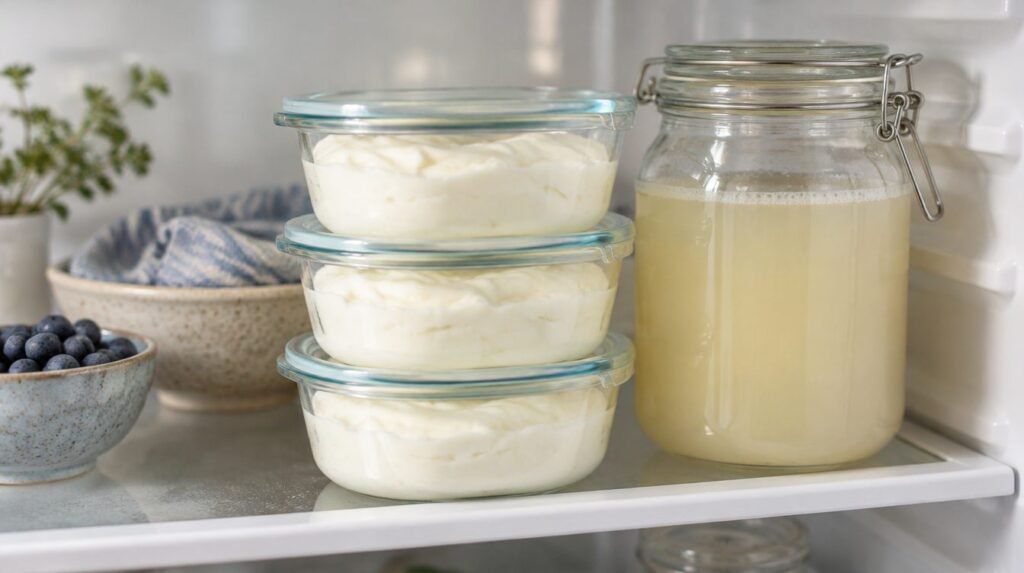
- Straining doesn’t reset the clock. Keep it covered at 40°F (4°C) or below and count from the day the yogurt was made: Illinois Extension says to eat homemade yogurt within 14 days. For bought yogurt, use the tub’s date.
- Freeze for longer. Kansas State University lists 1 to 2 months frozen for yogurt and notes it may separate. Refrigerate whey in a clean covered jar, or freeze it in small portions; food kept frozen at 0°F (−18°C) stays safe (FoodSafety.gov).
- Discard anything moldy or off. Throw out yogurt with mold rather than scooping it off (USDA FSIS), or with any odor other than fresh yogurt’s acidic smell (University of Alaska Fairbanks).
More on homemade Greek yogurt
- How to Make Greek Yogurt: A Step-by-Step Guide: the full straining method.
- Homemade Yogurt: What You Need to Know: the plain yogurt you will strain.
- Greek Yogurt with Probiotics: A Buyer’s Guide: reading culture claims.
- How Long Does Homemade Yogurt Last? The Complete Answer: storage and spoilage signs.
- Greek Yogurt Recipes You Can Make at Home: ways to use a thick batch.
Sources
- Karastamatis S, Zoidou E, Moatsou G, Moschopoulou E. Effect of modified manufacturing conditions on the composition of Greek strained yogurt and the quantity and composition of generated acid whey (Foods, 2022)
- Smith DK. Yogurt Made Simple (Washington State University Extension, distributed by the UC Master Food Preserver Program)
- Making Yogurt at Home (University of Illinois Extension)
- 21 CFR 131.200 Yogurt (Electronic Code of Federal Regulations, National Archives)
- Yang SY, Yoon KS. Effect of probiotic lactic acid bacteria (LAB) on the quality and safety of Greek yogurt (Foods, 2022)
- Milk and Cream Products and Yogurt Products; Final Rule (U.S. Food and Drug Administration, Federal Register, June 11, 2021)
- Yogurt, plain, whole milk (FDC ID 171284) (USDA FoodData Central)
- Yogurt, Greek, plain, whole milk (FDC ID 171304) (USDA FoodData Central)
- Yogurt, Greek, plain, nonfat (FDC ID 170894) (USDA FoodData Central)
- Yogurt, plain, skim milk (FDC ID 170887) (USDA FoodData Central)
- Wilbanks D. Yogurt Monograph Series: Concentrating Yogurt (Center for Dairy Research, University of Wisconsin–Madison, Dairy Pipeline, Winter 2024)
- Average Price: Milk, Fresh, Whole, Fortified (Cost per Gallon) in U.S. City Average (APU0000709112) (U.S. Bureau of Labor Statistics, via FRED, Federal Reserve Bank of St. Louis)
- Weekly Grocery Store Dairy Feature Activity (National Retail Report), October 9, 2026 (USDA Agricultural Marketing Service, Dairy Market News)
- Added Sugars on the Nutrition Facts Label (U.S. Food and Drug Administration)
- Marco ML, et al. The International Scientific Association for Probiotics and Prebiotics (ISAPP) consensus statement on fermented foods (Nature Reviews Gastroenterology & Hepatology, 2021)
- Hill C, et al. The International Scientific Association for Probiotics and Prebiotics consensus statement on the scope and appropriate use of the term probiotic (Nature Reviews Gastroenterology & Hepatology, 2014)
- Eating, Diet, & Nutrition for Lactose Intolerance (National Institute of Diabetes and Digestive and Kidney Diseases)
- Probiotics: What You Need To Know (National Center for Complementary and Integrative Health)
- 4 Steps to Food Safety (FoodSafety.gov, U.S. Department of Health and Human Services)
- How Temperatures Affect Food (USDA Food Safety and Inspection Service)
- Camacho Flinois JIJ. The Shift of Yogurt Acid Whey from Waste Product to Valuable Ingredient Across Value Added Food Product Categories (M.S. thesis, Cornell University, 2019)
- Simitzis P, Zikou F, Progoulakis D, Theodorou G, Politis I. A note on the effects of yoghurt acid whey marination on the tenderness and oxidative stability of different meat types (Foods, 2021)
- Karageorgou A, Paveli A, Goliomytis M, Theodorou G, Politis I, Simitzis P. The effects of yoghurt acid whey marination on quality parameters of pork and chicken meat (Foods, 2023)
- Grilling and Food Safety (USDA Food Safety and Inspection Service)
- Safe Food Storage: The Refrigerator and Freezer (MF3130) (Kansas State University Research and Extension)
- Cold Food Storage Chart (FoodSafety.gov, U.S. Department of Health and Human Services)
- Molds on Food: Are They Dangerous? (USDA Food Safety and Inspection Service)
- Cascio J, Dinstel RR. Making Yogurt at Home (FNH-00062) (University of Alaska Fairbanks Cooperative Extension Service)
- The Ultimate Yogurt Guide (eBook), Ultimate Health Solutions, publisher of this site