Greek Yogurt Dressing: What You Need to Know
What Greek yogurt dressing is
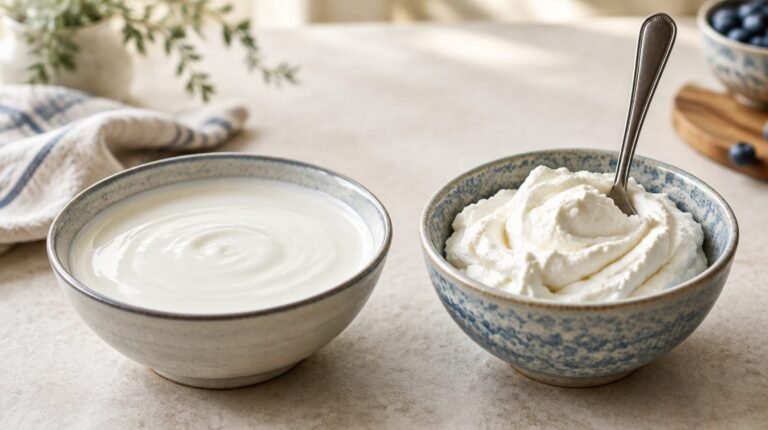
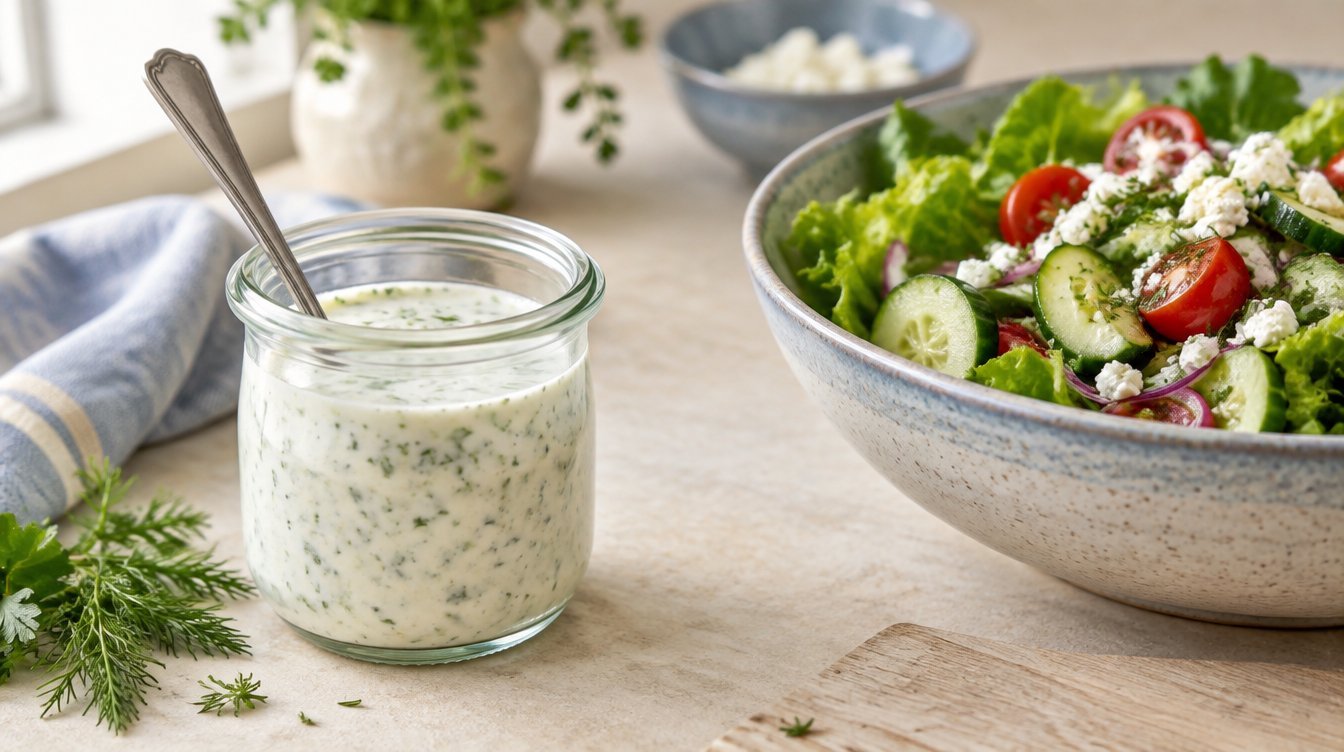
Greek yogurt dressing is plain strained yogurt thinned with acid and liquid, then seasoned. It does the same job as mayonnaise or a bottled creamy dressing: it coats greens, sauces grain bowls and works as a dip when you leave it thick.
Because the yogurt is never cooked, the dressing keeps whatever live cultures the yogurt had. It also starts much lower in fat and calories than a mayo-based dressing, which leaves room for olive oil, cheese or herbs.
Why it matters for gut health
Every yogurt in the US is made with Streptococcus thermophilus and Lactobacillus delbrueckii subsp. bulgaricus. Under the FDA yogurt standard, a label may say “contains live and active cultures” only if the yogurt has at least 10 million colony-forming units per gram at manufacture. Heat-treated yogurt has to say it does not contain live and active cultures.
Mixing yogurt into an uncooked sauce doesn’t appear to wipe those cultures out. In a lab study of a deli-style tzatziki stored up to 70 days at 39°F (4°C), lactic acid bacteria stayed high, at roughly 100 to 300 million per gram, and changed very little over storage. That was one product, and the bacteria weren’t identified as studied probiotic strains.
Two limits apply. Thinning the yogurt dilutes the cultures per spoonful. And the ISAPP consensus on fermented foods says a dressing or condiment that contains a fermented ingredient isn’t itself a fermented food, and live cultures alone don’t make a food a probiotic. No studies have tested yogurt dressing for gut health, so treat it as an easy way to eat more yogurt with live cultures. For the label details, see does all yogurt have probiotics.
The base ratio
Start with 1 cup of plain Greek yogurt and build from there. This makes about 1 1/4 cups, or roughly 10 servings of 2 tablespoons.
- Yogurt: 1 cup plain Greek yogurt.
- Acid: 2 tablespoons lemon juice or 1 tablespoon vinegar.
- Liquid to thin: 2 to 4 tablespoons water, milk or buttermilk.
- Fat (optional): 1 tablespoon olive oil for body and flavor.
- Salt: 1/2 teaspoon, then adjust.
How to thin it
Whisk in liquid 1 tablespoon at a time. For a dip, stop at 1 to 2 tablespoons. For a pourable salad dressing, plan on 1/4 to 1/3 cup of total liquid per cup of yogurt, counting the lemon juice. Milk or buttermilk keeps it creamy, water keeps it light, and extra lemon or vinegar adds tang.
The dressing thickens in the fridge, so expect to whisk in another spoonful of water before serving. Thick homemade strained yogurt needs more liquid than store-bought.
Six variations

Each recipe starts with 1 cup of plain Greek yogurt. Mix everything in a bowl or jar, taste, and thin as needed.
Ranch-style herb dressing
- 1/4 cup buttermilk or milk
- 1 tablespoon lemon juice
- 1 tablespoon chopped fresh dill (or 1 teaspoon dried)
- 1 tablespoon each chopped chives and parsley
- 1/2 teaspoon each garlic powder and onion powder
- 1/2 teaspoon salt and 1/4 teaspoon black pepper
Tzatziki-style dressing
- 1/2 cup grated cucumber, squeezed dry
- 1 small garlic clove, grated
- 1 tablespoon each lemon juice and olive oil
- 1 tablespoon chopped dill or mint
- 1/2 teaspoon salt
- 2 to 3 tablespoons water to make it pourable
Lemon-garlic dressing
- Zest of 1 lemon and 3 tablespoons lemon juice
- 1 garlic clove, grated
- 2 tablespoons olive oil
- 1/2 teaspoon salt and 1/4 teaspoon black pepper
- 2 to 3 tablespoons water
Caesar-style dressing
- 1/3 cup finely grated Parmesan
- 2 tablespoons lemon juice
- 1 teaspoon each Dijon mustard and Worcestershire sauce
- 1 to 2 teaspoons anchovy paste (optional)
- 1 garlic clove, grated, and 1/4 teaspoon black pepper
- 2 to 3 tablespoons water
The yogurt replaces the raw egg yolk of a classic Caesar, so there is no raw egg to worry about.
Honey mustard dressing
- 2 tablespoons Dijon mustard
- 1 tablespoon whole-grain mustard
- 2 tablespoons honey
- 1 tablespoon apple cider vinegar
- A pinch of salt
- 2 tablespoons water
Green goddess dressing
- 1 cup packed soft herbs, such as parsley, basil and chives, with a few tarragon leaves
- 2 tablespoons lemon juice
- 1 tablespoon olive oil
- 1 garlic clove
- 1 teaspoon anchovy paste (optional)
- 1/2 teaspoon salt; blend until smooth, then thin with water
For thicker versions to serve with vegetables, see Greek yogurt dip recipes and Greek yogurt sauce.
Nutrition compared with mayo-based dressings
Figures below come from USDA FoodData Central and are for the plain bases, before add-ins.
| Per 2 tablespoons | Calories | Fat (g) | Saturated fat (g) | Protein (g) | Sodium (mg) |
|---|---|---|---|---|---|
| Greek yogurt, plain, nonfat (30 g) | 18 | 0.1 | 0 | 3.1 | 11 |
| Greek yogurt, plain, whole milk (30 g) | 29 | 1.5 | 0.7 | 2.7 | 11 |
| Mayonnaise, regular (27.6 g) | 188 | 20.6 | 3.2 | 0.3 | 175 |
| Ranch dressing, regular, bottled (30 g) | 129 | 13.4 | 2.1 | 0.4 | 270 |
Add-ins change the picture. One teaspoon of olive oil adds about 40 calories and 4.5 grams of fat, and salt, Parmesan and anchovy add sodium. Even so, a yogurt dressing with a tablespoon of oil per cup stays far lighter per serving than mayo or bottled ranch, and adds a little protein.
How long it keeps in the fridge
Government storage charts don’t list homemade yogurt dressing, so use the closest guidance. FoodSafety.gov gives 3 to 4 days in the refrigerator for prepared salads such as egg, chicken and tuna salad, and University of Illinois Extension gives up to 14 days for plain homemade yogurt at 40°F or below. Once you add fresh garlic, herbs or cucumber, plan on using the dressing within 3 to 4 days.
- Keep your refrigerator at 40°F (4°C) or below, as FoodSafety.gov advises.
- Don’t leave the dressing out more than 2 hours, or 1 hour above 90°F (FoodSafety.gov).
- Store it in a clean, covered jar and use a clean spoon each time.
- Don’t count on lemon or vinegar to preserve it. In the tzatziki study above, Listeria added on purpose survived for the whole storage period.
- Throw it out if it smells off, grows mold or tastes unusually sour or yeasty.
How to choose the yogurt
Use plain, unsweetened Greek yogurt that says “contains live and active cultures,” since that is where the cultures come from. Whole-milk yogurt makes a richer dressing; nonfat keeps it lightest. Skip yogurt with added gelatin if you plan to strain it further, since gelatin keeps the whey from draining.
Homemade Greek yogurt is another option, since you control the milk and the starter. Strain regular homemade yogurt to the thickness you want, following how to make Greek yogurt, and check how long homemade yogurt lasts before you mix a batch. If you plan to cook with the dressing, read can you cook Greek yogurt first, because heat kills the cultures.
Related topics
- Homemade Greek Yogurt: the thick base for these dressings.
- Greek Yogurt Sauce: thicker sauces for meat, fish and bowls.
- Greek Yogurt Dip Recipes: the same flavors, served thick.
- Savory Greek Yogurt Recipes: more ways to use plain yogurt.
- Does All Yogurt Have Probiotics?: how to read culture labels.
Sources
- 21 CFR 131.200 Yogurt (Electronic Code of Federal Regulations, U.S. Food and Drug Administration)
- Tsiraki MI, et al. Viability of and Escherichia coli O157:H7 and Listeria monocytogenes in a delicatessen appetizer (yogurt-based) salad as affected by citrus extract (Citrox) and storage temperature (Food Microbiology, 2018)
- Marco ML, et al. The International Scientific Association for Probiotics and Prebiotics (ISAPP) consensus statement on fermented foods (Nature Reviews Gastroenterology & Hepatology, 2021)
- Cold Food Storage Chart (FoodSafety.gov, U.S. Department of Health and Human Services)
- 4 Steps to Food Safety (FoodSafety.gov, U.S. Department of Health and Human Services)
- Making Yogurt at Home (University of Illinois Extension, 2024)
- Yogurt, Greek, plain, nonfat (FDC ID 330137) (USDA FoodData Central)
- Yogurt, Greek, plain, whole milk (FDC ID 171304) (USDA FoodData Central)
- Salad dressing, mayonnaise, regular (FDC ID 171009) (USDA FoodData Central)
- Salad dressing, ranch dressing, regular (FDC ID 173592) (USDA FoodData Central)
- Oil, olive, salad or cooking (FDC ID 171413) (USDA FoodData Central)