Best Probiotic for Acne: Compared (2026)
Best Probiotic for Acne: Our Picks
No probiotic has strong evidence for acne. The research is early: a handful of small trials, mostly 12 weeks long, with mixed results when they are pooled. The American Academy of Dermatology’s 2024 acne guidelines found the evidence insufficient to make recommendations on dietary changes or alternative therapies such as vitamins or plant-based products, and NCCIH notes the academy’s earlier guidelines said the evidence was not strong enough to recommend probiotics.
With that in mind, here are the strains studied for skin, ranked by the size and quality of the human research:
- Largest single trial: Lacticaseibacillus rhamnosus CECT 30031 with the cyanobacterium Arthrospira platensis. One trial of 74 young people; modest gains, and several authors reported industry ties.
- Most cited adult acne trial: Lactobacillus rhamnosus SP1. One pilot trial of 20 adults.
- Other oral strain: Lactobacillus plantarum CJLP55. One trial of 28 people.
- Alongside acne antibiotics: two small trials added a probiotic to minocycline or doxycycline, with some extra benefit.
- Food first: a varied diet, with yogurt and kefir if you eat dairy. Dermatologist care comes before any supplement.
In October 2026 we could not find any of these specific strains on the label of a widely sold US product, so we do not name a product pick. Treat any probiotic marketed for “clear skin” with caution: no product has been shown in human trials to clear acne.
Ultimate Gut is published by Ultimate Health Solutions, which sells a yogurt maker, probiotic capsules and an inulin fiber supplement. None of the products reviewed here are ours, and these brands don’t pay us.
Many probiotics are sold as dietary supplements, and the FDA is not authorized to approve dietary supplements for safety and effectiveness before they are marketed. This article is general information, not medical advice.
Strains Studied for Acne Compared
This table summarizes the published human research by strain. Product details come only from brand pages; labels checked October 2026.
| Strain or product | Study | People and length | What was found | Evidence strength | Widely sold US product with this strain |
|---|---|---|---|---|---|
| L. rhamnosus CECT 30031 + A. platensis (oral capsule) | Eguren 2024 | 74 analyzed, ages 12 to 30; 12 weeks | More people improved on severity scales (50% vs 29%); fewer non-inflammatory lesions; total lesions not significant | Low: one trial, industry-linked authors | None found |
| L. rhamnosus SP1 (oral liquid) | Fabbrocini 2016 | 20 adults; 12 weeks | Improved acne ratings and skin gene markers tied to insulin signaling | Very low: pilot, very small | None found |
| L. plantarum CJLP55 (oral) | Kim 2021 | 28 people; 12 weeks | Better lesion counts and grade, less sebum fat, better hydration | Very low: one small trial, sponsor-linked authors | None found |
| Probiotic plus minocycline (oral) | Jung 2013 | 45 women; 12 weeks; open-label | Combination reduced lesions more than either alone | Very low: no placebo, no blinding | Strains not named in abstract |
| L. paracasei MSMC 39-1 lotion (topical, cell-free) | Sathikulpakdee 2022 | 104 people; 4 weeks | Similar results to 2.5% benzoyl peroxide | Low: short; a topical product, not a probiotic you swallow | None found |
| Florastor Digest + Skin Renew | No acne trial found | Label: 4 billion CFU; Bifidobacterium lactis HN019 and BI-04, plus a 300 mg botanical blend and 13.5 mg vitamin C | Brand skin claims (radiance, tone) rest on a study of the botanical ingredient, not acne | Not studied for acne | Yes (marketed for skin, not acne) |
How Each Strain Stacks Up
L. rhamnosus CECT 30031 with A. platensis: the largest trial, still small
In a 2024 randomized, placebo-controlled trial in Acta Dermato-Venereologica, patients aged 12 to 30 took a capsule combining this strain with the cyanobacterium Arthrospira platensis for 12 weeks. Half of the 40 in the probiotic group improved on a global severity scale, versus 10 of 34 on placebo. Non-inflammatory lesions dropped more with the probiotic, but the drop in total lesions fell just short of statistical significance.
Two limits matter. The capsule contained two ingredients, so the effect cannot be pinned on the probiotic alone. And according to the published conflict-of-interest statement, three authors were employees of the company Bioithas, and one reported owning stock or stock options. It is a useful early result, not proof.
L. rhamnosus SP1: the pilot study often quoted
A 2016 pilot trial gave 20 adults with acne (14 women, 6 men) either a liquid supplement with 3 billion CFU a day of L. rhamnosus SP1 or a placebo liquid for 12 weeks. Skin biopsies showed changes in genes linked to insulin signaling, and the probiotic group was more likely to be rated improved by physicians.
The effect estimate came with a very wide confidence range, a sign of how few people were studied. Ten people per group is too small to say how well this strain works or for whom. We found no widely sold US product that lists SP1 on its label.
L. plantarum CJLP55: one small trial
In a 2021 double-blind trial, 14 people took CJLP55 and 14 took placebo for 12 weeks. The probiotic group had better lesion counts and acne grade, less triglyceride in skin oil and better hydration. Three authors were employed by the food company that provided the strain, and the trial was small.
Probiotics added to acne antibiotics
Two trials tested probiotics on top of standard treatment. In a 2013 open-label trial, 45 women aged 18 to 35 took a probiotic, minocycline, or both for 12 weeks; the combination reduced lesions more than either alone. Two women in the minocycline-only group stopped because of vaginal yeast infections. With no placebo and no blinding, the results are easy to over-read.
In a 2025 trial of 80 people with moderate acne, everyone used a face wash and adapalene gel and took doxycycline; half also took a daily probiotic capsule. The probiotic group did better on the forehead, chin and nose, but not the cheeks, back or chest. These trials ask whether a probiotic adds to treatment, not whether it replaces it.
Topical probiotics are a different thing
Skin-care products with “probiotic” on the label are not the same as a capsule. In a 2022 trial, 104 people with mild to moderate acne used either a lotion made from a cell-free extract of L. paracasei MSMC 39-1 or 2.5% benzoyl peroxide for 4 weeks. Inflammatory lesions dropped in both groups with no significant difference between them. That lotion contained no live bacteria, and results from a lotion say nothing about a supplement you swallow.
Florastor Digest + Skin Renew: marketed for skin, not acne
This is one of the few widely sold probiotics marketed for skin. Its label lists 4 billion CFU of Bifidobacterium lactis HN019 and BI-04, a 300 mg botanical blend and 13.5 mg of vitamin C, taken once daily at room temperature. The brand’s radiance and tone claims are based on a study of the botanical ingredient alone, not the finished capsule, and the product is not marketed for acne. We found no acne trial of these two strains in a PubMed search.
What the Pooled Evidence Says
Reviews disagree, which is typical for an early field. A 2026 meta-analysis of 13 studies (1,453 people) found no significant drop in acne lesion counts with probiotics, though acne severity scores improved; the authors urged caution because the studies varied widely and acne naturally comes and goes. A 2026 review of Lactobacillus-based products (5 trials, 332 people) also found no significant reduction in lesions.
Other reviews are more positive. A 2025 meta-analysis of three double-blind trials (231 people) found a modest drop in inflammatory lesions but rated certainty low to moderate and said future studies could plausibly find no meaningful effect. A 2025 review of 9 studies (623 patients) reported improvements after 12 weeks. None of these reviews can say which strain, dose or person benefits.
The idea behind all this is the gut-skin axis: a 2018 review describes a two-way link between gut microbes and skin through the immune system. It is a reasonable theory, but it does not yet tell you which probiotic, if any, will help your skin. Acne itself starts when pores become clogged, and hormones called androgens can enlarge oil glands, the AAD explains.
Food First for Skin and Gut
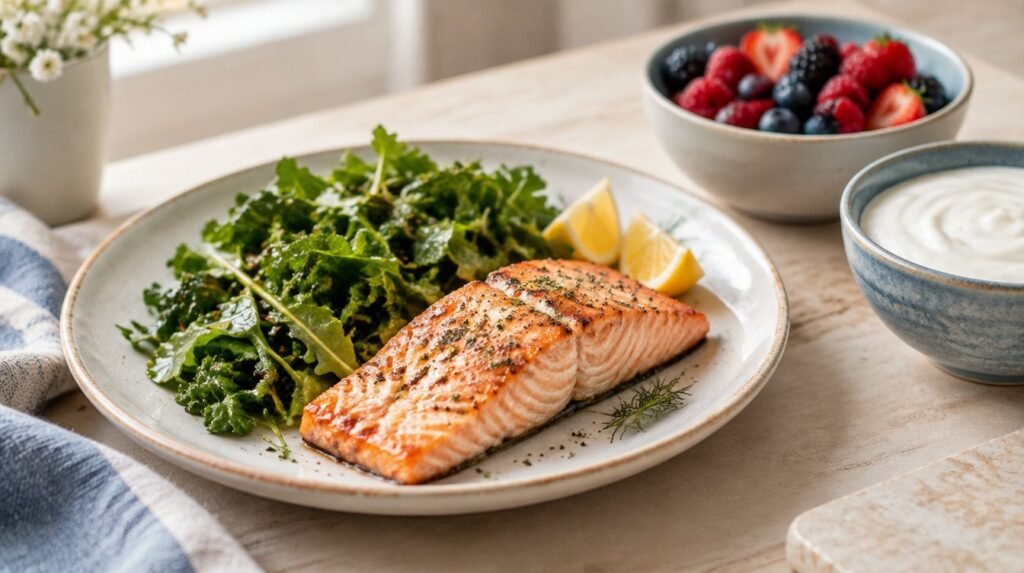
The AAD says small studies suggest a low-glycemic diet may reduce acne, while other studies found no link. All types of cow’s milk, including skim, have been linked to acne in some studies. But the academy also notes that no studies have found yogurt or cheese lead to more breakouts.
For gut health in general, fermented foods are a reasonable place to start. In a small Stanford study of 36 healthy adults over 17 weeks, a diet high in fermented foods raised gut microbe diversity and lowered inflammation markers; it did not study acne. See our guides to probiotic foods, plain yogurt and fermented foods for gut health.
When to See a Dermatologist
Effective acne treatments exist, and a probiotic should not delay them. The AAD suggests seeing a dermatologist if your acne:
- Causes cysts or nodules, the deep blemishes that can leave scars.
- Has not cleared with treatment you can buy without a prescription.
- Makes you uncomfortable and you want clearer skin.
Give a non-prescription treatment at least 4 weeks, and expect 2 to 3 months or longer to see clearing, the academy says. Even with a dermatologist’s plan, it takes at least 6 to 8 weeks before you see fewer breakouts. Options include topical retinoids, benzoyl peroxide, azelaic acid, oral antibiotics, hormonal treatments for some women and isotretinoin for severe nodular acne. If you are on acne treatment, do not stop it to try a probiotic.
Who Should Check With a Doctor First
Probiotics are unlikely to harm healthy people, and side effects are usually minor, the NIH Office of Dietary Supplements says. Serious infections have been reported mostly in people who were severely ill or immunocompromised, and risk is higher in intensive care and for people with a central venous catheter. NCCIH advises talking with your health care provider before taking a probiotic supplement, If you are pregnant, immunocompromised or seriously ill, ask your doctor first. Teens with acne should involve a parent and a doctor before adding any supplement.
How We Compared
We compared only published human research on named strains and what brands publish on their own pages. We did not buy, take or analyze any product. Our criteria, in order:
- Human trials in acne: randomized, placebo-controlled trials counted most; open-label trials and lab studies counted least.
- Size and length: how many people were studied and for how long.
- Strain match: whether the exact strain code from the research appears on a widely sold product label.
- Independence: whether authors had ties to the product or strain developer.
- Route: oral supplement versus topical product, which are not interchangeable.
- Expert guidance: what the AAD, NIH and NCCIH say.
Labels can tell you the strain, the amount and how to store a product. They cannot tell you whether that strain has been studied for acne, and terms like “skin support” are not evidence. As the ODS notes, probiotic effects are specific to the strain, so a study of one strain does not carry over to another of the same species. Labels were checked on brand pages in October 2026, and formulas can change.
Related Topics
- Best Probiotic: picks by need for digestion, travel and IBS.
- Best Probiotic for Women: strains studied for vaginal health.
- Best Foods for Gut Health: a food-first approach.
- Gut Health Supplements: what other supplements claim and show.
Sources
- American Academy of Dermatology issues updated guidelines for the management of acne (American Academy of Dermatology, 2024)
- Can the right diet get rid of acne? (American Academy of Dermatology)
- Acne: Diagnosis and treatment (American Academy of Dermatology)
- 9 things to try when acne won’t clear (American Academy of Dermatology)
- Acne: Who gets and causes (American Academy of Dermatology)
- Probiotics: Usefulness and Safety (National Center for Complementary and Integrative Health)
- Probiotics: Fact Sheet for Health Professionals (NIH Office of Dietary Supplements)
- Information for Consumers on Using Dietary Supplements (U.S. Food and Drug Administration)
- Eguren C, et al. A Randomized Clinical Trial to Evaluate the Efficacy of an Oral Probiotic in Acne Vulgaris (Acta Dermato-Venereologica, 2024)
- Fabbrocini G, et al. Supplementation with Lactobacillus rhamnosus SP1 normalises skin expression of genes implicated in insulin signalling and improves adult acne (Beneficial Microbes, 2016)
- Kim MJ, et al. Effects of Lactobacillus plantarum CJLP55 on Clinical Improvement, Skin Condition and Urine Bacterial Extracellular Vesicles in Patients with Acne Vulgaris (Nutrients, 2021)
- Jung GW, et al. Prospective, randomized, open-label trial comparing the safety, efficacy, and tolerability of an acne treatment regimen with and without a probiotic supplement and minocycline (Journal of Cutaneous Medicine and Surgery, 2013)
- Atefi N, et al. Evaluating the Effectiveness of Probiotic Supplementation in Combination With Doxycycline for the Treatment of Moderate Acne (Journal of Cosmetic Dermatology, 2025)
- Sathikulpakdee S, et al. Efficacy of probiotic-derived lotion from Lactobacillus paracasei MSMC 39-1 in mild to moderate acne vulgaris (Journal of Cosmetic Dermatology, 2022)
- Julanon N, et al. Role of Probiotics in Managing Acne Vulgaris: A Systematic Review and Meta-Analysis of Clinical Trials (Journal of Cutaneous Medicine and Surgery, 2026)
- Abedin ZU, et al. Lactobacillus-Based Microbiome Therapy for Acne Vulgaris: A GRADE Systematic Review and Meta-Analysis of Randomized Controlled Trials (Journal of Cosmetic Dermatology, 2026)
- Tjiu JW, et al. Oral Probiotics in Acne vulgaris: A Systematic Review and Meta-Analysis of Double-Blind Randomized Clinical Trials (Medicina, 2025)
- Lin HW, et al. Efficacy of oral probiotics in patients with acne: a systematic review and meta-analysis of randomized trials (Clinical and Experimental Dermatology, 2025)
- Salem I, et al. The Gut Microbiome as a Major Regulator of the Gut-Skin Axis (Frontiers in Microbiology, 2018)
- Wastyk HC, et al. Gut-microbiota-targeted diets modulate human immune status (Cell, 2021)
- Florastor Balanced Benefits Digest + Skin Renew Probiotic Supplement (Florastor product page, label checked October 2026)
This article is for general information and is not medical advice. Talk to your doctor or a registered dietitian before changing your diet, supplements or medication, especially if you have a health condition.