Raw Milk Yogurt: What You Need to Know
What is raw milk yogurt?
Raw milk yogurt is yogurt cultured from milk that has not been pasteurized. The FDA lists yogurt made from unpasteurized milk as a high-risk food: raw milk can carry Salmonella, E. coli, Listeria and other germs, and fermenting it does not reliably kill them. The safer choice is pasteurized milk, or raw milk pasteurized at home before culturing.
Pasteurization heats milk hot enough, for long enough, to remove disease-causing germs, and CDC credits it with greatly reducing milk-borne illness since the early 1900s. The federal standard for yogurt says dairy ingredients must be pasteurized or ultra-pasteurized before the culture is added, so raw milk yogurt is usually homemade, or bought directly where state rules allow raw dairy sales.
Why raw milk yogurt matters for gut health and safety
People often choose raw milk for perceived benefits that don’t hold up. FDA says pasteurization does not cause lactose intolerance or reduce milk’s nutritional value, and the American Academy of Pediatrics (AAP) says claims of superior health benefits are not supported by scientific evidence. Yogurt’s live cultures come from the starter, which FDA notes is purposely added during yogurt making, so yogurt made from pasteurized milk still has them.
Raw milk germs hit the gut
CDC lists Campylobacter, Cryptosporidium, E. coli, Listeria, Brucella and Salmonella among raw milk germs. Typical symptoms are diarrhea, stomach cramps and vomiting; some infections lead to Guillain-Barré syndrome or hemolytic uremic syndrome, which can cause paralysis, kidney failure, stroke or death.
Citing CDC data, FDA reports 202 outbreaks linked to raw milk from 1998 to 2018, with 2,645 illnesses and 228 hospitalizations. One analysis estimated that unpasteurized milk and cheese caused about 840 times more illnesses and 45 times more hospitalizations than pasteurized products (it did not include yogurt). In 2026, CDC investigated an E. coli outbreak linked to raw cheddar and raw milk that sickened 9 people, more than half of them children under 5.
Who is most at risk
CDC names children under 5, adults over 65, pregnant women and people with weakened immune systems. In pregnancy, Listeria can cause miscarriage or a newborn’s illness or death, and FDA warns that foods made from raw milk can harm the baby even if the mother doesn’t feel sick. The AAP says nearly half of raw dairy illnesses occur in people under 20. Still, CDC stresses that even healthy adults can get sick.
Why fermentation doesn’t make raw milk safe
Culturing makes milk acidic (yogurt sets at about pH 4.6; see how to tell when yogurt is done), but that is not the same as killing germs. FDA says nothing in raw milk naturally kills the pathogens of concern and calls pasteurization the only method that completely eliminates vegetative (actively growing) pathogens.
Timing also works against you. Yogurt incubates at about 110°F (43°C) for 4 to 7 hours, inside the 40°F to 140°F (4°C to 60°C) range where bacteria multiply rapidly, while acid builds gradually. In lab studies:
- E. coli O157:H7 added to milk grew more than 500-fold during yogurt fermentation, even as the yogurt reached about pH 4.6 (Osaili et al., 2013). Counts fell toward undetectable levels over 7 days of cold storage, but they were highest right when the yogurt would first be eaten.
- Another study found E. coli O157:H7 survived and multiplied during fermentation, and the contamination slowed the yogurt cultures themselves (Cutrim et al., 2017).
Bird flu (H5N1) and raw milk: the latest guidance
Since 2024, H5N1 bird flu has infected dairy cows in multiple states, and CDC reports the virus has been detected in raw milk from sick cows and cows without symptoms. Where things stood at the time of writing (October 2026):
- FDA continues to advise against consuming raw milk (May 10, 2024). Its latest update (March 14, 2025) said pasteurization inactivates H5N1 and the commercial pasteurized milk supply is safe. It also reported preliminary research in which viable virus survived 60 days of aging in raw milk cheese made at pH 6.6 or 5.8, though it was rapidly inactivated at pH 5.0; FDA said more research is needed.
- USDA began its National Milk Testing Strategy on December 6, 2024, requiring raw milk samples nationwide to be collected and tested to identify affected herds (program page last updated January 9, 2026).
- CDC, in its March 6, 2026 update, rated the current public health risk as low, with 71 human H5 cases in the U.S. since February 2024. Its clinician guidance (June 2024) calls the risk of infection from drinking contaminated raw milk unknown and supports drinking only pasteurized milk.
- The AAP (October 5, 2026) called H5N1 in raw milk “a credible, emerging threat,” noting it can stay detectable in refrigerated raw milk for up to five weeks, though no human infections from drinking raw milk have been confirmed to date.
These figures change, so check CDC’s current situation page for the latest.
Raw milk laws vary by state
Milk sold across state lines must be pasteurized, but each state controls sales within its borders; some allow raw milk in stores, on farms, at farmers markets or through herd shares. The AAP counts at least 27 states where raw milk products are legal to sell. Check with your state agriculture or health department. Legal status doesn’t change the risk: CDC notes that even good farm practices cannot guarantee raw milk is free of harmful germs.
How to make yogurt safely if you have raw milk
The simplest option is commercially pasteurized milk; see how to make yogurt at home, which starts with pasteurized milk. University of Alaska Fairbanks (UAF) Extension tells home yogurt makers to use commercially pasteurized milk or pasteurize raw milk first, and CDC advises choosing pasteurized dairy, especially for children under 5.
Pasteurizing raw milk at home
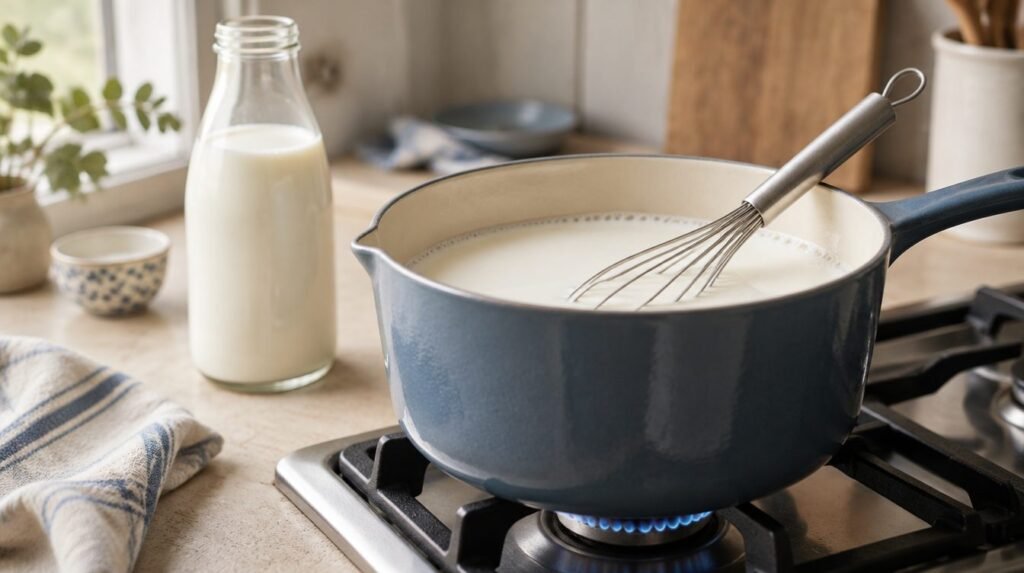
If you have raw milk, pasteurize it first. Ohio State and Oregon State University Extension give the same two options. You need a cooking thermometer and a double boiler (or a small pan set inside a larger pan of water).
| Method | Heat to | Hold for | Key detail |
|---|---|---|---|
| Standard | 161°F (72°C) | At least 15 seconds | Stir constantly (Ohio State) |
| Lower temperature | 145°F (63°C) | At least 30 minutes | All the milk, including the foam, must reach 145°F (63°C) (Ohio State); if it drops below, reheat and restart the timer (Oregon State) |
Oregon State cautions that milk kept below 145°F (63°C) is not hot enough to kill harmful bacteria. Cool the milk right away: Ohio State says to set the pan in cold water, switch to ice water once the milk drops below 130°F (54°C), and continue until it reaches 40°F (4°C) or below, then refrigerate at 40°F (4°C) or colder until use.
Then make yogurt as usual
Next, follow a standard method such as How to Make Yogurt at Home. UAF’s method heats the milk again to 185°F to 200°F (85°C to 93°C) for 10 to 20 minutes for texture, but says not to substitute that step for pasteurization. UAF also advises discarding any batch that fails to set. If you become ill after eating a raw milk product, FDA advises seeing a healthcare professional right away.
More on making yogurt safely
- How to Make Yogurt at Home: A Step-by-Step Guide: The full method once your milk is pasteurized.
- Yogurt Temperature: What You Need to Know: Heating, cooling and incubation temperatures.
- Homemade Yogurt: What You Need to Know: Why people make yogurt at home, plus safety basics.
- How Is Yogurt Made? Explained: How commercial yogurt is made from pasteurized milk.
- How Long Does Homemade Yogurt Last? The Complete Answer: Storage times and spoilage signs.
Sources
- U.S. Food and Drug Administration, The Dangers of Raw Milk: Unpasteurized Milk Can Pose a Serious Health Risk (content current as of May 30, 2024)
- U.S. Food and Drug Administration, Raw Milk Misconceptions and the Danger of Raw Milk Consumption (content current as of March 5, 2024)
- U.S. Food and Drug Administration, Investigation of Avian Influenza A (H5N1) Virus in Dairy Cattle (content current as of March 14, 2025)
- Centers for Disease Control and Prevention, Raw Milk (updated January 31, 2025)
- Centers for Disease Control and Prevention, Talking to Patients about Unpasteurized (Raw) Milk and Highly Pathogenic Avian Influenza (June 3, 2024)
- Centers for Disease Control and Prevention, A(H5) Bird Flu: Current Situation (updated March 6, 2026)
- Centers for Disease Control and Prevention, E. coli Outbreak Linked to Raw Dairy (2026)
- Centers for Disease Control and Prevention, Public Health Law Program, Research Anthology: Raw Milk (May 16, 2024)
- Costard S, et al. Outbreak-Related Disease Burden Associated with Consumption of Unpasteurized Cow’s Milk and Cheese, United States, 2009–2014. Emerging Infectious Diseases (CDC), 2017
- U.S. Department of Agriculture, USDA Announces New Federal Order, Begins National Milk Testing Strategy to Address H5N1 in Dairy Herds (December 6, 2024)
- USDA Animal and Plant Health Inspection Service, National Milk Testing Strategy (last modified January 9, 2026)
- American Academy of Pediatrics, American Academy of Pediatrics Warns of Dangers in Consuming Raw Milk, Dairy Products (news release, October 5, 2026)
- Code of Federal Regulations, 21 CFR 131.200 Yogurt (eCFR, National Archives)
- University of Alaska Fairbanks Cooperative Extension Service, Making Yogurt at Home (FNH-00062, reviewed October 2024)
- Ohio State University Extension, Food Preservation: Pasteurization of Raw Milk for Home Consumption (HYG-5817, revised May 2024)
- Oregon State University Extension Service, Home Pasteurization of Raw Milk (SP 50-932, revised January 2025)
- Osaili TM, et al. Survival of Escherichia coli O157:H7 during the Manufacture and Storage of Fruit Yogurt. Journal of Food Safety, 2013 (United Arab Emirates University research portal)
- Cutrim CS, et al. Survival of Escherichia coli O157:H7 in Traditional and Low-Lactose Yogurt during Fermentation and Cooling. Ciência Animal Brasileira, 2017 (article in Portuguese)