

Coconut Yogurt: What You Need to Know
What Is Coconut Yogurt?
Coconut yogurt is a dairy-free yogurt alternative made by fermenting coconut milk with live cultures, usually with a thickener such as pectin or starch. It has no milk or lactose, but in a survey of 61 US coconut yogurts it averaged about 1.2 g of protein per 100 g and had the most saturated fat of any yogurt type studied.
Why it needs a thickener
Dairy yogurt sets because milk proteins, mainly casein, link into a gel as the cultures make acid (Sfakianakis and Tzia, 2014). Coconut milk is mostly fat and water: USDA lists 2.0 g of protein and 21.3 g of fat per 100 g of canned coconut milk. In a 2026 lab study, fermented coconut milk could not form a cohesive gel on its own.
Manufacturers often add gums, starches or pectin, which must appear on the label (Libberecht et al.). In the US survey, 37 of the 61 coconut yogurts listed pectin, 26 locust bean gum and 20 rice starch.
What the name on the label means
The FDA’s yogurt standard (21 CFR 131.200) covers cultured milk and cream, so coconut products fall outside it, including its live-culture rules. A nonbinding 2025 FDA draft guidance recommends that plant-based alternatives name their plant source.
How coconut yogurt compares with dairy yogurt
| Per 100 g | Calories | Protein (g) | Saturated fat (g) | Calcium (mg) |
|---|---|---|---|---|
| Canned coconut milk, USDA (the usual base for homemade) | 197 | 2.0 | 18.9 | 18 |
| Store-bought coconut yogurts, US survey | About 114 | About 1.2 | Highest of all yogurt types (no figure given) | Highest of the plant-based types; depends on fortification |
| Plain whole-milk yogurt, USDA | 61 | 3.5 | 2.1 | 121 |
| Plain nonfat Greek yogurt, USDA | 59 | 10.2 | 0.1 | 110 |
- Protein: Across 79 US coconut yogurts, the median was 1 g per serving (Craig and Brothers, 2021).
- Saturated fat: Coconut was the only base that study called high in saturated fat. Yogurt made from full-fat canned coconut milk keeps it all: about 21 g per half cup (113 g), by our arithmetic. The Dietary Guidelines advise under 10% of calories (about 22 g a day at 2,000 calories); the American Heart Association, which lists coconut among tropical fats, suggests about 13 g.
- Calcium and vitamins: About half of coconut yogurts are fortified with calcium (Craig and Brothers), and in the US survey, 25 of the 61 listed added vitamin B12 and 25 added vitamin D. USDA’s MyPlate leaves coconut “milks” out of the Dairy Group because their nutrition differs.
Coconut yogurts had the lowest average nutrient-density score in the survey, though only 19 could be scored. For an almond-based comparison, see Kite Hill Almond Yogurt: What You Need to Know.
Coconut Yogurt and Gut Health
Live cultures, not a proven probiotic
Coconut yogurt made with live cultures is a fermented food, not automatically a probiotic. The International Scientific Association for Probiotics and Prebiotics (ISAPP) reserves “probiotic” for defined strains with evidence of a health benefit and suggests “live and active cultures” for foods with undefined microbes. The industry Live & Active Cultures seal is defined for yogurt and cultured dairy, so no set culture count applies to coconut products; look for named cultures (see Greek Yogurt with Probiotics: A Buyer’s Guide).
What the evidence shows
Most yogurt research is on dairy, including more than 20 randomized trials of yogurt and cultured milk, and the yogurt-culture benefit European regulators have approved, better lactose digestion, doesn’t apply without milk. A 2021 review of plant-based yogurt alternatives reported no human trials of health effects. In a small Stanford trial, 36 healthy adults on a 10-week diet high in fermented foods such as yogurt, kefir and kimchi had more diverse gut microbes; coconut yogurt wasn’t tested alone.
Watch added sugar too: the 2025–2030 Dietary Guidelines cap dairy snacks such as yogurt at 2.5 g per ⅔-cup equivalent, a fair yardstick here, and the label’s “Includes Added Sugars” line shows the amount.
Choosing or Making Coconut Yogurt
Who it suits
- Milk allergy or a vegan diet: It has no milk ingredients. Milk is one of the nine major food allergens, so read the label every time; at home, the starter must be dairy-free too.
- Lactose intolerance: There is no lactose, though the NIDDK says most people with lactose intolerance can have some, and dairy yogurt has less of it than milk.
- Tree-nut allergy: Since January 2025 the FDA no longer treats coconut as a tree nut for allergen labeling, though it stays in the ingredient list. The American College of Allergy, Asthma and Immunology says most people with tree-nut allergy can safely eat coconut, but reactions to coconut occur, so ask an allergist first. Some blends add cashews or pili nuts (Craig and Brothers).
- Check first if you rely on yogurt for protein or calcium, or limit saturated fat. Choose plain, unsweetened tubs and compare the % Daily Value for calcium, vitamin D and B12.
Coconut yogurt recipe: making it at home
The University of Guam Cooperative Extension publishes a home coconut yogurt method for fresh or canned coconut milk, using a freeze-dried culture or fresh yogurt (3 to 5% of the milk’s weight) as starter. This version uses canned milk and a dairy-free starter. You need a saucepan, whisk, thermometer, clean jars with lids and a way to hold the temperature, such as a yogurt maker.
- Two 13.5-ounce cans of coconut milk (about 3⅓ cups)
- About 2 tablespoons of plain, unsweetened coconut yogurt that lists live cultures (roughly 4% by weight, by our arithmetic), or a freeze-dried culture labeled dairy-free, used as its package directs
- Optional: tapioca flour to reduce whey separation (the Guam guide also lists gelatin, which is not vegan, and gives no amount for either)
- Whisk any thickener into the coconut milk, heat to 185–194°F (85–90°C) and hold for 15 minutes, stirring constantly; the heat also helps the coconut proteins gel.
- Cool the pan in ice or cold water to 106–110°F (41–43°C); hotter milk can kill the cultures.
- Stir the starter into a little of the warm milk, then mix it thoroughly into the rest.
- Pour into clean, sanitized jars, cover and incubate at 110°F (43°C) for about 10 to 16 hours, depending on the culture, jar size and incubator.
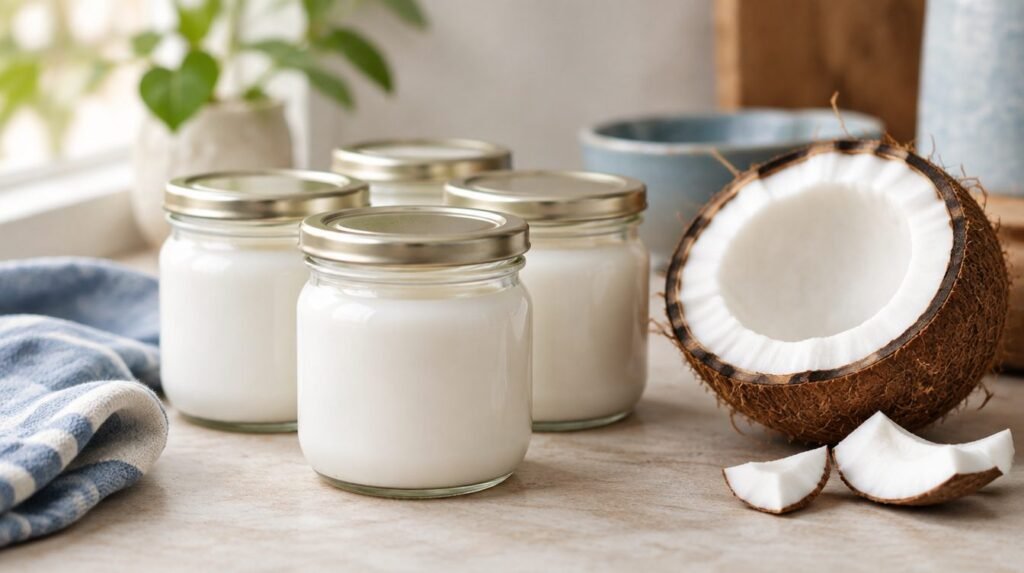
- Check that it has thickened and tastes tart; the guide’s target is a pH below 4.6, which test strips or a meter can confirm.
- Refrigerate at 40°F (4°C) to stop fermentation.
Some whey separation is normal, more so with coconut milk’s low protein. Without a thickener, expect a thinner yogurt; straining it in the refrigerator for 2 to 4 hours gives a Greek-style texture (Guam guide). The ferment runs longer than the dairy method in How to Make Yogurt at Home: A Step-by-Step Guide.
Storage and safety
- Keep it cold: store at 40°F (4°C) or below and eat within 2 weeks, per the Guam guide; see How Long Does Homemade Yogurt Last? The Complete Answer.
- Don’t judge by thickness alone: a thickener can firm up coconut milk that never fermented, so rely on tartness or pH.
- Discard failures: throw out any batch that fails to set or shows mold, off colors or odors other than fresh yogurt’s acidity (Guam Extension); never scoop off mold (USDA).
More on Dairy-Free and Homemade Yogurt
- Kite Hill Almond Yogurt: What You Need to Know: another dairy-free option.
- Greek Yogurt with Probiotics: A Buyer’s Guide: reading culture claims.
- Homemade Greek Yogurt: What You Need to Know: straining at home.
- Greek Yogurt Protein: What You Need to Know: the high-protein end of the range.
- Raw Milk Yogurt: What You Need to Know: another milk choice, with its own safety rules.
Sources
- D’Andrea AE, Kinchla AJ, Nolden AA. A comparison of the nutritional profile and nutrient density of commercially available plant-based and dairy yogurts in the United States (Frontiers in Nutrition, 2023)
- Craig WJ, Brothers CJ. Nutritional Content and Health Profile of Non-Dairy Plant-Based Yogurt Alternatives (Nutrients, 2021)
- Libberecht S, Ristevska M, Gibis M, Loeffler M. Potential of Homopolysaccharide-Producing Starter Cultures in the Fermentation of Coconut Yoghurt Alternatives Enriched with Pea Protein Isolate (Foods, 2026)
- Sfakianakis P, Tzia C. Conventional and Innovative Processing of Milk for Yogurt Manufacture; Development of Texture and Flavor: A Review (Foods, 2014)
- Nuts, coconut milk, canned (FDC ID 170173) (USDA FoodData Central)
- Yogurt, plain, whole milk (FDC ID 171284) (USDA FoodData Central)
- Yogurt, Greek, plain, nonfat (FDC ID 170894) (USDA FoodData Central)
- 21 CFR 131.200 Yogurt (Electronic Code of Federal Regulations, National Archives)
- Draft Guidance for Industry: Labeling of Plant-Based Alternatives to Animal-Derived Foods (U.S. Food and Drug Administration, January 2025)
- Dairy (MyPlate, U.S. Department of Agriculture)
- Dietary Guidelines for Americans, 2025–2030 (U.S. Department of Agriculture and U.S. Department of Health and Human Services)
- Saturated Fat (American Heart Association)
- Marco ML, et al. The International Scientific Association for Probiotics and Prebiotics (ISAPP) consensus statement on fermented foods (Nature Reviews Gastroenterology & Hepatology, 2021)
- Hill C, et al. The International Scientific Association for Probiotics and Prebiotics consensus statement on the scope and appropriate use of the term probiotic (Nature Reviews Gastroenterology & Hepatology, 2014)
- Live & Active Cultures Seal (International Dairy Foods Association)
- Montemurro M, et al. Plant-Based Alternatives to Yogurt: State-of-the-Art and Perspectives of New Biotechnological Challenges (Foods, 2021)
- Fermented-food diet increases microbiome diversity, decreases inflammatory proteins, study finds (Stanford Medicine)
- Added Sugars on the Nutrition Facts Label (U.S. Food and Drug Administration)
- Food Allergies: What You Need to Know (U.S. Food and Drug Administration)
- Frequently Asked Questions: Food Allergen Labeling Guidance for Industry (U.S. Food and Drug Administration)
- Tree Nut Allergy (American College of Allergy, Asthma and Immunology)
- Eating, Diet, & Nutrition for Lactose Intolerance (National Institute of Diabetes and Digestive and Kidney Diseases)
- De Jesus S, Yang J. Making Coconut Yogurt at Home (TB001-20) (University of Guam Cooperative Extension & Outreach)
- Molds on Food: Are They Dangerous? (USDA Food Safety and Inspection Service)


