How to Incubate Yogurt: A Step-by-Step Guide
How to incubate yogurt: the short answer
To incubate yogurt, pour milk cultured at 108–115°F (42–46°C) into warm, covered jars and hold them at about 110°F (43°C), within 5°F either way, without moving them. Most extension guides give 4 to 10 hours. Check for a soft gel from about 4 hours, then refrigerate at 40°F (4°C) or below right away.
What you’ll end up with
Incubation is the step where the cultures do the work. Done well, it turns a quart of inoculated milk into plain yogurt that holds together when you tilt the jar. A thin layer of clear whey on top is normal; University of Alaska Fairbanks (UAF) Extension calls it syneresis. The steps before incubation are in How to Make Yogurt at Home.
Why the target is about 110°F (43°C)
Yogurt is set by two heat-loving bacteria, Streptococcus thermophilus and Lactobacillus bulgaricus, which US rules require in yogurt. A dairy science review puts the best growth temperature for L. bulgaricus at 104–111°F (40–44°C). The Food and Agriculture Organization (FAO) says yogurt’s thermophilic cultures grow best at about 109°F (43°C).
So UAF and the National Center for Home Food Preservation (NCHFP) aim for 110°F, plus or minus 5°F: 105–115°F (41–46°C). UAF says the cultures can be killed above 130°F (54°C) and won’t grow well below 98°F (37°C). The band also sits inside the 40–140°F (4–60°C) range where bacteria grow most rapidly (USDA Food Safety and Inspection Service, FSIS), so a quick, steady start matters.
Probiotic capsule ferments differ: Ultimate Health Solutions, the company that publishes this site, cultures them for 24 hours at species-specific temperatures (see How Long to Incubate Yogurt).
Equipment for incubating yogurt
- An incubator that holds 110°F (43°C) for several hours (options below).
- A food thermometer that reads 0–220°F and can be calibrated (UAF). An oven probe with a cord is designed to stay in place in an oven or covered pot, so you can read the bath without opening it (FSIS).
- Clean jars with lids; small containers set faster than one large one (University of Illinois Extension).
- A spare jar of water to hold the thermometer as a stand-in for the yogurt.
- A kettle and a towel, if your incubator has no heater.
Ways to hold the temperature
Whichever you use, UAF advises monitoring the temperature throughout and adjusting as needed.
| Method | How it holds the heat | What to watch |
|---|---|---|
| Yogurt maker | Holds a set temperature; follow the manufacturer’s directions (UAF, Illinois Extension). | Check it once with a thermometer in a jar of water. |
| Multicooker | A yogurt program; the Instant Pot Pro Plus manual lists a fixed 106°F (41°C), default 8 hours. | Programs vary; see Instant Pot Yogurt. |
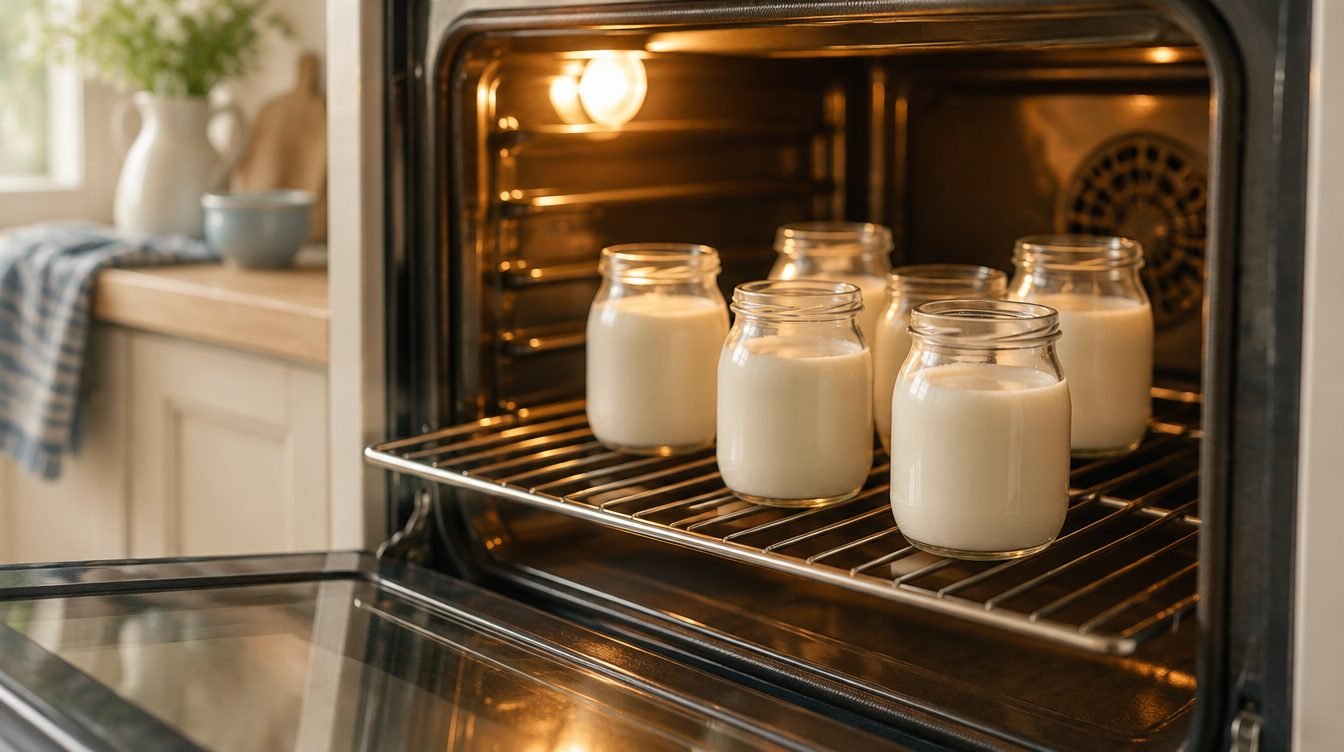
| Oven, water bath | Jars in deep pans of 110°F (43°C) water at least halfway up, oven at its lowest setting (UAF). | Read the water, not the dial. |
| Oven, preheated then off | Preheat to 200°F (93°C), switch off, then on briefly to stay around 100°F (38°C) (Illinois); a gas pilot light may hold it (Washington State University (WSU) Extension). | Easy to overheat; time each burst. |
| Oven light only | A UC Master Food Preservers handout suggests the light for extra heat but gives no temperature. | Test it with a pan of 110°F (43°C) water for two hours first. |
| Insulated cooler | Prewarmed; jars stand in 110–120°F (43–49°C) water (UAF, Illinois), and UAF says an incubator should maintain 110°F (43°C). | Loses heat; check every 1 to 2 hours. |
| Thermos | Prewarmed with boiling water, filled with milk at 110–115°F (43–46°C) (UAF). | Chill the yogurt in another container; rapid cooling stops acid development (UAF). |
| Slow cooker, off | An insulated bath of water at about 120°F (49°C) (Illinois). | Cooking settings run 170–280°F (77–138°C) (Clemson Extension). |
UAF also lists a heating pad. Full setups are in How to Make Yogurt without a Yogurt Maker. If you make yogurt often, an appliance with an adjustable thermostat saves most of the checking.
Ingredients for 1 quart
- 1 quart (about 950 mL) pasteurized milk, heated, then cooled to 108–115°F (42–46°C) (Illinois). Ultimate Health Solutions recommends whole milk or half-and-half; it says half-and-half sets thickest without straining.
- 2 tablespoons to 1/4 cup (30–60 mL) plain yogurt with live cultures (2 tablespoons in Illinois’s recipe, 1/4 cup in UAF’s), or a starter packet used as directed.
- Water for a water bath, enough to reach at least halfway up the jars (UAF), plus hot water for top-ups.
How to incubate yogurt, step by step
- Check your thermometer. In stirred crushed ice and water, with the stem at least 2 inches deep for at least 30 seconds, it should read 32°F (0°C) (University of Maryland Extension).
- Prewarm the incubator to 110°F (43°C) while the milk cools. Start the appliance, warm a cooler with almost-boiling water (UAF), or preheat the oven to 200°F (93°C) and switch it off (Illinois). Test any new setup with a jar of water for an hour or two first; it should stay at 105–115°F (41–46°C).
- Add the starter at 108–115°F (42–46°C), never hotter. Culture added to milk over 115°F (46°C) can be killed (UAF). Stir it into about 1 cup of the warm milk, then stir that back into the rest (Illinois).
- Fill warm jars right away and cover them. UAF says to pour immediately into clean, warm containers and cover them; Illinois links uncovered jars to off-flavors and thin yogurt. Ultimate Health Solutions recommends 1/2 inch of headspace per jar.
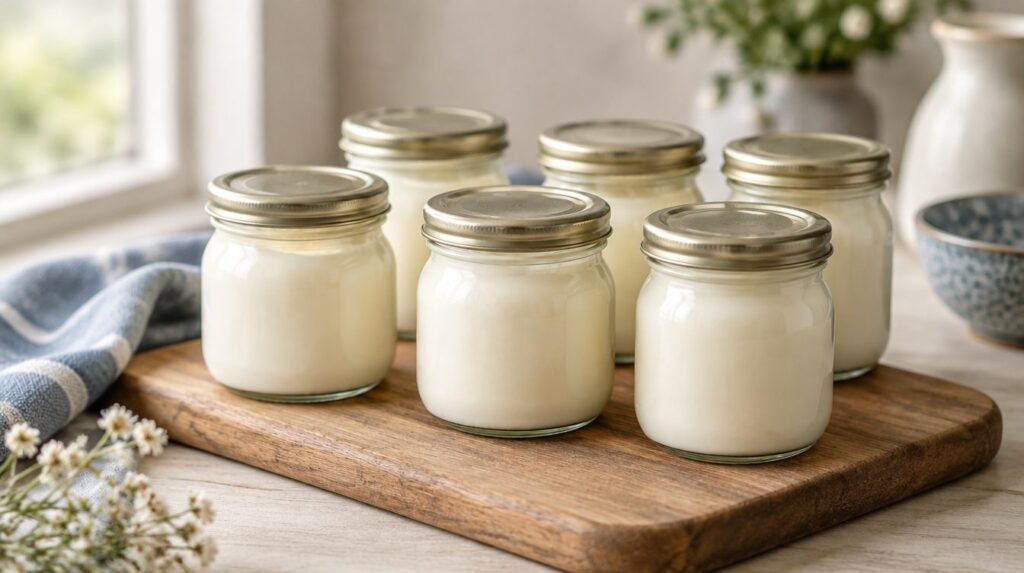
- Load the incubator and set it to 110°F (43°C). Bath water should reach at least halfway up the jars (UAF); University of Kentucky Extension brings it level with the milk, as Ultimate Health Solutions does for water-bath yogurt makers (about 1/2 inch from the top). Put the stand-in jar beside the yogurt.
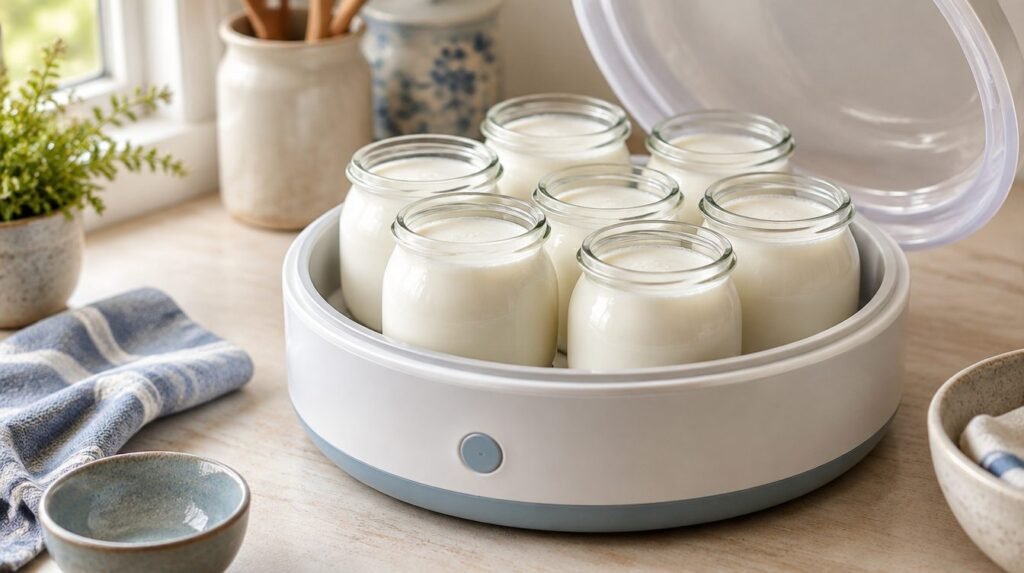
- Hold 105–115°F (41–46°C) and leave the jars still. Agitating yogurt while it sets can cause excess whey (UAF). Without a heater, read the stand-in jar every 1 to 2 hours. Below 105°F (41°C), add hot water down the side or switch the oven on briefly; above 115°F (46°C), turn the heat off. Never let it approach 130°F (54°C).
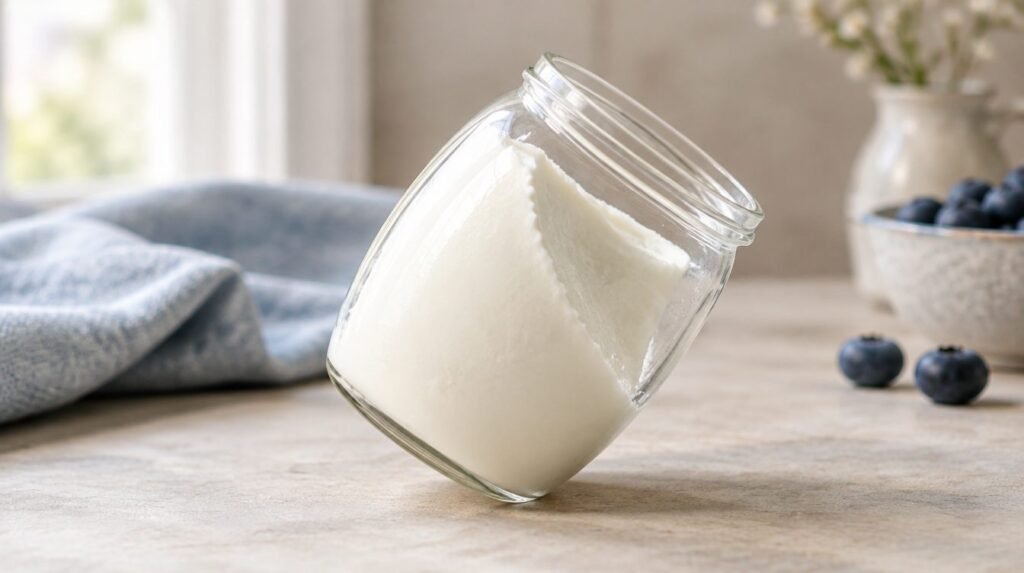
- Check for a set from 4 hours. UAF and the NCHFP give 4 to 7 hours; an NCHFP test batch reached pH 4.6, the acidity at which yogurt sets, at about 5 hours and was firm at 6. Tilt one jar gently: it is ready when it holds together as a jelly-like gel (WSU). If it still pours like milk, check again in 1 to 2 hours; Illinois allows up to 10 hours. Ultimate Health Solutions uses 8 hours.
- Chill it as soon as it sets, in a refrigerator at 40°F (4°C) or below (Illinois). Rapid cooling stops acid development (UAF); dairies end fermentation the same way, by cooling to about 39°F (4°C) (Sfakianakis and Tzia). Wait several hours before stirring: Kentucky notes the milk keeps coagulating as it cools.
What goes wrong during incubation, and how to fix it
University of Kentucky Extension traces grainy texture and “wheying off” to excessive or uneven incubation temperatures, slow cooling or careless handling of the gel.
It got too hot
The milk never sets, or sets grainy with a lot of whey. Above 130°F (54°C) the cultures can be killed (UAF), and even within the working range warmer isn’t better: a USDA-funded University of Wisconsin project found gels made at 115°F (46°C) were less stiff and lost more whey than gels made at 104°F (40°C) (USDA NIFA). Watch for an oven left on or starter added to milk over 115°F (46°C), and discard a batch that never sets (UAF).
It was too cold
The milk is still runny at the end of the usual window. Standard cultures grow poorly below 98°F (37°C) (UAF). A cooler loses heat faster in a cold room, which is why WSU says to incubate yogurt in a warm place. If you catch it during incubation, bring the bath back to 110°F (43°C). Don’t extend the time indefinitely, though: UAF says a batch that fails to set may signal a bad culture or unwanted microorganisms, so throw it out.
It was moved or stirred while setting
Expect a broken curd and pools of whey (UAF). Set up where nothing will be bumped and read the stand-in jar, not the yogurt. If it smells clean, the yogurt is still usable; NDSU Extension says the separated liquid can be stirred back in.
It incubated too long
Extra hours after it sets produce more acid, a tarter flavor and eventually separated whey (UAF). Ultimate Health Solutions’ guide also reads curds and whey as over-fermentation and suggests shortening the time or checking the temperature. Start checking earlier next time.
The temperature was right, but it still failed
Look at the starter and the equipment. UAF lists a starter that is contaminated, of poor quality or killed by milk that was still too hot, and WSU adds that detergent residue can stop the culture working.
It smells off or grows mold
Throw it out. UAF says to discard yogurt with visible growth or any odor other than an acidic one, and FSIS says moldy yogurt can be contaminated below the surface. Ultimate Health Solutions likewise says never to eat homemade yogurt that smells or looks off.
Frequently asked questions
What temperature should you incubate yogurt at?
About 110°F (43°C), within 105–115°F (41–46°C), according to UAF Extension and the NCHFP. The cultures can be killed above 130°F (54°C) and grow poorly below 98°F (37°C).
Can you incubate yogurt overnight?
Yes, if the temperature holds steady: Illinois Extension allows 6 to 10 hours and the University of Guam 6 to 12. Hours after it sets make it tarter and can push out whey (UAF), so chill it first thing.
Can you open the incubator to check on the yogurt?
Briefly, to read the temperature or tilt one jar near the end. Don’t stir, shake or carry the jars, because agitation while yogurt sets causes excess whey (UAF).
Does yogurt thicken more in the refrigerator?
Somewhat: University of Kentucky Extension notes that it keeps coagulating as it cools, so judge the texture after several hours of chilling.
More on homemade yogurt
- How Long to Incubate Yogurt? The Complete Answer: how time changes texture and tang.
- Yogurt Temperature: What You Need to Know: every temperature from heating the milk to storage.
- How to Make Yogurt without a Yogurt Maker: A Step-by-Step Guide: the cooler method in full.
- How to Make Greek Yogurt: A Step-by-Step Guide: strain a finished batch until thick.
- How Long Does Homemade Yogurt Last? The Complete Answer: storage times and spoilage signs.
Sources
- Cascio J, Dinstel RR. Making Yogurt at Home (FNH-00062). University of Alaska Fairbanks Cooperative Extension Service.
- University of Illinois Extension. Making Yogurt at Home (Best Practice Guide, 2024).
- Nummer BA. Fermenting Yogurt at Home. National Center for Home Food Preservation, 2002 (reprint hosted by UC Davis).
- Yang J. Making Yogurt at Home (FP-01). University of Guam Cooperative Extension, 2016.
- Smith DK. Yogurt Made Simple. Washington State University Extension (copy distributed by the UC Master Food Preserver Program).
- Russell-Campbell E, Hicks CL, Maruyama FT. Making Yogurt at Home (IP-36). University of Kentucky Cooperative Extension Service.
- UC Cooperative Extension Master Food Preservers of Amador/Calaveras Counties. Fermentation 101 (handout, February 2023). University of California Agriculture and Natural Resources.
- Sfakianakis P, Tzia C. Conventional and innovative processing of milk for yogurt manufacture; development of texture and flavor: a review. Foods. 2014;3(1):176–193.
- Food and Agriculture Organization of the United Nations. Small-Scale Dairy Farming Manual, Technology Unit 10.1: Starter Cultures (1993).
- USDA National Institute of Food and Agriculture. Understanding the structure-function relationships that control the rheological and sensory properties of stirred-type yogurt (CRIS project, University of Wisconsin).
- Electronic Code of Federal Regulations. 21 CFR 131.200, Yogurt. National Archives.
- USDA Food Safety and Inspection Service. How Temperatures Affect Food.
- USDA Food Safety and Inspection Service. Types of Food Thermometers (Thermy campaign).
- USDA Food Safety and Inspection Service. Molds on Food: Are They Dangerous?
- University of Maryland Extension. How to Use and Calibrate Your Food Thermometer (FS-1092), copy hosted by UC ANR.
- Hoyle EH. Slow Cooker Food Safety (HGIC 3585). Clemson Cooperative Extension, Home & Garden Information Center, updated 2022.
- NDSU Extension. How Long Can You Keep Yogurt? Food Wise, September 2016.
- Instant Brands. Instant Pot Pro Plus 5.7L Multi-Cooker User Manual, 2026 (appliance description only).
- The Ultimate Yogurt Guide (eBook), Ultimate Health Solutions, publisher of this site