Sourcing Live Cultures: Capsules, Sachets and Heirloom Starters Compared
What the table shows
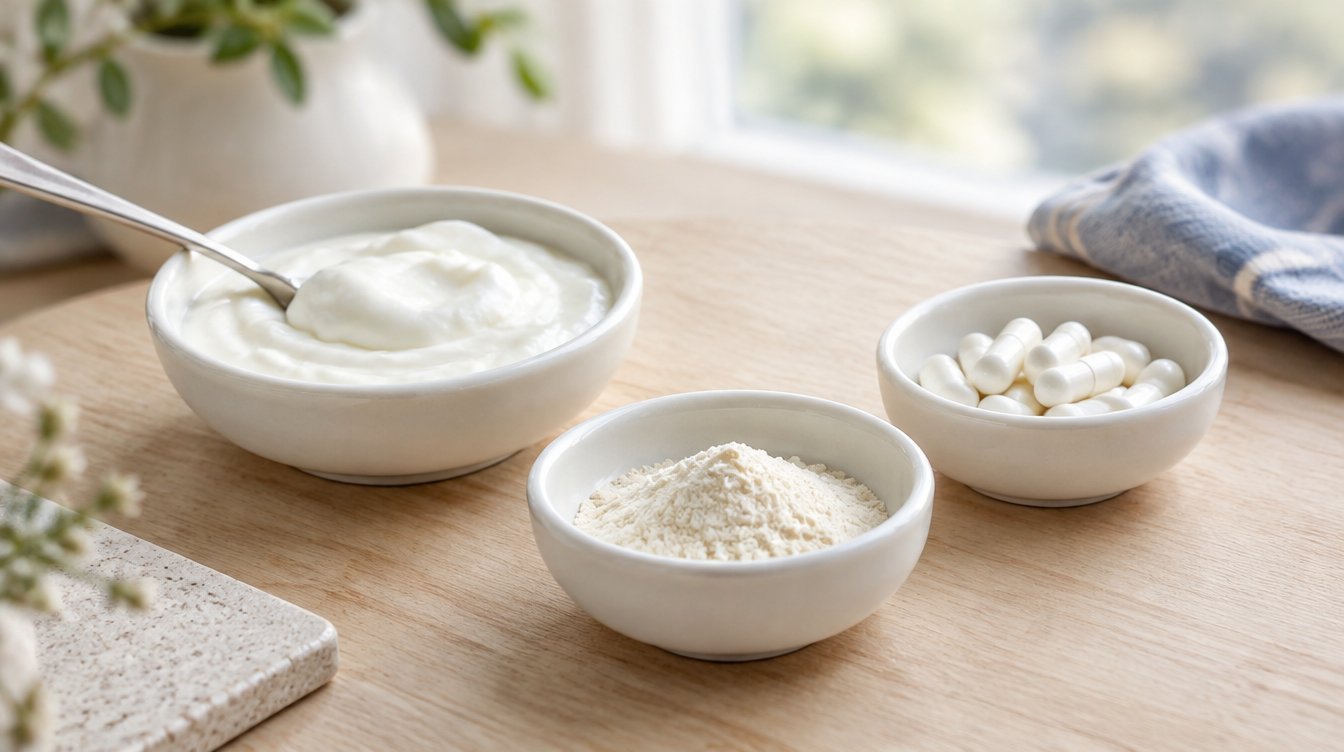
Sourcing live cultures for homemade yogurt comes down to five options: a cup of store-bought yogurt, a spoonful from your last batch, a freeze-dried starter packet, a reusable heirloom starter, or a probiotic capsule. Each one differs in what it contains, how its live count is stated, how it should be stored and how many batches it will carry. The table compares them on those points, using extension service guidance, federal rules and published lab studies.
No product brands are compared here. The goal is to help you pick a format, then read any label with the right questions in mind.
Live culture sources compared
| Source | What it contains | How the live count is stated | Storage | Reuse | Main watch-out |
|---|---|---|---|---|---|
| Store-bought plain yogurt | Yogurt by law is cultured with L. bulgaricus and S. thermophilus (21 CFR 131.200); some add other strains | Optional claim of 10 million CFU/g at manufacture (FDA) or seal of 100 million CFU/g at manufacture (IDFA) | Refrigerated; use before the best-by date | Save some of each batch (Illinois Extension) | Heat-treated yogurt carries no live cultures |
| Your last batch | Whatever cultures took hold in that batch | None; you cannot know the count | Sealed, in the fridge | Use within 5 to 7 days of making it (Illinois Extension) | Quality can drift; start fresh when it does (UAF Extension) |
| Freeze-dried starter packet | Dried yogurt cultures, sometimes with added strains | Per the packet; generally one 5 g package per quart (UAF Extension) | Per the package | Per the maker’s directions | Follow the maker’s instructions (Illinois Extension) |
| Heirloom (reusable) starter | A culture meant to be kept going batch after batch | Depends on the seller | Fridge between batches | Designed for repeated reuse | Contamination, including phages, can spoil a ferment (Garneau and Moineau, 2011) |
| Probiotic capsule | Specific named strains; may not include the two yogurt species | CFU at manufacture or through expiration, depending on the product (NIH ODS) | Cold storage preserved counts best in a 12-month study (Brousilova et al., 2026) | Varies by strain | Label counts and contents are not always accurate (Taha et al., 2025; NCCIH) |
How each source behaves

Store-bought yogurt
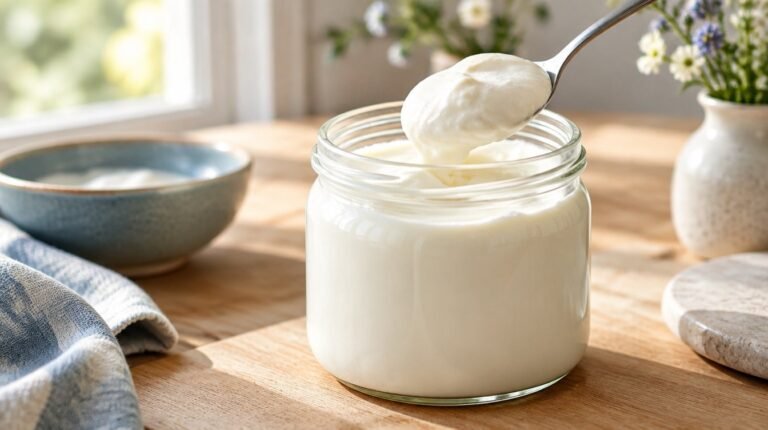
This is the cheapest and most widely available starter. The University of Illinois Extension recipe uses 2 tablespoons of plain yogurt with live cultures for 1 quart of milk, and says to use it before the “best by” or “sell by” date because fresher starter has more active bacteria. Its warning is blunt: starter cultures with dead bacteria will not make yogurt (Illinois Extension). Under federal rules, yogurt treated after culturing to kill its bacteria must say “does not contain live and active cultures” (21 CFR 131.200), so check the label.
A spoonful from your last batch
Re-culturing is free, and it is how most home yogurt makers keep going. Alaska Extension suggests saving about 1/4 cup per quart batch, keeping it sealed in the fridge, and buying a fresh culture if the yogurt starts to taste or smell off (UAF Extension). Neither extension guide gives a maximum number of rounds. If your batches get thinner or slower, our guide to a starter that weakened over time walks through the likely causes.
Freeze-dried starter packets
Dried cultures are sold in health food stores and online, and they are generally used at one 5-gram package per quart of milk (UAF Extension). They suit people who want a known culture and a fresh start each time. Because products differ, both extension guides say to follow the maker’s directions on temperature, time and whether the packet can be re-cultured.
Heirloom starters
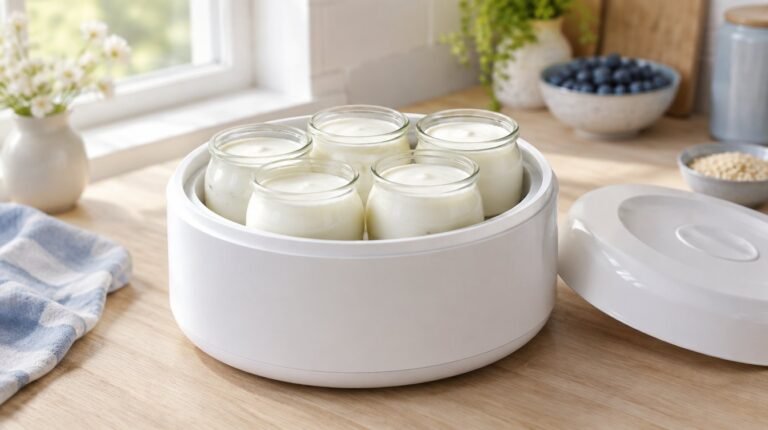
An heirloom starter is a culture sold or passed on with the idea that you keep it alive indefinitely. Some are warm-incubated like standard yogurt; others set at room temperature, closer to the cultures in our Lactococcus lactis guide. The trade-off is upkeep. You need to re-culture on a schedule, and every transfer is a chance for unwanted microbes to get in. In the dairy industry, bacteriophages, viruses that infect lactic acid bacteria, are the primary cause of fermentation failure (Garneau and Moineau, 2011). Clean jars and utensils help reduce that risk at home.
Probiotic capsules
Capsules let you culture a specific named strain, such as those in our Lactobacillus reuteri guide, which yogurt cultures alone do not offer. Strictly speaking, a ferment made without the two yogurt species is a cultured milk, not yogurt under the federal standard (21 CFR 131.200).
Read the label closely. Some products list CFU at the time of manufacture and others through the expiration date (NIH ODS). In a 12-month Czech study of commercial multi-strain supplements, counts held up best in the fridge or freezer, and some products fell short of their declared values whatever the storage (Brousilova et al., 2026). A UK study of five human probiotic products found one with no detectable live bacteria (Taha et al., 2025). NCCIH notes that some probiotic products have contained microbes not listed on the label (NCCIH).
Capsules are dietary supplements, and by law the FDA does not approve dietary supplements before they are marketed (FDA). NCCIH says the risk of harmful effects is greater for people with severe illnesses or weakened immune systems, so they should talk with a doctor first (NCCIH).
How to read the table
- Pick by goal. For plain, reliable yogurt, store-bought yogurt or a packet is enough. For a specific strain, a capsule is the only route, with the label caveats above.
- Check how the count is stated. “At manufacture” tells you less than “through expiration.”
- Freshness beats size. A fresh, lively starter matters more than a bigger dose; see CFU counts in homemade vs store-bought yogurt for the arithmetic.
- Match the temperature to the culture. Standard yogurt cultures incubate at about 108 to 115°F (Illinois Extension); other strains differ, as our incubation temperature reference shows.
Methodology and sources note
We did not buy, test or count any cultures. The table summarizes federal labeling rules, two university extension guides and published lab studies. Survey work shows live counts in fermented foods vary widely with how products are made and stored (Rezac et al., 2018), so treat each row as a typical pattern, not a measurement of any particular product. Heirloom starters have little published research, which is why that row leans on general dairy microbiology.
Related topics
- Yogurt Starter: what a starter is and how it works.
- How to Make Yogurt Starter: keeping your own culture going.
- How to Make Yogurt Without Starter: why it rarely works and what to try.
- Storage, Shelf Life and Re-culturing: how long a batch and its starter keep.
- Does All Yogurt Have Probiotics?: yogurt cultures versus probiotic strains.
Sources
- 21 CFR 131.200 Yogurt (Electronic Code of Federal Regulations, US FDA)
- Live & Active Cultures Seal (International Dairy Foods Association)
- Making Yogurt at Home (University of Illinois Extension)
- Making Yogurt (University of Alaska Fairbanks Cooperative Extension Service)
- Probiotics: Fact Sheet for Consumers (NIH Office of Dietary Supplements)
- Probiotics: Usefulness and Safety (National Center for Complementary and Integrative Health)
- Questions and Answers on Dietary Supplements (US Food and Drug Administration)
- Brousilova T, et al. Storage temperature as a determinant of probiotic long-term stability in commercial dietary supplements (Frontiers in Nutrition, 2026)
- Taha MW, et al. Assessing Bacterial Viability and Label Accuracy in Human and Poultry Probiotics Sold in the United Kingdom (Microorganisms, 2025)
- Garneau JE, Moineau S. Bacteriophages of lactic acid bacteria and their impact on milk fermentations (Microbial Cell Factories, 2011)
- Rezac S, et al. Fermented Foods as a Dietary Source of Live Organisms (Frontiers in Microbiology, 2018)