CFU Counts in Homemade vs Store-Bought Yogurt: The Arithmetic
What the table shows
A CFU (colony-forming unit) is a count of live bacteria that can grow into a colony on a lab plate. Yogurt counts are given per gram, which makes them hard to picture. This page turns those per-gram figures into totals for a real serving, using USDA’s weight of 245 grams for 1 cup of plain whole-milk yogurt and 170 grams for a 6-ounce container (USDA FoodData Central).
The short version: a cup of fresh, live yogurt, homemade or store-bought, usually carries billions to hundreds of billions of live cultures. The biggest differences come from heat treatment, age and storage, not from where the yogurt was made.
CFU per serving, from label rules to lab counts
| Yogurt and stage | Live cultures per gram | Per 1 cup (245 g) | Per 6 oz (170 g) | Source for the per-gram figure |
|---|---|---|---|---|
| US “contains live and active cultures” claim, minimum at manufacture | 10 million (107) | 2.45 billion | 1.7 billion | 21 CFR 131.200 |
| Same claim, expected level through shelf life | 1 million (106) | 245 million | 170 million | 21 CFR 131.200 |
| Live & Active Cultures seal, minimum at manufacture | 100 million (108) | 24.5 billion | 17 billion | IDFA |
| Retail yogurts in published surveys | Under 10,000 to 1 billion (104 to 109) | Under 2.5 million to 245 billion | Under 1.7 million to 170 billion | Rezac et al., 2018 |
| Yogurt heat-treated after culturing | Labeled “does not contain live and active cultures” | Not a live source | Not a live source | 21 CFR 131.200 |
| Homemade, freshly set (typical published range for fresh yogurt) | About 100 million to 1 billion (108 to 109) | About 24.5 to 245 billion | About 17 to 170 billion | Rezac et al.; Hamann and Marth, 1984 |
One real-world check: when pediatric researchers in West Virginia plated 10 commercial yogurts on a Lactobacillus-selective medium, they counted 4.8 billion to 95 billion CFU per 100 mL serving (Dunlap et al., 2009). That sits inside the range above.
The homemade arithmetic
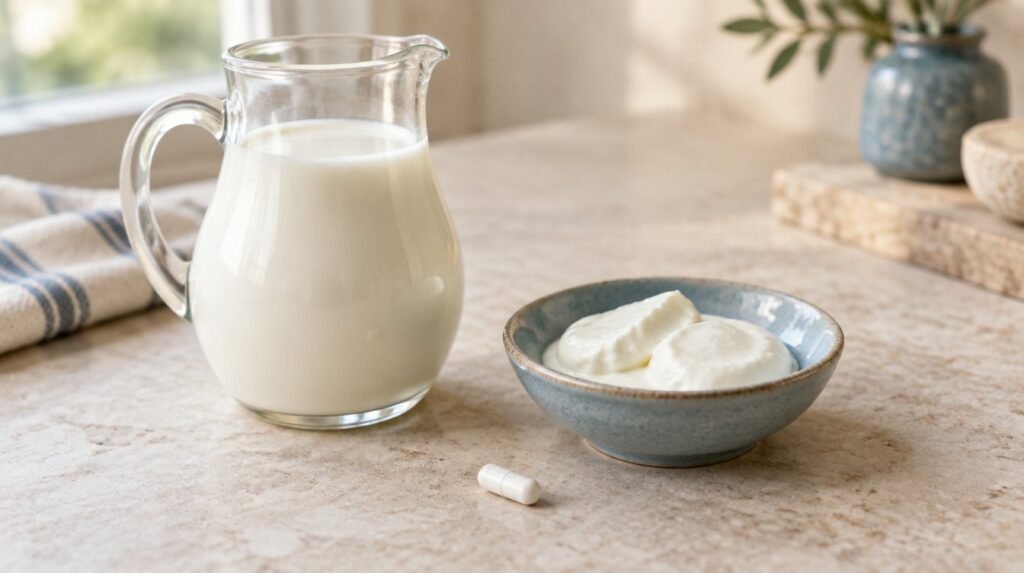
Homemade yogurt starts with far fewer bacteria than it ends with. The University of Illinois Extension recipe uses 2 tablespoons of plain yogurt with live cultures for 1 quart of milk (Illinois Extension). Using USDA weights, 2 tablespoons is about 31 grams of yogurt and a quart of whole milk weighs 976 grams (USDA; USDA).
| Starter added to 1 quart of milk | Live cells added (approx.) | Starting count per gram of milk |
|---|---|---|
| 2 tbsp yogurt at 100 million CFU/g | 3.1 billion | About 3 million |
| 2 tbsp yogurt at 10 million CFU/g (older or less lively starter) | 310 million | About 300,000 |
| One capsule labeled 10 billion CFU | 10 billion, if the label count holds | About 10 million |
| One dry starter packet (about 5 g per quart, per Alaska Extension) | Whatever the packet states, if it gives a count | Varies |
The packet row comes from the University of Alaska Fairbanks Cooperative Extension, which notes dry cultures are generally used at one 5-gram package per quart (UAF Extension).
During incubation the cultures multiply until the acid they make slows them down. Going from about 3 million per gram to a fresh-yogurt level of 100 million to 1 billion per gram is a 30- to 300-fold rise, roughly 5 to 8 doublings. If two batches finish in that same range, a capsule’s bigger starting dose does not give a tenfold richer yogurt. It mostly gives the bacteria a head start. Our guide to how much starter to use for a gallon of milk covers the practical side.
How storage changes the numbers
Counts do not stay fixed. In a University of Wisconsin study, yogurt cultures typically rose just after manufacture and then fell during refrigerated storage. Lab-made plain yogurts kept both yogurt species above 100 million per gram for 60 days at 5°C (41°F). In some commercial stirred yogurts, Lactobacillus bulgaricus fell below 1 million per gram after 25 to 32 days, while Streptococcus thermophilus held up better. Warmer storage at 10°C (50°F) caused bigger drops (Hamann and Marth, 1984).
For homemade yogurt, Illinois Extension advises refrigerating at 40°F or lower and eating it within 14 days (Illinois Extension). That window falls well inside the period where counts in the Wisconsin study stayed high. See how long homemade yogurt lasts for food-safety details.
How to read these numbers
- “At manufacture” is not “when you eat it.” Both the FDA claim and the industry seal set their main minimum at the time of manufacture. A cup at the end of its shelf life can hold far fewer.
- Most counts are yogurt cultures, not probiotics. The two required yogurt species usually make up most of the total. In the surveys Rezac and colleagues reviewed, added Lactobacillus and Bifidobacterium ranged from undetectable to about 100 million per gram.
- More is not automatically better. The NIH Office of Dietary Supplements notes that higher CFU counts alone do not necessarily mean greater health benefits; the strain matters too (NIH ODS).
- Homemade yogurt has no label. Without a lab, you cannot know your batch’s count. A firm set, tang and a sour smell show the culture worked; see how to verify your yogurt cultured.
Methodology and limits
We did not measure any yogurt. Per-gram figures are regulatory minimums or ranges reported in published studies, and the per-serving columns are simple multiplication using USDA serving weights. Retail survey data come from many countries and decades, and most samples were counted only once, so real products can fall outside these ranges.
We found no published counts for long, single-strain home ferments, such as 24- to 36-hour batches made from probiotic capsules. The homemade row reflects published data for fresh yogurt made with standard yogurt cultures. Treat it as a reasonable estimate, not a guarantee, and see fermentation time by culture for how long different cultures need.
Related topics
- How to Make Yogurt at Home: the basic method behind the homemade numbers.
- Does All Yogurt Have Probiotics?: the difference between yogurt cultures and probiotic strains.
- Sourcing Live Cultures: capsules, sachets and heirloom starters compared.
- Probiotic vs Yogurt: how a serving of yogurt compares with a supplement.
- Storage, Shelf Life and Re-culturing: keeping a batch and its starter at their best.
Sources
- 21 CFR 131.200 Yogurt (Electronic Code of Federal Regulations, US FDA)
- Live & Active Cultures Seal (International Dairy Foods Association)
- Yogurt, plain, whole milk (FDC 171284) (USDA FoodData Central)
- Milk, whole, 3.25% milkfat, with added vitamin D (FDC 171265) (USDA FoodData Central)
- Rezac S, et al. Fermented Foods as a Dietary Source of Live Organisms (Frontiers in Microbiology, 2018)
- Hamann WT, Marth EH. Survival of Streptococcus thermophilus and Lactobacillus bulgaricus in Commercial and Experimental Yogurts (Journal of Food Protection, 1984)
- Dunlap BS, et al. The probiotic content of commercial yogurts in West Virginia (Clinical Pediatrics, 2009)
- Making Yogurt at Home (University of Illinois Extension)
- Making Yogurt (University of Alaska Fairbanks Cooperative Extension Service)
- Probiotics: Fact Sheet for Consumers (NIH Office of Dietary Supplements)