Lactococcus lactis: How to Culture It at Home (72-77°F / 12h)
What Lactococcus lactis is
Lactococcus lactis is a small, round lactic acid bacterium that sours milk at room temperature. It is the most commonly used cheese starter in the world and the best-studied lactic acid bacterium in the lab (Bolotin et al., Genome Research, 2001). Cheddar, buttermilk, sour cream and many Nordic cultured milks start with it or its close cousin, Lactococcus cremoris.
Unlike yogurt bacteria, it likes it cool. Fermented milks fall into two broad groups: thermophilic sour milks fermented at 42 to 45°C (108 to 113°F), and mesophilic sour milks fermented at 20 to 30°C (68 to 86°F) (Rampanti et al., Foods, 2024). L. lactis belongs to the second group, which is why this guide uses 72 to 77°F (22 to 25°C) on the kitchen counter instead of a warm incubator.
One point on names. A “Lactococcus lactis yogurt” is not yogurt in the legal sense, since the FDA standard for yogurt requires L. bulgaricus and Streptococcus thermophilus (21 CFR 131.200). What you make with L. lactis is a cultured milk. The FDA standard for cultured milk sets a minimum acidity of 0.5 percent, measured as lactic acid, and lets the product be called cultured buttermilk when certain flavor cultures and ingredients are used (21 CFR 131.112). At home it sets into a soft, spoonable, mildly sour milk, a little like thin yogurt or Nordic viili.
Where it sits in the family tree
The table follows the NCBI Taxonomy database. L. lactis belongs to the family Streptococcaceae, alongside Streptococcus, and its older name was Streptococcus lactis. In 2021 researchers moved the cream-souring subspecies, long labeled L. lactis subsp. cremoris, into its own species, Lactococcus cremoris, based on DNA comparisons (Li et al., International Journal of Systematic and Evolutionary Microbiology, 2021). NCBI now lists it that way (NCBI Taxonomy), but many culture packets still use the old subspecies names.
| Domain | Phylum | Genus | Species | Strain |
|---|---|---|---|---|
| Bacteria | Bacillota (formerly Firmicutes) | Lactococcus | L. lactis (subsp. lactis); L. cremoris is now separate | Many; IL1403 and MG1363 are lab strains, and “Plasma” has been tested in human trials |
The genome of lab strain IL1403 has about 2.37 million DNA letters and codes for 2,310 proteins, including genes for several fermentation pathways and even aerobic respiration (Bolotin et al., 2001).
What the research says
From plants to milk
L. lactis is widely thought to have evolved from plant-dwelling strains. Its move into milk came with gene loss and with genes for using lactose and milk protein picked up from other bacteria (Cavanagh et al., Food Microbiology, 2015). That is why dairy strains sour milk quickly, while strains from plants often grow poorly in it.
Traditional cultured milks still carry these bacteria. In a study of four natural viili starters, a Finnish ropy fermented milk, L. lactis was the dominant species, followed by several Enterococcus species and L. cremoris. The researchers reactivated the starters by adding them to milk at 5 percent and holding them at 25°C (77°F) for 20 hours (Rampanti et al., 2024).
Nisin, a natural preservative
Some strains make nisin, a small antimicrobial protein. U.S. regulations describe nisin preparation as coming from pure culture fermentations of certain strains of Streptococcus lactis, the old name for L. lactis, and affirm it as safe for use in pasteurized cheese spreads to stop Clostridium botulinum spores from growing, at up to 250 parts per million (21 CFR 184.1538). Not every strain makes nisin, and a home culture gives you no control over it.
Does it survive digestion?
Mostly not. In a small study, groups of six volunteers ate 150 g of fermented milk containing one of three bacteria, and researchers sampled fluid from the end of the small intestine. Only about 1 percent of the L. lactis strain MG1363 survived that far, it was gone within about 4 hours, and none of the strains settled in the gut (Vesa et al., Alimentary Pharmacology and Therapeutics, 2000). Think of L. lactis as a food culture, not a gut colonizer.
Human studies on specific strains
The most human data come from one named strain called Plasma. A pooled analysis of eight randomized trials with 619 healthy adults found it kept certain immune-cell markers more active than placebo. In 555 participants, it was linked with fewer days of cough (about 0.7 fewer per 28 days) and feverishness (about 0.3 fewer days) (Kato et al., Frontiers in Immunology, 2025). The differences were small, and three of the six authors were employees of Kirin Holdings.
L. lactis is also a tool in drug research. In a first safety trial, 10 people with Crohn’s disease took a genetically modified strain built to release the anti-inflammatory protein interleukin-10 in the gut. Side effects were minor, but the trial had no placebo group (Braat et al., Clinical Gastroenterology and Hepatology, 2006). That engineered strain has nothing to do with a cultured milk on your counter.
Safety
L. lactis has a long record of safe use in food. A 2023 review notes, though, that disease-causing strains have occasionally been found in clinical cases, including blood and urine samples from human patients with endocarditis, and in cows with mastitis (Wu et al., World Journal of Microbiology and Biotechnology, 2023). These cases are rare. As with any live culture, people who are seriously ill or have weakened immune systems face more risk from probiotics (NCCIH), so if you are immunocompromised, pregnant or have a central line, check with your doctor before using probiotic products. Probiotic supplements are not approved by the FDA for safety or effectiveness before sale (FDA).
How to culture Lactococcus lactis at home
You need a mesophilic starter that lists L. lactis, L. cremoris or the older subspecies names. Packets sold for buttermilk, sour cream, viili or filmjölk usually contain them, sometimes with aroma bacteria. A few tablespoons of a cultured milk whose label lists live cultures can also work. The heating step follows the University of Alaska Fairbanks Cooperative Extension Service; the cool culturing step is adapted for this mesophilic culture. Our yogurt starter guide explains culture types.
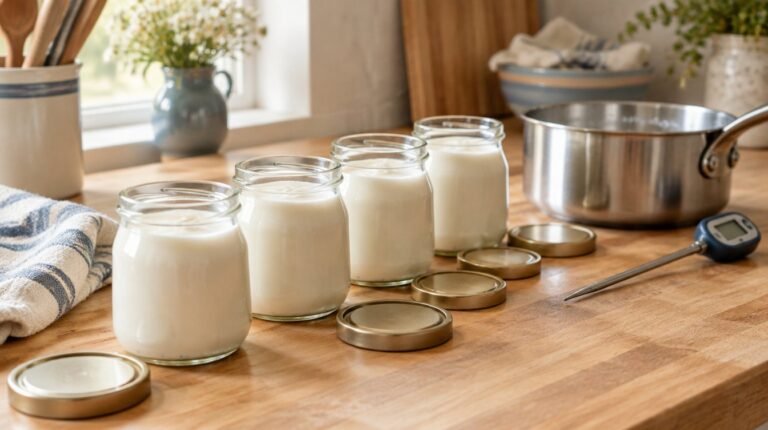
You will need: 1 quart of pasteurized whole milk, a mesophilic starter (packet, or 3 tablespoons of active cultured milk), a heavy pot, an instant-read thermometer, clean jars and a spot in the kitchen that stays between 72 and 77°F.
- Clean everything. Wash the pot, whisk, thermometer and jars in hot, soapy water and rinse well.
- Heat the milk to 185°F (85°C) and hold it for 10 minutes. Warm it gently without boiling (UAF Extension). This gives a thicker set. Stir often so the bottom does not scorch.
- Cool to 77°F (25°C). Use a cold-water bath with ice and stir. This takes longer than cooling for yogurt, so be patient. Adding culture to hot milk can damage it.
- Add the starter. Stir the packet amount, or 3 tablespoons of active cultured milk per quart (about 5 percent, the rate used in the viili study above), into a cup of the milk, then mix it back in.
- Pour into jars and cover loosely. A lid set on top or a cloth secured with a band is fine.
- Culture at 72 to 77°F (22 to 25°C) for 12 hours. Keep the jars on the counter, out of direct sun and away from the stove. No yogurt maker is needed; the tips in how to make yogurt without a yogurt maker for finding a steady spot still apply. Avoid anything above about 86°F.
- Check at 12 hours. Tilt a jar. If the milk moves as one soft mass and pulls from the side, it is done. In a cool kitchen it may need 18 to 24 hours.
- Chill. Refrigerate at 40°F (4°C) or colder. It firms up as it cools.
- Save some for next time. Keep 3 tablespoons from a fresh batch to start the next one. If batches slowly weaken, see heirloom starter weakened over time.
Why not warmer? Even 37.5°C (99.5°F) is a stress temperature for this organism: in one lab study, growing strain MG1363 at that temperature led to spontaneous mutations that changed how well it handled heat and salt (Smith et al., Applied and Environmental Microbiology, 2012). A yogurt maker set to yogurt temperatures can weaken a mesophilic culture over time. For how temperature shapes different cultures, see yogurt temperature.
How to tell it worked
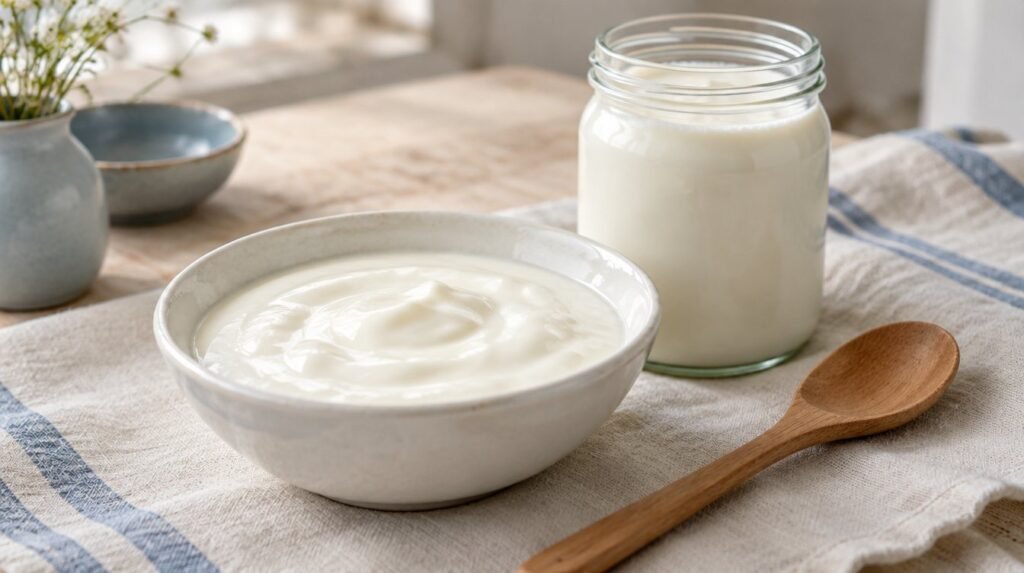
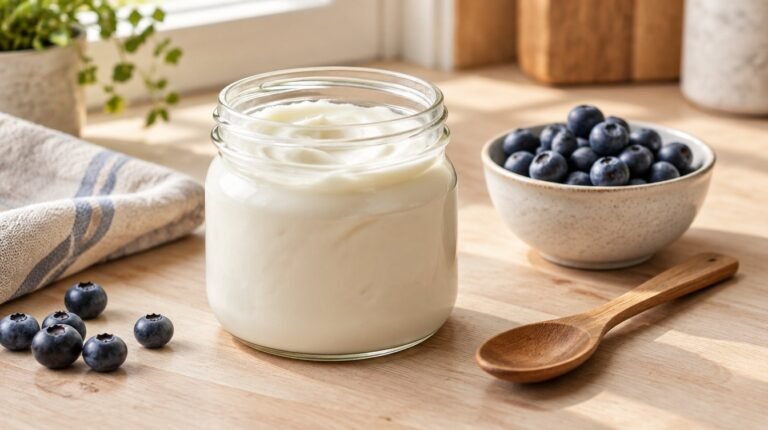
- It sets softly. Expect a texture between thick buttermilk and loose yogurt. Some strains make it ropy or stretchy, which is normal for viili-type cultures.
- It is clearly sour. Food-grade pH strips should read 4.6 or lower, the set point used for yogurt in the UAF guide. Commercial cultured milk must reach at least 0.5 percent acidity (21 CFR 131.112), but home kits rarely measure that.
- It smells clean. Fresh, mildly sour, sometimes buttery if the culture includes aroma bacteria. Yeasty, cheesy-rotten or sharp alcohol smells are not normal.
- Know the limits. A good set shows that acid bacteria grew. It does not tell you which species did the work or in what numbers; only a lab test can.
Common problems and fixes
| Problem | Likely cause | Fix |
|---|---|---|
| Still liquid at 24 hours | Kitchen below 70°F, or a weak or dead starter | Move to a warmer spot next time or use a fresh packet. Throw out a batch that has not soured by 24 hours. |
| Separated with lots of whey | Too warm, or ran too long | Culture nearer 72°F and check at 12 hours. See whey from yogurt. |
| Thin and runny after chilling | Milk not heated, or low-fat milk | Heat to 185°F for 10 minutes and use whole milk. |
| Each batch slower | Starter drift or stress from heat | Start again from a fresh packet and keep it below 86°F. |
| Bitter taste | Long culturing or strong protein breakdown | Chill sooner, at 12 hours. |
| Fuzzy mold, pink or orange spots | Contamination | Throw it out and start over with clean jars. |
Traditional viili also involves yeast-like fungi (Rampanti et al., 2024), but unless your starter is sold as a viili culture, treat any fuzzy growth as spoilage. The USDA advises throwing out moldy yogurt and sour cream, because soft foods can be contaminated below the surface (USDA FSIS, Molds on Food). Cultured milk is a soft, moist food in the same category. Never taste a batch that smells wrong.
This article is general information about home fermentation and is not medical advice.
Related topics
- Leuconostoc mesenteroides: How to Culture It at Home: another room-temperature culture often paired with lactococci.
- Streptococcus thermophilus: How to Culture It at Home: the warm-loving relative that makes yogurt.
- Fermented Cheese: where L. lactis does most of its work.
- Fermented Drinks: buttermilk, kefir and other cultured drinks.
- Probiotic Foods: which foods carry live cultures.
Sources
- 21 CFR 131.200 Yogurt (U.S. Food and Drug Administration, Electronic Code of Federal Regulations)
- 21 CFR 131.112 Cultured milk (U.S. Food and Drug Administration, Electronic Code of Federal Regulations)
- 21 CFR 184.1538 Nisin preparation (U.S. Food and Drug Administration, Electronic Code of Federal Regulations)
- Making Yogurt at Home (University of Alaska Fairbanks Cooperative Extension Service)
- Lactococcus lactis, Taxonomy Browser (National Center for Biotechnology Information)
- Lactococcus cremoris, Taxonomy Browser (National Center for Biotechnology Information)
- Molds on Food: Are They Dangerous? (USDA Food Safety and Inspection Service)
- Probiotics: What You Need To Know (National Center for Complementary and Integrative Health)
- Dietary Supplements (U.S. Food and Drug Administration)
- Bolotin A, et al. The complete genome sequence of the lactic acid bacterium Lactococcus lactis ssp. lactis IL1403 (Genome Res, 2001)
- Li TT, et al. Elevation of Lactococcus lactis subsp. cremoris to the species level as Lactococcus cremoris sp. nov. and transfer of Lactococcus lactis subsp. tructae to Lactococcus cremoris as Lactococcus cremoris subsp. tructae comb. nov. (Int J Syst Evol Microbiol, 2021)
- Cavanagh D, et al. From field to fermentation: the origins of Lactococcus lactis and its domestication to the dairy environment (Food Microbiol, 2015)
- Rampanti G, et al. Technological and enzymatic characterization of autochthonous lactic acid bacteria isolated from viili natural starters (Foods, 2024)
- Smith WM, et al. Heat resistance and salt hypersensitivity in Lactococcus lactis due to spontaneous mutation of llmg_1816 (gdpP) induced by high-temperature growth (Appl Environ Microbiol, 2012)
- Vesa T, et al. Pharmacokinetics of Lactobacillus plantarum NCIMB 8826, Lactobacillus fermentum KLD, and Lactococcus lactis MG 1363 in the human gastrointestinal tract (Aliment Pharmacol Ther, 2000)
- Kato Y, et al. Lactococcus lactis strain Plasma activates plasmacytoid dendritic cells and mitigates common cold-like symptoms in healthy adults: a meta-analysis of individual participant data (Front Immunol, 2025)
- Braat H, et al. A phase I trial with transgenic bacteria expressing interleukin-10 in Crohn’s disease (Clin Gastroenterol Hepatol, 2006)
- Wu F, et al. Lactococcus lactis, a bacterium with probiotic functions and pathogenicity (World J Microbiol Biotechnol, 2023)