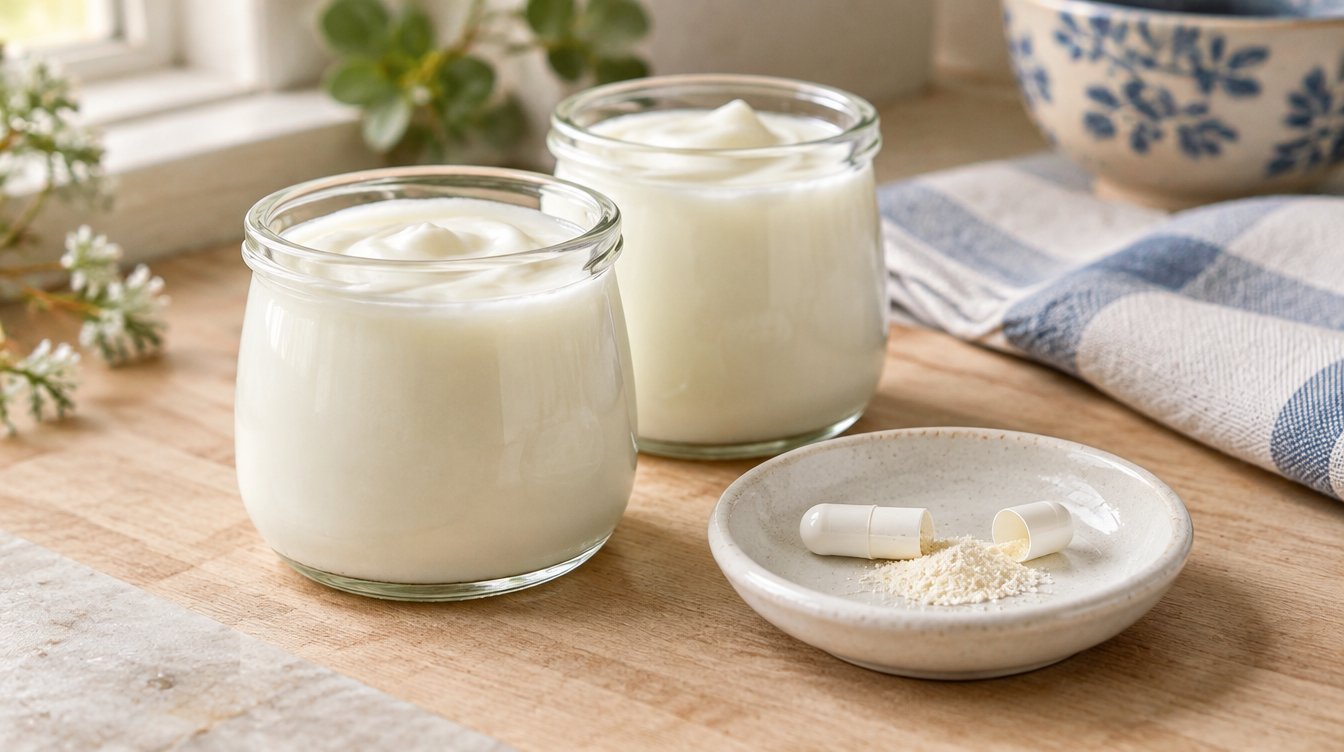
Bacillus coagulans GBI-30: How to Culture It at Home (115-122°F / 36h)
What Bacillus coagulans GBI-30 is
Bacillus coagulans is a lactic acid bacterium with an unusual trick: it forms spores. A spore is a dormant, tough-walled form that survives heat, drying and stomach acid, then “wakes up” when conditions suit it. A 2018 review describes the species as a Gram-positive, spore-forming bacterium that makes lactic acid, grows with or without oxygen, and has an optimum growth range of 35 to 50°C (95 to 122°F) (Konuray and Erginkaya, 2018).
It was first isolated from spoiled milk, and in 1933 it was named Lactobacillus sporogenes before being moved to Bacillus (Konuray and Erginkaya, 2018). That old name still turns up on some supplement labels. The species name itself means “curdling” (LPSN), a fair description of what it can do to milk.
GBI-30, 6086 is one specific strain, sold under the trade name GanedenBC30. It is the most studied strain of the species in people, and in 2012 the FDA responded “no questions” to a notice that its spores are generally recognized as safe (GRAS) as an ingredient in foods, including milk products, at up to about 2 billion CFU per serving (FDA GRAS Notice 399). A bacillus coagulans GBI-30 yogurt is therefore a reasonable home project, as long as you understand that it behaves differently from ordinary yogurt cultures.
Where it sits in the family tree
| Domain | Phylum | Genus | Species | Strain |
|---|---|---|---|---|
| Bacteria | Bacillota (formerly Firmicutes) | Heyndrickxia (formerly Bacillus, briefly Weizmannia) | H. coagulans (B. coagulans) | GBI-30, 6086 (GanedenBC30) |
The name has changed twice in recent years. In 2020, a genome study split many species out of Bacillus and placed this one in a new genus, Weizmannia (Gupta et al., 2020). In 2023, a follow-up study merged Weizmannia into Heyndrickxia (Narsing Rao et al., 2023). The LPSN database now lists Heyndrickxia coagulans as the correct name, with Bacillus coagulans and Weizmannia coagulans as synonyms, in risk group 1. Bacillota is the current name of the phylum once called Firmicutes (Oren and Garrity, 2021).
Labels and most studies still say Bacillus coagulans, so this guide does too. What matters for your jar is the strain code. Look for “GBI-30, 6086” on the label if you want the strain behind the research below.
What the research shows
The human trials of GBI-30 used capsules or tablets, not homemade yogurt. Most were small, and some authors worked for or were funded by the strain’s owner, so read them as early evidence.
Survival in the gut
In a computer-controlled model of the human stomach and small intestine, run with a meal, 97% of GBI-30 spores survived the stomach. About half of the dose came out of the small intestine alive, and more than 90% of those had germinated into active cells (Keller et al., 2019). This was a lab model, not people, and several authors worked for the companies that own the strain.
Gas, bloating and bowel habits
In a 4-week trial of 61 adults with gas and bloating after meals but no diagnosed gut disease, the GBI-30 group improved more than placebo on an abdominal pain score and a total symptom score. The authors noted a strong placebo effect that may explain why many other measures showed no difference (Kalman et al., 2009).
Two small 8-week pilot trials looked at people with irritable bowel syndrome. In one with 44 participants, baseline scores differed so much between groups that only within-group changes could be analyzed (Hun, 2009). In the other, 52 people with diarrhea-predominant IBS had fewer daily bowel movements on GBI-30 than on placebo, but symptom severity could not be assessed (Dolin, 2009). Neither shows the strain treats IBS.
A larger, more recent trial randomized 111 healthy adults in China with everyday gut complaints to GBI-30 (1 billion CFU a day) or placebo for four weeks. The GBI-30 group had more stools per week, better stool consistency and less constipation, with only minor changes to the gut microbiome (Gang et al., 2025).
Protein digestion
A review by researchers funded by, or working for, the strain’s owner argues that GBI-30 germinates in the small intestine and may help the body absorb protein taken at the same time (Jäger et al., 2018). The studies behind this claim are small, and independent work is limited.
Safety and use in yogurt
A genome-based safety review of GBI-30 found no genes for known virulence factors or harmful biogenic amines. The strain resisted two antibiotics, streptomycin and kanamycin, but the related genes did not appear easily transferable (Salvetti et al., 2016).
In a lab study where GBI-30 was added alongside regular yogurt cultures, it improved acidification and protein breakdown, stayed at high counts through 14 days of chilled storage, and the yogurt scored about the same on taste as the control. Levels of buttery-smelling compounds such as diacetyl (2,3-butanedione) rose during storage, and the yogurt became less firm but more viscous over time (Cao et al., 2022). A similar study of 30 other B. coagulans strains found big differences between strains in how well they grew in yogurt (Ma et al., 2021).
Can it make yogurt on its own?
It can sour milk. B. coagulans is one of the bacteria blamed for “flat sour” spoilage of canned evaporated milk, where acid builds up without gas, and in one study all 15 strains tested from spoiled cans produced acid in milk (Kalogridou-Vassiliadou, 1992). The amount of acid varied by strain.
What the research does not tell you is how firm or tangy a single-strain GBI-30 milk ferment will be. The yogurt studies above used it as an add-on to regular cultures. Expect a softer, milder set than store yogurt, and know that adding a tablespoon of plain live yogurt gives a firmer, more reliable result. The 115 to 122°F, 36-hour schedule in this guide is a home method, not a published lab protocol. It sits at the warm end of the species’ optimum range, which is also too hot for most ordinary yogurt bacteria to compete well.
How to culture Bacillus coagulans GBI-30 at home
This makes 1 quart. Active time is about 30 minutes, plus 24 to 36 hours of incubation and at least 6 hours of chilling. The heating and cooling steps follow the University of Missouri Extension.
You will need: 1 quart of pasteurized whole or 2% milk, a supplement or starter that names Bacillus coagulans GBI-30, 6086, an instant-read thermometer, a clean pot, clean jars, and an incubator that holds 115 to 122°F for up to 36 hours. Many basic yogurt makers top out lower than that, so check yours with a thermometer in a jar of water first. Our guides to yogurt temperature and how to incubate yogurt cover the options.
- Clean everything. Wash the pot, whisk, thermometer and jars in hot, soapy water and rinse well. A long, warm ferment gives stray microbes more time to grow.
- Heat the milk to 180°F (82°C). Warm it gently, stirring, until it reaches 180°F. This kills competing bacteria and denatures the whey proteins (University of Missouri Extension).
- Cool to 115 to 118°F (46 to 48°C). A cold-water bath in the sink speeds this up. Stir so the temperature is even.
- Add the culture. Empty one capsule, or the amount the starter packet gives per quart, into a cup of the warm milk. Whisk until smooth, then stir it back into the pot. For a firmer set, also whisk in 1 tablespoon of plain yogurt with live cultures.
- Fill the jars and cover them loosely. Move them straight into the incubator.
- Incubate at 115 to 122°F (46 to 50°C) for 24 to 36 hours. Do not stir or move the jars. Keep the temperature at or below 122°F, the top of the optimum range. Some starter makers suggest about 118°F for 24 hours; if your packet gives a schedule, follow it.
- Check at 24 hours. If it has set and tastes pleasantly tart, you can stop. If it is still loose, give it up to 12 more hours. See how long to incubate yogurt for how time changes tang and texture.
- Chill promptly. Refrigerate for at least 6 hours before eating. Cold stops the ferment, as the Missouri guide notes.
- Save a few tablespoons from a fresh, clean-smelling batch to start the next one, or restart from a capsule if later batches weaken.
How to tell it worked
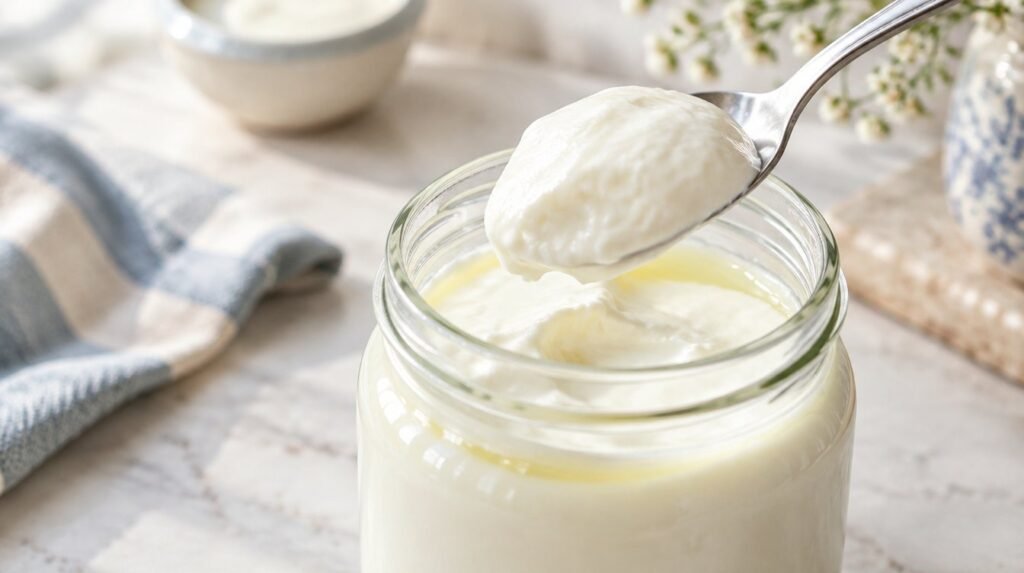
- It has thickened. Tip the jar. The milk should move as one soft mass. A single-strain batch may be closer to a drinkable or spoonable custard than a firm gel.
- The pH is 4.6 or lower. That is the FDA’s acidity standard for yogurt (21 CFR 131.200), and food-grade pH strips make it easy to check. A ferment that has not reached it after 36 hours did not work.
- It smells clean and tart. A mild, slightly buttery note fits the diacetyl results above. Cheesy, yeasty or putrid smells do not.
- A little whey, not a pool. Some clear liquid on top is normal after a long ferment. See whey from yogurt.
Common problems and fixes
| Problem | Likely cause | Fix |
|---|---|---|
| Still liquid at 36 hours | Incubator ran cool, culture added too hot, or too few live spores | Check the incubator with a thermometer. Add culture only below 118°F. Use a fresh capsule within its date. Discard the unset batch. |
| Thin, barely tart | Strain grows slowly in milk on its own | Add 1 tablespoon of plain live yogurt next time, or use a yogurt starter plus the capsule. |
| Very sour, grainy or curdled | Ran long or above 122°F | Stop at 24 hours and keep the temperature at 115 to 118°F. |
| Lots of whey | Over-fermented or jostled | Shorten the time and keep the jars still. Strain it for a thicker texture. |
| Batches weaken over time | Culture balance drifts as you re-culture | Restart from a capsule. See heirloom starter weakened over time. |
| Mold, pink or orange color, rotten smell | Contamination | Throw out the whole jar and clean your equipment. |
The USDA advises discarding yogurt with mold, because soft, moist foods can be contaminated below the surface and may harbor bacteria along with the mold (USDA FSIS). Do not taste a batch that smells wrong to find out.
Safety note
Probiotics are generally considered safe in healthy people, but the risk of harmful effects is greater in people with severe illnesses or compromised immune systems, and serious infections have been reported in premature infants given probiotics (NCCIH). The NIH Office of Dietary Supplements suggests asking your health care provider before you try probiotics (NIH ODS). If you are pregnant, immunocompromised, critically ill or have a central line, talk to your clinician first.
GBI-30 capsules are sold as dietary supplements. The FDA does not approve supplements for safety or effectiveness before sale; their makers are responsible for evaluating safety and labeling (FDA). This article is general information, not medical advice.
Related topics
- Lactobacillus gasseri: How to Culture It at Home: a cooler, slower human-gut culture.
- Lactobacillus reuteri: the long-ferment culture many home makers start with.
- Streptococcus thermophilus: How to Culture It at Home: the classic yogurt partner that helps a soft set.
- Yogurt Temperature: how heat shapes texture and tang.
- Best Probiotic: how strains are chosen by evidence.
Sources
- Konuray G, Erginkaya Z. Potential use of Bacillus coagulans in the food industry (Foods, 2018)
- Heyndrickxia coagulans (List of Prokaryotic names with Standing in Nomenclature, DSMZ)
- GRN No. 399: Preparation of Bacillus coagulans strain GBI-30, 6086 spores (U.S. Food and Drug Administration, GRAS Notice Inventory)
- Gupta RS, et al. Robust demarcation of 17 distinct Bacillus species clades, proposed as novel Bacillaceae genera, by phylogenomics and comparative genomic analyses (Int J Syst Evol Microbiol, 2020)
- Narsing Rao MP, et al. Genome-based reclassification of Bacillus acidicola, Bacillus pervagus and the genera Heyndrickxia, Margalitia and Weizmannia (Int J Syst Evol Microbiol, 2023)
- Oren A, Garrity GM. Valid publication of the names of forty-two phyla of prokaryotes (Int J Syst Evol Microbiol, 2021)
- Keller D, et al. Spores of Bacillus coagulans GBI-30, 6086 show high germination, survival and enzyme activity in a dynamic, computer-controlled in vitro model of the gastrointestinal tract (Benef Microbes, 2019)
- Kalman DS, et al. A prospective, randomized, double-blind, placebo-controlled parallel-group dual site trial to evaluate the effects of a Bacillus coagulans-based product on functional intestinal gas symptoms (BMC Gastroenterol, 2009)
- Hun L. Bacillus coagulans significantly improved abdominal pain and bloating in patients with IBS (Postgrad Med, 2009)
- Dolin BJ. Effects of a proprietary Bacillus coagulans preparation on symptoms of diarrhea-predominant irritable bowel syndrome (Methods Find Exp Clin Pharmacol, 2009)
- Gang H, et al. Impact of Heyndrickxia (Bacillus) coagulans GBI-30, 6086 (BC30) probiotic on gastrointestinal function in healthy adults: a randomised controlled trial (Benef Microbes, 2025)
- Jäger R, et al. Probiotic Bacillus coagulans GBI-30, 6086 improves protein absorption and utilization (Probiotics Antimicrob Proteins, 2018)
- Salvetti E, et al. Integrate genome-based assessment of safety for probiotic strains: Bacillus coagulans GBI-30, 6086 as a case study (Appl Microbiol Biotechnol, 2016)
- Cao J, et al. Effects of Bacillus coagulans GBI-30, 6086 as an adjunct starter culture on the production of yogurt (Food Res Int, 2022)
- Ma S, et al. Effects of Bacillus coagulans as an adjunct starter culture on yogurt quality and storage (J Dairy Sci, 2021)
- Kalogridou-Vassiliadou D. Biochemical activities of Bacillus species isolated from flat sour evaporated milk (J Dairy Sci, 1992)
- Making Yogurt at Home (Preserve It Fresh, Preserve It Safe, HES126) (University of Missouri Extension)
- 21 CFR 131.200 Yogurt (U.S. Food and Drug Administration, Electronic Code of Federal Regulations)
- Molds on Food: Are They Dangerous? (USDA Food Safety and Inspection Service)
- Probiotics: Usefulness and Safety (National Center for Complementary and Integrative Health)
- Probiotics: Fact Sheet for Consumers (NIH Office of Dietary Supplements)
- Dietary Supplements (U.S. Food and Drug Administration)