Whey from Yogurt: What You Need to Know
What the liquid on your yogurt is
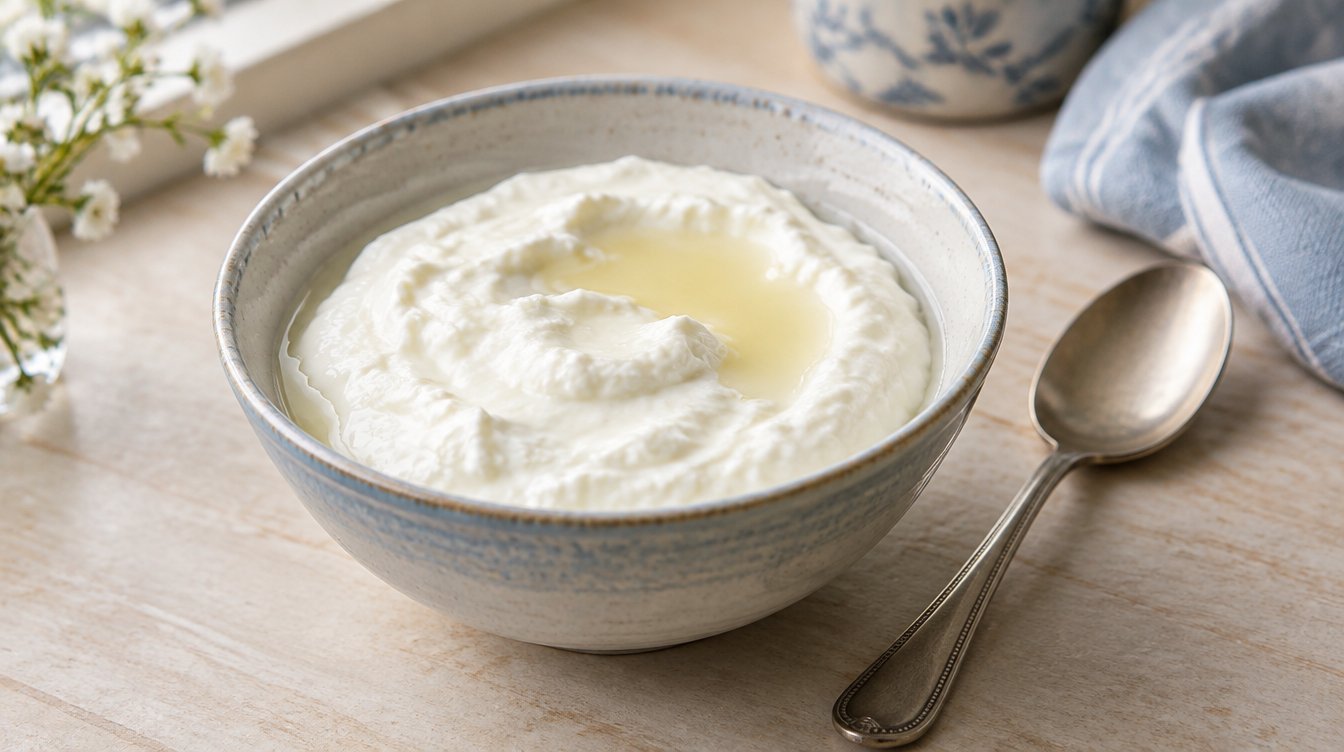
The thin, cloudy liquid that pools on top of yogurt, or drips out when you strain it, is whey. More precisely, whey from yogurt is acid whey: the watery part of milk left behind after lactic acid sets the milk proteins into a gel. It is normal, it is edible, and a little of it in a jar of homemade yogurt does not mean anything went wrong.
Acid whey is mostly water with a small load of milk solids. A 2022 study of Greek strained yogurt summarizes published figures for acid whey from Greek yogurt: a pH of 3.5 to 4.5, 5 to 7% total solids, 3.37 to 4.99% lactose, 0.17 to 0.66% protein, 0.5 to 0.7% ash (the minerals) and 0.6 to 1.4% lactic acid. In plain terms, it carries a good share of the milk sugar, the minerals and the acid, but little of the protein, which stays mostly in the yogurt.
Why whey separates from yogurt
The separation has a name: syneresis. A University of Alaska Fairbanks Cooperative Extension guide says some syneresis is natural, and that excessive whey separation can come from incubating yogurt too long or agitating it while it sets. The University of Illinois Extension troubleshooting table adds a temperature that is too hot or too cold during incubation, and yogurt that was not refrigerated soon after incubation.
Lab research points the same way. In a University of Wisconsin study of yogurt gels, gels made at about 46°C (115°F) instead of 40°C (104°F), or with less starter culture, had a more open structure and more whey separation. A follow-up study from the same lab found that longer fermentation times increased whey separation. Both were controlled lab experiments, so treat them as explaining the pattern rather than giving exact numbers for your kitchen.
How to get less whey next time
- Heat the milk well. Washington State University Extension explains that heat treatment changes milk proteins so the yogurt is firmer and whey does not separate as easily.
- Hold a steady incubation temperature of about 108 to 112°F rather than letting it climb. Our yogurt temperature guide covers the range.
- Stop on time. Chill the yogurt once it has set. How long to incubate yogurt explains how to judge the point.
- Leave it alone. The University of Kentucky guide links wheying off to uneven incubation temperatures, slow cooling and careless handling of the gel.
Stir it back in or pour it off?

Either is fine. Stirring the whey back in keeps its lactose, minerals and acid in the yogurt and gives a looser texture. Pouring it off makes the yogurt a little thicker. Neither choice affects safety.
If you want much thicker yogurt, drain it on purpose. Straining is how Greek yogurt is made, and it removes far more whey than what floats on top: the Greek yogurt study above cites a figure of 2 to 3 kg of acid whey left behind for every 1 kg of Greek strained yogurt made commercially. How to make Greek yogurt has the full method. If you like tang, expect more whey; long, tart ferments tend to weep, as how to make sour yogurt explains.
Whey is not the problem to watch for. The UAF guide says to discard yogurt with visible signs of microbial growth or any odor other than the acidic smell of fresh yogurt, and to discard batches that fail to set.
Acid whey vs. sweet whey vs. whey protein powder
There are two main kinds of liquid whey. Sweet whey is left over from making hard cheeses such as cheddar. Acid whey comes from foods set by acid; a 2021 review in the Journal of Dairy Science notes that its production has grown with demand for Greek yogurt and acid-set cheeses, and that the dairy industry has long struggled to find uses for it.
The whey protein powder sold in tubs is a different product again. A Cornell University paper describes sweet whey, from hard cheese making, as the starting material for whey protein concentrates and isolates. The drying and filtration used to make those products are hindered with yogurt acid whey because of its high acidity and mineral content. So the whey you pour off your yogurt is not a homemade version of protein powder.
| Type | Where it comes from | What sets it apart |
|---|---|---|
| Acid whey | Greek yogurt, strained yogurt, acid-set cheeses | Sour, low pH; USDA lists about twice the calcium of sweet whey |
| Sweet whey | Hard cheeses such as cheddar | Milder taste; the usual raw material for whey protein products |
| Whey protein powder | Sweet whey that is filtered and dried | Concentrated protein; very different from liquid whey |
Whey nutrition
USDA FoodData Central lists fluid acid whey at 24 calories, 0.76 g protein, 0.09 g fat and 5.12 g carbohydrate (all of it sugars) per 100 g. Scaled to USDA’s 1-cup portion of 246 g, that works out to about:
| Nutrient (1 cup, 246 g) | Acid whey | Sweet whey |
|---|---|---|
| Calories | 59 | 66 |
| Protein | 1.9 g | 2.1 g |
| Fat | 0.2 g | 0.9 g |
| Carbohydrate (sugars) | 12.6 g | 12.6 g |
| Calcium | 253 mg | 116 mg |
| Phosphorus | 192 mg | 113 mg |
| Potassium | 352 mg | 396 mg |
| Sodium | 118 mg | 133 mg |
The sweet whey column comes from USDA’s fluid sweet whey entry, calculated the same way. These are general reference values, not measurements of homemade yogurt whey. The Greek yogurt study above notes that published acid whey compositions vary with the milk and the process, so treat the table as a rough guide.
Whey and your digestion
The number most relevant to digestion is the sugar, which in whey is mostly lactose. A cup of acid whey carries about 12.6 g by USDA’s figures. That is close to the 12 grams in about 1 cup of milk that, according to the National Institute of Diabetes and Digestive and Kidney Diseases, many people with lactose intolerance can have without symptoms. If you are sensitive to lactose, start with small amounts, the same way NIDDK suggests adding dairy a little at a time.
The 2021 review discusses potential health benefits of acid whey components, ranging from antibacterial effects to gut health. Potential is the key word: we found no human trials showing that drinking yogurt whey improves gut health, so treat it as a useful cooking liquid rather than a gut-health remedy.
How long whey keeps
We found no official storage time for homemade yogurt whey, so the cautious approach is to treat it like the yogurt it came from. Keep it covered in the refrigerator at 40°F (4°C) or below, and use it within the 14 days Illinois Extension gives for eating homemade yogurt. Count from the day you made the yogurt, not the day you drained it.
For longer storage, freeze it in ice cube trays or small jars. FoodSafety.gov notes that freezer times are for quality only, and that food kept continuously at 0°F (-18°C) or below stays safe indefinitely. Throw out whey that smells off, looks slimy or grows mold. For ideas on what to do with it, see recipes using whey from yogurt.
Related topics
- Recipes Using Whey from Yogurt: pancakes, bread, marinades and more.
- How to Make Greek Yogurt with a Yogurt Maker: make yogurt, then strain off the whey.
- What is Greek Yogurt?: how straining changes yogurt.
- How Long does Homemade Yogurt Last?: storage times and spoilage signs.
- Homemade Greek Yogurt: the style and its uses.
Sources
- Karastamatis S, et al. Effect of modified manufacturing conditions on the composition of Greek strained yogurt and the quantity and composition of generated acid whey (Foods, 2022)
- Making Yogurt at Home (University of Alaska Fairbanks Cooperative Extension, via University of California Cooperative Extension)
- Making Yogurt at Home (University of Illinois Extension, 2024)
- Lee WJ, Lucey JA. Structure and physical properties of yogurt gels: effect of inoculation rate and incubation temperature (Journal of Dairy Science, 2004)
- Peng Y, et al. Impact of preacidification of milk and fermentation time on the properties of yogurt (Journal of Dairy Science, 2009)
- Yogurt Made Simple (FS173E) (Washington State University Extension, 2015)
- Making Yogurt at Home (IP-36) (University of Kentucky Cooperative Extension)
- Rocha-Mendoza D, et al. Invited review: Acid whey trends and health benefits (Journal of Dairy Science, 2021)
- Camacho Flinois J, et al. Yogurt acid whey utilization for production of baked goods: pancakes and pizza crust (Foods, 2019)
- Whey, acid, fluid (FDC ID 170885) (USDA FoodData Central, SR Legacy)
- Whey, sweet, fluid (FDC ID 171282) (USDA FoodData Central, SR Legacy)
- Eating, Diet, & Nutrition for Lactose Intolerance (National Institute of Diabetes and Digestive and Kidney Diseases)
- Cold Food Storage Chart (FoodSafety.gov, U.S. Department of Health and Human Services)