Condensation Dripping into Jars: Causes and Fixes
What condensation in the jars looks like
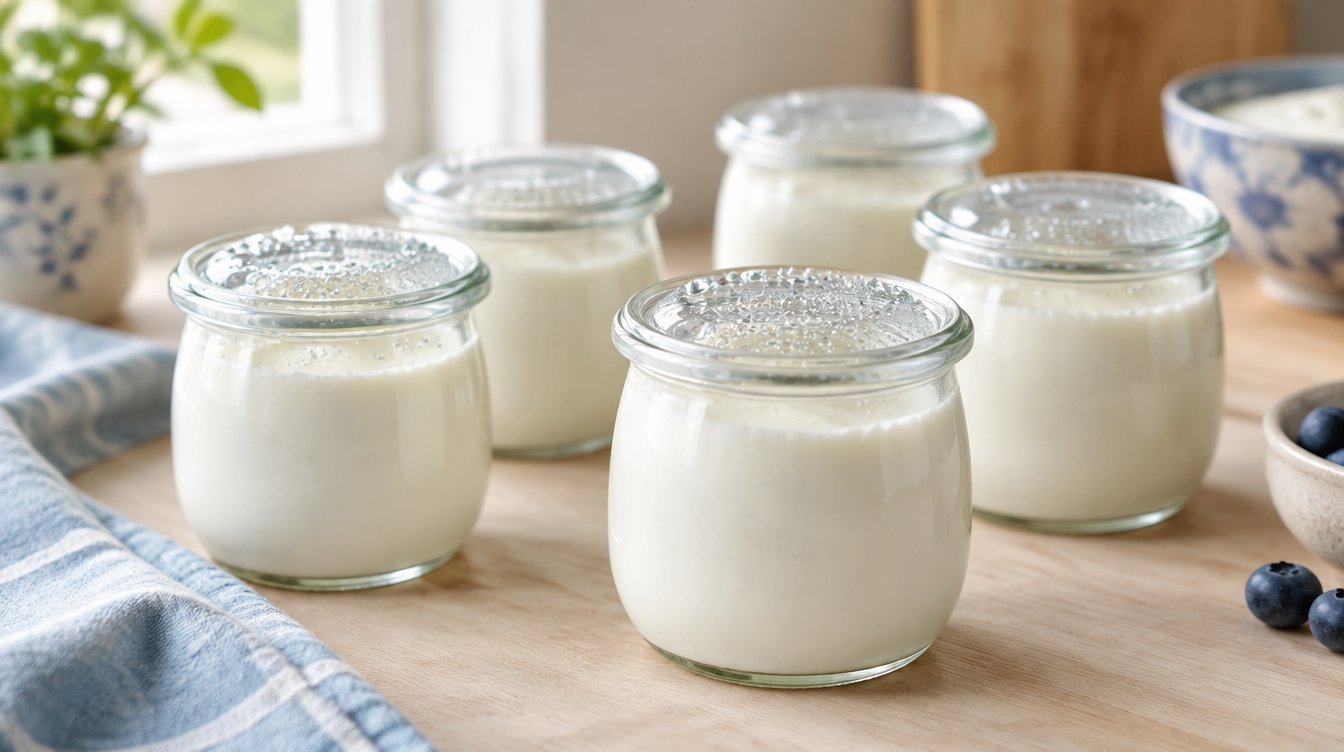
You lift the lid of the yogurt maker and find beads of water on its underside, a few drops sliding down the inside of the jars, and a thin layer of clear liquid pooled on top of the yogurt.
This is common, and on its own it is a cosmetic problem, not a failed batch. The water is mostly vapor from your own warm milk that rose, hit a cooler surface and turned back into liquid.
The most likely cause: a warm batch under a cooler lid
Incubating milk sits at about 110°F, and University of Alaska Fairbanks Extension recommends holding it at 110°F, plus or minus 5°F, for 4 to 7 hours (UAF Cooperative Extension). Air touching that warm milk picks up moisture. When that moist air meets a surface colder than its dew point, such as the inside of an appliance lid that faces room air, it can no longer hold all of its water as vapor, and the extra comes out as liquid (National Weather Service).
Those drops collect on the lid until they are heavy enough to fall. If the jars are open, or capped loosely with a gap, the drops land straight on the setting yogurt. A cold kitchen or an incubator running hot widens the temperature gap and makes it worse.
How to fix it

- Cap every jar. Illinois Extension tells home cooks to pour the milk into containers and add a lid before incubating, and lists “not covered while incubating” as a cause of off-flavors (University of Illinois Extension). With jar lids on, drops fall on the jar lid, not on the yogurt.
- Add a towel barrier if your jars have no lids. Lay a clean, dry cotton towel or a double layer of paper towel over the jar tops, under the appliance lid, so it catches drips.
- Check the real temperature. Put a thermometer in a jar of water in the incubator for an hour. If it reads well above 115°F, the extra heat drives off more vapor, and UAF notes that a temperature that is too hot or too cold slows culture growth (UAF Cooperative Extension). Our guide to yogurt maker temperature drift explains why some units run warm.
- Warm the room side, not the milk side. If your kitchen is cold, move the machine off a cold window sill or stone counter, or set it on a folded towel.
- Lift the lid straight up and tip it away. At the end of incubation, raise the lid slowly and tilt it so the collected water runs off the far edge, then wipe it dry.
- Deal with the water that did fall. If the yogurt set, tip the jar gently and pour off the clear layer, or blot it with a clean paper towel. Stirring it in also works.
Secondary causes
Condensation forming in the fridge
Warm jars that go straight into the refrigerator with their lids on will also fog up as they cool, and drops can run back onto the yogurt. USDA says hot food can go directly into the refrigerator, and that food should be refrigerated within 2 hours of coming out of an appliance that kept it warm (USDA FSIS). Keep the lids on and simply pour off the water when you open the jar.
It is whey, not condensation
Not all clear liquid on top is condensation. Whey, the watery part of milk, can weep out of the gel itself. In a University of Wisconsin lab study, whey separation increased when less starter was used and when yogurt was incubated at a higher temperature (about 46°C, or 115°F, versus 40°C, or 104°F) (Lee and Lucey, 2004). Yellowish liquid that keeps coming back after you pour it off is likely whey. See whey from yogurt and yogurt separated into curds and whey for those fixes.
A dirty lid
Drops that fall from the underside of a lid carry whatever is on it. Missouri Extension advises washing all equipment in hot, soapy water, rinsing, then sanitizing before you make yogurt (University of Missouri Extension). Wash the incubator lid with the jars each time.
Preventing it next time
- Use jars with their own lids, and screw them on before the jars go in the machine.
- Confirm your incubation temperature with a thermometer, as covered in how to incubate yogurt and our yogurt temperature guide.
- Refrigerate as soon as the yogurt has set, with lids on. Illinois Extension recommends 40°F or lower and eating homemade yogurt within 14 days (University of Illinois Extension).
When to throw a batch out
Condensation alone is not a reason to discard yogurt. A batch that set, smells clean and sour, and only has a little clear water on top is fine to eat once you pour the water off.
Throw it out if you see mold. USDA says yogurt with mold should be discarded, because moist foods can be contaminated below the surface and bacteria may grow along with the mold (USDA FSIS). University of Guam Extension also advises discarding batches that fail to set properly and any yogurt with visible microbial growth or odors other than the clean acid smell of fresh yogurt (University of Guam Cooperative Extension). For how long a good batch keeps, see how long homemade yogurt lasts.
Related topics
- How to Incubate Yogurt: setups that hold a steady temperature.
- Yogurt Maker Wattage, Temperature Drift and Why It Matters: why some machines run hot.
- Whey from Yogurt: telling whey from water, and what to do with it.
- Yogurt Separated After Refrigeration: liquid that appears in the fridge.
- Storage, Shelf Life and Re-culturing: keeping finished batches fresh.
Sources
- Making Yogurt at Home (FNH-00062) (University of Alaska Fairbanks Cooperative Extension Service)
- Dew Point vs Humidity (National Weather Service, La Crosse, WI)
- Making Yogurt at Home (University of Illinois Extension, 2024)
- Leftovers and Food Safety (USDA Food Safety and Inspection Service)
- Lee WJ, Lucey JA. Structure and physical properties of yogurt gels: effect of inoculation rate and incubation temperature (Journal of Dairy Science, 2004)
- Preserve It Fresh, Preserve It Safe: Making Yogurt at Home (University of Missouri Extension, 2019)
- Molds on Food: Are They Dangerous? (USDA Food Safety and Inspection Service)
- Making Yogurt at Home (FP-01) (University of Guam Cooperative Extension, 2016)