Yogurt Is Runny or Thin: Causes and Fixes
When yogurt is runny or thin
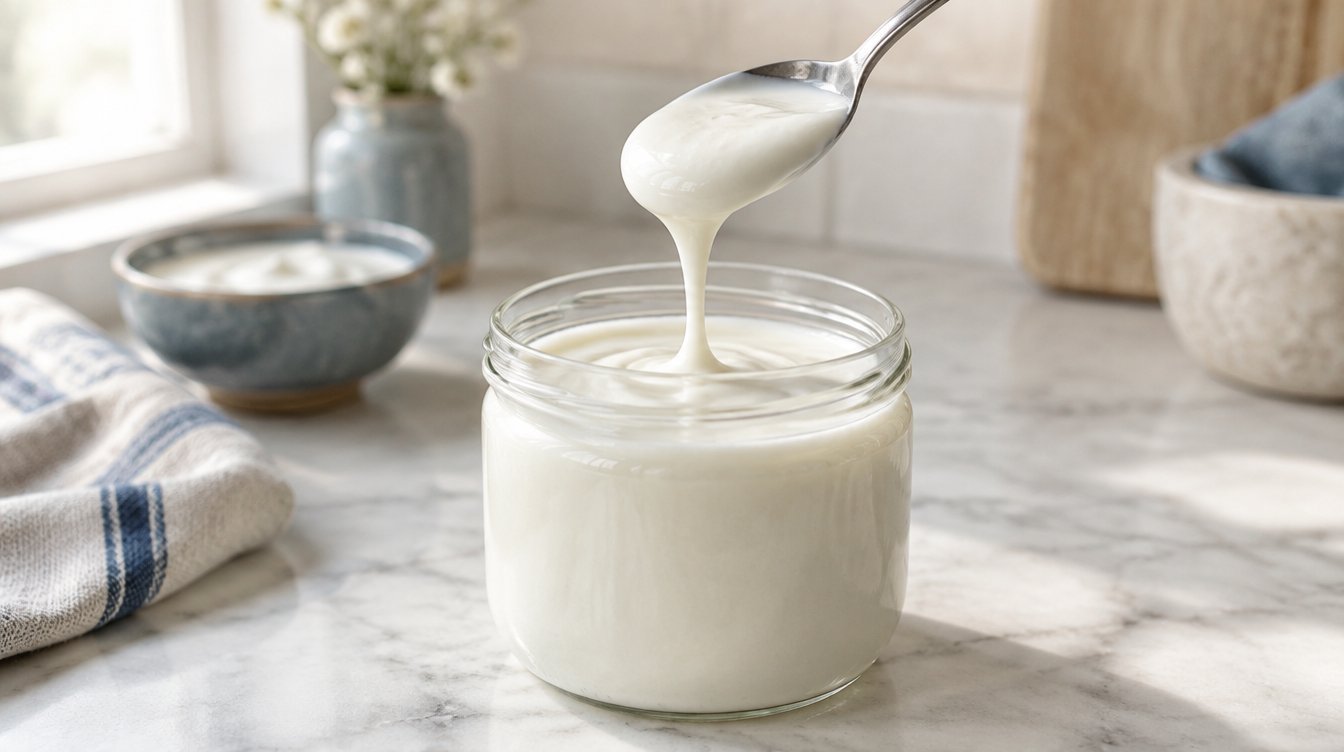
The batch smells and tastes like yogurt, tangy and clean, but it pours instead of holding a spoon. It may look like a drinkable yogurt, or a loose custard that slumps the moment you scoop it.
That is different from a batch that never set. If the milk still tastes sweet and plain after a full incubation, the cultures did not work, and yogurt did not set is the guide you need. A thin but sour batch did culture. It just formed a weak gel.
The most likely cause: the milk was not heated long enough
Heating milk before culturing does more than kill stray bacteria. University of Guam Extension explains that the heat also changes the shape of milk proteins so they bind more water and form a firmer gel, and that yogurt made straight from store-bought pasteurized milk without this step will have a soft texture (University of Guam Cooperative Extension).
Time at temperature matters as much as the peak. University of Alaska Fairbanks Extension says to hold milk at 185 to 200°F for 10 minutes for thinner yogurt, or up to 20 minutes for thicker yogurt (UAF Cooperative Extension). Bringing milk to 180°F and pulling it off the heat at once is a common reason for a loose set.
How to fix it

- Heat and hold. Heat the milk slowly to 185°F, stirring so it does not scorch, and keep it there for 10 to 20 minutes. Do not boil it; UAF notes that boiling causes an off flavor (UAF Cooperative Extension).
- Add milk powder for skim or low-fat milk. Illinois Extension suggests stirring ¼ cup of nonfat dry milk into each quart of cold skim milk before heating, for a thicker yogurt (University of Illinois Extension). Add it cold; UAF warns that powder added to hot milk forms strings.
- Cool to 108 to 112°F before adding starter. Above 115°F the heat can kill the bacteria (UAF Cooperative Extension).
- Incubate at about 110°F and leave it alone. UAF and Guam Extension both list moving or agitating yogurt while it sets as a cause of whey separation (University of Guam Cooperative Extension).
- Test before you stop. If the yogurt still moves like milk when you tilt a spoon through it, Illinois Extension says to incubate for another 2 hours and test again (University of Illinois Extension).
- Chill it before judging it. Refrigerate the jars for at least several hours without stirring. Kentucky Extension notes that yogurt keeps firming as it cools, and that whisking the gel turns it into a smooth, free-flowing yogurt, so leave it whole if you want it firm (University of Kentucky Cooperative Extension).
To rescue the batch you already have, strain it. Illinois Extension drains yogurt in cheesecloth in the refrigerator for 2 to 4 hours for Greek style (University of Illinois Extension). Our guides to thickening yogurt and making Greek yogurt cover the details.
Secondary causes
The temperature drifted
Illinois Extension lists incubation that was too hot or too cold, and milk that was too cold before incubating, among the causes of a soft or thin set (University of Illinois Extension). In a University of Wisconsin lab study, yogurt gels made at about 115°F were weaker and released more whey than gels made at 104°F (Lee and Lucey, 2004). Check your machine with a thermometer; see yogurt temperature.
Too little or tired starter
The same Wisconsin study found that lower inoculation rates gave weaker, more porous gels with more whey separation (Lee and Lucey, 2004). A starter without enough live bacteria can leave yogurt soft or unset (University of Illinois Extension).
The milk itself
Skim milk, goat milk and plant milks set softer. Illinois Extension names goat milk as a cause of thin yogurt (University of Illinois Extension), and in a 2025 study, yogurt from 0.1% fat milk had far more whey separation than yogurt from higher-fat milk (Çelik and Karakus, 2025). Evidence on ultra-pasteurized milk is mixed: that study found no significant firmness difference between pasteurized and UHT milk, while an industry study found curd from milk heated to about 266°F for 2 seconds was very fragile (Ichimura et al., 2022). See milk type vs yogurt texture and ultra-pasteurized milk for yogurt.
A soft-setting culture
Some cultures, including L. reuteri, often give a softer set than classic yogurt starters. Our guide to reuteri yogurt that did not thicken covers that case.
Prevention
- Heat and hold the milk every time, even if it is already pasteurized.
- Use whole milk, or add nonfat dry milk to lower-fat milk.
- Measure the starter rather than guessing, and use it fresh.
- Keep the incubator steady near 110°F and do not move the jars until they have set.
When to throw a batch out
A thin yogurt that smells clean and tastes tangy is safe to eat, strain or use in smoothies. University of Guam Extension advises discarding batches that fail to set properly and any yogurt with visible microbial growth or odors other than the acidity of fresh yogurt (University of Guam Cooperative Extension). A batch that is still sweet, milky and liquid after a full incubation falls in that group. USDA says yogurt with mold should always be thrown out (USDA FSIS).
Related topics
- Yogurt Did Not Set: when the milk never cultured at all.
- How to Thicken Yogurt: straining, milk powder and other methods.
- Milk Type vs Yogurt Texture: how each milk sets.
- Yogurt Tastes Too Sour: when the flavor is the problem instead.
- Plant Milk Would Not Thicken: fixes for non-dairy batches.
Sources
- Making Yogurt at Home (FP-01) (University of Guam Cooperative Extension, 2016)
- Making Yogurt at Home (FNH-00062) (University of Alaska Fairbanks Cooperative Extension Service)
- Making Yogurt at Home (University of Illinois Extension, 2024)
- Making Yogurt at Home (IP-36) (University of Kentucky Cooperative Extension Service)
- Lee WJ, Lucey JA. Structure and physical properties of yogurt gels: effect of inoculation rate and incubation temperature (Journal of Dairy Science, 2004)
- Çelik ÖF, Karakus B. Effect of fat content, heat treatment, and vitamin D addition on physicochemical characteristics of yoghurt (Journal of Dairy Research, 2025)
- Ichimura T, et al. A new method for producing superior set yogurt, focusing on heat treatment and homogenization (Journal of Dairy Science, 2022)
- Molds on Food: Are They Dangerous? (USDA Food Safety and Inspection Service)