Plant Milk Would Not Thicken: Causes and Fixes
The symptom
You held the plant milk warm with a starter for 8 to 12 hours, and it came out pourable, maybe a little tangy, maybe separated. Nothing set.
Dairy yogurt sets because the bacteria turn milk sugar into lactic acid, and the acid makes the milk proteins pull together into a gel (University of Illinois Extension). Most plant milks lack one or both parts: enough protein to build a gel, and a sugar to turn into acid.
Most likely cause: too little protein
USDA FoodData Central lists these values per 100 grams (about 3.5 ounces). Almond, oat and coconut drinks carry a fraction of the protein in cow’s milk; only soy comes close.
| Milk | Protein (g per 100 g) | Sugars (g per 100 g) | What to expect |
|---|---|---|---|
| Whole cow’s milk | 3.15 | 5.05, all lactose | Sets on its own |
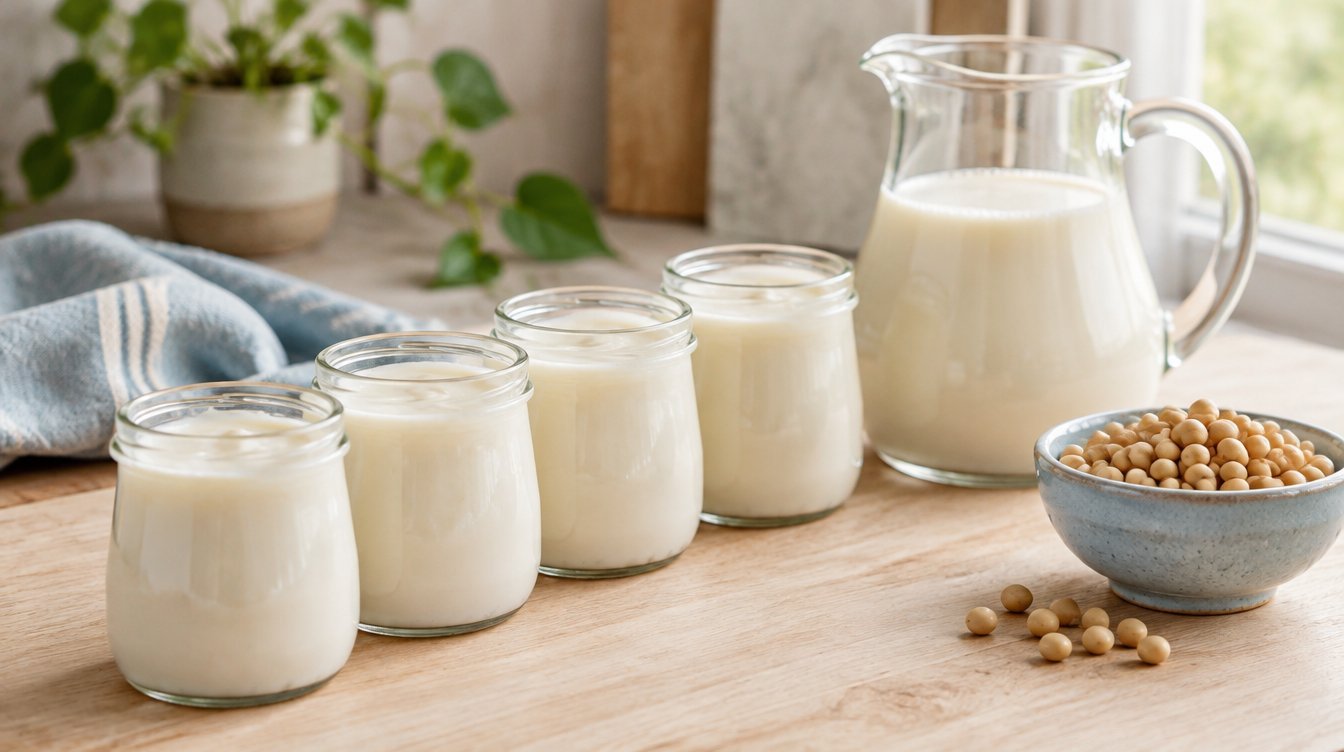
| Soy milk, unsweetened | 2.86 | 0.41 | Can set |
| Oat milk, unsweetened | 0.80 | 2.32 | Needs a thickener |
| Almond milk, unsweetened, refrigerated | 0.66 | Sucrose 0.04 (total not listed) | Needs sugar and a thickener |
| Coconut milk beverage, sweetened | 0.21 | 2.5 | Needs a thickener |
| Coconut milk, canned | 2.02 | Not listed | Far more fat (21.3 g) than carton coconut |
In one lab comparison fermented to the same pH of 4.5, soy yogurt was the firmest, while oat yogurt had a looser structure and the lowest firmness (Wang et al., Food Research International, 2023).
Store-bought plant yogurt is thick for a reason. A review found that none of the commercial products analyzed matched dairy for protein, and that their texture usually comes from additives such as protein extracts, thickeners and emulsifiers; agar and similar gums can stand in for the protein network (Montemurro et al., Foods, 2021).
Second cause: nothing for the bacteria to eat
Yogurt bacteria need sugar to make acid. In dairy that sugar is lactose. USDA lists zero lactose for almond and oat milk, and unsweetened almond milk has almost no sugar of any kind. With little to ferment, the acid never builds, and the pH does not fall below 4.6, where milk takes on a yogurt-like texture (University of Guam Extension).
Soy milk usually works: the same review calls commercial soy milk a good substrate for the standard yogurt bacteria (Montemurro et al., 2021).
How to fix it next time
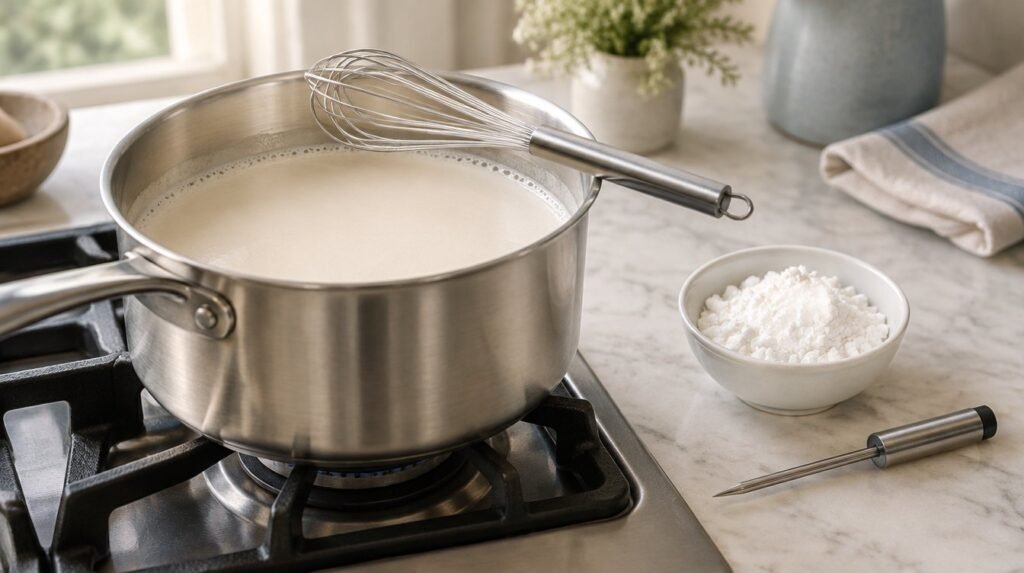
A thin batch that smells clean and tangy has fermented; only the texture failed. Drink it or blend it into a smoothie. Longer incubation will not add protein, and heating it with a thickener now would kill the cultures. Build the thickener in from the start:
- Pick the milk. Soy gives the best chance of a natural set. For other plant milks, plan on a thickener.
- Add food for the culture. If the milk is unsweetened, whisk in about 1 tablespoon of sugar per quart.
- Add a thickener, cold. Whisk in tapioca starch, pectin or agar (all common yogurt stabilizers, per University of Guam Extension) following the package amount for a soft gel.
- Heat it. Bring it to a gentle simmer, around 190°F, for 2 minutes, stirring. Starch thickens only when heated in liquid, and agar must be heated to dissolve. Soy yogurt research used about 194°F (90°C) (Montemurro et al., 2021).
- Cool to 108 to 112°F. Milk that is too hot when the starter goes in will kill it (University of Guam Extension).
- Add the starter. Use a dairy-free culture per its directions, or 2 to 3 tablespoons of unsweetened plant yogurt with live cultures per quart.
- Incubate 8 to 12 hours at about 110°F, covered and undisturbed. Extension guidance for dairy uses 110°F for 6 to 12 hours (University of Guam Extension).
- Chill at least 6 hours. Yogurt keeps firming as it cools in the refrigerator (University of Kentucky Extension), and starch or agar sets more as it cools.
Other causes
- Wrong temperature. Too hot or too cold during incubation is a standard reason yogurt is not firm (University of Illinois Extension). Check the incubator with a thermometer; see our guide to yogurt temperature.
- A dead starter. Starters with dead bacteria will not make yogurt (University of Illinois Extension). Check the date on capsules and saved yogurt.
- Canned coconut milk splitting. If it parted into a fat layer and a watery layer, see coconut yogurt separated.
Prevention
- Choose a plant milk with more protein; see our milk type vs texture matrix.
- Add sugar and a thickener before heating, not after culturing.
- Use a thermometer at the cooling step and in the incubator.
- Use fresh starter, and confirm the batch cultured with the checks in how to verify your yogurt cultured.
When to throw a batch out
Texture alone is not a safety problem. These signs mean the batch goes in the trash:
- Any mold. USDA says to discard moldy yogurt, because moist foods can be contaminated below the surface (USDA FSIS).
- No tang at all after a full incubation. It never acidified, so it spent hours in the range where bacteria grow rapidly, 40°F to 140°F (USDA FSIS), with no acid to hold them back.
- Rotten, yeasty or alcoholic smells, fizz, or pink or orange streaks.
Keep finished yogurt at 40°F or below. Illinois Extension advises eating homemade dairy yogurt within 14 days (University of Illinois Extension). No separate guideline exists for plant batches.
Related topics
- Coconut Yogurt: a dairy-free method built around coconut.
- Yogurt Is Runny or Thin: the dairy version of this problem.
- How to Thicken Yogurt: straining, milk powder and stabilizers.
- pH and Acidity Targets for Safe Home Fermentation: why acid matters for safety.
Sources
- Making Yogurt at Home (University of Illinois Extension, 2024)
- Making Yogurt at Home (University of Guam Cooperative Extension, 2016)
- Making Yogurt at Home (University of Kentucky Cooperative Extension Service)
- Montemurro M, et al. Plant-Based Alternatives to Yogurt: State-of-the-Art and Perspectives of New Biotechnological Challenges (Foods, 2021)
- Wang X, et al. Comparison of physicochemical properties and volatile flavor compounds of plant-based yoghurt and dairy yoghurt (Food Research International, 2023)
- Milk, whole, 3.25% milkfat, with added vitamin D (USDA FoodData Central)
- Soymilk (all flavors), unsweetened, with added calcium, vitamins A and D (USDA FoodData Central)
- Oat milk, unsweetened, plain, refrigerated (USDA FoodData Central)
- Almond milk, unsweetened, plain, refrigerated (USDA FoodData Central)
- Beverages, coconut milk, sweetened, fortified with calcium, vitamins A, B12, D2 (USDA FoodData Central)
- Nuts, coconut milk, canned (liquid expressed from grated meat and water) (USDA FoodData Central)
- Molds on Food: Are They Dangerous? (USDA Food Safety and Inspection Service)
- Leftovers and Food Safety (USDA Food Safety and Inspection Service)