Milk Type vs Yogurt Texture: A Complete Matrix
What this matrix shows
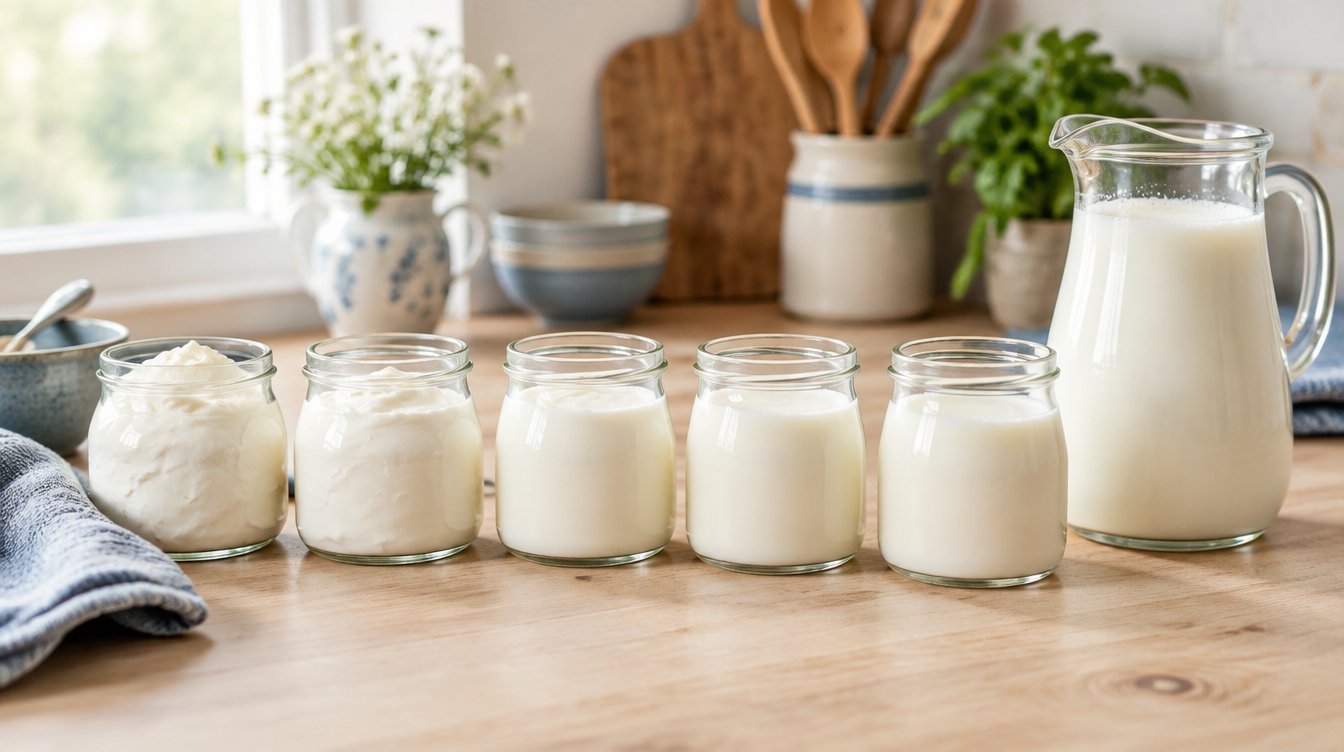
The milk you choose decides much of your yogurt’s body. Yogurt sets because lactic acid makes milk proteins pull together into a gel, so the amount of protein, the amount of fat and how the milk was heated all shape the final texture (University of Illinois Extension).
The table below lines up 13 common milks. Protein and fat come from USDA FoodData Central. The texture column summarizes extension guides and food-science studies. These are typical results, not measurements we made.
Milk type vs yogurt texture: the matrix
| Milk | Protein per 100 g | Fat per 100 g | Typical yogurt texture | What helps |
|---|---|---|---|---|
| Whole cow milk (3.25%) | 3.2 g | 3.3 g | Smooth, medium-firm set; the usual benchmark | Heat to 180 to 185°F first |
| 2% cow milk | 3.3 g | 2.0 g | Slightly softer and less rich than whole | Add nonfat dry milk for more body |
| Skim (nonfat) cow milk | 3.4 g | 0.1 g | Thinner, more whey, less smooth | Add ¼ cup nonfat dry milk per quart |
| Skim + ¼ cup nonfat dry milk per quart | about 4.3 g (calculated from USDA dry milk data) | under 0.1 g | Noticeably thicker, less whey | Stir powder into cold milk |
| Half-and-half | 3.1 g | 11.5 g | Rich, creamy, custard-like | Same method as whole milk |
| Ultra-pasteurized cow milk | same as its fat level | same | Sets, but can be softer or more fragile | Strain if the set is soft |
| Raw cow milk | same as its fat level | same | Often thinner and runnier | Pasteurize first (heat to at least 165°F) |
| Goat milk | 3.6 g | 4.1 g | Soft, loose set; most whey separation | Heat well; strain or add dry milk |
| Sheep milk | 6.0 g | 7.0 g | Thick, firm, high viscosity | Little help needed |
| Soy milk, unsweetened | 2.9 g | 1.6 g | Can set into a soft gel | Best plant option for a set |
| Canned coconut milk | 2.0 g | 21.3 g | Rich but loose; often needs a thickener | Agar, tapioca or chilling |
| Almond milk, unsweetened | 0.4 g | 1.0 g | Stays thin and drinkable | Needs a thickener to set |
| Oat milk, unsweetened | 0.8 g | 2.8 g | Thin; may thicken slightly | Needs a thickener to set |
Column sources: protein and fat are USDA FoodData Central values per 100 g of milk (about 3.4 fluid ounces). The skim-plus-powder figure is our arithmetic from USDA values for skim milk and nonfat dry milk, using the ¼ cup per quart that Illinois Extension recommends. Texture and “what helps” come from the sources discussed below.
How to read the table
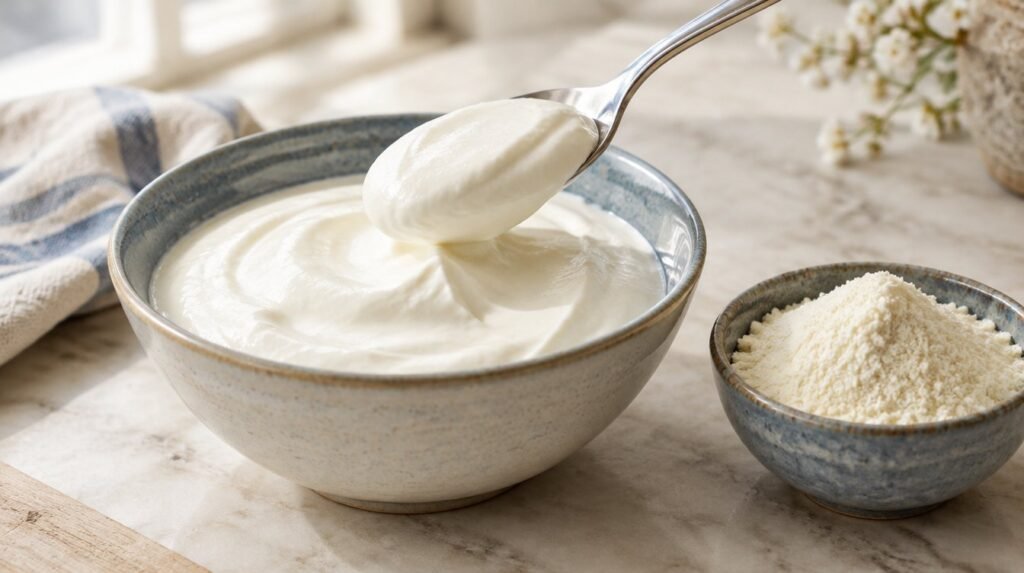
Protein sets the gel
More protein usually means a firmer set, which is why sheep milk, with almost twice the protein of cow milk, makes such thick yogurt. A study that made yogurt from cow, goat, sheep and buffalo milk found sheep and buffalo yogurts had the highest dry matter, viscosity and hardness, while goat milk yogurt held water least well and lost the most whey (Demirhan et al., Food Science and Nutrition, 2026).
Adding protein works too. University of Alaska Fairbanks Extension notes that nonfat dry milk adds solids and gives a firmer set, and a University of Kentucky Extension guide recommends about 5 percent nonfat dry milk to keep whey from separating out of the curd. For protein in the finished yogurt, see our protein by milk and straining method table.
Fat adds creaminess and holds whey
Fat does not build the gel, but it smooths the mouthfeel and helps the curd hold liquid. In a lab study of cow milk yogurts at 0.1, 1.5, 3 and 3.5 percent fat, the 0.1 percent yogurt lost by far the most whey (about 51 percent syneresis versus 15 to 22 percent for higher-fat batches), and tasters preferred the 3 and 3.5 percent versions (Çelik and Karakus, Journal of Dairy Research, 2025). The Kentucky guide puts it simply: lower-fat yogurts may not be as smooth or as full in flavor.
Half-and-half has about the same protein as whole milk and three to four times the fat, so expect a creamier spoon rather than a firmer one. Our guide to making yogurt with half-and-half covers the method.
Heat treatment changes the protein
Heating milk to about 180°F before culturing denatures whey proteins so they join the gel instead of floating free (University of Missouri Extension). Alaska Extension suggests going to 200°F, or holding the heat up to 20 minutes, for a thicker yogurt. In goat milk, one study found heating to 85°C (185°F) for 5 minutes gave firmer yogurt than either 72°C for 30 seconds or 95°C for 5 minutes (Hovjecki et al., Journal of Texture Studies, 2020).
Very high heat is where results conflict. One study found cow milk heated to 130°C for 2 seconds made an “extremely fragile” set yogurt compared with conventional heating, unless the fat was homogenized very finely (Ichimura et al., Journal of Dairy Science, 2022). Another found no significant difference in firmness between pasteurized and UHT milk yogurts (Çelik and Karakus, 2025). In practice, ultra-pasteurized milk usually works; read more in our ultra-pasteurized milk guide.
Goat and raw milk run thin
Illinois Extension lists goat milk as a cause of thin yogurt. Raw milk often sets loosely too, and it carries a safety issue: the FDA warns that raw milk can contain Salmonella, E. coli O157:H7 and Listeria, among others (FDA). Alaska Extension says to always pasteurize raw milk or use commercially pasteurized milk for yogurt. See raw milk yogurt for the details.
Plant milks need help
Almond and oat milks have under 1 gram of protein per 100 grams, so there is little for acid to set. Soy milk is the exception among common plant milks. A comparison of store-bought plant yogurts found soy, coconut and cashew versions had firmness close to a dairy yogurt, but texture depended heavily on added hydrocolloids such as agar and starch (Grasso et al., Foods, 2020). At home, expect to add a thickener to anything but soy; our coconut yogurt guide shows one way.
Methodology and limits
- Protein and fat are USDA reference values for milk, not finished yogurt. Brands vary, so check your carton.
- Texture descriptions are typical results drawn from extension guides and lab studies. We did not make or measure these yogurts.
- Your starter, incubation time and temperature also change texture; see yogurt temperature.
- Plant milk results depend heavily on the brand’s added gums, starches and protein.
If a batch comes out thin, straining is the simplest fix for any milk. It removes whey and concentrates protein, which is how Greek yogurt is made.
Related topics
- How to Make Yogurt at Home: the full method these milks plug into.
- Best Milk for Gut Health: how the same milks compare for digestion.
- Whey from Yogurt: why liquid separates and what to do with it.
- Yogurt Incubation Temperature by Strain: the other half of the texture equation.
- Protein Content of Yogurt by Milk and Straining Method: protein after culturing and straining.
Sources
- Milk, whole, 3.25% milkfat, with added vitamin D (USDA FoodData Central)
- Milk, reduced fat, fluid, 2% milkfat (USDA FoodData Central)
- Milk, nonfat, fluid, with added vitamin A and vitamin D (USDA FoodData Central)
- Milk, dry, nonfat, regular, with added vitamin A and vitamin D (USDA FoodData Central)
- Cream, fluid, half and half (USDA FoodData Central)
- Milk, goat, fluid, with added vitamin D (USDA FoodData Central)
- Milk, sheep, fluid (USDA FoodData Central)
- Soymilk (all flavors), unsweetened, with added calcium, vitamins A and D (USDA FoodData Central)
- Nuts, coconut milk, canned (USDA FoodData Central)
- Beverages, almond milk, unsweetened, shelf stable (USDA FoodData Central)
- Oat milk, unsweetened, plain, refrigerated (USDA FoodData Central)
- Making Yogurt at Home (University of Illinois Extension, 2024)
- Making Yogurt at Home, FNH-00062 (University of Alaska Fairbanks Cooperative Extension Service)
- Making Yogurt at Home, IP-36 (University of Kentucky Cooperative Extension Service)
- Preserve It Fresh, Preserve It Safe, HES126 (University of Missouri Extension, 2019)
- Raw Milk Misconceptions and the Danger of Raw Milk Consumption (U.S. Food and Drug Administration)
- Demirhan ŞŞ, et al. Comparison of physicochemical, microbiological, and sensory properties of yogurt made from cow, goat, sheep, and buffalo milk with and without probiotic cultures (Food Science and Nutrition, 2026)
- Çelik ÖF, Karakus B. Effect of fat content, heat treatment, and vitamin D addition on physicochemical characteristics of yoghurt (Journal of Dairy Research, 2025)
- Hovjecki M, et al. Influence of heat treatment of goat milk on casein micelle size, rheological and textural properties of acid gels and set type yoghurts (Journal of Texture Studies, 2020)
- Ichimura T, et al. A new method for producing superior set yogurt, focusing on heat treatment and homogenization (Journal of Dairy Science, 2022)
- Grasso N, et al. Composition, physicochemical and sensorial properties of commercial plant-based yogurts (Foods, 2020)