Reuteri Yogurt Did Not Thicken: Causes and Fixes
The symptom
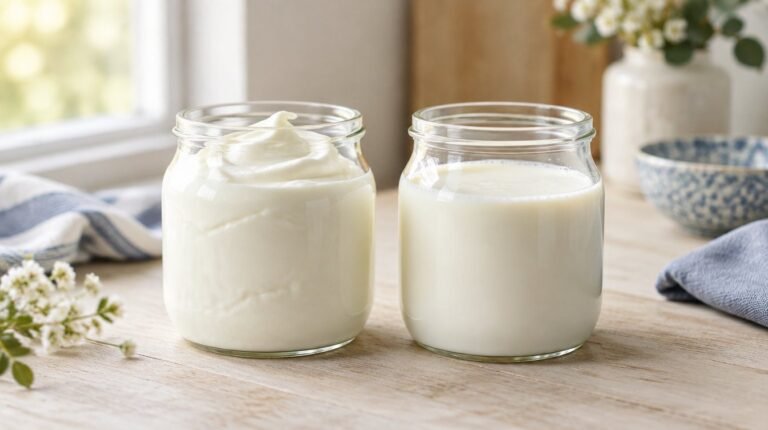
You fermented milk or cream with Lactobacillus reuteri for 24 or even 36 hours, and it is still pourable, like milk or thin cream, instead of spoonable. Before you pour it out, it helps to know that L. reuteri is not a classic yogurt culture, and a soft result is common.
L. reuteri is a bacterium found in the human gut, urinary tract, skin and breast milk, according to a 2018 review in Frontiers in Microbiology. In 2020 it was reclassified as Limosilactobacillus reuteri, so you may see either name on a label.
The most likely cause: L. reuteri is a weak milk thickener
Yogurt thickens when acid made by bacteria causes casein, the main milk protein, to link into a gel. A 2002 review by John Lucey describes casein particles as the building blocks of that gel. Traditional cultures (S. thermophilus and L. bulgaricus) do this fast: University of Illinois Extension sets yogurt in 6 to 10 hours at 108°F to 115°F.
L. reuteri is slower. In a 2005 lab study, one strain (NRRL 14171) showed low milk acidification ability. Adding casein peptone, a protein digest, to the milk improved its growth and acid production, and the authors suggested the strain struggles to break down milk protein for food. That is one strain in a lab, but it matches what home cooks report.
This is why most home L. reuteri recipes use half-and-half. USDA data show it has about the same protein as whole milk but more than three times the fat, so much of the body in a reuteri batch comes from cream rather than a firm protein gel.
| Per 100 g | Fat | Protein | Water |
|---|---|---|---|
| Half-and-half (USDA) | 11.5 g | 3.13 g | 80.6 g |
| Whole milk, 3.25% (USDA) | 3.25 g | 3.15 g | 88.1 g |
How to fix it next batch

- Use half-and-half. Whole or low-fat milk fermented with L. reuteri alone usually stays thin. Making yogurt with half-and-half covers the basics.
- Heat it, then cool it. Warm the half-and-half to 180°F to 185°F, the range Illinois Extension uses for yogurt, and hold it for 10 to 20 minutes, as UAF Extension advises for a firmer set. Cool it below 100°F before adding the culture.
- Use fresh, strong starter. Follow the amount on your capsule or tablet directions. If you start from a previous batch, Illinois Extension says to use homemade starter within 5 to 7 days.
- Include the prebiotic if your recipe calls for one. Many reuteri recipes add a little inulin. Whether it changes texture has not been well studied. See prebiotic fibers for culturing.
- Hold it at body temperature. Ferment at 99°F (37°C) for 24 hours. In a 2019 production study, the L. reuteri strain DSM 17938 was grown at 32°C to 37°C (90°F to 99°F). Check your maker with a thermometer in a jar of water, because many makers drift.
- Do not stir or move it. Leave the jars closed and still for the whole ferment.
- Chill before judging. Refrigerate at 40°F or below for 6 to 8 hours. A reuteri batch is often loose when warm and firms up as the cream gets cold.
- Extend if it smells tangy but is thin. Next time, try 36 hours at the same temperature. Yogurt that never thickened after 36 hours covers what to do if that fails too.
Secondary causes
The temperature was set for regular yogurt
Settings of 108°F to 115°F suit traditional cultures, not a microbe that lives at body temperature. Incubation temperature by strain lists the right range for each culture.
The starter was weak or dead
Illinois Extension notes that starter cultures with dead bacteria will not make yogurt. Capsules kept warm or past their date, and starter carried over many batches, can lose strength. See heirloom starter weakened over time.
The culture went into hot milk
Adding the starter before the milk cools can harm the bacteria. Always check that the milk is below 100°F first.
You expected a classic yogurt set
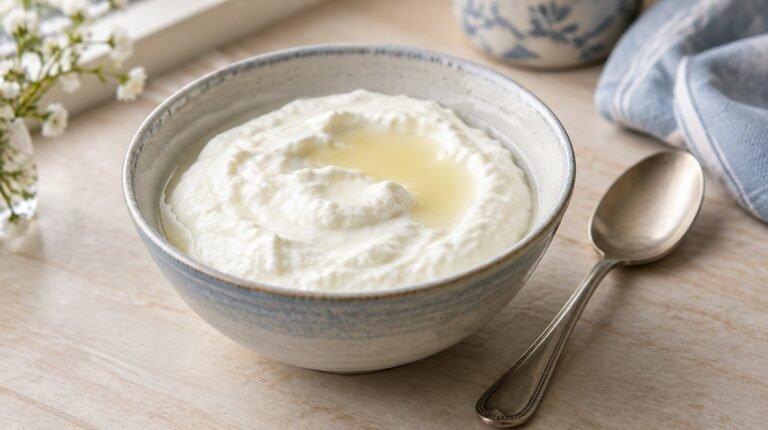
Even a good L. reuteri batch is usually softer than store-bought yogurt, closer to sour cream. If it smells clean and tangy, it probably fermented. How to verify your yogurt cultured explains simple checks.
How to prevent it
- Keep a notebook of the milk, starter amount, temperature and hours for each batch, so you can repeat what works.
- Test your maker with a thermometer every few months.
- Store starter capsules the way the package says, and replace old ones.
- Strain a soft batch in the fridge for 2 to 4 hours if you want it thicker.
When to throw a batch out
UAF Extension says both heat and acidity are needed for a safe home yogurt, and advises discarding batches that fail to set properly. Throw it out if:
- It never soured. After 24 to 36 hours, it still smells and tastes like plain milk or cream. Do not keep re-warming it.
- It smells off. UAF Extension says to discard any yogurt with an odor other than a fresh, acidic smell, or with visible growth. A pink or orange tint is another warning sign.
- You see mold. USDA advises discarding moldy yogurt, because high-moisture foods can be contaminated below the surface.
- It sat out after incubation. Perishable food should not stay at room temperature for more than 2 hours, or 1 hour above 90°F (USDA FSIS).
Related topics
- Lactobacillus reuteri: what the organism is and how it is cultured at home.
- Yogurt Did Not Set: Causes and Fixes: causes that apply to any culture.
- Fermentation Time by Culture: why some cultures need 24 to 36 hours.
- pH and Acidity Targets for Safe Home Fermentation: how sour a safe batch should be.
- Second Batch Failed But First Worked: when a starter loses strength.
Sources
- Hidalgo-Morales M, et al. Lactobacillus reuteri beta-galactosidase activity and low milk acidification ability (Canadian Journal of Microbiology, 2005)
- Mu Q, et al. Role of Lactobacillus reuteri in Human Health and Diseases (Frontiers in Microbiology, 2018)
- Zheng J, et al. A taxonomic note on the genus Lactobacillus: Description of 23 novel genera (International Journal of Systematic and Evolutionary Microbiology, 2020)
- Hernández A, et al. Impact of the fermentation parameters pH and temperature on stress resilience of Lactobacillus reuteri DSM 17938 (AMB Express, 2019)
- Lucey JA. Formation and physical properties of milk protein gels (Journal of Dairy Science, 2002)
- Cream, fluid, half and half (FDC 171255) (USDA FoodData Central, SR Legacy)
- Milk, whole, 3.25% milkfat, with added vitamin D (FDC 171265) (USDA FoodData Central, SR Legacy)
- Making Yogurt at Home (University of Illinois Extension)
- Making Yogurt at Home, FNH-00062 (University of Alaska Fairbanks Cooperative Extension Service)
- Molds on Food: Are They Dangerous? (USDA Food Safety and Inspection Service)
- Leftovers and Food Safety (USDA Food Safety and Inspection Service)