Second Yogurt Batch Failed but First Worked: Causes and Fixes
Why a second batch fails when the first one worked
When your first batch of yogurt set and the second batch failed, something changed between them, and it is almost always the starter, the milk or the temperature. The recipe can be identical and still fail, because a second batch usually starts from a spoonful of the first batch instead of the fresh yogurt or culture packet you began with.
Put the two batches side by side: starter source and age, milk brand and type, amount, container size, temperature and hours. Whatever differs is your lead.
The most likely cause: the starter from batch one
Fresher starter has more active bacteria. Illinois Extension advises using homemade yogurt as starter within 5 to 7 days of making it, and store-bought yogurt before its best-by date (University of Illinois Extension). Common ways the carried-over starter lets you down:
- It was too old, or it came from a jar that had been opened and dipped into all week.
- The bacterial balance shifted. Classic yogurt relies on two species helping each other. Streptococcus thermophilus makes formate, which stimulates Lactobacillus bulgaricus, and L. bulgaricus frees amino acids and peptides from milk protein that feed S. thermophilus, shortening fermentation (Horiuchi and Sasaki, 2012). In a home kitchen nobody controls that ratio from batch to batch, which is one reason a starter can weaken over time.
- The first culture was meant for one batch. Some packet cultures are sold for single use, and probiotic capsules are not always designed to be carried forward. Check the package; our guide to sourcing live cultures explains the options.
- Batch one carried a contaminant. If it smelled a little yeasty or looked odd, those stray microbes came along in the spoonful. See yogurt smells yeasty.
- Phages. These viruses infect starter bacteria. Industry reviews call them one of the most persistent threats to dairy fermentations (Ortiz Charneco and colleagues, 2023) and list adequate sanitizers and limited reuse of recycled material among the controls (Marcó and colleagues, 2012). How often this happens in home kitchens is not well documented.
The fix, step by step

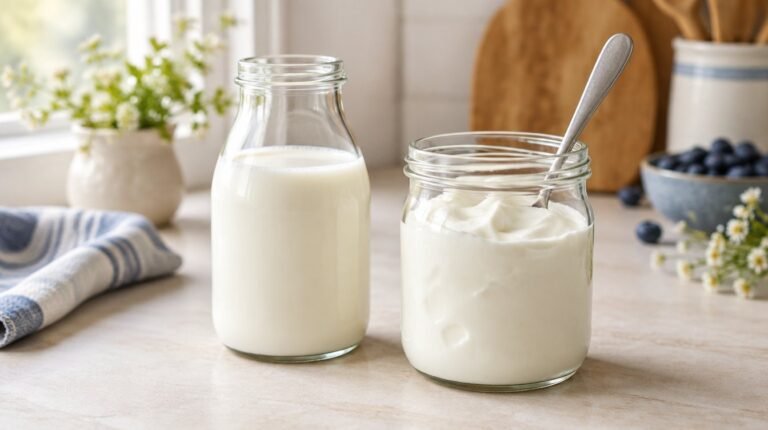
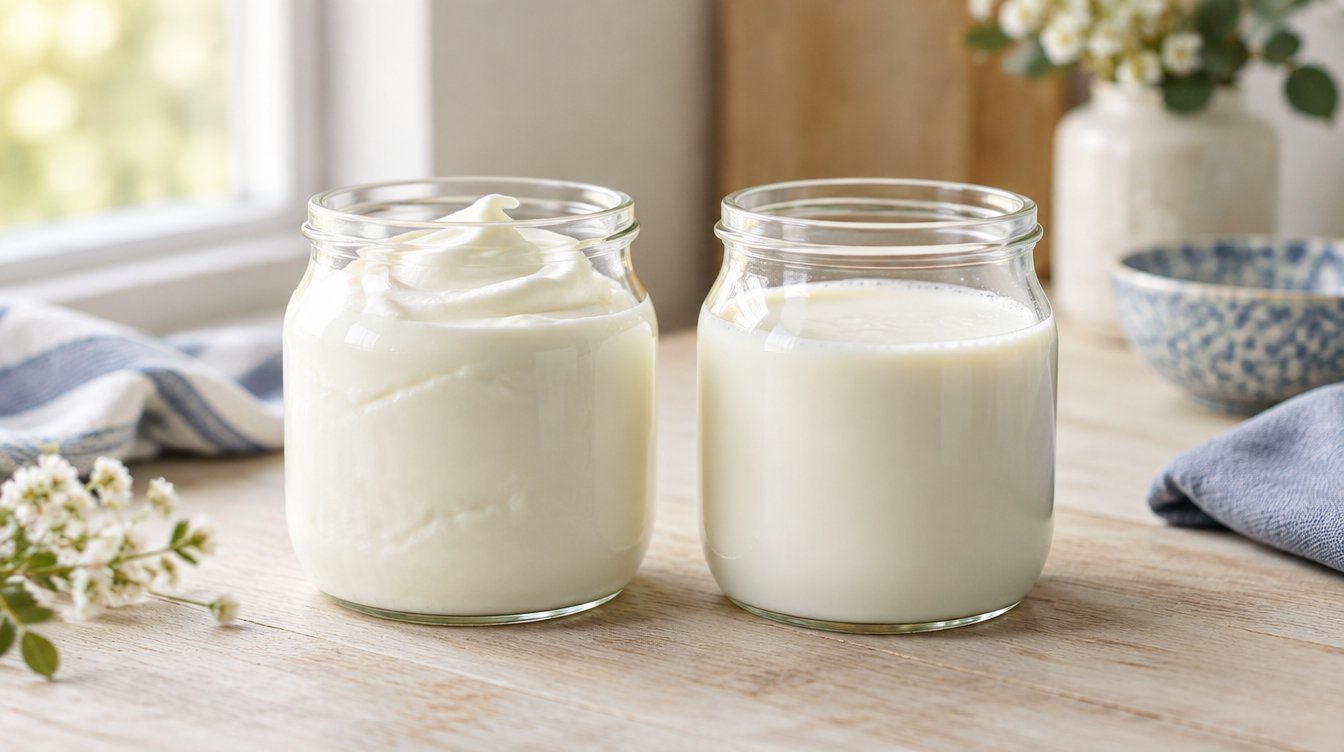
- Judge the failed batch. If it never set and sat warm, throw it out: bacteria grow rapidly between 40 and 140°F (USDA FSIS). If it thickened, smells clean and tangy and shows no spots, it fermented and is only thin.
- Restart with fresh starter: plain store-bought yogurt with live cultures, used before its best-by date, or a new culture packet (University of Illinois Extension).
- Heat the milk to 180 to 185°F, then cool it to 108 to 115°F before adding starter (University of Illinois Extension).
- Use a measured amount of starter, about 2 tablespoons of plain yogurt per quart, whisked smooth into a cup of the warm milk first (University of Illinois Extension).
- Incubate covered and undisturbed at 108 to 115°F for 6 to 10 hours (University of Illinois Extension). Check your thermometer in ice water first; it should read 32°F (USDA FSIS).
- Save starter first. As soon as the new batch is chilled, spoon a few tablespoons into a small clean, covered jar before anyone eats from it, and use it within 5 to 7 days.
Secondary causes: what else changed
- The milk. A new brand, ultra-pasteurized milk or a plant milk can behave differently. Goat milk and skim milk without added milk powder give thinner yogurt (University of Illinois Extension).
- The batch size. A large container takes longer to incubate than small jars (University of Illinois Extension), so the same hours may not be enough.
- The temperature. A colder kitchen, a machine moved near a window, or an oven light left off can shift the heat. Illinois lists incubation that is too hot or too cold as a cause of yogurt that is not firm. See yogurt temperature.
- Cleanliness. Equipment that is not clean is on the same Illinois list. Wash in hot, soapy water, rinse and sanitize, as University of Missouri Extension recommends.
How to keep batch three from failing
- Keep a short log of starter source and age, milk, amount, temperature and hours.
- Set aside starter from every good batch before serving it.
- Restart from a fresh culture whenever batches slow down, thin out or taste off.
When to throw a batch out
- It never set and sat in the 40 to 140°F range; USDA advises discarding perishable food left there more than 2 hours (USDA FSIS).
- You see mold, fuzz, or pink, orange or black spots. USDA says to discard moldy yogurt (USDA FSIS).
- It smells rotten, alcoholic or yeasty instead of clean and tangy.
How many times can I reuse homemade yogurt as starter?
There is no fixed number. Use it within 5 to 7 days (University of Illinois Extension) and restart from a fresh culture when batches weaken.
Will more starter fix a weak batch?
Usually not. Stick to the recipe amount, about 2 tablespoons per quart, and use a fresher starter instead.
Can I stir fresh starter into the failed batch?
Not if it sat warm without setting. That milk should be discarded and the batch started over.
Related topics
- Yogurt Did Not Set: Causes and Fixes: when any batch stays liquid.
- Yogurt Never Thickened After 36 Hours: why a long-failed batch must go.
- Storage, Shelf Life and Re-culturing: how to keep a starter going.
- How Much Yogurt Starter for a Gallon of Milk?: starter amounts by batch size.
- How to Make Yogurt at Home: the full method.
Sources
- Making Yogurt at Home (University of Illinois Extension, 2024)
- Preserve It Fresh, Preserve It Safe: Making Yogurt at Home (HES126) (University of Missouri Extension)
- Horiuchi H, Sasaki Y. Short communication: effect of oxygen on symbiosis between Lactobacillus bulgaricus and Streptococcus thermophilus (J Dairy Sci, 2012)
- Ortiz Charneco G, et al. Bacteriophages in the dairy industry: a problem solved? (Annu Rev Food Sci Technol, 2023)
- Marcó MB, et al. Bacteriophages and dairy fermentations (Bacteriophage, 2012)
- Leftovers and Food Safety (USDA Food Safety and Inspection Service)
- Food Thermometers (USDA Food Safety and Inspection Service)
- Molds on Food: Are They Dangerous? (USDA Food Safety and Inspection Service)