Yogurt Never Thickened After 36 Hours: Causes and Fixes
What it means when yogurt stays liquid this long
If your yogurt never thickened after 36 hours, the culture almost certainly never got going. Yogurt sets when bacteria turn milk sugar into lactic acid, and that acid makes the milk proteins pull together into a gel (University of Illinois Extension). Standard cultures do this in 6 to 10 hours at 108 to 115°F, so milk that is still liquid after a day and a half has made little or no acid.
That also means the batch cannot be rescued. Without acid to protect it, the milk spent 36 hours in the range where, according to USDA, bacteria grow rapidly: 40 to 140°F (USDA FSIS). Throw it out, then work through the causes below before you try again.
The most likely cause: the starter was dead or killed
Illinois Extension puts a starter without live cultures at the top of its list of reasons yogurt is not firm, and notes that starters with dead bacteria will not make yogurt (University of Illinois Extension). The usual ways that happens:
- Milk was too hot when the starter went in. Both Illinois and Missouri Extension cool heated milk to 115°F or below before adding starter. Measure it rather than judging by touch.
- The starter was old. Use store-bought yogurt before its best-by date, and homemade yogurt within 5 to 7 days of making it (University of Illinois Extension).
- Capsules or powder were past their date or stored against the label directions. Our guide to sourcing live cultures covers what to look for.
The fix, step by step

- Discard the failed batch. Do not add new starter to it.
- Check your thermometer. In a glass of ice water it should read 32°F; if it does, it is accurate (USDA FSIS).
- Check your incubator. Fill a jar with water, run the machine for a few hours, and measure the water. A machine that runs cold or hot is a common hidden cause; see yogurt maker temperature drift.
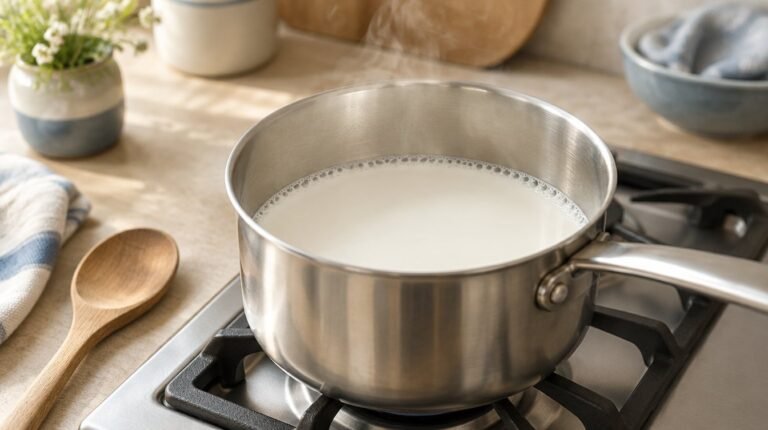
- Heat the milk to 180 to 185°F (University of Illinois Extension). Heating to 180°F denatures whey proteins (University of Missouri Extension), and bonds between caseins and denatured whey proteins help hold a yogurt gel together (Lee and Lucey, 2010).
- Cool to 108 to 115°F, measured, before adding starter (University of Illinois Extension). For probiotic strains, use the temperature for your strain.
- Add fresh starter, about 2 tablespoons of plain yogurt per quart of milk, stirred smooth into a cup of the warm milk first (University of Illinois Extension).
- Incubate covered and undisturbed, and check early. For a standard culture, test at 6 to 8 hours: if it still moves like milk on a spoon, give it 2 more hours and test again (University of Illinois Extension). If nothing has happened by about 12 hours, stop and look upstream instead of waiting.
Secondary causes
- Incubation too hot or too cold. Illinois lists both as causes of yogurt that is not firm (University of Illinois Extension). Incubation temperature shapes texture (Lee and Lucey, 2010).
- A slow probiotic strain. Cultures such as L. reuteri and L. gasseri are often fermented for 24 to 36 hours, so the timing rules for regular yogurt do not apply. See fermentation time by culture and reuteri yogurt did not thicken.
- Plant milk. A dairy yogurt gel is built mainly from casein, a milk protein (Lee and Lucey, 2010), so many plant milks set poorly without help. See plant milk would not thicken.
- Antibiotic residues. In a 1972 lab study, yogurt bacteria were inhibited by very small amounts of penicillin and other antibiotics (Cogan, 1972). If you use milk straight from a farm, ask whether a recently treated animal was milked into it.
- Goat milk or unfortified skim milk. These tend to give thin yogurt rather than none at all (University of Illinois Extension). If yours thickened a little, see yogurt is runny or thin.
How to prevent it next time
- Measure milk temperature every time, before the starter goes in.
- Test a new starter or a new machine with one small jar before committing a full batch.
- Set a reminder to check standard cultures at 8 to 12 hours, not 36.
- Use an incubator that holds a set temperature for long probiotic ferments.
When to throw a batch out
- It never thickened after a long incubation. Milk that stays liquid has not soured, and USDA advises discarding perishable food left in the 40 to 140°F range for more than 2 hours (USDA FSIS).
- You see mold, fuzz, or pink or orange spots. USDA says to discard yogurt with mold (USDA FSIS).
- It smells rotten, yeasty or “off” rather than clean and tangy.
Can I add more starter and keep incubating?
Not after 36 hours. The milk has sat warm without acid to protect it, so start over with fresh milk (USDA FSIS).
How long should yogurt take to set?
Standard cultures usually set in 6 to 10 hours at 108 to 115°F (University of Illinois Extension). Long-ferment probiotic strains take longer.
Can I drink milk that did not turn into yogurt?
No. Unsoured milk that sat warm for hours should be thrown out, not drunk or cooked.
Related topics
- Yogurt Did Not Set: Causes and Fixes: the shorter-incubation version of this problem.
- How Long to Incubate Yogurt?: timing by culture and temperature.
- Ultra-Pasteurized Milk Would Not Culture: when the milk is the suspect.
- How to Verify Your Yogurt Actually Cultured: signs a batch fermented properly.
- Yogurt Starter: choosing and keeping a starter.
Sources
- Making Yogurt at Home (University of Illinois Extension, 2024)
- Preserve It Fresh, Preserve It Safe: Making Yogurt at Home (HES126) (University of Missouri Extension)
- Lee WJ, Lucey JA. Formation and physical properties of yogurt (Asian-Australas J Anim Sci, 2010)
- Cogan TM. Susceptibility of cheese and yoghurt starter bacteria to antibiotics (Appl Microbiol, 1972)
- Leftovers and Food Safety (USDA Food Safety and Inspection Service)
- Food Thermometers (USDA Food Safety and Inspection Service)
- Molds on Food: Are They Dangerous? (USDA Food Safety and Inspection Service)