Akkermansia muciniphila: Can You Culture It at Home?
The short answer
You cannot make an Akkermansia muciniphila yogurt at home, at least not in any way that would give you a jar full of it. This gut bacterium was first grown in the lab in an oxygen-free medium where pig stomach mucin was its only food (Derrien et al., 2004). A pot of warm milk on your counter offers neither of those conditions.
That is why the temperature and time in this guide read “n/a”. What you can do is understand what the research on it actually shows, avoid the mistakes people make when they try to ferment it, and focus on the parts you control: the foods that feed the microbes already living in your gut, and a yogurt made from cultures that do grow in milk.
What Akkermansia muciniphila is
A. muciniphila lives in the layer of mucus that lines the inside of the human gut. Its name means “mucin-loving”, and it earns it: it breaks down mucin, the main protein in that mucus, and uses it for both carbon and nitrogen. Dutch researchers at Wageningen University described it as a new genus and species in 2004, after isolating strain MucT from a person’s stool (Derrien et al., 2004).
It looks nothing like a yogurt bacterium. It is a Gram-negative, oval-shaped cell that does not form spores, and the original paper described it as strictly anaerobic. It could grow on a few sugars, including glucose, but only when a protein source was added, and it grew more slowly and to lower numbers than it did on mucin. Milk is not mucin, and plain sugars alone were not enough.
Later work found it is more oxygen tolerant than first thought. At the oxygen levels found right next to the gut wall, measured in nanomolar amounts, it can even use oxygen and grow a little faster (Ouwerkerk et al., 2016). Nanomolar is a tiny fraction of the oxygen in open air or in a jar of milk, so this finding does not make it a kitchen culture.
Where it sits in the family tree
| Domain | Phylum | Genus | Species | Strain |
|---|---|---|---|---|
| Bacteria | Verrucomicrobiota (formerly Verrucomicrobia) | Akkermansia | A. muciniphila | Type strain MucT (ATCC BAA-835, DSM 22959); commercial products use their own strains |
The List of Prokaryotic names with Standing in Nomenclature (LPSN) lists A. muciniphila as a validly published, correct name in risk group 1, the lowest-risk category. The phylum name Verrucomicrobiota was formally published in 2021 alongside 41 other phylum names (Oren and Garrity, 2021).
Its closest described relative at the time of discovery shared only 92% of the key 16S rRNA gene sequence, which is why it got a genus of its own. In practical terms, it is about as distant from the lactobacilli in your yogurt as a bacterium can be while still living in the same gut.
What the research shows
Most of the interest in this bacterium comes from studies linking it to metabolic health. The evidence moves from mice to small human trials, and the details matter.
Mouse studies
In mice, levels of A. muciniphila fell with obesity and type 2 diabetes, and feeding a prebiotic fiber brought them back up. Giving live A. muciniphila to mice on a high-fat diet reduced fat-mass gain and insulin resistance, while heat-killed cells did not help in that study (Everard et al., 2013). Mouse results are a starting point, not proof of anything in people.
Observational work in people
In 49 overweight or obese adults (41 of them women) on a 6-week calorie-restricted diet followed by 6 weeks of weight stabilization, people who started with more A. muciniphila had healthier fasting glucose, blood fats and body-fat distribution, and they saw bigger improvements in insulin sensitivity markers (Dao et al., 2016). This shows an association. It does not show that the bacterium caused the better health.
The first human supplement trial
A small randomized, double-blind, placebo-controlled pilot study enrolled 40 overweight or obese adults with insulin resistance, and 32 finished. They took 10 billion A. muciniphila cells a day, live or pasteurized, for three months. Both forms were safe and well tolerated. The pasteurized form improved insulin sensitivity by about 29% and lowered insulin and total cholesterol compared with placebo, while changes in body weight and fat mass were small and not statistically significant (Depommier et al., Nature Medicine, 2019).
Two details help when you read the marketing. First, the pasteurized (dead) form did better than the live one in this trial, the opposite of what most people expect from a probiotic. Second, several authors are named as inventors on patents covering the use of this bacterium, which the paper discloses.
Multi-strain products
A 12-week trial in 76 people with type 2 diabetes tested a five-strain capsule containing A. muciniphila, two Clostridium species, Bifidobacterium infantis, Anaerobutyricum hallii and inulin. Compared with placebo, it modestly improved blood sugar after a test meal and lowered A1c by 0.6 points (Perraudeau et al., 2020). The study was run by employees of Pendulum Therapeutics, which sells the product, and the authors note the small sample. Because several strains were combined, it cannot tell you what A. muciniphila did on its own. Our Pendulum review covers the brand in more detail.
Yogurt with an Akkermansia postbiotic
One Iranian trial gave 66 overweight or obese adults low-fat yogurt for 8 weeks: plain, with a Lactobacillus rhamnosus postbiotic, or with an A. muciniphila postbiotic (non-living bacterial material). The Akkermansia group saw small reductions in waist size, body-fat percentage and one liver enzyme compared with plain yogurt (Aalipanah et al., 2025). The groups had only 22 people each, and the bacteria were added to finished yogurt, not grown in it. The authors say further studies are needed.
Regulatory status
In 2021, the European Food Safety Authority concluded that pasteurized A. muciniphila is safe as a food supplement for adults at up to 34 billion cells a day, on the condition that it contains essentially no live cells. The opinion excludes pregnant and breastfeeding women (EFSA NDA Panel, 2021). A safety opinion is not a judgment that a product works. A 2017 review by two of the bacterium’s discoverers calls it a “promising candidate” and notes that pasteurization made it more stable (Cani and de Vos, 2017).
Why it will not grow in a yogurt maker
People who try to make an Akkermansia muciniphila yogurt usually open a capsule into warm milk and leave it for a day or two, the way they would with Lactobacillus reuteri. Here is why that does not work.
- Wrong food. It grows best on mucin, and in the original lab work it managed only weak growth on a few simple sugars even with added protein. Milk is a poor match for it.
- Too much oxygen. It tolerates only trace oxygen. A jar of milk under a loose lid holds far more.
- Many capsules contain dead cells. The form approved in Europe and tested most successfully in people is pasteurized. Dead cells cannot multiply, whatever the temperature.
- Other microbes win. If anything sours the milk over 24 to 48 hours, it is far more likely to be lactic acid bacteria from the capsule’s other ingredients, or stray bacteria from your kitchen, than A. muciniphila.
- No way to check. You cannot taste, smell or see whether this bacterium grew. Only lab methods such as DNA sequencing can count it.
What you can do at home instead
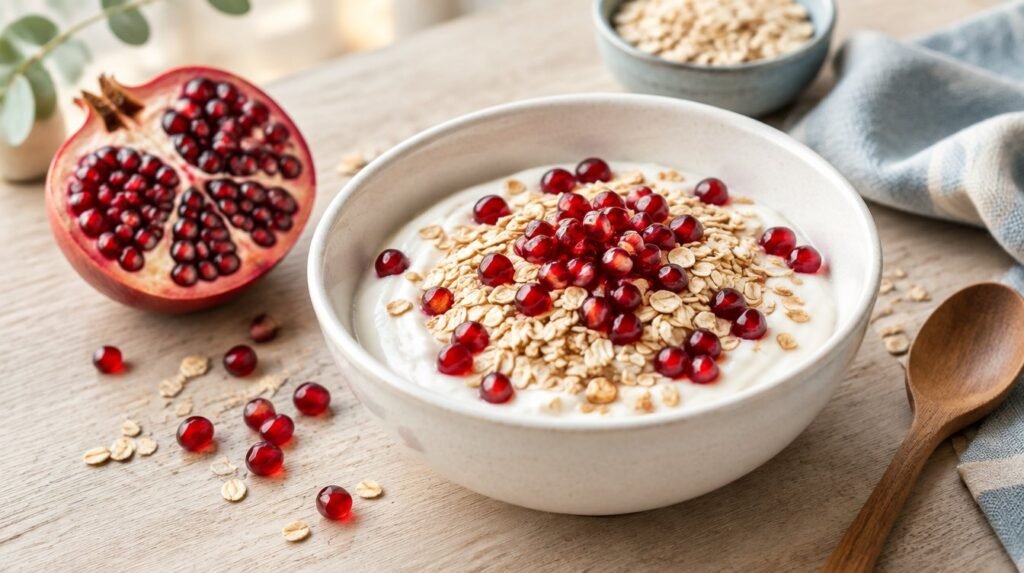
There is no home protocol for growing this organism, but there is a practical plan for people interested in it. Work through these steps in order.
- Start with your diet. A systematic review of 29 dietary trials (1,444 people in total, though only 11 trials measured A. muciniphila) found that calorie restriction and supplements of inulin, polydextrose, pomegranate extract, resveratrol, sodium butyrate and a yeast fermentate increased its levels, while a low-FODMAP diet reduced them (Verhoog et al., 2019). The authors call the evidence unclear and say more research is needed. Our guide to fiber supplements covers inulin and other fibers.
- Make yogurt with cultures that do grow in milk. Classic yogurt cultures, or human-gut lactobacilli such as L. reuteri and L. gasseri, ferment lactose and set milk at home. Heat the milk to 180°F, cool it to about 115°F before adding culture, and hold the temperature the culture needs ({a(U[“mizzou”], “University of Missouri Extension”)}).
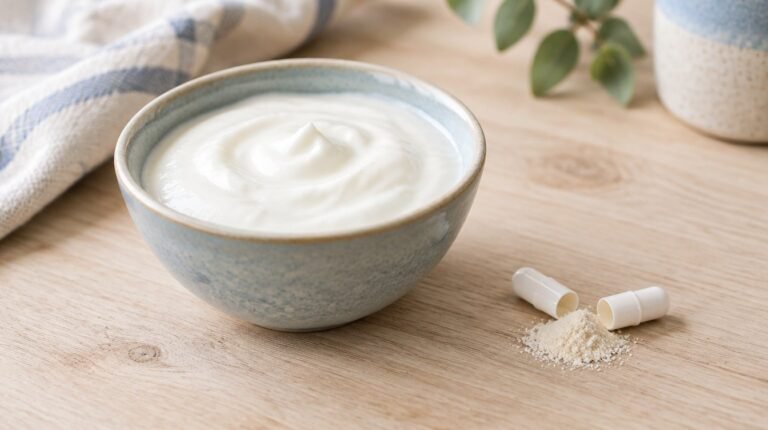
- If you buy an Akkermansia supplement, take it as the label directs. Do not try to multiply it in milk. Stirring capsule powder into a bowl of finished yogurt just before you eat it is a matter of convenience; it is not fermentation.
- Check with your clinician first if you are in a higher-risk group. See the safety note below.
- Measure only if you are curious. A stool test is the only way to estimate how much of this bacterium you carry. See our guide to the stool test for gut health for what these tests can and cannot tell you.
How to tell whether anything worked
For a home ferment, there is no reliable sign. A thick, sour jar after an “Akkermansia yogurt” attempt tells you that some acid-making bacteria grew. It says nothing about A. muciniphila.
For your gut, consumer stool tests that report Akkermansia levels use DNA sequencing, and results can shift from one sample to the next. In the studies above, levels rose and fell with diet, so a single test is a snapshot. Notice too that in the calorie-restriction study, levels went down as people lost weight and improved their insulin markers, so a lower number on a test is not automatically bad news.
Common mistakes and what to do
| What happened | Likely cause | What to do |
|---|---|---|
| Milk soured and thickened | Other bacteria in the capsule blend or from the kitchen | Do not assume it is Akkermansia. If it smells clean and tangy, it is likely a lactic ferment; if you are unsure, discard it. |
| Milk stayed thin and sweet after 24 hours | Nothing grew, likely because the cells were pasteurized or could not grow in milk | Throw it out. Milk held warm with no acid forming is not safe to keep. |
| Gray, pink or fuzzy spots, or a rotten smell | Contamination | Discard the whole jar. The USDA advises throwing out yogurt with mold because soft foods can be contaminated below the surface (USDA FSIS). |
| Bloating or gas after starting a supplement | Gas is a known, usually mild side effect of probiotics (NIH ODS) | Lower the amount or stop, and talk with your clinician if it persists. |
Safety note
Probiotics have a good safety record in healthy people, but the risk of harmful effects is greater in people with severe illnesses or compromised immune systems, and serious infections have been reported in premature infants given probiotics (NCCIH). The NIH Office of Dietary Supplements advises asking your health care provider before trying probiotics, and says they may not be safe for people who are seriously ill or have weak immune systems (NIH ODS). If you are pregnant, immunocompromised, critically ill or have a central line, talk to your clinician first. The European safety opinion on pasteurized A. muciniphila did not cover pregnant or breastfeeding women.
Akkermansia capsules in the US are sold as dietary supplements. The FDA does not approve supplements for safety or effectiveness before they go on sale; their makers are responsible for evaluating safety and labeling before marketing (FDA). This article is general information, not medical advice.
Related topics
- Pendulum: a closer look at one brand that sells Akkermansia.
- Gut Health Test: how at-home microbiome tests work.
- Lactobacillus reuteri: a gut bacterium you can culture in milk.
- Bifidobacterium infantis: another strain in the multi-strain trial above.
- Best Probiotic for Weight Loss: what trials show for weight and metabolism.
- Probiotic vs Yogurt: how capsules and fermented foods differ.
Sources
- Derrien M, et al. Akkermansia muciniphila gen. nov., sp. nov., a human intestinal mucin-degrading bacterium (Int J Syst Evol Microbiol, 2004)
- Ouwerkerk JP, et al. Adaptation of Akkermansia muciniphila to the oxic-anoxic interface of the mucus layer (Appl Environ Microbiol, 2016)
- Akkermansia muciniphila (List of Prokaryotic names with Standing in Nomenclature, DSMZ)
- Oren A, Garrity GM. Valid publication of the names of forty-two phyla of prokaryotes (Int J Syst Evol Microbiol, 2021)
- Everard A, et al. Cross-talk between Akkermansia muciniphila and intestinal epithelium controls diet-induced obesity (Proc Natl Acad Sci U S A, 2013)
- Dao MC, et al. Akkermansia muciniphila and improved metabolic health during a dietary intervention in obesity: relationship with gut microbiome richness and ecology (Gut, 2016)
- Depommier C, et al. Supplementation with Akkermansia muciniphila in overweight and obese human volunteers: a proof-of-concept exploratory study (Nat Med, 2019)
- Perraudeau F, et al. Improvements to postprandial glucose control in subjects with type 2 diabetes: a multicenter, double blind, randomized placebo-controlled trial of a novel probiotic formulation (BMJ Open Diabetes Res Care, 2020)
- Aalipanah E, et al. Comparing the effects of yogurt containing Akkermansia muciniphilia postbiotic with yogurt containing Lactobacillus rhamnosus postbiotic on body composition, biochemical indices, appetite, and depression scores in overweight or obese adults (Clin Nutr ESPEN, 2025)
- EFSA NDA Panel. Safety of pasteurised Akkermansia muciniphila as a novel food pursuant to Regulation (EU) 2015/2283 (EFSA J, 2021)
- Cani PD, de Vos WM. Next-generation beneficial microbes: the case of Akkermansia muciniphila (Front Microbiol, 2017)
- Verhoog S, et al. Dietary factors and modulation of bacteria strains of Akkermansia muciniphila and Faecalibacterium prausnitzii: a systematic review (Nutrients, 2019)
- Making Yogurt at Home (Preserve It Fresh, Preserve It Safe, HES126) (University of Missouri Extension)
- Molds on Food: Are They Dangerous? (USDA Food Safety and Inspection Service)
- Probiotics: Usefulness and Safety (National Center for Complementary and Integrative Health)
- Probiotics: Fact Sheet for Consumers (NIH Office of Dietary Supplements)
- Dietary Supplements (U.S. Food and Drug Administration)