Saccharomyces boulardii Yogurt: Can You Make It at Home?
What Saccharomyces boulardii is
Saccharomyces boulardii is a probiotic yeast, not a bacterium. It was isolated from fruit in Indochina and has been used as a remedy for diarrhea since 1950 (Edwards-Ingram et al., Applied and Environmental Microbiology, 2007). Today it is sold mainly as capsules and powder sachets, and the most studied strain is CNCM I-745.
It is a close relative of baker’s and brewer’s yeast. Its genome is so similar to Saccharomyces cerevisiae that researchers say the two should be classed as one species. It still behaves differently: it copes better with acid, carries an extra copy of one chromosome and rarely forms spores (Edwards-Ingram et al., 2007). Another comparison found it grows and survives better under heat and acid stress than a lab strain of baker’s yeast (Fietto et al., Canadian Journal of Microbiology, 2004). Unlike other Saccharomyces strains, which grow best at about 30°C (86°F), it survives best at body temperature, 37°C (98.6°F) (Sarwar et al., Foods, 2019).
The short answer on Saccharomyces boulardii yogurt: you do not culture S. boulardii the way you culture yogurt bacteria, which is why there is no single temperature and time for it. The yeast is not what sets the milk. Yogurt bacteria do that, and the FDA standard for yogurt requires two of them, L. bulgaricus and Streptococcus thermophilus (21 CFR 131.200). You make yogurt as usual and add the yeast, either with the starter or after the yogurt is made.
Where it sits in the family tree
Yeasts are fungi, so S. boulardii sits on a completely different branch of life from yogurt bacteria. The NCBI Taxonomy database does not list it as its own species. It files the name Saccharomyces boulardii under Saccharomyces cerevisiae and marks it as not validly published.
| Domain | Phylum | Genus | Species | Strain |
|---|---|---|---|---|
| Eukaryota (kingdom Fungi) | Ascomycota | Saccharomyces | S. cerevisiae (sold as S. boulardii or S. cerevisiae var. boulardii) | CNCM I-745 is the most studied |
The practical result: a label that says S. boulardii and one that says S. cerevisiae var. boulardii mean the same organism. What matters for the research is the strain, so look for a strain code on the label.
What the research says
Capsule and sachet trials
Most human evidence comes from supplements, not food. A 2015 meta-analysis pooled 21 randomized trials with 4,780 people taking antibiotics. Diarrhea linked to the antibiotics occurred in 8.5 percent of those given S. boulardii, compared with 18.7 percent of those given placebo or nothing. The results held in children and adults. For C. difficile diarrhea, the difference was significant only in children, in two trials (Szajewska and Kołodziej, Alimentary Pharmacology and Therapeutics, 2015).
For acute diarrhea, the NIH Office of Dietary Supplements reports that across 22 trials with 2,440 participants, S. boulardii at roughly 1 to 10 billion CFU a day for 5 to 10 days shortened diarrhea, by about a day on average. Those trials used measured doses of a known strain. A spoonful of homemade yogurt with an opened capsule is not the same thing, and none of this means yogurt treats diarrhea. Anyone with severe or lasting diarrhea should see a doctor.
Yeast in yogurt
Food scientists have tested yogurt made with this yeast. In one study, milk was heated to 85°C (185°F) for 30 minutes, cooled to 43°C (109°F), inoculated with a standard yogurt culture and then with S. boulardii CNCM I-745, and incubated at about 43°C until it reached pH 4.5. Yeast counts started at 100 million or more per gram. In yogurt without added fiber they fell to about 300,000 per gram (5.5 log CFU) after 28 days in the fridge. Adding 1 to 2 percent inulin kept counts above 1 million per gram (Sarwar et al., 2019).
A follow-up study from the same group tracked chemical changes in yogurt made with CNCM I-745, with and without inulin, over 28 days at 4°C (39°F), and found inulin changed which compounds formed (Zhou et al., Food Chemistry, 2025). Both studies are lab work on texture, survival and chemistry. Neither tested health effects in people.
Yeast in other ferments
Yeast and lactic acid bacteria share milk in some traditional drinks. The sour milk in a 1996 blood pressure trial was fermented with Lactobacillus helveticus and S. cerevisiae together (Hata et al., American Journal of Clinical Nutrition, 1996); see our Lactobacillus helveticus guide. Given sugar, though, this yeast makes alcohol. When researchers fermented lychee juice with S. boulardii for 24 hours at 30°C and added sugar, the sweetest version reached about 8.7 percent ethanol (Moreira Terhaag et al., Foods, 2025). That is a reason to keep sugar, honey and fruit out of the jar until serving time.
Safety
S. boulardii is a live yeast, and in rare cases it has entered the bloodstream. In one Spanish intensive care unit, three patients developed yeast bloodstream infections after receiving an S. boulardii probiotic through a feeding tube; the yeast in their blood matched the product by DNA fingerprinting. The authors found 57 other published cases of this yeast in the blood, most in intensive care or on tube or IV feeding, and urged care in people who are critically ill or immunosuppressed (Muñoz et al., Clinical Infectious Diseases, 2005). The NIH ODS adds central venous catheters to the list of risk factors.
If you or someone you live with is immunocompromised, critically ill, pregnant or has a central line, talk with a doctor before using S. boulardii (NCCIH). Probiotic supplements are not approved by the FDA for safety or effectiveness before sale (FDA). For more on dose questions, see can you take too many probiotics.
How to make Saccharomyces boulardii yogurt at home
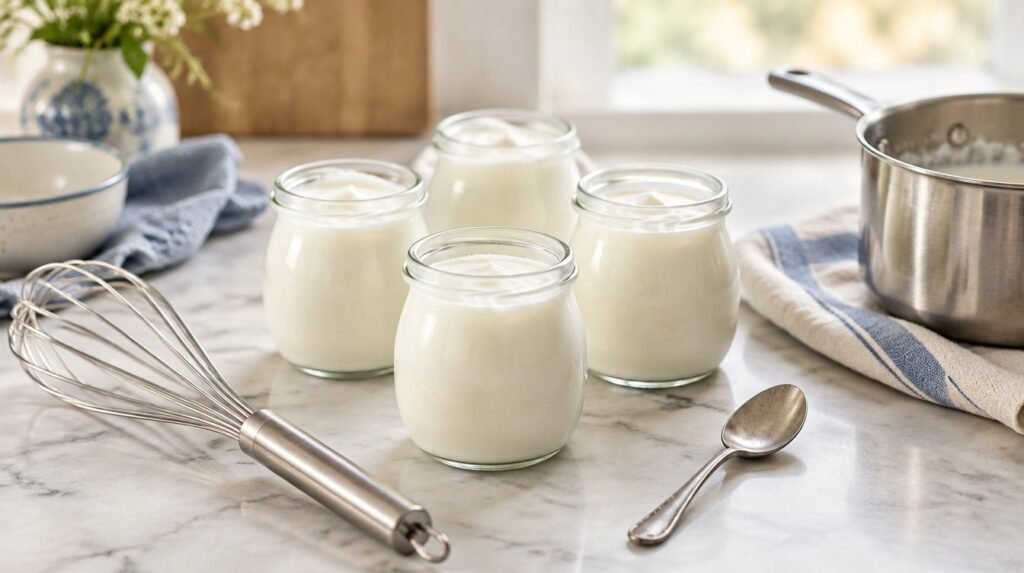
There are two ways to do it. The stir-in method adds the yeast to finished yogurt and skips culturing it entirely. The co-culture method follows the research above and adds the yeast with the yogurt starter. Both start from a normal batch of yogurt, using the heating and cooling steps from the University of Alaska Fairbanks Cooperative Extension Service. Our how to make yogurt at home guide covers the basics.
You will need: 1 quart of pasteurized whole or 2% milk, a live yogurt starter (packet, or 1/4 cup of plain yogurt with live cultures), one S. boulardii capsule or sachet, an instant-read thermometer, clean jars and an incubator that holds about 110°F. Optional: about 10 grams (1 percent) of inulin powder.
- Clean everything. Wash the pot, whisk, thermometer and jars in hot, soapy water and rinse well.
- Heat the milk to 185°F (85°C). Hold it at 185 to 200°F for 10 to 20 minutes without boiling (UAF Extension).
- Cool to 110 to 112°F (43 to 44°C). Never add cultures above 115°F.
- Add the yogurt starter. Mix it into a cup of the warm milk, then stir it back in. See our yogurt starter guide for options.
- Co-culture method only: open the capsule and whisk its contents, plus the inulin if using, into the milk now.
- Incubate at about 110°F (43°C) until set. The UAF guide gives 4 to 7 hours for a standard culture; a slower probiotic starter may need longer. Our guide to how to incubate yogurt covers setups.
- Chill at 40°F (4°C) or colder.
- Stir-in method only: once the yogurt is cold, stir one capsule’s contents into a jar or a single serving shortly before eating.
- Eat it sooner rather than later. Yeast counts dropped steadily over four weeks in the fridge in the study above. Plain homemade yogurt keeps about 10 to 21 days (UAF Extension); see how long homemade yogurt lasts.
Which method to pick: the stir-in method is simpler and does not depend on the yeast surviving incubation, so you know what went into each serving. The co-culture method matches the lab studies but adds a variable. Either way, check the label: supplement labels are only required to list the weight of the microorganisms, which can include dead cells, and CFU counts are voluntary (NIH ODS). A CFU count “at expiration” tells you more than one “at manufacture.”
How to tell it worked
- The yogurt sets. It holds together and pulls away from the side of the jar. This shows the bacteria worked; the yeast does not set milk.
- The pH is 4.6 or lower. That is the FDA mark for yogurt (21 CFR 131.200). Food-grade pH strips work.
- It tastes like plain yogurt. A faint bready note may show up with the co-culture method. Strong fizz or an alcohol smell means the yeast found extra sugar.
- Know the limits. There is no home test for how much live yeast is in the jar. Only a lab count can tell you.
Common problems and fixes
| Problem | Likely cause | Fix |
|---|---|---|
| Did not set | Weak yogurt starter or wrong temperature | The yeast is not the problem. Use a fresh live starter and check the incubator temperature. |
| Fizzy or smells of alcohol | Sugar, honey or fruit added before culturing | Keep sweeteners and fruit for serving time. |
| Bready or yeasty flavor | Yeast growing during incubation | Switch to the stir-in method. |
| Capsule powder clumps | Added straight to cold yogurt | Mix the powder into a spoonful of yogurt first, then stir it into the rest. |
| Fuzzy mold, pink or orange spots | Contamination | Throw it out and start over with clean jars. |
The USDA advises throwing out yogurt with mold, because soft foods can be contaminated below the surface and bacteria can grow alongside the mold (USDA FSIS, Molds on Food). Never taste a batch that smells wrong.
This article is general information about home fermentation and is not medical advice.
Related topics
- Kefir Benefits: What the Evidence Shows: a cultured milk that naturally contains yeasts.
- Lactobacillus reuteri: a probiotic bacterium that is cultured in milk.
- Probiotic vs Yogurt: Which Is Better?: how capsules and cultured foods differ.
- How to Restore Gut Health After Antibiotics: food and probiotic options after a course of antibiotics.
- Akkermansia muciniphila: another probiotic that does not fit the usual yogurt method.
Sources
- 21 CFR 131.200 Yogurt (U.S. Food and Drug Administration, Electronic Code of Federal Regulations)
- Making Yogurt at Home (University of Alaska Fairbanks Cooperative Extension Service)
- Saccharomyces cerevisiae, Taxonomy Browser (National Center for Biotechnology Information)
- Molds on Food: Are They Dangerous? (USDA Food Safety and Inspection Service)
- Probiotics: Fact Sheet for Health Professionals (NIH Office of Dietary Supplements)
- Probiotics: What You Need To Know (National Center for Complementary and Integrative Health)
- Dietary Supplements (U.S. Food and Drug Administration)
- Edwards-Ingram L, et al. Genotypic and physiological characterization of Saccharomyces boulardii, the probiotic strain of Saccharomyces cerevisiae (Appl Environ Microbiol, 2007)
- Fietto JL, et al. Molecular and physiological comparisons between Saccharomyces cerevisiae and Saccharomyces boulardii (Can J Microbiol, 2004)
- Szajewska H, Kołodziej M. Systematic review with meta-analysis: Saccharomyces boulardii in the prevention of antibiotic-associated diarrhoea (Aliment Pharmacol Ther, 2015)
- Sarwar A, et al. Physicochemical and microbiological properties of synbiotic yogurt made with probiotic yeast Saccharomyces boulardii in combination with inulin (Foods, 2019)
- Zhou Z, et al. Identification of potential key metabolites in synbiotic yoghurt made with probiotic Saccharomyces cerevisiae var. boulardii CNCM I-745 and prebiotic inulin by non-targeted metabolomics analysis (Food Chem, 2025)
- Moreira Terhaag M, et al. The probiotication of a lychee beverage with Saccharomyces boulardii: an alternative to dairy-based probiotic products (Foods, 2025)
- Hata Y, et al. A placebo-controlled study of the effect of sour milk on blood pressure in hypertensive subjects (Am J Clin Nutr, 1996)
- Muñoz P, et al. Saccharomyces cerevisiae fungemia: an emerging infectious disease (Clin Infect Dis, 2005)