Leuconostoc mesenteroides: How to Culture It at Home (72-77°F / 12h)
What Leuconostoc mesenteroides is
Leuconostoc mesenteroides is a lactic acid bacterium found on plants, in vegetable ferments and in many traditional dairy cultures. It is a round bacterium (a coccus) rather than a rod, and it is heterofermentative, meaning it breaks down sugar by a route (the phosphoketolase pathway) that yields more than lactic acid alone (Frantzen et al., 2017). In milk it is valued for aroma and a little carbon dioxide gas rather than for strong souring.
In vegetables, it is a major player. Studies of commercial sauerkraut have long listed L. mesenteroides among the four primary lactic acid bacteria in the process, alongside Lactobacillus plantarum and others (Plengvidhya et al., 2007). In dairy, it plays a quieter supporting role in mixed mesophilic starter cultures, such as those used for Dutch-type cheeses, where it adds aroma and a little gas (Frantzen et al., 2017).
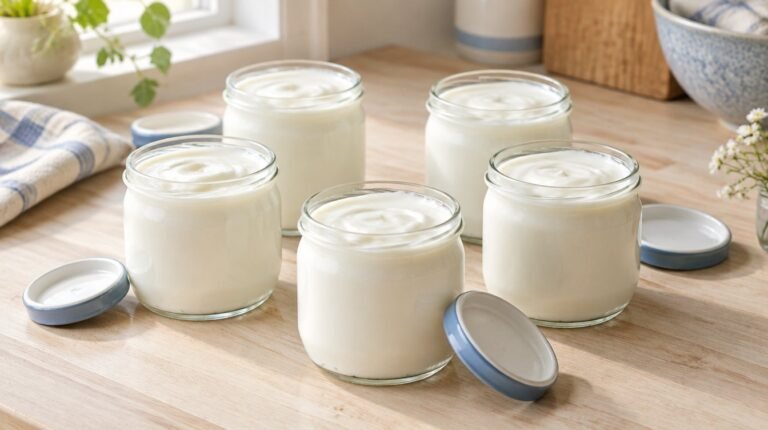
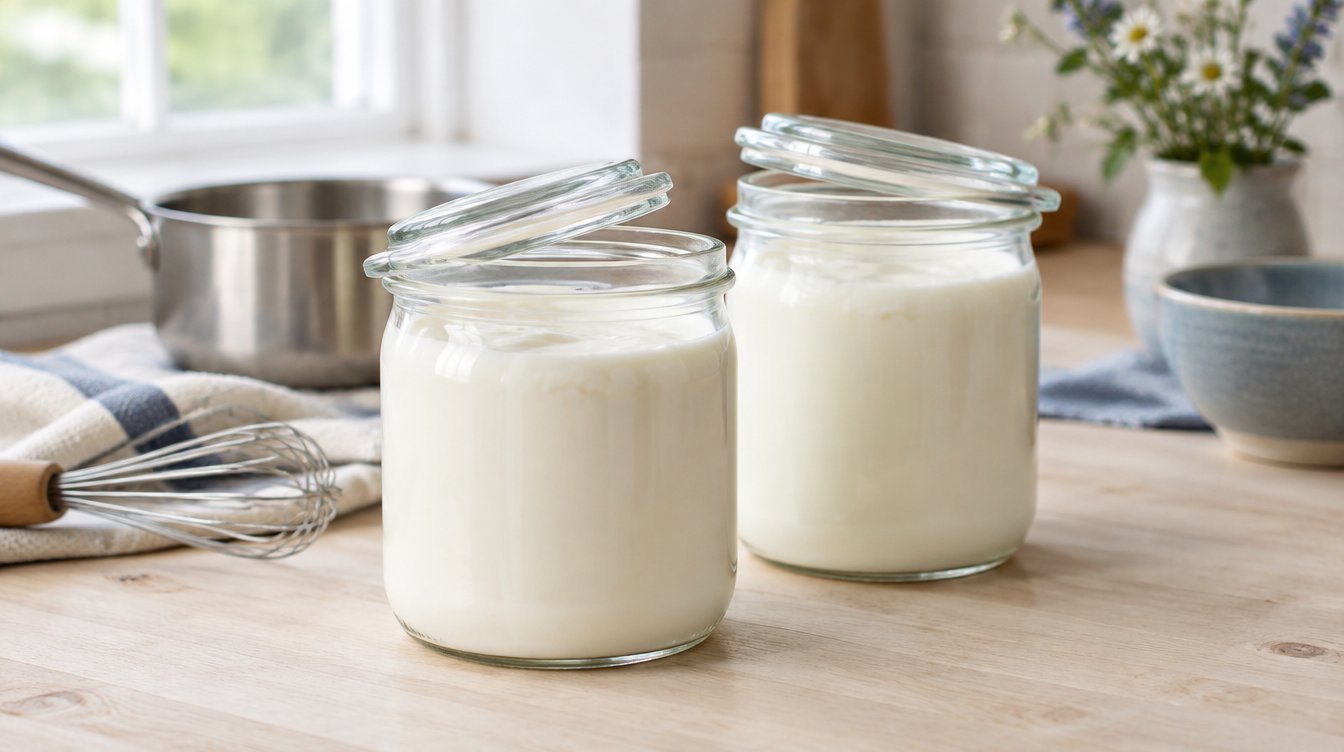
If you searched for leuconostoc mesenteroides yogurt, one point first: what you make with it is not yogurt in the legal sense. In the United States, yogurt must be cultured with Lactobacillus delbrueckii subsp. bulgaricus and Streptococcus thermophilus (21 CFR 131.200). A Leuconostoc ferment is a mesophilic cultured milk, closer to buttermilk or a soft, mild sour milk. It is made at room temperature, 72 to 77°F (22 to 25°C), not in a hot yogurt maker.
Taxonomy at a glance
| Domain | Phylum | Genus | Species | Strain |
|---|---|---|---|---|
| Bacteria | Bacillota (formerly Firmicutes) | Leuconostoc | L. mesenteroides | Varies by product; dairy aroma cultures often list subsp. cremoris |
The List of Prokaryotic names with Standing in Nomenclature (LPSN) places L. mesenteroides in the family Lactobacillaceae and lists it in risk group 1, the lowest-risk category. It has five named subspecies, including cremoris, dextranicum, mesenteroides and jonggajibkimchii (from kimchi). The family is new: in 2020, taxonomists folded the old Leuconostocaceae family into Lactobacillaceae while splitting up the genus Lactobacillus (Zheng et al., 2020). The phylum name Bacillota became the valid name in 2021, with Firmicutes kept as a synonym (LPSN).
Subspecies and strain matter here more than usual. Compared with other dairy leuconostocs, the subspecies cremoris grows more slowly and to a lower density ({a(FR,”Frantzen et al., 2017″)}). Read the culture label for the full name, and treat any study as applying to its own strain.
What the research shows
Most research on L. mesenteroides is food science: how it shapes flavor, texture and safety in ferments. Human trials are few, small and strain-specific, and none tested a homemade cultured milk.
Why it needs a partner in milk
A genome study of dairy Leuconostoc strains explains a practical problem. Leuconostocs lack the enzymes to break down milk protein, so they depend on small protein fragments released by other bacteria, and they “commonly grow poorly in milk without the presence of lactococci” (Frantzen et al., 2017). In mixed mesophilic starters, Leuconostoc makes up only about 1 to 10% of the bacteria, while Lactococcus does most of the souring. The same paper notes that the dairy subspecies cremoris grows slowly and not at all at 86°F (30°C) or above.
In those mixed starters, Leuconostoc and a citrate-using type of Lactococcus turn the citrate naturally present in milk into diacetyl (a buttery-smelling aroma compound), acetoin and carbon dioxide, while other Lactococcus strains make most of the acid ({a(FR,”Frantzen et al., 2017″)}). That is its real job in a dairy culture: aroma and texture, not acid.
Temperature
In growth studies of one meat-fermentation strain, E131, the best growth temperature was close to 77°F (25°C) (Drosinos et al., 2005). That lines up with the room-temperature range used for buttermilk-style cultures and with the cremoris finding above. Warm kitchens above the mid-80s work against this organism.
Slime from sugar
Many Leuconostoc strains carry enzymes that build long sugar chains called dextran (and related polymers) out of sucrose, which is table sugar. A 2020 review notes that the type and amount made are strain-specific and depend heavily on growing conditions (Zikmanis et al., 2020). For a home cook this means a ferment sweetened before culturing can turn thick, stringy or slimy.
Human studies (strain NTM048)
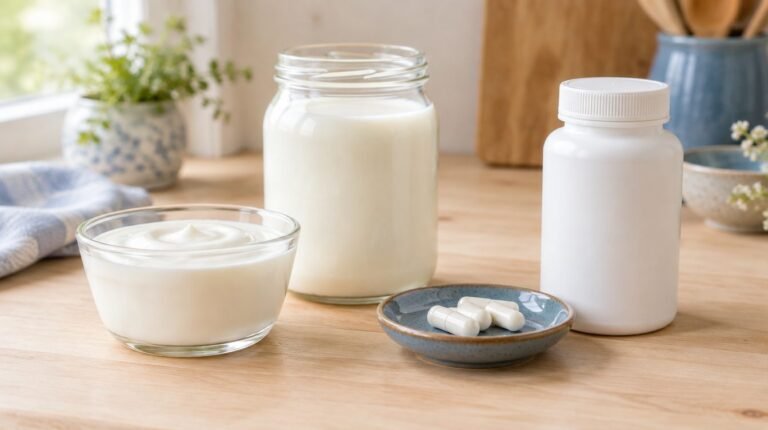
In a 16-week double-blind trial, 40 healthy adults and 40 people with Japanese cedar pollen allergy took capsules of L. mesenteroides NTM048 or placebo. The strain did not raise salivary IgA, the main thing the trial set out to measure, and did not change allergy antibody levels. Nasal blockage scores improved at week 12 in the allergy group (Yamamoto et al., 2023).
An earlier 4-week trial gave healthy adults chocolate with NTM048 or plain chocolate and reported small differences on a combined immune score and some T-cell counts (Kuroda et al., 2018). Several authors worked for the chocolate maker and the strain supplier. Both are early studies of one strain given in capsules or chocolate, and they say nothing about cultured milk made at home.
Before you start: a short safety note
Leuconostoc has a long history in cultured dairy. A safety review found that reported infections involved only severely immunodepressed patients and that none had been linked to eating fermented food (Ogier et al., 2008). Still, a 2026 study of 129 adults with Leuconostoc bloodstream infections at one Korean hospital over 27 years found most cases were hospital-acquired, half in people with solid cancers, and noted the genus is naturally resistant to vancomycin-type antibiotics (Choi et al., 2026). A smaller Spanish series linked every case to a central line and intravenous feeding (Caso et al., 2024).
More generally, the risk of harm from live microbes is greater in people with severe illness or a weakened immune system, and serious infections have been reported in premature infants given probiotics (NCCIH). People who are seriously ill or have weak immune systems face a higher risk of infection from live microbes (NIH Office of Dietary Supplements). If that is you, or you are pregnant, have a central line, or are feeding a premature baby, ask your health care provider before eating home-cultured probiotic foods. Starter cultures sold as dietary supplements are not approved by the FDA before sale; their makers are responsible for safety and labeling (FDA). This article is general information, not medical advice.
Home protocol: Leuconostoc cultured milk at 72-77°F for 12 hours
Because Leuconostoc grows poorly in milk alone, the practical home method uses a mesophilic aroma culture: a freeze-dried mix that lists Lactococcus lactis (often several subspecies) and Leuconostoc mesenteroides subsp. cremoris on the label. Single-strain Leuconostoc packs for home use are rare. This makes 1 quart. Active time is about 20 minutes, plus 12 to 18 hours at room temperature and 6 hours of chilling.
Equipment
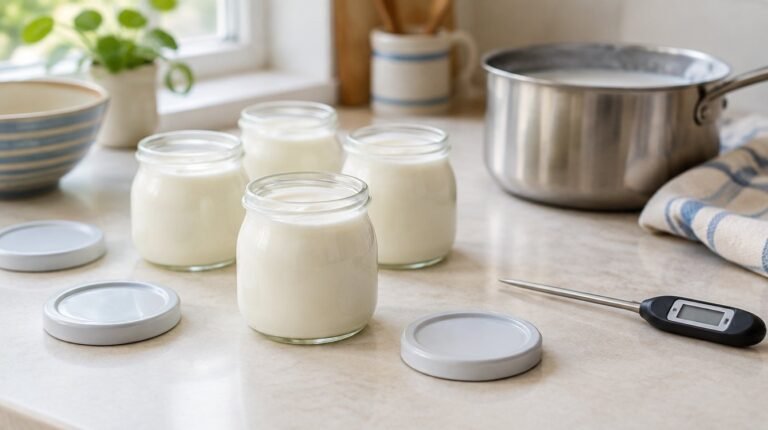
- A spot that holds 72 to 77°F: a kitchen counter away from the stove, a cooler box, or an oven with only the light on (check it with a thermometer first, since some get much warmer). A yogurt maker set this low also works if yours allows it.
- A probe thermometer.
- Clean glass jars with lids, a saucepan and a whisk.
Ingredients
- 1 quart (946 mL) pasteurized milk: whole milk gives the fullest body; cream or half-and-half gives a sour-cream style result. See making cultured milk with pasteurized milk.
- Mesophilic aroma culture: the amount the packet gives for 1 quart. Look for Leuconostoc mesenteroides (ideally subsp. cremoris) in the ingredient list.
- No sugar before culturing: sucrose feeds dextran-making strains and can make the batch slimy. Sweeten after chilling.
Steps
- Heat the milk slowly to 180 to 185°F (82 to 85°C), stirring so it does not scorch. Heating to 180°F kills competing bacteria and changes the whey proteins (University of Missouri Extension), which gives a thicker set. For a thinner, buttermilk-style drink you can skip this with fresh pasteurized milk, but the result is less predictable.
- Cool the milk to 77°F (25°C). A sink of cold water speeds this up. Adding the culture to hot milk will kill it.
- Sprinkle the culture over the surface, wait 2 minutes, then stir gently but thoroughly for about 30 seconds.
- Pour into jars and put the lids on loosely, since the culture makes some gas.
- Leave undisturbed at 72 to 77°F for 12 hours. If it has not set, check every 2 hours up to 18 hours (24 hours in a cool room).
- Once it is set and smells clean and tangy, tighten the lids and refrigerate at 40°F or below for at least 6 hours. It thickens as it cools.
- Use within about 2 weeks, the guideline the University of Illinois gives for homemade yogurt (University of Illinois Extension). See how long homemade yogurt lasts for signs a batch has turned.
Compare this with standard yogurt, which incubates at 108 to 115°F for 6 to 10 hours (University of Illinois Extension). Our guides to yogurt temperature and incubation time explain why warm and cool cultures behave so differently. The main partner organism has its own guide: Lactococcus lactis.
How to tell it worked
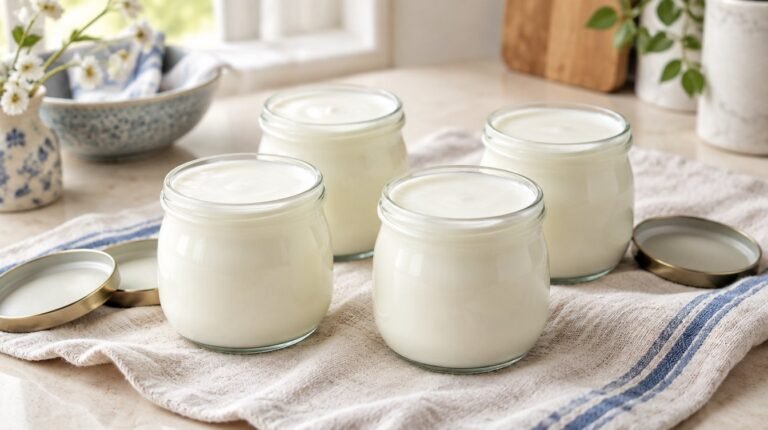
- Set: a soft, spoonable or thick pourable gel that moves as one mass when you tilt the jar. Mesophilic cultured milk is softer than yogurt.
- Smell: clean, mildly sour and buttery. That buttery note is diacetyl from citrate, the signature of the aroma bacteria.
- Tiny bubbles: small holes or a slight prickle on the tongue come from carbon dioxide made by Leuconostoc.
- Acidity (optional): pH strips give a more objective check. A reading of 4.6 or lower is the benchmark U.S. rules set for finished yogurt (21 CFR 131.200), and a well-soured mesophilic milk should reach a similar range.
What you cannot tell at home is how much of the culture is Leuconostoc. In commercial mixed starters it is a small minority, and the balance shifts with temperature, time and how many times you reuse a batch. A good set and buttery smell show the culture worked as a team.
Failure modes and fixes
| Problem | Likely cause | Fix |
|---|---|---|
| Still liquid after 18 to 24 hours | Room too cold, culture old, or milk too hot when culture was added | Move to a spot at 72 to 77°F, add culture at 77°F or below, and use fresh culture |
| Set, but no buttery smell | Leuconostoc and aroma strains lost out, often because the room was too warm | Keep below 80°F; do not reuse a batch more than a few times |
| Stringy or slimy | Sugar added before culturing, or a dextran-making strain | Sweeten only after chilling; some slight ropiness is harmless if the smell is clean |
| Grainy curds and lots of whey | Fermented too long or too warm | Chill as soon as it sets; next time check at 10 to 12 hours |
| Yeasty, cheesy or rotten smell; pink, orange or fuzzy spots | Contamination or mold | Throw out the whole batch and sanitize jars and utensils |
The USDA says yogurt and sour cream with mold should be discarded, because foods with high moisture can be contaminated below the surface (USDA FSIS). For a batch that is weepy but smells fine, see whey from yogurt.
Reusing a batch and the vegetable route
Many mesophilic cultures can be kept going by saving 2 to 3 tablespoons of a fresh batch to start the next quart. Expect the mix of bacteria to drift over time; if the buttery aroma or set fades, start again from a fresh packet. Our article on why an heirloom starter weakens over time explains the pattern.
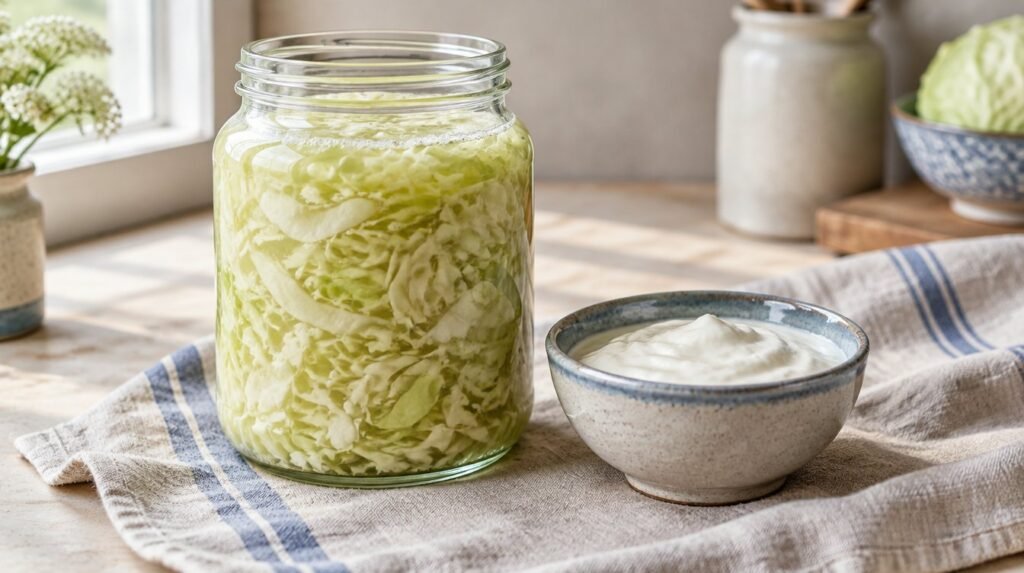
If your real interest in L. mesenteroides is gut-friendly food rather than dairy, the easiest place to meet it is a vegetable ferment. Leuconostoc is one of the main bacteria in sauerkraut ferments, together with Lactobacillus plantarum. See raw sauerkraut and what kimchi is to start there.
Can Leuconostoc mesenteroides make yogurt?
Not yogurt in the legal sense, which requires L. bulgaricus and S. thermophilus (21 CFR 131.200). It makes a soft, buttery cultured milk, usually together with Lactococcus.
Why culture Leuconostoc at room temperature?
It is a mesophilic organism: one studied strain grew best near 77°F, and the dairy subspecies cremoris does not grow at 86°F or above.
Is Leuconostoc mesenteroides a probiotic?
One strain, NTM048, has been studied in small human trials, but the evidence is early and strain-specific, and no study has tested homemade cultured milk.
Related topics
- Lactococcus lactis: the main partner in mesophilic cultures.
- Lactobacillus plantarum: the acid-tolerant species that takes over later in vegetable ferments.
- Yogurt Starter: how warm and cool starters differ.
- Raw Sauerkraut: where Leuconostoc does its best-known work.
- Fermented Foods for Gut Health: what the evidence says about fermented foods.
Sources
- Frantzen CA, et al. Genomic characterization of dairy associated Leuconostoc species and diversity of leuconostocs in undefined mixed mesophilic starter cultures (Frontiers in Microbiology, 2017)
- Plengvidhya V, et al. DNA fingerprinting of lactic acid bacteria in sauerkraut fermentations (Applied and Environmental Microbiology, 2007)
- 21 CFR 131.200: Yogurt (Electronic Code of Federal Regulations)
- Species: Leuconostoc mesenteroides (LPSN, Leibniz Institute DSMZ)
- Zheng J, et al. A taxonomic note on the genus Lactobacillus: description of 23 novel genera, emended description of the genus Lactobacillus Beijerinck 1901, and union of Lactobacillaceae and Leuconostocaceae (International Journal of Systematic and Evolutionary Microbiology, 2020)
- Phylum: Bacillota (LPSN, Leibniz Institute DSMZ)
- Drosinos EH, et al. Growth and bacteriocin production kinetics of Leuconostoc mesenteroides E131 (Journal of Applied Microbiology, 2005)
- Zikmanis P, et al. Extracellular polysaccharides produced by bacteria of the Leuconostoc genus (World Journal of Microbiology and Biotechnology, 2020)
- Yamamoto Y, et al. Leuconostoc mesenteroides subsp. strain NTM048 ameliorated nasal symptoms in patients with Japan cedar pollinosis: randomized, double-blind, and placebo-controlled trial (Medicine (Baltimore), 2023)
- Kuroda R, et al. Effects of chocolate containing Leuconostoc mesenteroides strain NTM048 on immune function: a randomized, double-blind, placebo-controlled trial (Immunity & Ageing, 2018)
- Ogier JC, et al. Safety assessment of dairy microorganisms: the Leuconostoc genus (International Journal of Food Microbiology, 2008)
- Choi YJ, et al. Clinical characteristics and outcomes of adult patients with Leuconostoc species bacteremia: an analysis of 129 consecutive cases (European Journal of Clinical Microbiology and Infectious Diseases, 2026)
- Caso JM, et al. Bacteremia due to Leuconostoc species: a 13-year single-center case series (Enfermedades Infecciosas y Microbiología Clínica, 2024)
- Probiotics: Usefulness and Safety (National Center for Complementary and Integrative Health)
- Probiotics: Fact Sheet for Consumers (NIH Office of Dietary Supplements)
- Dietary Supplements (U.S. Food and Drug Administration)
- Preserve It Fresh, Preserve It Safe: 2019, No. 1 (University of Missouri Extension)
- Making Yogurt at Home (University of Illinois Extension)
- Molds on Food: Are They Dangerous? (USDA Food Safety and Inspection Service)