Raw Sauerkraut: What You Need to Know
What raw sauerkraut is
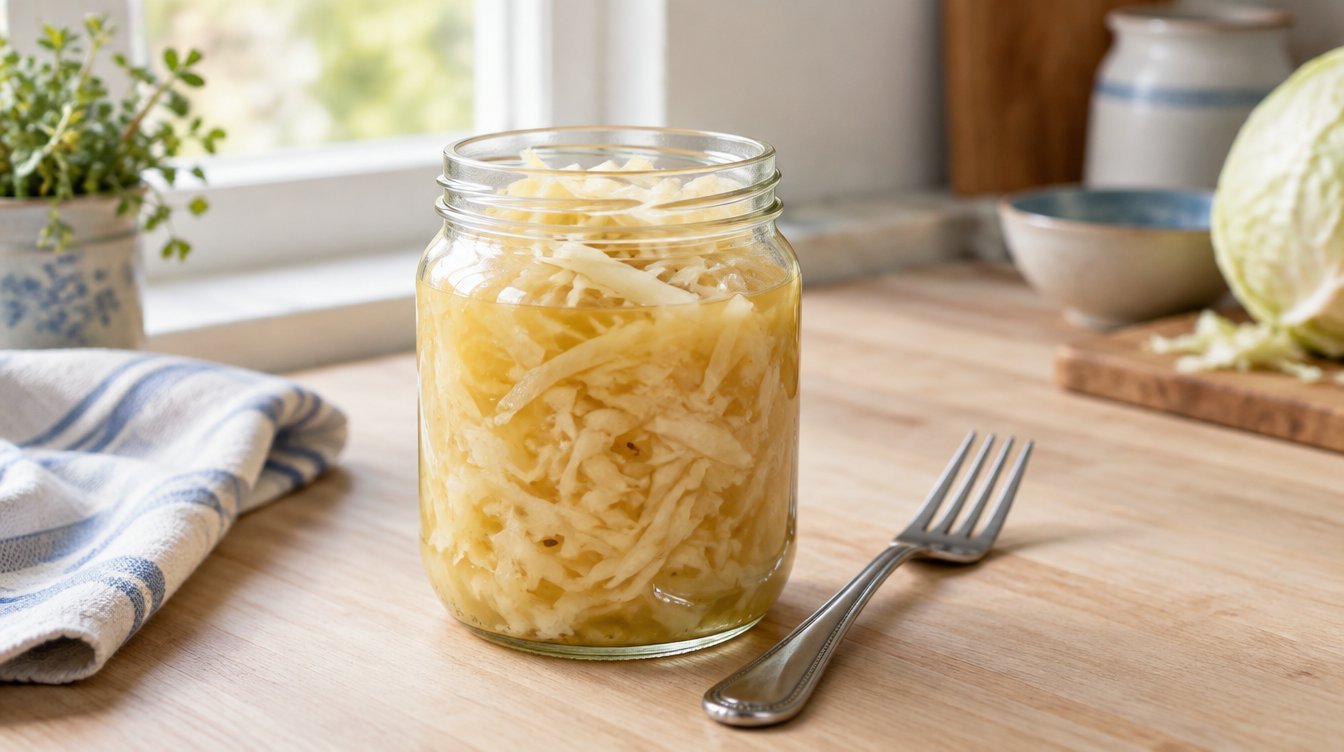
Raw sauerkraut is shredded cabbage fermented in salt and never heated afterward. The salt pulls water out of the cabbage to make a brine, and bacteria that live naturally on the leaves turn the cabbage sugars into lactic acid. That acid gives sauerkraut its sour taste and keeps it from spoiling. Because raw kraut is not cooked or pasteurized after fermenting, the bacteria that made it are still alive when you eat it.
Those bacteria are lactic acid bacteria. Older studies of commercial sauerkraut named four main species, Leuconostoc mesenteroides, Lactobacillus plantarum, Pediococcus pentosaceus and Lactobacillus brevis, and a DNA study of 686 bacterial isolates found an even wider mix (Plengvidhya et al., 2007). A 2018 study found that the sauerkraut community forms quickly once fermentation starts and stays stable through packaging (Zabat et al., 2018). Our pages on Leuconostoc mesenteroides and Lactobacillus plantarum cover two of these species in depth.
Raw vs. pasteurized sauerkraut
Most sauerkraut on store shelves has been heated after fermenting so it can sit at room temperature. Heat kills the bacteria. An expert panel from the International Scientific Association for Probiotics and Prebiotics (ISAPP) lists non-heated fermented vegetables among foods with live microbes, and heat-treated or pasteurized fermented vegetables among foods without them (Marco et al., 2021).
| Raw (unpasteurized) | Pasteurized or canned | |
|---|---|---|
| Where you find it | Refrigerated case | Shelf, in cans or jars |
| Live bacteria | Yes | No |
| Storage | Keep cold | Room temperature until opened |
| Label words | “Raw,” “unpasteurized,” “live cultures” | No live-culture claim |
Pasteurized kraut is still a fermented food and still has fiber and flavor. It just has no live microbes. For more on that question, see does canned sauerkraut have probiotics.
Why raw sauerkraut may matter for gut health
The research on sauerkraut itself is thin. The most direct study is a 2018 pilot trial in 34 Norwegian adults with irritable bowel syndrome (IBS). For six weeks, 19 ate unpasteurized sauerkraut and 15 ate pasteurized sauerkraut every day, without knowing which. Symptom scores improved in both groups, with no significant difference between them, and gut bacteria shifted in both.
Sauerkraut bacteria such as L. plantarum and L. brevis showed up more often in the stool of the raw-kraut group. The authors said the study was too small to be sure, and that the benefit may have come more from the cabbage fiber and other compounds than from the live bacteria. It is not evidence that sauerkraut treats IBS.
Sauerkraut was also one of the foods in a 17-week Stanford study, where 18 healthy adults per group ate a diet high in fermented foods. That group’s gut microbe diversity rose and several inflammation markers fell (Wastyk et al., 2021). Sauerkraut was one food among many, so the result cannot be credited to it alone.
One point to keep straight: the bacteria in raw sauerkraut are not probiotics in the strict sense. The ISAPP panel notes that traditional sauerkraut likely holds several unidentified strains of L. plantarum at unknown doses, which would not qualify as probiotics. Live, yes; tested for a specific benefit, no. For a wider look at the research, read sauerkraut benefits.
Nutrition in a typical serving
USDA FoodData Central lists values for canned sauerkraut, which has the same basic ingredients as raw (FDC 169279). A half cup (71 grams) has about 14 calories, 2 grams of fiber, 10 milligrams of vitamin C and 470 milligrams of sodium. That sodium is about 20% of the 2,300-milligram Daily Value. Raw brands vary with their salt level, so check the label.
How to choose raw sauerkraut
- Shop the refrigerated case. Raw kraut needs refrigeration, so look in the chilled section, not the canned-goods aisle.
- Read the front label. Look for “raw,” “unpasteurized,” “live cultures” or “naturally fermented.”
- Read the ingredients. Simple kraut is cabbage and salt, sometimes with spices or other vegetables. Vinegar suggests the vegetables may be pickled rather than fermented; the ISAPP panel treats vegetables pickled in brine or vinegar without fermentation as not fermented.
- Compare sodium. Sodium per serving can differ a lot between brands.
How to eat it
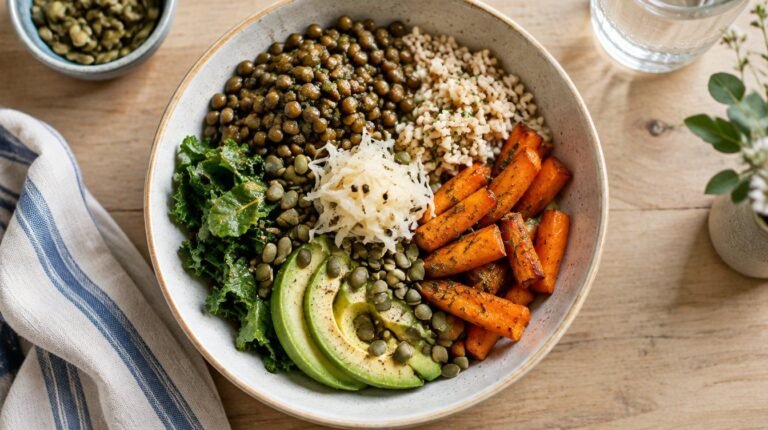
To keep the bacteria alive, eat raw kraut cold or stir it in after cooking rather than simmering it. Start with a forkful or two and build up. Our guides on how to eat sauerkraut for gut health, how much sauerkraut a day and the best time to eat sauerkraut offer simple ideas, from topping eggs and grain bowls to serving it beside sausages or roasted vegetables.
Making raw sauerkraut at home
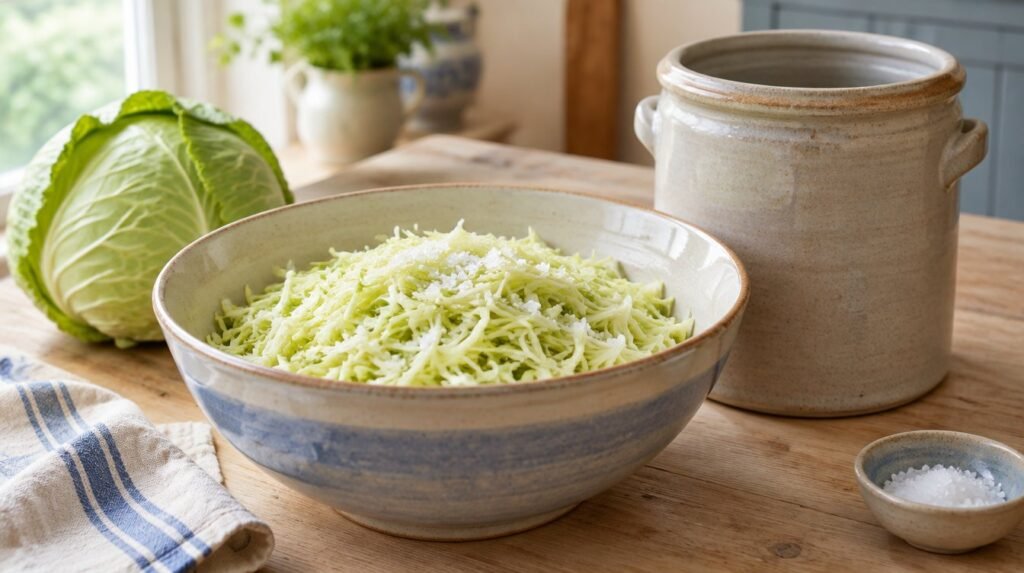
Homemade kraut is raw by default, as long as you do not can it. The National Center for Home Food Preservation gives these basics:
- Use firm, fresh heads of cabbage. Remove the outer leaves and cores, and shred thinly.
- Mix each 5 pounds of shredded cabbage with 3 tablespoons of canning or pickling salt, and pack it firmly until the salt draws out juice.
- Keep the cabbage under the brine with a weight. If the juice does not cover it, add boiled and cooled brine.
- Ferment at 70 to 75°F, where kraut is fully fermented in about 3 to 4 weeks. At 60 to 65°F it may take 5 to 6 weeks. Below 60°F it may not ferment, and above 75°F it may turn soft.
- If you use jars as weights, check 2 to 3 times a week and skim off any scum.
- When bubbling stops, cover the kraut tightly and refrigerate. It keeps for several months.
The same source explains how to can sauerkraut, but canning brings it to a boil, so canned kraut is no longer raw. For other vegetable ferments, see do pickles have probiotics.
Who should be careful
- People watching sodium. A half cup can supply about a fifth of the daily sodium limit.
- People taking MAOI antidepressants. The Mayo Clinic lists sauerkraut among fermented foods generally considered high in tyramine, which can cause a dangerous rise in blood pressure with these drugs.
- People sensitive to histamine or prone to migraines. The ISAPP panel notes that some lactic acid bacteria form histamine, tyramine and other amines during vegetable fermentation, which can cause effects such as migraines in some people.
- People with weak immune systems. The National Center for Complementary and Integrative Health says live microbes carry more risk for people with severe illness or compromised immune systems. Ask your doctor before adding raw fermented foods.
Related topics
- Sauerkraut Benefits: what the evidence shows.
- How Much Sauerkraut a Day for Gut Health?: sensible serving sizes.
- Does Canned Sauerkraut Have Probiotics?: why shelf-stable kraut differs.
- Fermented Foods for Gut Health: other foods to rotate with sauerkraut.
- Best Fermented Pickles: another refrigerated ferment to try.
Sources
- Plengvidhya V, et al. DNA fingerprinting of lactic acid bacteria in sauerkraut fermentations (Applied and Environmental Microbiology, 2007)
- Zabat MA, et al. Microbial community analysis of sauerkraut fermentation reveals a stable and rapidly established community (Foods, 2018)
- Marco ML, et al. The International Scientific Association for Probiotics and Prebiotics (ISAPP) consensus statement on fermented foods (Nature Reviews Gastroenterology and Hepatology, 2021)
- Nielsen ES, et al. Lacto-fermented sauerkraut improves symptoms in IBS patients independent of product pasteurisation: a pilot study (Food and Function, 2018)
- Wastyk HC, et al. Gut-microbiota-targeted diets modulate human immune status (Cell, 2021)
- Sauerkraut, canned, solids and liquids (FDC 169279) (USDA FoodData Central)
- Daily Value on the Nutrition and Supplement Facts Labels (U.S. Food and Drug Administration)
- Sauerkraut (National Center for Home Food Preservation, University of Georgia)
- MAOIs and diet: Is it necessary to restrict tyramine? (Mayo Clinic)
- Probiotics: Usefulness and Safety (National Center for Complementary and Integrative Health)