Best Time to Eat Kimchi for Gut Health: Compared (2026)
Best Time to Eat Kimchi for Gut Health: Our Picks
The best time to eat kimchi for gut health is with a meal you already eat every day, most often lunch or dinner. No study has compared morning kimchi with evening kimchi, so the clock matters less than eating it raw, eating it often and keeping the portion small enough for the salt to fit your day.
- Best overall: with lunch or dinner. Food in the stomach may help some bacteria survive, and a side dish is easy to repeat daily.
- Best for building a habit: with breakfast. A few forkfuls next to eggs or rice works well if your stomach handles spice early in the day.
- Good option: at the start of a meal. Eating it first, with the rest of the meal close behind, still counts as eating it with food.
- Least useful: on an empty stomach. There is no evidence it helps, and acid plus chili can bother some stomachs.
- Skip if you get reflux: late at night or right before bed. Spicy food and lying down soon after eating are common reflux triggers.
- Fine for flavor, not for live microbes: cooked into a hot dish. Heat kills the bacteria that make raw kimchi a live fermented food.
These picks are based on what published research shows about kimchi, fermented foods and how bacteria survive digestion. Much of that research is small or done in a lab, which we note in each section.
Kimchi Timing Compared
| When you eat it | Possible upside | Drawbacks | Best for |
|---|---|---|---|
| With lunch or dinner | Eaten alongside food, which may buffer stomach acid; easy daily habit | Late dinners can be a reflux problem | Most people |
| With breakfast | Ties kimchi to a fixed routine | Spice and sourness early in the day do not suit everyone | People who eat a savory breakfast |
| At the start of a meal | Still eaten with food; may help you eat more vegetables | None beyond the usual salt and spice | People who like a small starter |
| On an empty stomach | None shown in research | May irritate a sensitive stomach | Not recommended as a strategy |
| Late night or before bed | None shown in research | Spicy food and lying down can worsen reflux | People without reflux, if it is the only time they can eat it |
| Cooked (stew, fried rice) | Same fiber and flavor, lower risk of a sour surprise | Live bacteria are killed by heat | Variety, not live cultures |
How Each Time of Day Stacks Up

With lunch or dinner
In Korea, kimchi is usually a side dish served with meals, and the large observational studies on kimchi measure it that way. A cross-sectional analysis of 115,726 Korean adults in the Health Examinees study found that men who ate 1 to 3 servings a day had lower odds of obesity than men who ate less than one serving. The pattern was J-shaped, meaning very high intakes did not look better, and a study of this kind cannot show cause and effect.
There is also a practical reason to pair kimchi with food. In a lab model of the human stomach and upper gut, a probiotic capsule survived best when it was given with a meal or 30 minutes before one, and poorly when given 30 minutes after. That was a capsule, not kimchi, and a lab model is not a person. Still, it fits the simple idea that food buffers stomach acid. A side of kimchi at lunch or dinner is the easiest way to act on that.
With breakfast
Breakfast works well for people who eat the same thing most mornings, because a habit tied to a routine is easier to keep. Kimchi pairs naturally with eggs, rice, toast or a savory porridge.
The catch is comfort. Kimchi is sour, salty and often hot with chili. If that feels harsh first thing in the morning, move it to a later meal. You give up nothing, since no study shows a morning advantage.
At the start of a meal
Some people like a few bites of kimchi before the main dish, the way you might start with a small salad. As long as the rest of the meal follows soon after, this is still eating it with food. It can also help you fit in more vegetables, which our guide to the best foods for gut health treats as a base for any gut-friendly diet.
On an empty stomach
You will see claims online that fermented foods work better on an empty stomach. We found no human study that tested this for kimchi. The lab work on probiotic survival points the other way, toward eating them with a meal.
An empty stomach is also when acidic, spicy food is most likely to cause discomfort in people who are prone to it. If you like kimchi as a snack, pair it with something such as rice, eggs or tofu.
Late at night or before bed
The NIDDK lists spicy foods among the foods commonly linked to reflux symptoms, and says that eating meals at least 3 hours before you lie down may help if your symptoms come at night. Kimchi can be fiery, so a late bowl is a poor fit for anyone with heartburn.
Gas is the other issue. NIDDK lists cruciferous vegetables among common gas-causing foods, and napa cabbage and radish, the base of most kimchi, belong to that plant family. If kimchi makes you gassy, eating it earlier in the day means the effects are over by bedtime. Our article on what to eat when your stomach hurts from gas has more on this.
Cooked into a hot dish
Kimchi stew and kimchi fried rice are delicious ways to use sour, older kimchi. They are still fermented foods, but the ISAPP consensus statement on fermented foods groups heat-treated or pasteurized fermented vegetables with foods that no longer contain live microorganisms.
That does not make cooked kimchi worthless. It still brings vegetables, fiber and flavor. If live cultures are your goal, though, keep at least some of your kimchi raw, or add a spoonful on top of a hot dish after cooking.
What Matters More Than the Clock
Eating it often
The best-known trial on fermented foods and the gut did not test timing at all. It tested amount and consistency. In a 17-week randomized study at Stanford, 36 healthy adults were assigned to a high-fiber diet or a diet high in fermented foods such as yogurt, kefir, kimchi, other fermented vegetables and kombucha. According to Stanford Medicine, over the 10-week diet period the fermented-food group showed rising gut microbiome diversity and lower levels of 19 inflammatory proteins in the blood, and larger servings were linked to stronger effects on diversity.
That is one small study, and kimchi was only one of several foods. It does suggest that a daily habit matters far more than the hour you choose.
How ripe the kimchi is
Kimchi changes as it ferments. A review of kimchi microflora explains that lactic acid bacteria such as Leuconostoc, Lactobacillus and Weissella drive the process, and that ingredients and fermentation conditions shape which microbes grow.
Two small Korean trials compared fresh and fermented kimchi directly. In a crossover trial of 21 adults with prediabetes, participants ate fresh (1-day-old) or fermented (10-day-old) kimchi for 8 weeks each. Both lowered body weight and waist size, while the fermented kimchi was also linked to better insulin sensitivity and lower blood pressure. A trial in 24 obese women over 8 weeks found the two types had different effects on gut bacteria and blood markers. Both studies were small, and neither tested time of day.
Keeping the salt in check
Kimchi is salty. USDA FoodData Central lists 498 mg of sodium per 100 grams of cabbage kimchi, which works out to about 750 mg in a 150-gram cup and roughly 375 mg in a half cup. The FDA notes that the Dietary Guidelines advise adults to keep sodium under 2,300 mg a day, while the average American already eats about 3,400 mg.
So a quarter to a half cup a day is a sensible portion for most people. The Korean data back this up: the Health Examinees analysis warned against excessive intake because of its J-shaped results, and a recent commentary on kimchi and stomach cancer called the evidence inconsistent and suggested lowering the sodium in kimchi while keeping traditional fermentation.
A Simple Way to Make Kimchi a Daily Habit
Since steady intake seems to matter more than timing, the goal is to make kimchi easy to eat without thinking about it. A routine like this works for most people:
- Pick one anchor meal. Choose the meal you eat at home most reliably, often lunch or dinner, and serve kimchi with it every day.
- Start small. Begin with one or two tablespoons for the first week, then work up to a quarter or half cup if your stomach is comfortable.
- Keep it raw. Serve it cold from the fridge, or spoon it on top of hot food after cooking instead of simmering it.
- Use a clean utensil. Scoop with a clean fork or tongs and press the rest back under the brine before closing the jar.
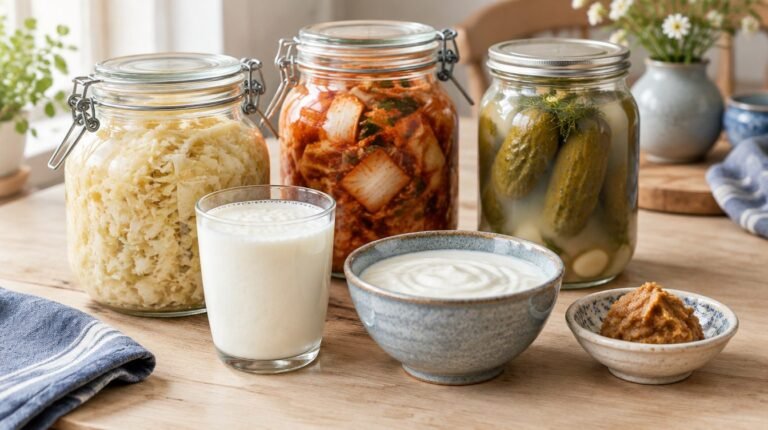
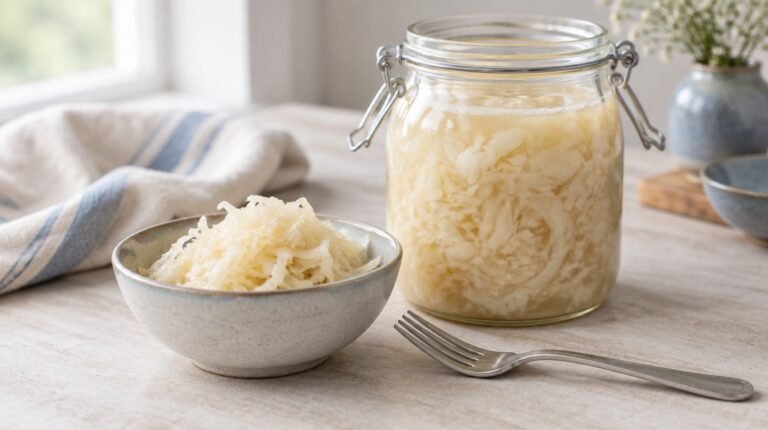
- Rotate with other fermented foods. Yogurt, kefir and sauerkraut give you a wider mix of microbes than one food alone, much like the varied menu in the Stanford trial.
- Balance the salt. On kimchi days, go easier on other salty foods such as soy sauce, instant noodles and cured meats.
If you notice more gas or bloating in the first couple of weeks, hold the portion steady for a while before increasing it again.
Who Should Be Careful With Kimchi
- People with reflux or heartburn: spicy foods are a common trigger, so keep portions small and avoid it late in the evening (NIDDK).
- People watching their sodium: anyone told to limit salt for blood pressure or kidney reasons should count kimchi toward the daily total.
- People who get gassy from cabbage family vegetables: start with a spoonful or two and build up.
- People sensitive to histamine: the ISAPP panel notes that some lactic acid bacteria form histamine and other biogenic amines during vegetable fermentation.
This article is general information, not medical advice. If you have a digestive condition or take medicine that interacts with diet, ask your doctor before making big changes.
How We Compared
We did not taste, test or lab-analyze any kimchi. We compared eating times using published research and government guidance, using these criteria:
- Human evidence on timing. We searched for trials comparing kimchi eaten at different times of day and found none, so no time scored highly on this alone.
- Microbe survival. Whether food was present, based on lab digestion models and the ISAPP view of heat-treated foods.
- Comfort. How likely the time is to clash with common issues such as reflux and gas, based on NIDDK guidance.
- Ease of habit. Whether the time fits a meal most people eat daily, since the Stanford trial points to steady intake.
- Salt. Whether the eating pattern makes it easy to keep a small, steady portion.
What jar labels can and cannot tell you
Timing only matters if the kimchi still has live microbes. Kimchi sold in the refrigerated section and labeled unpasteurized, raw or containing live cultures is more likely to have them. Shelf-stable jars that have been heat-treated may not.
Labels cannot tell you how many bacteria are in the jar, which species they are or how ripe the kimchi is. Our guide to choosing a kimchi brand covers label reading in more detail.
Related Topics
- Best Time to Eat Sauerkraut for Gut Health: the same timing question for kimchi’s European cousin.
- Best Time to Eat Yogurt: timing advice for another everyday fermented food.
- Fermented Foods for Gut Health: how kimchi compares with kefir, miso and others.
- Kimchi Weight Loss: What You Need to Know: a closer look at the weight studies mentioned here.
- Is Spicy Food Good for You?: what the chili in kimchi means for your stomach.
- Probiotic Foods: other foods that can carry live cultures.
Sources
- An SY, et al. Beneficial effects of fresh and fermented kimchi in prediabetic individuals (Annals of Nutrition and Metabolism, 2013)
- Han K, et al. Contrasting effects of fresh and fermented kimchi consumption on gut microbiota composition and gene expression related to metabolic syndrome in obese Korean women (Molecular Nutrition & Food Research, 2015)
- Jung H, et al. Association between kimchi consumption and obesity based on BMI and abdominal obesity in Korean adults: a cross-sectional analysis of the Health Examinees study (BMJ Open, 2024)
- Wastyk HC, et al. Gut-microbiota-targeted diets modulate human immune status (Cell, 2021)
- Fermented-food diet increases microbiome diversity, decreases inflammatory proteins, study finds (Stanford Medicine, 2021)
- Tompkins TA, et al. The impact of meals on a probiotic during transit through a model of the human upper gastrointestinal tract (Beneficial Microbes, 2011)
- Marco ML, et al. The International Scientific Association for Probiotics and Prebiotics (ISAPP) consensus statement on fermented foods (Nature Reviews Gastroenterology & Hepatology, 2021)
- Jung JY, et al. Kimchi microflora: history, current status, and perspectives for industrial kimchi production (Applied Microbiology and Biotechnology, 2014)
- Yang JY, et al. Kimchi friend or foe: preserving cultural foods developed pre-refrigeration (Preventive Medicine Reports, 2026)
- Cabbage, kimchi (SR Legacy) (USDA FoodData Central)
- Sodium in Your Diet (U.S. Food and Drug Administration)
- Eating, Diet, & Nutrition for GER & GERD (National Institute of Diabetes and Digestive and Kidney Diseases)
- Eating, Diet, & Nutrition for Gas in the Digestive Tract (National Institute of Diabetes and Digestive and Kidney Diseases)