Best Fermented Pickles: Compared (2026)
Best Fermented Pickles: Our Picks
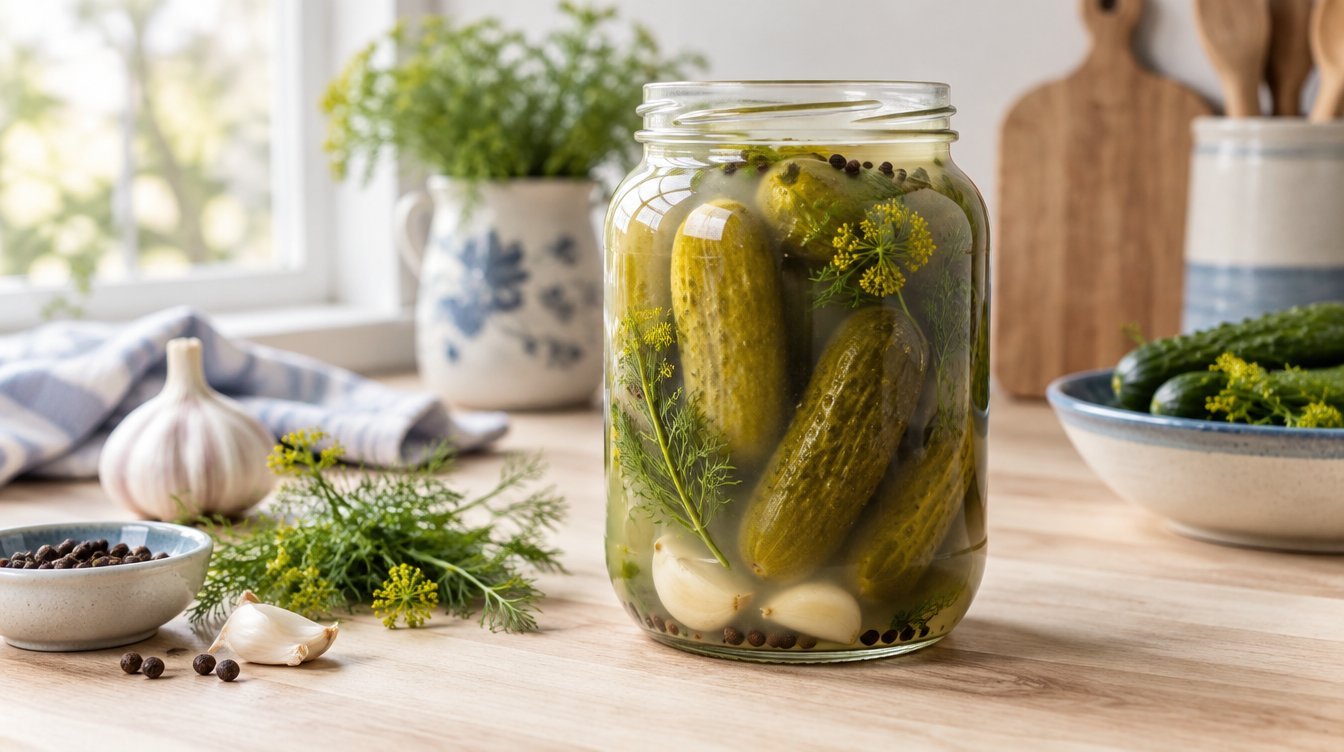
If you want a pickle that still carries live bacteria, look for three things on the jar: a salt brine with no vinegar, the word “fermented,” and a spot in the refrigerated case. Based on what each brand publishes about its own pickles, these are the strongest choices.
- Best widely available fermented pickle: Bubbies Kosher Dill Pickles. Salt-brine fermented, sold raw and refrigerated, no vinegar.
- Best organic and regional pick: Real Pickles Organic Dill Pickles. Fermented without vinegar from Northeast-grown cucumbers, sold in the Northeast.
- Best for home delivery: Olive My Pickle Kosher Dill Fermented Pickles. Salt-water fermented, ships nationally, lowest sodium per serving among the fermented jars here.
- Best if you like a vinegar tang: Cleveland Kitchen Classic Dill Pickle Spears. A vinegar brine with live L. plantarum cultures listed as an ingredient.
- Best shelf-stable option (no live cultures): Mt. Olive. Some lines are fermented, but the company pasteurizes everything.
- Best value of all: your own crock, using the tested fermented dill pickle method from the National Center for Home Food Preservation.
Ultimate Gut is published by Ultimate Health Solutions, which sells a yogurt maker, probiotic capsules and an inulin fiber supplement. None of the products reviewed here are ours, and these brands don’t pay us.
Fermented Pickles Compared
All figures below come from each brand’s own product page, label or FAQ, checked in October 2026. Sodium is per 1-ounce (28 g) serving, which is about half a large pickle or two chips. Formulas change, so check the jar in front of you.
| Pickle | How the brand says it’s made | Live cultures? | Sodium per 28 g | Where sold |
|---|---|---|---|---|
| Bubbies Kosher Dill | Fermented in salt brine, raw, no vinegar | Yes, naturally present (not counted) | 270 mg | Refrigerated, national |
| Real Pickles Organic Dill | Fermented without vinegar, raw, organic | Yes (brand says raw, cold-packed) | 330 mg | Refrigerated, Northeast only |
| Olive My Pickle Kosher Dill | Salt-water brine fermented, not pasteurized | Yes, brand lists 3 species | 220 mg | Ships nationally, refrigerated |
| Cleveland Kitchen Classic Dill Spears | Vinegar brine with added cultures | Live L. plantarum on the label | 240 mg | Refrigerated, national |
| Mt. Olive (fermented lines) | Some products fermented, then pasteurized | No | 200 mg (Hint of Salt spears) | Shelf-stable, national |
| Claussen Kosher Dill Chips | Vinegar brine with sodium benzoate | None claimed | 320 mg | Refrigerated, national |
| Grillo’s Classic Dill | “Fresh pickling” with vinegar, not fermented | No (per brand FAQ) | See jar | Refrigerated, national |
How Each Pickle Stacks Up
Bubbies Kosher Dill Pickles
Bubbies is the fermented pickle most shoppers can find without a special trip. The product page describes the dills as “naturally-fermented raw,” with no vinegar, no added sugar and no preservatives. The ingredient list is short: cucumbers, water, salt, garlic, dill, spices, mustard seed and calcium chloride, which the company says it uses to keep the pickles crisp.
The US label lists 270 mg of sodium per 28 g serving and about 20 servings in a 33-ounce jar. The brand’s online shop lists that jar at $9.99, which works out to roughly 50 cents a serving before shipping. In its FAQ, Bubbies says its pickles are fermented with naturally present cultures but that it does not test how many live cultures are in each jar. That is a fair, plain answer, and more than many brands offer.
Worth knowing: the spicy dills list vinegar, because the hot peppers added to them are pickled in it. If you want the no-vinegar version, choose the classic kosher dills.
Real Pickles Organic Dill Pickles
Real Pickles is a worker-owned cooperative in Greenfield, Massachusetts. Its Organic Dill Pickles are “naturally fermented without vinegar” using cucumbers, filtered water, unrefined sea salt, garlic, dill and whole spices, all organic. The company’s FAQ explains that its jars are cold-packed and raw rather than heated to seal, which is why they don’t pop when opened and may be fizzy.
Two limits keep this from being the top pick for everyone. The pickles are seasonal and sold mainly at stores in the Northeast, and online orders ship only to New England, New York, New Jersey and Pennsylvania. Sodium is also the highest of the fermented jars here at 330 mg per serving. The brand lists a 4-jar pack at $68 with shipping included and about 14 servings per jar, or about $1.21 a serving.
Olive My Pickle Kosher Dill Fermented Pickles
This Jacksonville, Florida company sells mostly online and ships refrigerated boxes. Its Kosher Dill page says the pickles are fermented in a sea salt brine and not pasteurized, and lists the main bacteria as Lactobacillus plantarum, Lactobacillus pentosus and Leuconostoc mesenteroides. Ingredients are cucumbers, garlic, dill, onions, green olives, spices, filtered water and sea salt.
At 220 mg of sodium per 28 g, it has the lowest sodium of the fermented pickles we compared. The page lists $15.99 for a 32-ounce pack with 20 servings, about 80 cents a serving. One caution: the same page gives two different bacteria counts (12 billion and 13 billion CFUs per serving) and says the counts were verified by a third party, but no lab report is shown. Treat any CFU number on a food as a brand claim, since live counts in a fermented food shift with time and temperature.
Cleveland Kitchen Classic Dill Pickle Spears
Cleveland Kitchen is best known for its sauerkraut, and its pickles take a different route from the others. The Classic Dill Pickle Spears label lists cucumber, water, white distilled vinegar, salt, garlic, spices, calcium chloride, dill, dill oil, turmeric and “Live Cultures L. Plantarum.” The page calls them pickles with live cultures; it doesn’t describe the classic spears as fermented.
That makes them a middle ground. You get the sharper vinegar flavor many people grew up with, plus a named live culture added to the jar. Sodium is 240 mg per serving. If your goal is a traditional salt-brine ferment, though, the three jars above are closer to it.
Mt. Olive
Mt. Olive is a useful example of why “fermented” and “live” are not the same thing. The company’s FAQ says some of its relishes and its sweet, sour and dill pickles are fermented, but that this does not make them probiotic, because it pasteurizes all of its products and pasteurization eliminates the bacteria in the jar.
Mt. Olive is still a reasonable pantry pickle, and it makes a Hint of Salt Kosher Dill Spear with 200 mg of sodium per serving, which the brand says is 25% less than its regular spears. Just don’t buy it expecting live cultures.
Claussen and Grillo’s: popular, but not fermented
Both brands sit in the refrigerated case, which leads many shoppers to assume they are fermented. Grillo’s answers the question directly in its FAQ: its pickles are made in a fresh pickling process with vinegar, “do not contain active cultures,” and are refrigerated because they are not fermented.
Claussen’s Kosher Dill Pickle Chips list distilled vinegar and sodium benzoate in the ingredients, at 320 mg of sodium per serving, and the product page makes no fermentation or live-culture claim. Both are fine pickles to eat. They just aren’t the ones to pick if live microbes are the point.
Your own fermented pickles
Home fermentation is the cheapest way to get a raw, salt-brine pickle, and the method is well documented. The National Center for Home Food Preservation’s fermented dill pickle recipe uses 4 pounds of pickling cucumbers, 1/2 cup of salt, 1/4 cup of vinegar and 8 cups of water per gallon of container, fermented at 70 to 75°F for about 3 to 4 weeks. Cooler temperatures of 55 to 65°F work but take 5 to 6 weeks, and temperatures above 80°F make soft pickles.
The same page is clear about safety: if pickles turn soft or slimy or smell bad, throw them out. Fully fermented pickles keep about 4 to 6 months in the refrigerator if surface scum and mold are removed regularly. If you can them afterward, the heat ends the live cultures, just as it does for shelf-stable brands.
Fermented vs. Vinegar Pickles: Why It Matters
Most pickles on grocery shelves are not fermented. According to the National Center for Home Food Preservation, regular dill pickles are fermented and cured for about 3 weeks, while fresh-pack or quick pickles are not fermented at all; they are covered with vinegar and seasonings. In a fermented pickle, lactic acid bacteria that live on the cucumbers turn sugars into lactic acid, which sours the pickle and preserves it.
Whether those bacteria do anything for your gut is less settled than the marketing suggests. A 2019 review of fermented foods by Dimidi and colleagues at King’s College London (Nutrients) found that kefir, sauerkraut, natto and sourdough bread had each been tested in at least one randomized trial for gut effects, but that clinical evidence for most fermented foods is very limited. Fermented cucumber pickles were not among the foods with trial data.
The most cited human study is broader. In a Stanford trial (Wastyk et al., Cell, 2021), 36 healthy adults were assigned to either a high-fiber diet or a high-fermented-food diet for 10 weeks. The fermented-food group, which ate foods such as yogurt, kefir, kimchi, other fermented vegetables, vegetable brine drinks and kombucha, saw their gut microbial diversity rise and 19 inflammatory proteins in the blood fall, according to Stanford Medicine. It was a small study of mixed foods, so it can’t tell you what pickles alone do. It does suggest that making fermented foods a regular habit may be worth it. For more on the question, see Do Pickles Have Probiotics?.
How to Spot a Truly Fermented Pickle in the Store
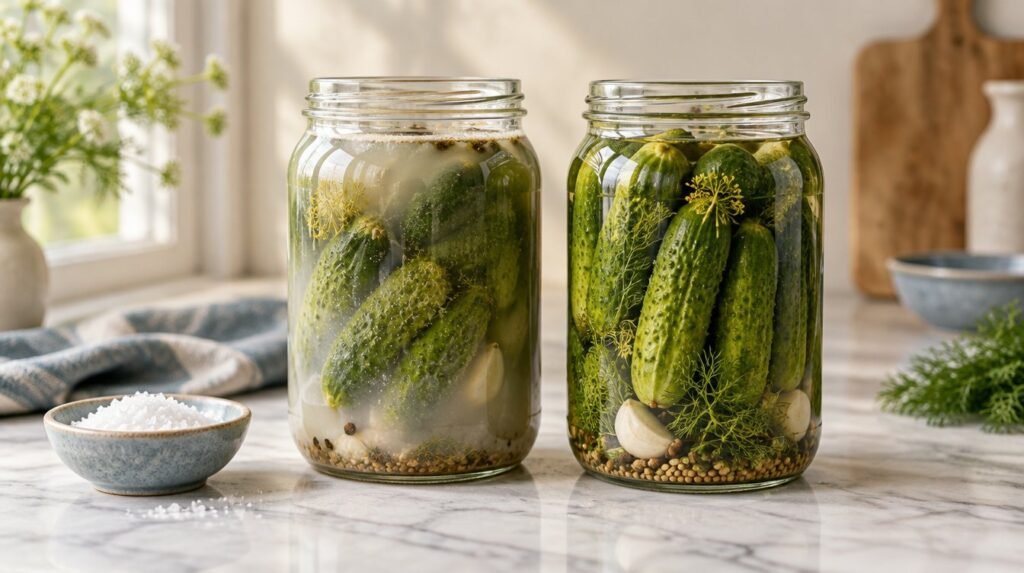
You can sort most jars in a few seconds once you know what to look for.
- Check the brine: salt and water with no vinegar usually means a traditional ferment. Vinegar can still appear for flavor in some recipes, so read the front label too.
- Look for the words: “fermented,” “naturally fermented,” “raw” or “live cultures.” “Kosher dill” and “deli style” describe flavor, not process.
- Find the refrigerated case: raw fermented pickles need cold storage. A pickle stored at room temperature has been heat-treated, so even if it was fermented, the cultures are gone.
- Expect cloudy brine: a hazy brine and white sediment are normal by-products of fermentation, as Real Pickles explains in its FAQ.
- Skip preservatives if you want live cultures: sodium benzoate in the ingredient list points to a vinegar pickle.
The same rules apply to sauerkraut. Our guide to canned sauerkraut walks through why shelf-stable jars lose their cultures.
Watch the Salt
Every pickle in this comparison carries 200 to 330 mg of sodium per 1-ounce serving. The FDA’s Daily Value for sodium is less than 2,300 mg a day, so one serving uses about 9% to 14% of it. A whole large dill pickle is often two or more servings, so it is easy to eat 600 mg or more in a single snack.
A few practical ways to keep the benefits and lose some of the salt: slice one pickle over a sandwich or salad instead of eating several, compare sodium per 28 g rather than per pickle, and count the brine if you drink it. If you are watching sodium for health reasons, ask your doctor how fermented vegetables fit your plan. Our guide to fermented foods for gut health covers lower-sodium options such as yogurt and kefir.
How We Compared
We did not buy, taste or test any of these pickles. We compared only what the manufacturers publish.
- Process: whether the brand says the pickle is fermented in salt brine, made with vinegar, or both.
- Live cultures: whether the brand says the product is raw and unpasteurized, adds named cultures, or pasteurizes.
- Ingredients: length of the list, use of preservatives such as sodium benzoate, and added sugar.
- Sodium: milligrams per 28 g serving from the Nutrition Facts panel.
- Availability: whether you can find it nationally, regionally, or only online.
- Price per serving: only where the brand’s own page shows both a price and a serving count.
What labels can tell you: how the pickle was made, what went into it, how much sodium it has, and whether it was heated. What labels can’t tell you: how many live bacteria are in your particular jar today, which strains survived, or whether eating them will change anything in your gut. Counts drop over time even in the fridge, and no brand here publishes a lab report for each batch. All label details were checked in October 2026.
Frequently Asked Questions
Are refrigerated pickles always fermented?
No. Claussen and Grillo’s are refrigerated vinegar pickles, and Grillo’s says in its FAQ that its pickles are not fermented and contain no active cultures.
Do pasteurized fermented pickles have probiotics?
No. Mt. Olive notes in its FAQ that pasteurization eliminates the bacteria in the jar, good and bad alike, so its fermented lines are not probiotic.
Is the cloudy brine in fermented pickles safe?
Cloudiness and white sediment are normal in fermented pickles. Throw out pickles that turn soft or slimy or smell bad.
How many fermented pickles should I eat?
There is no set amount. Because one serving has 200 to 330 mg of sodium, a slice or two alongside other fermented foods is a sensible way to start.
Related Topics
- Are Pickles Fermented?: how to tell fermented and vinegar pickles apart.
- Do Pickles Have Probiotics?: what the evidence says about live bacteria in pickles.
- Fermented Foods for Gut Health: the wider family of fermented foods.
- Probiotic Foods: foods that carry live cultures.
- How to Eat Sauerkraut for Gut Health: another salt-brine ferment, step by step.
- Non Dairy Probiotics: live-culture options without milk.
Sources
- Kosher Dill Pickles (Bubbies Fine Foods, product page and US label, checked October 2026)
- Frequently Asked Questions (Bubbies Fine Foods, checked October 2026)
- Bubbies Kosher Dill Pickles 33 oz. (Bubbies online shop, checked October 2026)
- Organic Dill Pickles (Real Pickles, checked October 2026)
- Fermentation FAQ (Real Pickles, checked October 2026)
- Kosher Dill Fermented Pickles (Olive My Pickle, checked October 2026)
- Classic Dill Pickle Spears (Cleveland Kitchen, checked October 2026)
- FAQ (Mt. Olive Pickle Company, checked October 2026)
- Hint of Salt Low Sodium Kosher Dill Spears (Mt. Olive Pickle Company, checked October 2026)
- Claussen Kosher Dill Pickle Chips (Kraft Heinz, checked October 2026)
- FAQ (Grillo’s Pickles, checked October 2026)
- General Information on Fermenting (National Center for Home Food Preservation, University of Georgia)
- Dill Pickles (fermented) (National Center for Home Food Preservation, University of Georgia)
- Sodium in Your Diet (U.S. Food and Drug Administration)
- Dimidi E, et al. Fermented Foods: Definitions and Characteristics, Impact on the Gut Microbiota and Effects on Gastrointestinal Health and Disease (Nutrients, 2019)
- Wastyk HC, et al. Gut-microbiota-targeted diets modulate human immune status (Cell, 2021)
- Fermented-food diet increases microbiome diversity, decreases inflammatory proteins, study finds (Stanford Medicine, 2021)