What Is Kimchi? A Clear Answer
What is kimchi?
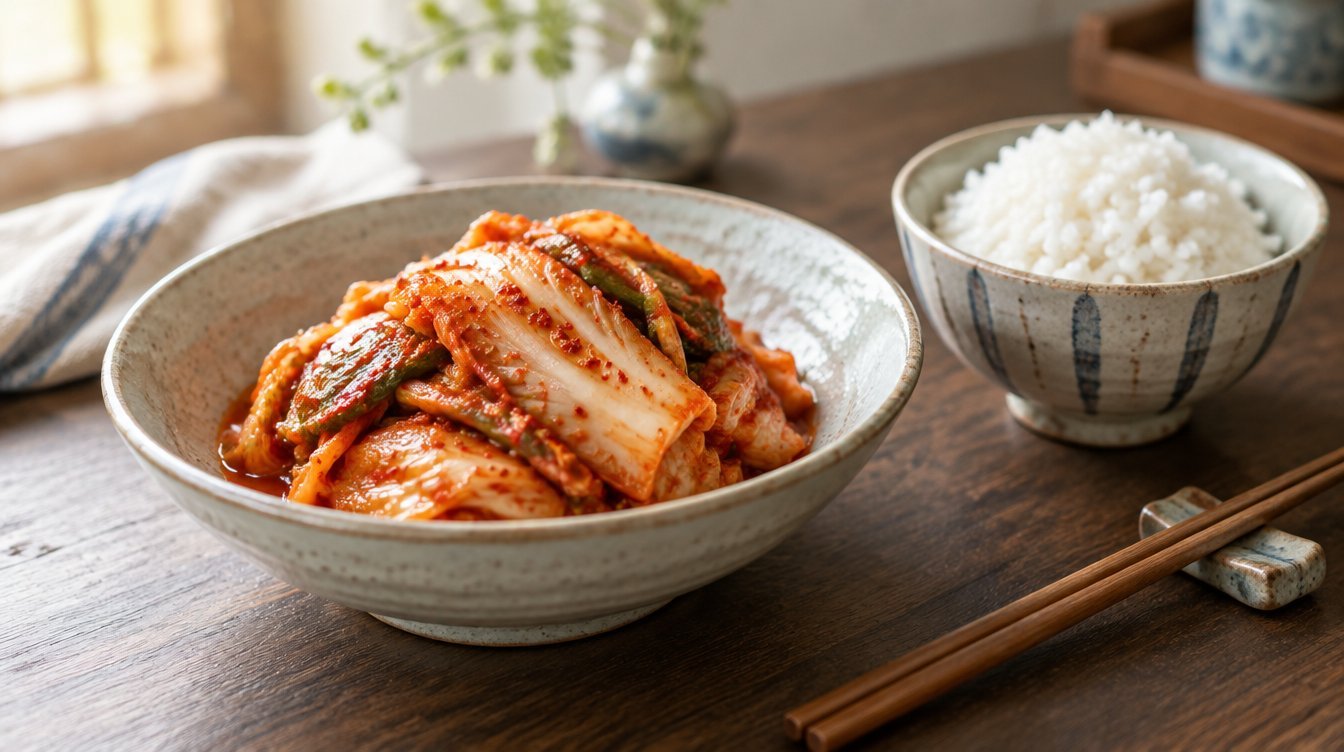
Kimchi is a Korean side dish of salted vegetables, most often napa cabbage, mixed with seasonings such as chili powder, garlic, ginger and fish sauce, then left to ferment. Lactic acid bacteria that come in on the raw ingredients sour it over days to weeks, giving it a tangy, salty, often spicy flavor (University of Georgia Extension; Cha and colleagues, 2024).
UNESCO, which added the Korean custom of making and sharing kimchi to its cultural heritage list in 2013, describes kimchi simply as “preserved vegetables seasoned with spices and fermented seafood” (UNESCO). Families traditionally made it in huge batches in late autumn, an event called kimjang, so they had vegetables through the winter.
What goes into kimchi
The best-known version, baechu kimchi, starts with napa cabbage. A typical home recipe from University of Georgia Extension adds carrots, onions, green onions, radish, ginger, garlic, fish sauce and gochugaru, a coarse Korean red chili powder. Many traditional recipes also use fermented seafood such as salted shrimp or anchovy (UNESCO).
- The vegetable: napa cabbage is the most common, but radish, cucumber and mustard greens are used too.
- Salt: the cabbage is salted first to pull out water and form a brine.
- Seasoning paste: chili, garlic, ginger and green onion.
- Seafood (optional): fish sauce or salted shrimp add savory depth.
Because seafood is common, much kimchi is not vegetarian, and some recipes contain allergens such as shellfish, fish, sesame, soy or nuts (UGA Extension).
How kimchi is made and fermented
The process is simple in outline. The cabbage is rubbed with salt and massaged every 30 minutes for about 2 hours to draw out water, then mixed with the seasoning paste. It is packed tightly into jars and left at room temperature for the first 48 hours, then moved to the refrigerator (UGA Extension).
Bubbling usually appears in the first day or two, and the flavor turns noticeably tangier around days 5 to 7. As the bacteria make acid, the pH drops below 4.6 within about 2 weeks, a level that holds back most foodborne pathogens. UGA advises keeping kimchi at 41°F or below once it goes into the fridge (UGA Extension).
The microbes doing this work are not added from a packet. A genetic analysis of kimchi over a 29-day ferment found the community was dominated by three groups of lactic acid bacteria: Leuconostoc, Lactobacillus and Weissella (Jung and colleagues, 2011). A 2024 review estimated that these bacteria can reach roughly 1 billion to 10 billion per gram of kimchi during fermentation (Cha and colleagues, 2024).
Common types of kimchi
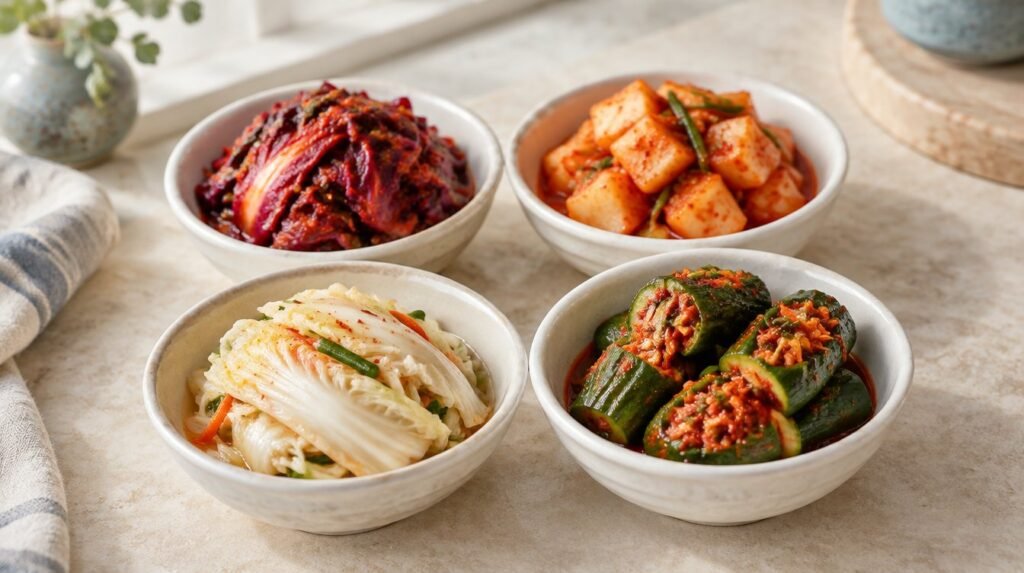
There are many regional and family versions. These are some of the most common, as described by Encyclopaedia Britannica:
| Type | Main ingredient | What sets it apart |
|---|---|---|
| Baechu kimchi | Napa cabbage | The classic red, spicy kimchi most people picture |
| Kkakdugi | Korean radish (mu), cubed | Juicy, crunchy cubes |
| Baek kimchi (white kimchi) | Varies by recipe | Made without chili, flavored with garlic, radish, pear and jujube |
| Oi sobagi | Cucumber | Stuffed cucumbers, best eaten within a few days |
| Dongchimi | Radish in a lot of water | A “water kimchi” whose brine turns fizzy and sweet-sour |
| Gat kimchi | Mustard leaves | Sharp and pungent |
Some Buddhist temple-style kimchi skips garlic, onions and other pungent vegetables and leaves out seafood, making it nearly vegan (Britannica).
Kimchi nutrition at a glance
Kimchi is low in calories but high in salt. These figures are for 100 grams (about two-thirds of a cup) of cabbage kimchi from USDA FoodData Central:
| Nutrient | Per 100 g |
|---|---|
| Calories | 15 |
| Protein | 1.1 g |
| Carbohydrate | 2.4 g |
| Fiber | 1.6 g |
| Sodium | 498 mg |
| Vitamin K | 43.6 mcg |
| Folate | 52 mcg |
A full cup (150 grams, per the same USDA entry) carries about 750 mg of sodium. That is roughly a third of the Daily Value of less than 2,300 mg a day (FDA), so a small side portion fits more easily into a day than a big bowl. Brands vary, so check the label.
Is kimchi a probiotic food?
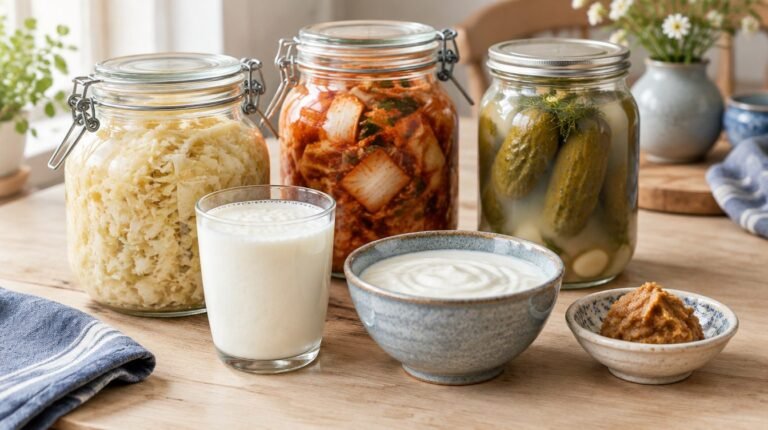
Kimchi that is naturally fermented and kept cold contains live bacteria. Harvard Health lists kimchi among fermented foods with live cultures, along with yogurt, kefir and sauerkraut (Harvard Health). A 2014 review by Korean food scientists argued that kimchi can be thought of as a vegetable counterpart to yogurt (Park and colleagues, 2014).
The human evidence for specific health effects is still early. In one small trial, 22 adults with overweight or obesity ate fresh and then fermented kimchi (or the reverse) for 4 weeks each; body weight and body fat fell in both phases (Kim and colleagues, 2011). In a 10-week Stanford study of 36 healthy adults, people who ate about six servings a day of fermented foods such as yogurt, kefir and kimchi had more diverse gut bacteria and lower levels of several inflammation markers (Wastyk and colleagues, 2021). Those are promising signals, not proof that kimchi treats any condition. We cover the research in more depth in Is Kimchi Good for Gut Health? and Kimchi and Weight Loss.
How to buy, store and eat kimchi
- Look in the refrigerated case. Fermented kimchi with live cultures is sold chilled. Our guide to choosing a kimchi brand covers what to look for on labels.
- Keep it cold. Kimchi keeps for months in the refrigerator, though it gets more sour over time (Oregon State University Extension). Very sour kimchi is still useful in soups, stews and fried rice.
- Know when to toss it. Throw kimchi out if you see mold, smell something off, or the texture turns soft and slimy (UGA Extension; Oregon State Extension).
- Keep portions small. A few forkfuls next to rice, eggs or grilled meat keeps the sodium down. See the best time to eat kimchi for ideas.
For other fermented vegetables, see our pages on sauerkraut and fermented foods for gut health.
Frequently asked questions
Is kimchi vegan?
Often not, because many recipes use fish sauce, salted shrimp or anchovy sauce. Some styles, such as Buddhist temple kimchi, leave out seafood (Britannica).
Is all kimchi spicy?
No. Baek kimchi, or white kimchi, is made without hot pepper flakes, so it is mild (Britannica).
Does kimchi have probiotics?
Naturally fermented kimchi kept in the refrigerator contains live lactic acid bacteria (Harvard Health). Research on specific health effects in people is still limited.
How long does kimchi last in the fridge?
It can keep for months in the refrigerator, getting more sour as it ages (Oregon State Extension). Discard it if you see mold or it smells off or turns slimy.
Related topics
- Is Kimchi Good for Gut Health?: what the studies actually show.
- Choosing the Best Kimchi Brand: how to read store labels.
- Best Time to Eat Kimchi: when and how much to eat.
- Kimchi and Weight Loss: the small trials on body weight.
- Probiotic Foods: other foods with live cultures.
- Sauerkraut Benefits: kimchi’s closest relative.
Sources
- Kimjang, making and sharing kimchi in the Republic of Korea (UNESCO Intangible Cultural Heritage)
- Homemade Kimchi: A Science-Based Guide to Safe Fermentation (Circular 1362) (University of Georgia Cooperative Extension, 2025)
- Is my kimchi safe to eat? (Oregon State University Extension Service)
- Beyond the Cabbage: 10 Types of Kimchi (Encyclopaedia Britannica)
- Cabbage, kimchi (FDC ID 170392) (USDA FoodData Central, SR Legacy)
- Sodium in Your Diet (U.S. Food and Drug Administration)
- Fermented foods can add depth to your diet (Harvard Health Publishing)
- Jung JY, et al. Metagenomic analysis of kimchi, a traditional Korean fermented food (Applied and Environmental Microbiology, 2011)
- Cha J, et al. Does kimchi deserve the status of a probiotic food? (Critical Reviews in Food Science and Nutrition, 2024)
- Park KY, et al. Health benefits of kimchi (Korean fermented vegetables) as a probiotic food (Journal of Medicinal Food, 2014)
- Kim EK, et al. Fermented kimchi reduces body weight and improves metabolic parameters in overweight and obese patients (Nutrition Research, 2011)
- Wastyk HC, et al. Gut-microbiota-targeted diets modulate human immune status (Cell, 2021)