Lactobacillus rhamnosus GG: How to Culture It at Home (108-110°F / 12h)
What Lactobacillus rhamnosus GG is
Lactobacillus rhamnosus GG, usually shortened to LGG, is a single strain of the species L. rhamnosus. It was the first Lactobacillus strain to be patented, in 1989, because it survives stomach acid and bile and sticks to cells lining the gut (Capurso, 2019). Researchers describe it as the most studied probiotic bacterium in the world (Hussain et al., 2021), and its culture-collection number is ATCC 53103 (Koyama et al., 2019).
Its stickiness has a known cause. A genome study found that LGG carries hair-like surface structures called pili, with a tip protein that binds human intestinal mucus; a closely related dairy starter strain without them binds mucus poorly (Kankainen et al., 2009). Many authors of that study worked for or were funded by the company that markets LGG.
Since 2020 the official species name is Lacticaseibacillus rhamnosus, and the NIH now writes the strain as Lacticaseibacillus rhamnosus GG (NIH Office of Dietary Supplements). For a home fermenter the key fact is less flattering: LGG is poor at growing in milk on its own. A lactobacillus rhamnosus gg yogurt therefore works best as a team effort with a classic yogurt bacterium, incubated at 108 to 110°F (42 to 43°C) for about 12 hours.
Taxonomy at a glance
| Domain | Phylum | Genus | Species | Strain |
|---|---|---|---|---|
| Bacteria | Bacillota (formerly Firmicutes) | Lacticaseibacillus (formerly Lactobacillus) | L. rhamnosus | GG (ATCC 53103) |
The genus change came when taxonomists split the old Lactobacillus genus into 25 genera (Zheng et al., 2020). The List of Prokaryotic names with Standing in Nomenclature (LPSN) lists L. rhamnosus as a correct, validly published name, notes it was once a subspecies of L. casei, and places the species in biosafety risk group 2, one step above most food cultures. Risk groups are laboratory handling categories; the safety section below covers what is known about eating it. Firmicutes is now a synonym of the phylum name Bacillota (LPSN).
The strain column matters. Other L. rhamnosus strains are sold too, and research on GG does not carry over to them. Check that your label says GG, or the full strain number.
What the research shows
LGG has more human trials than almost any other strain, but they used capsules or powders at measured doses, not homemade yogurt. Results depend on the condition and the group studied.
Diarrhea with antibiotics
A 2015 meta-analysis pooled 12 randomized trials with 1,499 people. Overall, LGG lowered the rate of antibiotic-associated diarrhea from 22.4% to 12.3%. When children and adults were looked at separately, the benefit held in children (moderate-quality evidence) but was not statistically significant in adults, except in a small subset taking antibiotics for H. pylori (Szajewska and Kołodziej, 2015).
Stomach bugs in young children
A large U.S. trial gave 971 children aged 3 months to 4 years with acute gastroenteritis either LGG twice daily for 5 days or a placebo. LGG did not reduce moderate-to-severe illness (11.8% vs 12.6%) or shorten diarrhea (Schnadower et al., 2018). It is a good example of a well-run trial finding no benefit for a popular use.
The wider picture
A 30-year review lists LGG studies across diarrhea, irritable bowel syndrome, respiratory infections, allergy and more (Capurso, 2019). Breadth of research is not the same as proof for each use, and many outcomes rest on small or mixed trials. No study has tested whether yogurt fermented at home with LGG does anything for health.
Why LGG needs a partner in milk

LGG neither uses lactose, the main sugar in milk, nor breaks down casein, the main milk protein, effectively, so it grows poorly in plain milk (Hussain et al., 2021). Researchers are still working on lab-made derivatives that can use lactose (Xie et al., 2026). In a Norwegian study, LGG did sour milk at 98.6°F (37°C), but that milk had been supplemented with tryptone (a protein digest) or fructose (Østlie et al., 2003).
The practical fix comes from a project that brings LGG-based fermented foods to communities in East Africa. Researchers paired an LGG-derived strain with a Streptococcus thermophilus strain, which breaks down lactose and milk protein and feeds its partner. Together they soured milk to pH 4.3 in about 12 hours at 99 to 113°F (37 to 45°C), and the LGG-type strain reached about 780 million CFU per milliliter. The S. thermophilus strain grew best at 108°F (42°C) (Kort et al., 2015). That is the basis of the 108 to 110°F, 12-hour protocol below. Learn more about the partner in our Streptococcus thermophilus guide.
Before you start: a short safety note
LGG is widely used and generally safe for healthy people, but there are documented cases of bloodstream infection with the strain in vulnerable patients. One involved a man recovering from a stem cell transplant who ate a commercial LGG-enriched yogurt for severe diarrhea and developed septic shock from the same strain a week later (Koyama et al., 2019). Another involved a hospitalized woman with a central venous catheter who was given LGG and developed a bloodstream infection with the same strain (Rubin et al., 2022).
The risk of harm from probiotics is greater in people with severe illness or a weakened immune system, and severe infections have been reported in premature infants (NCCIH). People who are seriously ill or have weak immune systems may be at higher risk of infection from live microbes (NIH Office of Dietary Supplements). If that applies to you, or you are pregnant, have a central line, or are feeding a premature baby, ask your health care provider before eating LGG foods. LGG capsules are sold as dietary supplements, which the FDA does not approve before sale; their makers are responsible for safety and labeling (FDA). This article is general information, not medical advice.
Home protocol: LGG yogurt at 108-110°F for 12 hours
This makes 1 quart. Active time is about 30 minutes, plus about 12 hours of incubation and at least 6 hours of chilling.
Equipment
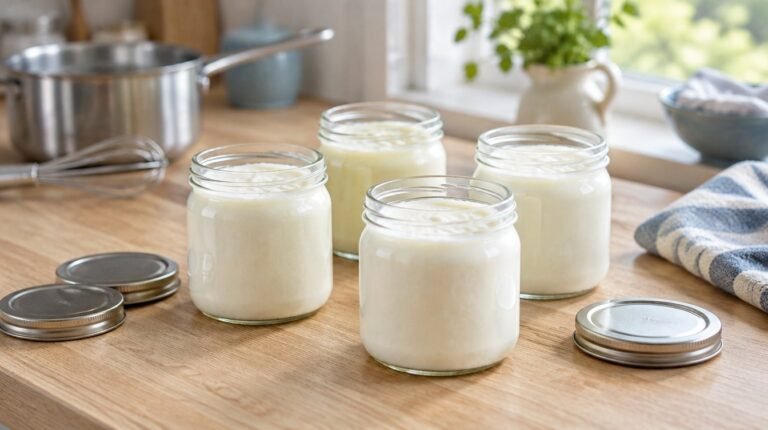
- An incubator that holds 108 to 110°F: any yogurt maker, a multicooker yogurt setting, or an oven with the light on. See How to Incubate Yogurt and making yogurt without a yogurt maker.
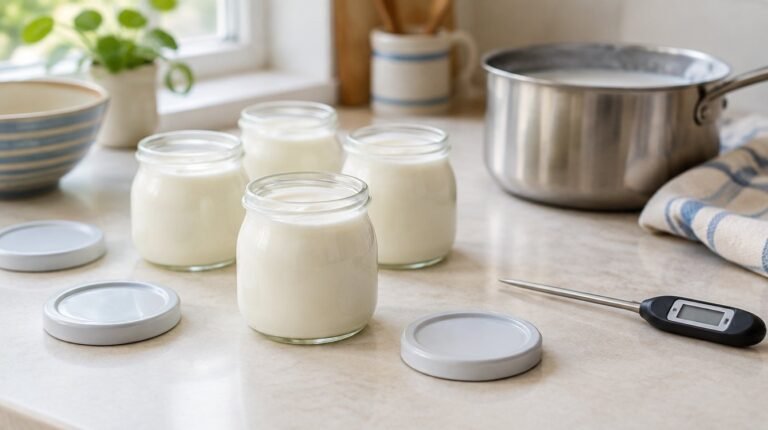
- A probe thermometer: check the incubator with a jar of water first, and keep it at or below 113°F, the top of the range used in the research.
- Clean glass jars with lids, a saucepan and a whisk.
Ingredients
- 1 quart (946 mL) milk: whole milk gives the thickest result. Ultra-pasteurized milk also works; see using ultra-pasteurized milk.
- LGG starter: the contents of capsules that list Lactobacillus (or Lacticaseibacillus) rhamnosus GG. Start with one label serving.
- Partner culture: a yogurt starter containing Streptococcus thermophilus, used at the packet rate for 1 quart, or 2 tablespoons of plain yogurt with live cultures. A starter with S. thermophilus alone is closest to the research; most plain yogurt also contains L. bulgaricus, which makes a tangier result.
- 1/4 cup nonfat dry milk (optional): for a thicker set.
Steps
- Whisk the dry milk into the cold milk, if using. Heat slowly to 180 to 185°F (82 to 85°C), stirring so it does not scorch. Heating to 180°F kills competing bacteria and changes the whey proteins so the yogurt sets better (University of Missouri Extension).
- Cool to 110°F (43°C). A sink of cold water speeds this up. Adding culture to hotter milk can kill it.
- In a small bowl, whisk the LGG capsule contents and the partner culture into half a cup of the warm milk until smooth, then stir it back into the rest.
- Pour into jars and put the lids on.
- Incubate at 108 to 110°F for 12 hours without stirring. Check one jar at 8 hours; if it is set and pleasantly tart, you can stop early.
- Refrigerate at 40°F or below for at least 6 hours, then eat within 14 days (University of Illinois Extension). See how long homemade yogurt lasts for storage details.
This sits close to the classic method, which incubates at 108 to 115°F for 6 to 10 hours (University of Illinois Extension). The 12-hour time follows the research co-culture, which took about that long to reach full acidity. For more on how time changes tang and texture, see How Long to Incubate Yogurt.
How to tell it worked
- Set: a smooth, spoonable gel that pulls away cleanly from the side of the jar when tilted, much like ordinary homemade yogurt.
- Smell and taste: clean, fresh and tart. It should not smell yeasty, cheesy or rotten.
- Acidity (optional): pH strips should read 4.6 or lower, the U.S. benchmark for finished yogurt (21 CFR 131.200). The research co-culture reached 4.3.
- Whey: a little clear liquid on top is normal; a lot means it ran too long or too hot.
A good set shows the partner culture worked. It cannot show how much LGG grew, and in a mixed batch the partner does most of the visible work. Only lab counts on selective media can measure LGG, so treat any homemade batch as a fermented food, not a measured dose.
Failure modes and fixes
| Problem | Likely cause | Fix |
|---|---|---|
| Still liquid at 12 hours | No partner culture, weak partner, or milk too hot when cultures went in | Always add S. thermophilus or live yogurt, inoculate at 110°F, and check the incubator |
| LGG alone, still milky after a day | Expected: LGG uses lactose and casein poorly | Use the partner culture; do not keep extending a solo batch |
| Very sour with lots of whey | Fermented too long or above 113°F | Stop at 8 to 10 hours, or lower the temperature to 108°F |
| Slimy, fizzy or yeasty | Contamination from jars, utensils or a reused batch | Discard, wash everything in hot soapy water, start fresh |
| Pink, orange, black or fuzzy spots; rotten smell | Mold or spoilage | Throw out the whole batch |
The USDA says yogurt with mold should be discarded, because foods with high moisture can be contaminated below the surface (USDA FSIS). For a batch that weeps but smells fine, see Whey from Yogurt.
Can you use a batch to start the next one?
Partly. In the African project, the fermented milk from a first batch was used to start the next, and the LGG-type strain kept its mucus-binding pili through two rounds (Kort et al., 2015). At home, without lab checks, it is safer to assume the balance shifts toward the faster partner over several rounds. Reuse a batch once or twice, then return to a fresh capsule. Our article on why an heirloom starter weakens over time explains the pattern.
Can LGG make yogurt by itself?
Not well. LGG uses lactose and casein poorly, so it grows weakly in plain milk (Hussain et al., 2021); pair it with Streptococcus thermophilus.
Why ferment LGG at 108-110°F?
That temperature suits the partner S. thermophilus, which did best near 108°F in the research, while LGG still grows in the 99 to 113°F range used in that study.
Is LGG yogurt as effective as LGG capsules?
No one knows. Trials used capsules or powders at measured doses, and a home batch gives no way to count how much LGG it contains.
Related topics
- Lactobacillus casei: a close relative in the casei group.
- Lactobacillus paracasei: the third member of the group.
- Streptococcus thermophilus: the partner that helps LGG grow in milk.
- Lactobacillus acidophilus: another probiotic culture made at warm temperatures.
- How to Restore Gut Health After Antibiotics: food and probiotic options in context.
- Best Yogurt for Probiotics: if you would rather buy than make.
Sources
- Capurso L. Thirty years of Lactobacillus rhamnosus GG: a review (Journal of Clinical Gastroenterology, 2019)
- Koyama S, et al. Septicemia from Lactobacillus rhamnosus GG, from a probiotic enriched yogurt, in a patient with autologous stem cell transplantation (Probiotics and Antimicrobial Proteins, 2019)
- Kankainen M, et al. Comparative genomic analysis of Lactobacillus rhamnosus GG reveals pili containing a human-mucus binding protein (Proceedings of the National Academy of Sciences, 2009)
- Probiotics: Fact Sheet for Consumers (NIH Office of Dietary Supplements)
- Zheng J, et al. A taxonomic note on the genus Lactobacillus: description of 23 novel genera, emended description of the genus Lactobacillus Beijerinck 1901, and union of Lactobacillaceae and Leuconostocaceae (International Journal of Systematic and Evolutionary Microbiology, 2020)
- Species: Lacticaseibacillus rhamnosus (LPSN, Leibniz Institute DSMZ)
- Phylum: Bacillota (LPSN, Leibniz Institute DSMZ)
- Szajewska H, Kołodziej M. Systematic review with meta-analysis: Lactobacillus rhamnosus GG in the prevention of antibiotic-associated diarrhoea in children and adults (Alimentary Pharmacology and Therapeutics, 2015)
- Schnadower D, et al. Lactobacillus rhamnosus GG versus placebo for acute gastroenteritis in children (New England Journal of Medicine, 2018)
- Hussain N, et al. Generation of lactose- and protease-positive probiotic Lacticaseibacillus rhamnosus GG by conjugation with Lactococcus lactis NCDO 712 (Applied and Environmental Microbiology, 2021)
- Xie Z, et al. Restoration of lactose metabolism in Lacticaseibacillus rhamnosus GG for dairy fermentation applications (Journal of Dairy Science, 2026)
- Østlie HM, et al. Growth and metabolism of selected strains of probiotic bacteria in milk (International Journal of Food Microbiology, 2003)
- Kort R, et al. A novel consortium of Lactobacillus rhamnosus and Streptococcus thermophilus for increased access to functional fermented foods (Microbial Cell Factories, 2015)
- Rubin IMC, et al. Bacteraemia caused by Lactobacillus rhamnosus given as a probiotic in a patient with a central venous catheter: a WGS case report (Infection Prevention in Practice, 2022)
- Probiotics: Usefulness and Safety (National Center for Complementary and Integrative Health)
- Dietary Supplements (U.S. Food and Drug Administration)
- Preserve It Fresh, Preserve It Safe: 2019, No. 1 (University of Missouri Extension)
- Making Yogurt at Home (University of Illinois Extension)
- 21 CFR 131.200: Yogurt (Electronic Code of Federal Regulations)
- Molds on Food: Are They Dangerous? (USDA Food Safety and Inspection Service)