Bifidobacterium animalis subsp. lactis: How to Culture It at Home (100-105°F / 24h)
What Bifidobacterium animalis subsp. lactis is
Bifidobacterium animalis subsp. lactis, often shortened to B. lactis, is the bifidobacterium you are most likely to find in yogurt and probiotic capsules. It was first described in 1997 as a separate species, Bifidobacterium lactis, and its name means “of milk” (LPSN). In 2004, researchers showed it is a subspecies of B. animalis, and one of the traits that set it apart from its sister subspecies was its ability to grow in milk (Masco et al., 2004).
That milk-friendliness is the main reason it shows up in dairy foods. Bifidobacteria in general have to cope with oxygen and acid during food production (Ruiz et al., 2011), and B. lactis is unusually well suited to milk for its genus. A review written by scientists at the company that sells strain BB-12 says that strain came from a dairy culture collection and is highly stable in foods and freeze-dried powders (Jungersen et al., 2014).
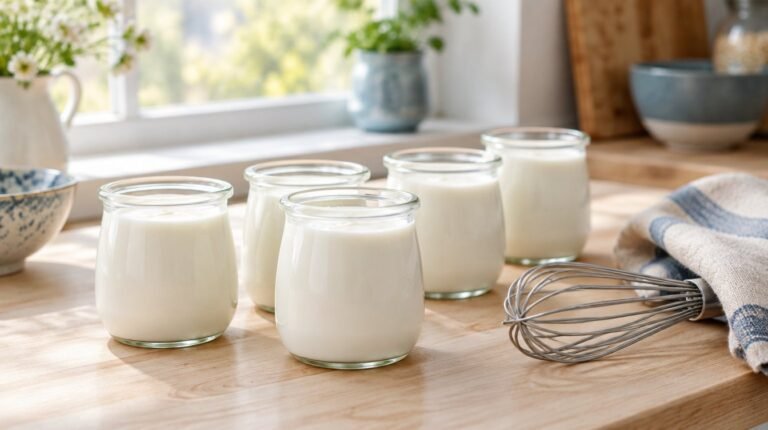
For a bifidobacterium animalis subsp. lactis yogurt at home, the method is a body-temperature ferment at 100 to 105°F (38 to 41°C) for about 24 hours. That is cooler and longer than ordinary yogurt, which incubates at 108 to 115°F for 6 to 10 hours (University of Illinois Extension).
Taxonomy at a glance
| Domain | Phylum | Genus | Species | Strain |
|---|---|---|---|---|
| Bacteria | Actinomycetota (formerly Actinobacteria) | Bifidobacterium | B. animalis subsp. lactis | Varies by product, for example BB-12 or HN019 |
The classification follows the List of Prokaryotic names with Standing in Nomenclature (LPSN), which lists the subspecies as validly published and in risk group 1, the lowest-risk category. Actinomycetota became the formal phylum name in 2021 (Oren and Garrity, 2021).
Labels write it several ways: B. lactis, B. animalis lactis, or the full Bifidobacterium animalis subsp. lactis. They all mean the same subspecies. What separates one product from another is the strain code, and research on one strain does not automatically apply to another.
What the research shows
B. lactis is one of the most studied probiotics, mainly for bowel habits. The trials below used capsules or powders of one strain, not homemade yogurt, and several were run or funded by the strain’s maker. The results are mixed.
Bowel frequency in healthy adults (strain BB-12)
In a large trial of 1,248 adults with infrequent bowel movements and abdominal discomfort, four weeks of BB-12 at 1 or 10 billion CFU a day modestly raised average weekly bowel movements compared with placebo. Relief of abdominal discomfort, the other main outcome, did not differ between groups, and both doses worked about the same (Eskesen et al., 2015).
Gut transit time (strain HN019)
In a 14-day trial of 100 adults with digestive symptoms, HN019 shortened whole gut transit time in a dose-dependent way, while the placebo group did not change (Waller et al., 2011). But a later 28-day trial of 228 adults with functional constipation found no difference from placebo on its main or secondary outcomes; only a smaller subgroup with three or fewer bowel movements a week improved in an after-the-fact analysis (Ibarra et al., 2018).
The largest independent test so far was an eight-week, triple-blind trial of 229 adults with functional constipation in China. HN019 did not beat placebo for complete bowel movements per week, and the authors wrote that their trial did not confirm earlier results (Cheng et al., 2024).
In short: some trials found small changes in bowel habits, larger and later trials often did not, and none tested homemade yogurt. Treat any effect from a home ferment as unknown.
How B. lactis behaves in milk

In a lab study, strain BB12 grew in ultra-high temperature (UHT) milk enriched with a little protein digest or fructose at 37°C (98.6°F). It brought the milk from pH 6.7 down to between 3.9 and 4.4 within 24 hours, and reached high counts within 6 to 16 hours. Its numbers then fell somewhat between 24 and 72 hours of continued fermentation (Østlie et al., 2003). For home cooks, that is a case for stopping at about 24 hours rather than letting a batch run on.
Temperature matters too. In a yogurt made with L. casei and B. lactis strain V9, the B. lactis reached higher counts at 42°C (108°F) than at 37°C, while the L. casei did better at the cooler temperature (Wang et al., 2021). A protocol of 100 to 105°F sits between body temperature and that warmer point, which suits most strains.
B. lactis also works well with a partner. In a goat milk study, a mixed culture of B. animalis and L. acidophilus fermented under controlled temperature (37°C) and low oxygen reached its highest B. animalis count by 20 hours, and both cultures survived well through 10 days in the fridge (Kongo et al., 2006). Our L. acidophilus guide covers that partner on its own.
Before you start: a short safety note
Probiotics carry a greater risk of harmful effects for people with severe illnesses or weakened immune systems, and severe infections have been reported in premature infants given probiotics (NCCIH). If you are immunocompromised, seriously ill, pregnant, or feeding an infant, ask your health care provider first (NIH Office of Dietary Supplements). Probiotic capsules are usually sold as dietary supplements, and their makers, not the FDA, are responsible for checking safety before sale (FDA). This article is general information, not medical advice.
Home protocol: B. lactis yogurt at 100-105°F for 24 hours
This makes 1 quart. Hands-on time is about 30 minutes, then 24 hours of incubation and at least 6 hours of chilling.
Equipment
- An incubator that holds 100 to 105°F for a full day: an adjustable yogurt maker, a multicooker with a low setting, or a proofing box. See How to Incubate Yogurt for setups.
- A probe thermometer, to check the incubator with a jar of water before your first batch.
- Glass jars with tight lids, a saucepan and a whisk.
Ingredients
- 1 quart (946 mL) whole milk: pasteurized or ultra-pasteurized both work; see using ultra-pasteurized milk.
- 1/4 cup nonfat dry milk (optional): thickens the result.
- 1 teaspoon inulin powder (optional): extra fiber for the culture to use.
- B. lactis starter: a capsule or powder listing B. lactis or B. animalis subsp. lactis, ideally with a strain code. Start with the label’s serving amount; see how much starter to use.
- Optional partner: a starter with L. acidophilus or S. thermophilus, for a firmer and faster set.
Steps
- Whisk the dry milk into the cold milk, if using. Heat slowly to 180 to 185°F (82 to 85°C), stirring so it does not scorch. Heating to 180°F kills competing bacteria and changes the whey proteins so the yogurt sets better (University of Missouri Extension).
- Cool to 104°F (40°C). Do not add the culture when the milk is hotter than 105°F.
- Mix the starter and inulin into half a cup of the warm milk until smooth, then stir gently into the rest. Add the partner culture now if using one.
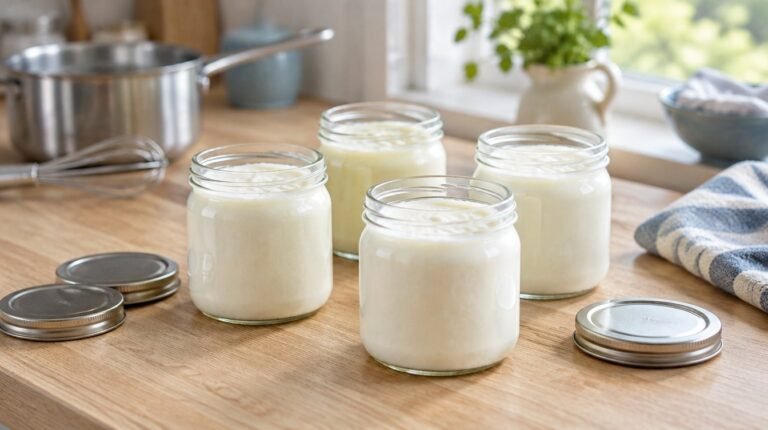
- Fill jars close to the rim to limit air, and close the lids.
- Incubate at 100 to 105°F for 24 hours without moving the jars. Check one jar at 12 hours, and again at 18. If it has set and tastes pleasantly tart, you can stop early.
- Chill at 40°F or below for at least 6 hours. The texture firms as it cools.
- Eat within 14 days (University of Illinois Extension). See How Long Does Homemade Yogurt Last for storage tips.
For the reasoning behind cooler, longer ferments, see Yogurt Temperature and How Long to Incubate Yogurt.
How to tell it worked
- Set: a soft to medium gel that moves as one piece when you tilt the jar. B. lactis alone usually sets looser than store yogurt.
- Smell and taste: clean, mild and tart, like a gentle plain yogurt.
- Acidity (optional): with pH strips, look for a reading in the low 4s. In the BB12 study, milk reached pH 3.9 to 4.4 at 24 hours (Østlie et al., 2003).
- Whey: a little clear liquid on top is normal. Lots of whey and a curdy texture mean it ran too long or too warm.
There is no home test for which bacteria grew. Counting bifidobacteria separately from other lactic acid bacteria takes selective lab media (Shah, 2000). If you used a partner culture, it probably did much of the thickening.
Failure modes and fixes
| Problem | Likely cause | Fix |
|---|---|---|
| No change after 24 hours | Dead or weak starter, or culture added to milk that was too hot | Use a fresh starter, add it at 104°F, check the incubator temperature |
| Thin but tangy | Normal for single-strain B. lactis | Add dry milk, or use a partner culture for a firmer set |
| Very sour, curdled, lots of whey | Fermented too long or too warm | Stop at 16 to 20 hours, or set the incubator nearer 100°F |
| Yeasty, fizzy or cheesy smell | Contamination from jars, tools or a reused batch | Discard, wash everything in hot soapy water, start fresh |
| Fuzzy spots or pink, orange or dark patches | Mold or spoilage | Throw out the whole batch |
The USDA advises discarding yogurt that shows mold, because moist foods can be contaminated below the surface, and bacteria can grow along with the mold (USDA FSIS). If a batch only weeps whey and smells clean, see Whey from Yogurt.
Can you reuse a batch as starter?
B. lactis is sturdier than most bifidobacteria, so reusing 2 tablespoons from a fresh, clean batch to start the next quart sometimes works for a round or two. Over time, though, the balance tends to shift toward whatever tough bacteria get in, and texture or tang fades. When that happens, start again from a fresh capsule. Heirloom Starter Weakened Over Time explains the pattern.
Is B. lactis the same as Bifidobacterium animalis subsp. lactis?
Yes. Bifidobacterium lactis was reclassified as a subspecies of B. animalis in 2004, and labels use both names (Masco et al., 2004).
Why is B. lactis easier to culture than other bifidobacteria?
Its ability to grow in milk is one of the traits that set it apart from its sister subspecies, and strains such as BB-12 are described as stable in foods.
Does homemade B. lactis yogurt help with constipation?
That has not been tested. Capsule trials of specific strains found small effects in some studies and none in others, including a large 2024 trial.
Related topics
- Bifidobacterium breve: a fussier bifidobacterium cultured the same way.
- Lactobacillus acidophilus: a common partner culture for B. lactis.
- Lactobacillus salivarius: another 24-hour, body-temperature ferment.
- Yogurt Starter: how starters differ and how to choose one.
- Best Yogurt for Probiotics: store-bought yogurts that list bifidobacteria.
- Can You Take Too Many Probiotics?: what the evidence says about dose.
Sources
- Subspecies: Bifidobacterium animalis subsp. lactis (LPSN, Leibniz Institute DSMZ)
- Masco L, et al. Polyphasic taxonomic analysis of Bifidobacterium animalis and Bifidobacterium lactis reveals relatedness at the subspecies level (International Journal of Systematic and Evolutionary Microbiology, 2004)
- Oren A, Garrity GM. Valid publication of the names of forty-two phyla of prokaryotes (International Journal of Systematic and Evolutionary Microbiology, 2021)
- Ruiz L, et al. How do bifidobacteria counteract environmental challenges? Mechanisms involved and physiological consequences (Genes & Nutrition, 2011)
- Jungersen M, et al. The science behind the probiotic strain Bifidobacterium animalis subsp. lactis BB-12 (Microorganisms, 2014)
- Eskesen D, et al. Effect of the probiotic strain Bifidobacterium animalis subsp. lactis, BB-12, on defecation frequency in healthy subjects with low defecation frequency and abdominal discomfort (British Journal of Nutrition, 2015)
- Waller PA, et al. Dose-response effect of Bifidobacterium lactis HN019 on whole gut transit time and functional gastrointestinal symptoms in adults (Scandinavian Journal of Gastroenterology, 2011)
- Ibarra A, et al. Effects of 28-day Bifidobacterium animalis subsp. lactis HN019 supplementation on colonic transit time and gastrointestinal symptoms in adults with functional constipation (Gut Microbes, 2018)
- Cheng J, et al. Eight-week supplementation with Bifidobacterium lactis HN019 and functional constipation: a randomized clinical trial (JAMA Network Open, 2024)
- Østlie HM, et al. Growth and metabolism of selected strains of probiotic bacteria in milk (International Journal of Food Microbiology, 2003)
- Wang J, et al. Different growth behaviors and metabolomic profiles in yogurts induced by multistrain probiotics of Lactobacillus casei Zhang and Bifidobacterium lactis V9 under different fermentation temperatures (Journal of Dairy Science, 2021)
- Kongo JM, et al. Manufacturing of fermented goat milk with a mixed starter culture of Bifidobacterium animalis and Lactobacillus acidophilus in a controlled bioreactor (Letters in Applied Microbiology, 2006)
- Shah NP. Probiotic bacteria: selective enumeration and survival in dairy foods (Journal of Dairy Science, 2000)
- Probiotics: Usefulness and Safety (National Center for Complementary and Integrative Health)
- Probiotics: Fact Sheet for Consumers (NIH Office of Dietary Supplements)
- Dietary Supplements (U.S. Food and Drug Administration)
- Making Yogurt at Home (University of Illinois Extension)
- Preserve It Fresh, Preserve It Safe: 2019, No. 1 (University of Missouri Extension)
- Molds on Food: Are They Dangerous? (USDA Food Safety and Inspection Service)