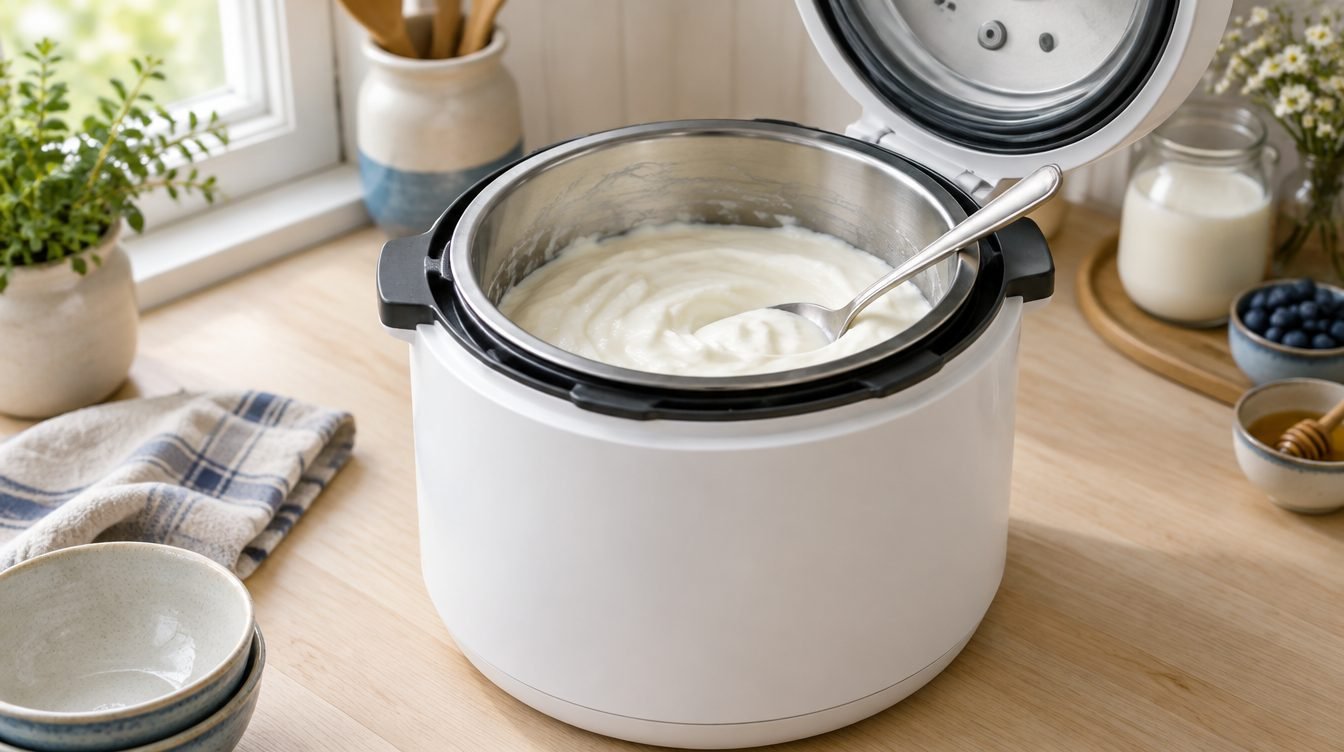
Instant Pot Yogurt: What You Need to Know
Instant Pot yogurt: what the Yogurt program does
Instant Pot yogurt is homemade yogurt made with the cooker’s Yogurt program. On Duo models, the More setting heats the milk to pasteurize it (the display reads “boiL”), and the Normal setting then holds the cultured milk warm for 8 hours by default. You supply the milk, a starter with live cultures and a thermometer check.
The manufacturer calls the Yogurt program a non-pressure function. Settings differ between models, so check the manual for yours on Instant Pot’s manuals page.
The three Duo settings
| Setting | What the Duo manual says it’s for | Time |
|---|---|---|
| Less | Lower-temperature fermentation, such as jiu niang, a sweet fermented rice dessert | 24 hours by default |
| Normal | Fermenting milk after the culture is added | 8 hours by default, adjustable up to 99 hours 30 minutes |
| More | Pasteurizing milk (“boiL”) | Preset, not adjustable |
Newer models rename these: the Pro manual lists Low (Ferment), High (Pasteurise) and Custom, with pasteurizing taking 30 minutes to 1 hour depending on the amount of milk. Delay Start doesn’t work with the Yogurt program, so you can’t schedule a batch.
What temperatures does it use?
The Duo manual doesn’t publish a temperature for Less or Normal. It says the milk must reach at least 161°F (72°C) to pasteurize, to check it with a thermometer once the cycle ends, and to cool it to just below 110°F (43°C) before adding starter.
Some manuals are more specific. The 2026 Pro Plus manual lists pasteurization at 185°F (85°C) for 30 minutes and fermentation at 106°F (41°C) for 6 to 12 hours, and the Duo Evo Plus has a Custom setting from 77°F to 194°F (25–90°C). Extension guides incubate at 110°F ±5°F (43°C ±3°C), so 106°F (41°C) sits inside that range. See yogurt temperature for each stage.
Why the Yogurt setting matters for gut health
An incubator’s job is to keep the cultures alive and working. Standard yogurt cultures can be killed above 130°F (54°C) and grow poorly below 98°F (37°C), according to University of Alaska Fairbanks (UAF) Cooperative Extension, and a thermostat holds that range without constant checking.
Homemade yogurt isn’t heat-treated after it sets, so its cultures stay alive; commercial yogurt heat-treated after culturing must be labeled “does not contain live and active cultures”. Fermentation cuts lactose by about 30%, and the cultures’ lactase underpins an EFSA-approved claim that live yogurt cultures improve lactose digestion, notes the ISAPP consensus statement. In a small Stanford trial of 36 adults, a 10-week diet high in fermented foods, including yogurt, increased microbiome diversity and lowered 19 inflammatory proteins; it was a proof-of-concept study and didn’t test yogurt alone.
Warm milk is also a food-safety question: incubation sits inside the 40–140°F (4–60°C) range where bacteria grow most rapidly. Extension methods rely on pasteurized milk, clean equipment and an active starter, and UAF says to discard any batch that fails to set.
How to make yogurt in an Instant Pot
The method in brief
This is the Duo sequence; the full method is in how to make yogurt at home.
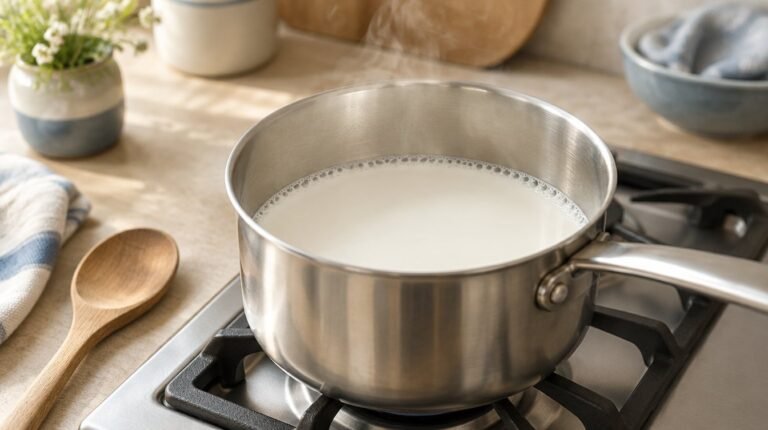
- Pasteurize. Add milk to the inner pot (about 4 cups to 4 quarts, or 1 to 3.8 liters, in a 6-quart model, per the Duo manual). Close the lid, set the steam release to Venting, press Yogurt and cycle to More.
- Check the temperature. At End, remove the lid and confirm at least 161°F (72°C). Extension guides heat to 180–185°F (82–85°C) and hold 10 to 20 minutes for thicker yogurt; the manual suggests pasteurizing twice for extra-thick yogurt.
- Cool to just below 110°F (43°C). Culture added to milk over 115°F (46°C) can be killed (UAF).
- Add the starter. Mix it into about 1 cup of the warm milk, then stir that back in (Illinois Extension). The manual suggests 2 tablespoons of yogurt per gallon or a trusted recipe; extension guides use 2 tablespoons (Illinois) to ¼ cup (UAF) per quart.
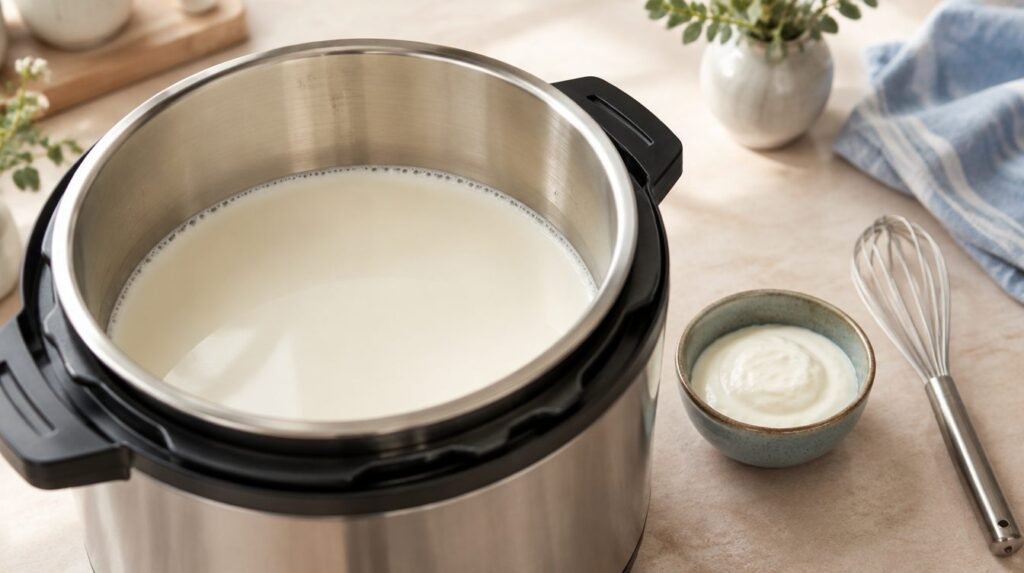
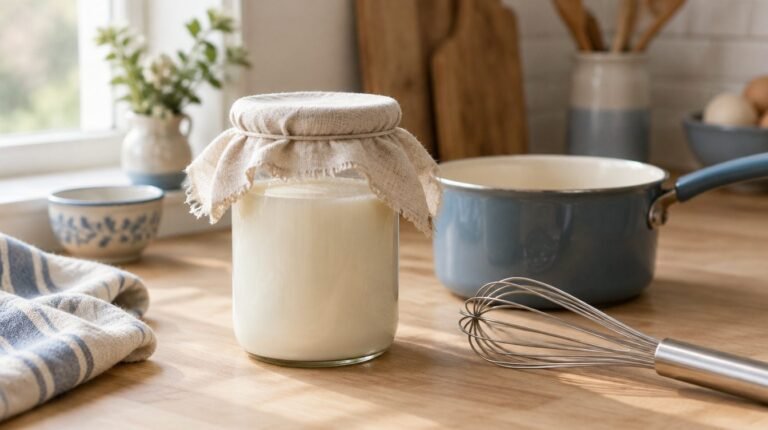
- Ferment on Normal (8 hours). Ultimate Health Solutions, the company that publishes this site, recommends 8 hours at 110°F (43°C). One large container sets more slowly than small ones (Illinois); the manual also allows sealed jars on the steam rack in water.
- Chill as soon as it sets; rapid cooling stops acid development. Eat it within 14 days.
Cold start. The manuals let you skip pasteurizing with ultra-pasteurized or long-life milk. Ultimate Health Solutions also treats heating as optional for unopened pasteurized dairy, though heating gives a thicker texture. Washington State University (WSU) Extension notes that heating also kills competing bacteria, so it is the more cautious choice. Start with commercially pasteurized milk: the National Center for Home Food Preservation warns that acid-tolerant E. coli O157:H7 means acidity alone can’t make unpasteurized milk safe.
Common problems and fixes
| Problem | Likely causes | Fix |
|---|---|---|
| Didn’t set | Milk too hot for the starter (UAF), a starter with dead bacteria, or the wrong setting (Less runs cooler; More only pasteurizes) | Discard it (UAF). Next time cool the milk fully, use fresh starter and choose Normal. |
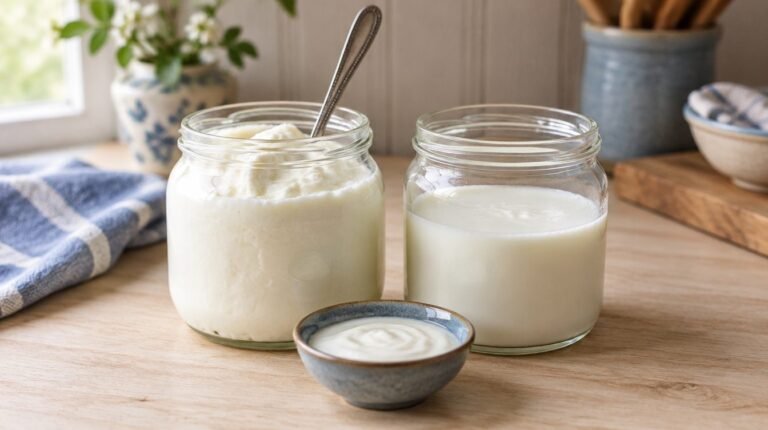
| Thin or runny | Milk not heated enough, weak starter, or too short a ferment for one large batch (Illinois) | Pasteurize twice, add ⅓ cup dry milk per quart to the cold milk (UAF, WSU), or strain it into Greek-style yogurt. |
| Too tangy, or whey on top | Long ferment or a disturbed pot (UAF) | Shorten the time, since longer gives tangier yogurt; refrigerate promptly. Whey can be stirred back in. |
| Savory off-flavors | The sealing ring holds odors | Instant Pot suggests one ring for sweet and dairy foods, another for savory. |
| Unknown temperature | Many manuals don’t list one | Run Normal with warm water and check it with a thermometer after an hour or two. |
Instant Pot vs other ways to incubate yogurt
University of Illinois Extension lists electric pressure cookers alongside yogurt makers and says to follow the manufacturer’s directions for both. Methods differ mainly in how steadily they hold temperature and how much attention they need.
| Method | How it holds the temperature | Good to know |
|---|---|---|
| Multicooker | Thermostat; heats and ferments in one pot | Settings vary by model; the cooker is busy for the whole ferment. |
| Yogurt maker | Thermostat; follow the maker’s directions (UAF) | Some only incubate; some let you set temperature and time. |
| Oven | Preheat to 200°F (93°C), turn off (Illinois); jars in a pan of 110°F (43°C) water (UAF) | Switch it on briefly as it cools. |
| Insulated cooler | Half-filled with about 120°F (49°C) water, wrapped in a towel (Illinois) | Heat drifts, so monitor it and add warmth. |
| Thermos | Preheated with boiling water, filled with milk at 110–115°F (43–46°C) (UAF) | Small batches only. |
The Instant Pot’s strengths are steadiness and convenience: one pot for heating and fermenting, and no hourly checks. Its limits depend on the model. Ultimate Health Solutions recommends 24-hour ferments at 99–118°F (37–48°C) for its probiotic capsule starters, so if you use cultures with their own temperatures, check whether your model has a custom setting.
A dedicated yogurt maker is the other thermostat-controlled option. It leaves the multicooker free for cooking, and models with an adjustable temperature and timer can match cultures outside the standard range.
More on making yogurt at home
- How to Make Yogurt at Home: A Step-by-Step Guide: the full method, step by step.
- Yogurt Temperature: What You Need to Know: the temperatures that matter at each stage.
- How Long to Incubate Yogurt? The Complete Answer: how time changes texture and tang.
- How to Make Greek Yogurt: A Step-by-Step Guide: strain a batch into thick yogurt.
- How Long Does Homemade Yogurt Last? The Complete Answer: storage times and spoilage signs.
Sources
- Instant Brands. Instant Pot Duo Multi-Use Pressure Cooker User Manual (Duo Mini v3, Duo 60 v4, Duo 80 v3), 2021.
- Instant Brands. Instant Pot Duo Evo Plus User Manual, 2020.
- Instant Brands. Instant Pot Pro User Manual, 2021.
- Instant Pot Brands. Instant Pot Pro Plus 5.7L Multi-Cooker User Manual, 2026.
- Instant Pot. Multi-Cooker Product Manuals.
- Instant Pot. 4, 5 & 6 QT Color Sealing Ring, 2-Pack (product page).
- Cascio J, Dinstel RR. Making Yogurt at Home (FNH-00062). University of Alaska Fairbanks Cooperative Extension Service.
- University of Illinois Extension. Making Yogurt at Home (2024).
- Smith DK. Yogurt Made Simple. Washington State University Extension, distributed by the UC Master Food Preserver Program.
- Nummer BA. Fermenting Yogurt at Home. National Center for Home Food Preservation (2002), reprint hosted by UC Davis.
- NDSU Extension. How Long Can You Keep Yogurt? (Food Wise, 2016).
- Electronic Code of Federal Regulations. 21 CFR 131.200, Yogurt.
- Sfakianakis P, Tzia C. Conventional and innovative processing of milk for yogurt manufacture; development of texture and flavor: a review. Foods. 2014;3(1):176–193.
- Marco ML, Sanders ME, Gänzle M, et al. The International Scientific Association for Probiotics and Prebiotics (ISAPP) consensus statement on fermented foods. Nature Reviews Gastroenterology & Hepatology. 2021;18:196–208.
- Stanford Medicine. Fermented-food diet increases microbiome diversity, decreases inflammatory proteins, study finds (2021).
- USDA Food Safety and Inspection Service. How Temperatures Affect Food.
- The Ultimate Yogurt Guide (eBook), Ultimate Health Solutions, publisher of this site