Emma Gut Health Reviews: An Honest Assessment
The short answer
Emma is a two-capsule daily digestive supplement from Enclave BioActives. Its best-researched ingredient, berberine, has one placebo-controlled trial in people with diarrhea-predominant IBS, but that trial used twice the amount Emma provides. Most of the other ingredients are either present in much smaller amounts than studied doses or have little human research for digestion, and we found no published clinical trial of Emma itself.
That does not make Emma useless or unsafe for everyone. It means the evidence for the finished product is thin, and some ingredients (berberine and garlic in particular) call for a word with your doctor if you take medication or are pregnant. Labels checked October 2026.
Ultimate Gut is published by Ultimate Health Solutions, which sells a yogurt maker, probiotic capsules and an inulin fiber supplement. None of the products reviewed here are ours, and these brands don’t pay us.
What Emma is and who makes it
Emma is sold by Enclave BioActives on its official product page, which lists it under gut health and describes it as supporting regular bowel movements, comfort after meals and “complete elimination.” The directions are two capsules a day with water, preferably before a meal. A company press release from April 2026 says Emma is now sold at Target stores and Target.com.
Search results for Emma often mention a doctor by name. The product page we read does not state who formulated Emma or describe any doctor’s role, so we could not confirm that link from the brand’s own materials. The page does say Emma is not a laxative and contains no stimulants.
Like all supplements, Emma did not need FDA sign-off before going on sale. Under federal law, the FDA is not authorized to approve dietary supplements for safety and effectiveness before they are marketed.
What’s in Emma
The ingredients below come from the Supplement Facts panel shown on the Emma product page (label checked October 2026). One serving is 2 capsules, and a bottle holds 30 servings. Amounts are disclosed for every ingredient, so this is not a proprietary blend.
| Ingredient (per 2 capsules) | Amount | What human research exists |
|---|---|---|
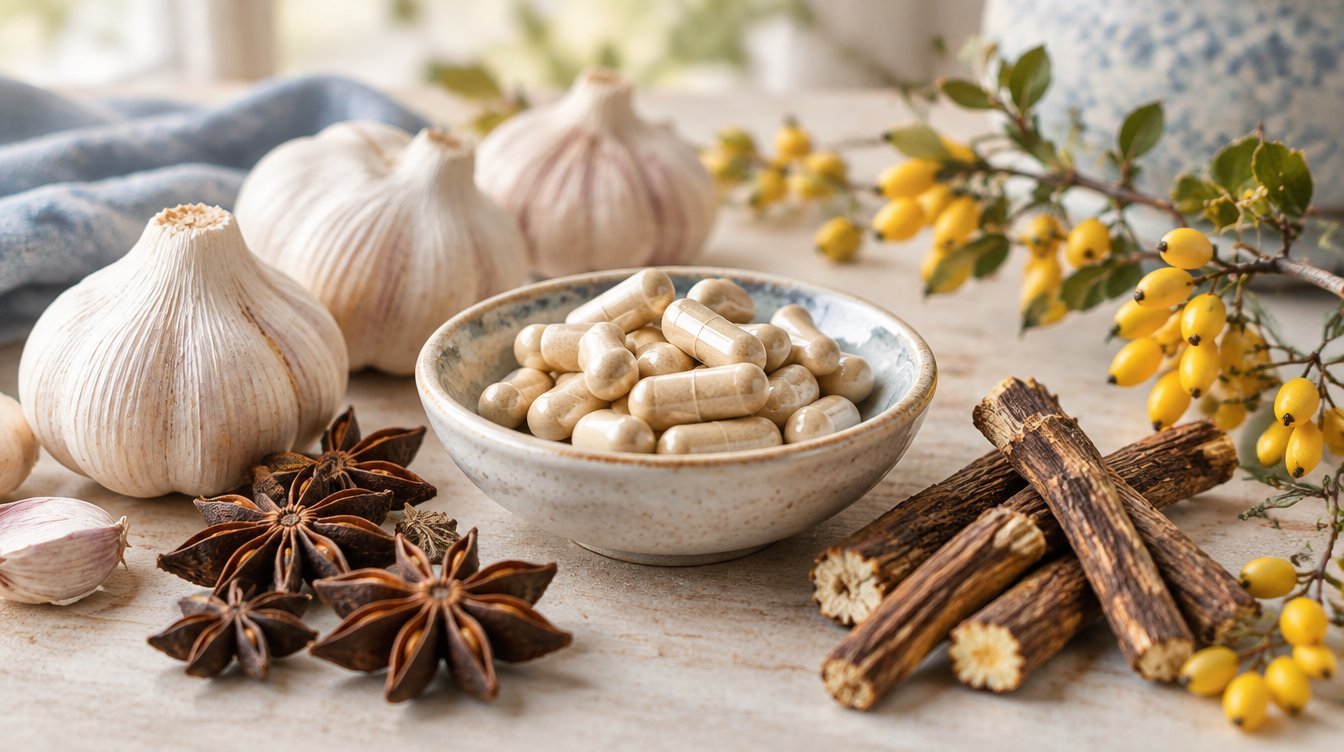
| Berberine hydrochloride | 200 mg | One randomized trial in diarrhea-predominant IBS used 400 mg a day for 8 weeks (Chen 2015). Common side effects are digestive (NCCIH). |
| Resveratrol (from Japanese knotweed root) | 125 mg | We found no human trials testing it for digestive comfort or regularity. |
| Quercetin (as dihydrate) | 125 mg | We found no human trials testing it for digestive comfort or regularity. |
| Star anise seed | 100 mg | We found no controlled human trials for digestive symptoms. |
| Garlic bulb | 100 mg | Not studied for regularity in our search. Garlic can cause gas and nausea and may raise bleeding risk (NCCIH). |
| Deglycyrrhizinated licorice (DGL) root extract | 50 mg | NCCIH says it is unclear whether licorice products affect digestive symptoms (NCCIH). |
| Chicory root inulin | 50 mg | A constipation trial used 12 g a day, about 240 times this amount (Micka 2017). |
| Larch arabinogalactan | 50 mg | We found no human trials for digestive symptoms at this amount. |
| Vitamin D, B vitamins, biotin, folate | Various (for example B6 15 mg, B12 100 mcg) | Essential nutrients, not digestive aids. |
| Magnesium (as oxide) | 90 mg (21% DV) | Below the 350 mg adult upper limit for supplemental magnesium (NIH ODS). |
| Zinc (as oxide) | 15 mg (136% DV) | Below the 40 mg adult upper limit, which counts zinc from all sources (NIH ODS). |
One oddity on the panel: thiamin, riboflavin and niacin are each listed at 20 mcg, but the %DV figures next to them (1,667%, 1,538% and 125%) match 20 mg, not 20 mcg. We could not tell from the page which figure is correct, so check the bottle if this matters to you.
What Emma claims vs what the evidence shows
The product page calls Emma “research-backed” and says it works in three ways: supporting motility, nurturing a healthy gut environment and promoting comfortable elimination. It does not cite any study. The April 2026 press release reports symptom percentages from an “8-week consumer study” but gives no sample size, method, control group or journal, so there is no way to judge those numbers.
Berberine: the strongest piece
In a randomized, double-blind trial at a Shanghai hospital, 132 adults with diarrhea-predominant IBS took 400 mg of berberine hydrochloride a day or a placebo for 8 weeks. The berberine group had fewer episodes of diarrhea, abdominal pain and urgency than the placebo group. That is a real but limited finding: one trial, one population, and twice Emma’s daily dose. It says nothing about constipation, which Emma’s page also mentions.
Berberine is not a neutral ingredient. NCCIH notes that its most common side effects are abdominal pain, constipation, diarrhea, nausea and vomiting, that it may interact with medicines, and that people who are pregnant or breastfeeding should not use it. NCCIH also reports some evidence of modest effects on blood sugar and cholesterol in people with type 2 diabetes.
The rest of the formula
The fiber in Emma is a small amount. A randomized crossover trial of 44 constipated adults found that 12 g a day of chicory inulin for 4 weeks increased stool frequency compared with placebo. Emma has 50 mg. For licorice, NCCIH says there isn’t enough high-quality evidence to support it for any health condition, though it says deglycyrrhizinated forms might be safe for up to 4 months.
For resveratrol, quercetin, star anise and larch arabinogalactan, we found no human trials testing them for bowel regularity or digestive comfort. Claims that this combination “works in 3 ways” are not supported by published human trials of the product.
Has Consumer Reports reviewed Emma?
We searched Consumer Reports in October 2026 and found no review, rating or test of Emma. Consumer Reports has published general cautions, including an article on dietary supplements marketed online that warns about aggressive online ads and auto-renewing subscriptions. In our searches of FTC press releases and BBB National Programs advertising decisions, we found no case naming Emma or Enclave BioActives.
Price per serving
The product page lists prices per bottle, and each bottle holds 30 daily servings. Prices below were checked on the Emma product page in October 2026 and may change.
| Option | Price per bottle | Price per serving |
|---|---|---|
| 1 bottle, one-time | $59 (plus $4.95 shipping) | About $1.97 |
| 3 bottles, one-time | $49 | About $1.63 |
| 6 bottles, one-time | $39 | About $1.30 |
| 1 bottle, monthly subscription | $50.15 | About $1.67 |
| 6 bottles, subscription | $33.15 | About $1.11 |
The page also offers a 90-day money-back guarantee. Read the subscription terms before checking out.
Who it may suit, and who should skip it
Emma may suit an adult who is not pregnant, takes no regular medication, and wants to try a berberine product at a modest dose with a refund window. Keep expectations in line with the evidence: no trial has tested this formula.
Talk to a doctor or pharmacist first, or skip it, if any of these apply:
- Pregnant or breastfeeding: NCCIH advises against berberine in pregnancy and breastfeeding.
- You take prescription medicine: berberine may interact with medicines, and it has been studied for blood sugar effects, which matters if you take diabetes medication (NCCIH).
- You take blood thinners or have surgery coming up: garlic supplements may increase bleeding risk (NCCIH).
- You take certain antibiotics or osteoporosis drugs: magnesium can reduce absorption of some antibiotics and bisphosphonates if taken too close together (NIH ODS).
- You already take zinc or a multivitamin: add up your total so you stay under the 40 mg zinc upper limit (NIH ODS).
When to see a doctor
Ongoing constipation, diarrhea or bloating deserves a diagnosis, not just a supplement. NIDDK advises seeing a doctor right away if constipation comes with bleeding from the rectum, blood in the stool, constant belly pain, vomiting, fever or weight loss without trying. For diarrhea, NIDDK lists diarrhea lasting more than 2 days, high fever, or six or more loose stools a day as reasons to call. This article is general information, not medical advice.
Alternatives worth considering

- Fermented foods: yogurt and kefir with live cultures are an easy food-first option. See our guides to yogurt for probiotics, kefir brands and fermented foods for gut health.
- Fiber at studied doses: if regularity is the goal, fiber from food or a fiber supplement at gram-level doses matches the research better than milligram amounts.
- A probiotic with strain-level research: look for strains tested in people with your symptom. Our probiotic comparison covers what to check. People who are seriously ill or have weakened immune systems face higher risks from probiotics and should ask a doctor first (NCCIH).
Related topics
- Gut Health Supplements: how the main supplement types compare.
- Fiber Supplement: fiber types and doses used in research.
- Best Probiotic: strain-by-strain evidence for common goals.
- What to Eat when your Stomach Hurts from Gas: food steps for gas and bloating.
- Fermented Foods for Gut Health: food sources of live cultures.
Sources
- Emma product page and Supplement Facts (Enclave BioActives, checked October 2026)
- Emma, the Gut Health Formula Everyone’s Talking About, Lands at Target Nationwide (Enclave BioActives press release via PR Newswire, 2026)
- Information for Consumers on Using Dietary Supplements (U.S. Food and Drug Administration)
- In the News: Berberine (National Center for Complementary and Integrative Health)
- Chen C, et al. A Randomized Clinical Trial of Berberine Hydrochloride in Patients with Diarrhea-Predominant Irritable Bowel Syndrome (Phytotherapy Research, 2015)
- Licorice Root: Usefulness and Safety (National Center for Complementary and Integrative Health)
- Micka A, et al. Effect of consumption of chicory inulin on bowel function in healthy subjects with constipation (International Journal of Food Sciences and Nutrition, 2017)
- Garlic: Usefulness and Safety (National Center for Complementary and Integrative Health)
- Magnesium: Fact Sheet for Consumers (NIH Office of Dietary Supplements)
- Zinc: Fact Sheet for Consumers (NIH Office of Dietary Supplements)
- Beware Dietary Supplements Marketed Online (Consumer Reports, 2021)
- Symptoms and Causes of Constipation (NIDDK)
- Symptoms and Causes of Diarrhea (NIDDK)
- Probiotics: Usefulness and Safety (National Center for Complementary and Integrative Health)
This article is for general information and is not medical advice. Talk to your doctor or a registered dietitian before changing your diet, supplements or medication, especially if you have a health condition.