Psoriasis and Gut Health: What You Need to Know
What psoriasis has to do with the gut
Psoriasis is a skin condition, but it is driven by the immune system, which is why researchers have looked hard at the gut. Studies link psoriasis with a higher risk of inflammatory bowel disease and celiac disease, and people with psoriasis tend to have somewhat different gut bacteria. What the research does not show yet is that changing your gut will clear your skin.
Diet changes with the best evidence are weight loss for people who are overweight and a gluten-free diet only for people who test positive for gluten sensitivity. Probiotics are an early, promising area, not a proven treatment. This article is general information, not medical advice.
What psoriasis is
NIAMS describes psoriasis as a chronic disease in which an overactive immune system speeds up the production of skin cells, leaving skin inflamed and scaly. It is more common in adults than children and affects men and women at similar rates (NIAMS). It is not contagious (NHS).
Common triggers include stress, drinking alcohol or smoking, living with obesity, pregnancy, certain medicines, infections such as strep A, skin injuries and sunlight (NHS). Some people also develop psoriatic arthritis, which causes joint pain, swelling and stiffness (NIAMS).
NIAMS also notes that people with psoriasis have a higher risk of several other conditions, including Crohn’s disease, diabetes, metabolic syndrome and heart disease (NIAMS). See our guide to gut health and autoimmune disease.
The links researchers have found
| Link | What studies found | How strong |
|---|---|---|
| Inflammatory bowel disease | People with psoriasis had higher odds of Crohn’s disease and ulcerative colitis (Fu et al., 2018) | Consistent, from large observational studies |
| Celiac disease | About 3 times the odds of celiac disease in people with psoriasis (Ungprasert et al., 2017) | Moderate; most studies did not adjust for other factors |
| Gut bacteria | Lower diversity and different bacterial mix in 19 patients compared with 20 healthy people (Hidalgo-Cantabrana et al., 2019) | Early; small studies, cause and effect unknown |
Inflammatory bowel disease
A 2018 meta-analysis pooled 9 studies with more than 7.7 million people. Psoriasis was linked with higher odds of both Crohn’s disease and ulcerative colitis, and in the cohort studies people with psoriasis had about 2.5 times the risk of developing Crohn’s disease. The authors suggested that people with psoriasis who have bowel symptoms may need to see a gastroenterologist (Fu et al., JAMA Dermatology, 2018).
Skin and gut do not always respond alike. In one trial of 59 people with Crohn’s disease, secukinumab, a drug that blocks a signal called IL-17A and is used for psoriasis, did not help the bowel disease and caused more side effects than placebo (Hueber et al., Gut, 2012). This is one reason your dermatologist should know about any bowel problems.
Celiac disease and gluten
A meta-analysis of 4 cohort studies, with about 12,900 people with psoriasis and 24,700 without, found about 3 times the odds of celiac disease among those with psoriasis. Most of the studies did not adjust for other factors, which the authors flagged as a limit (Ungprasert et al., Indian Journal of Dermatology, 2017).
In a Swedish study, 30 people with psoriasis who had antibodies to gliadin, a gluten protein, followed a gluten-free diet for 3 months, and their psoriasis scores dropped significantly. Six people without those antibodies did not improve (Michaëlsson et al., British Journal of Dermatology, 2000). The study was small and had no randomized control group.
Gut bacteria
In one Spanish study of 19 patients and 20 healthy people, the patients’ gut bacteria were less diverse and had a different mix of groups (Hidalgo-Cantabrana et al., British Journal of Dermatology, 2019). Studies like this cannot tell whether the bacteria change first or the disease and its treatment change the bacteria.
What diet and probiotics can and cannot do
In 2018, the medical board of the US National Psoriasis Foundation reviewed 55 studies and made formal dietary recommendations. It strongly recommended weight loss with a lower-calorie diet for people with psoriasis who are overweight or obese. It weakly recommended a gluten-free diet, and only for people who test positive for markers of gluten sensitivity. Evidence for other foods and diet patterns was low quality, and diet changes should go alongside standard treatment, not replace it (Ford et al., JAMA Dermatology, 2018).
- Weight loss: in a Danish trial, 60 overweight or obese people with psoriasis were randomized to a low-calorie diet or their usual diet for 16 weeks. The diet group lost about 15 kg more. Their psoriasis scores showed a trend toward improvement that did not quite reach significance, and their quality-of-life scores improved (Jensen et al., JAMA Dermatology, 2013). Our guide to gut health and weight loss covers the diet side.
- Mediterranean-style eating: in a French survey of more than 35,000 adults, about 3,500 of whom reported psoriasis, people with severe psoriasis were less likely to follow a Mediterranean diet. This was an observational study, so it shows a link, not cause (Phan et al., JAMA Dermatology, 2018).
- Probiotics: in a 12-week randomized, placebo-controlled trial of 90 adults with plaque psoriasis who were also using topical steroids, 66.7% of those taking a mix of Bifidobacterium longum CECT 7347, B. lactis CECT 8145 and Lactobacillus rhamnosus CECT 8361 reached a 75% drop in their psoriasis score, compared with 41.9% on placebo (Navarro-López et al., Acta Dermato-Venereologica, 2019). Four authors were employees of ADM Biopolis, a conflict of interest the paper discloses (full text), and the result applies to that specific mix only.
- Microbiome treatments overall: a 2025 meta-analysis of 8 randomized trials with 409 patients found a modest drop in psoriasis severity with gut-targeted treatments, but the trials were small and the results varied widely (Zhu et al., BMC Immunology, 2025).
If you want to try a probiotic, talk with your doctor first, especially if you take medicine that suppresses the immune system. NCCIH notes that the risk of harmful effects from probiotics is greater in people with severe illnesses or weakened immune systems (NCCIH). Foods such as yogurt and kefir are a gentler way to add live cultures; see our guide to fermented foods for gut health.
Practical steps that fit the evidence

- Keep using the treatment your doctor prescribed. Diet works as an add-on (Ford et al., 2018).
- If you are carrying extra weight, a steady, lower-calorie eating plan has the strongest evidence among diet changes (Ford et al., 2018).
- Ask about a celiac blood test before going gluten-free. A gluten-free diet is recommended only if testing shows gluten sensitivity (Ford et al., 2018).
- Cut back on alcohol and stop smoking, two triggers the NHS lists (NHS).
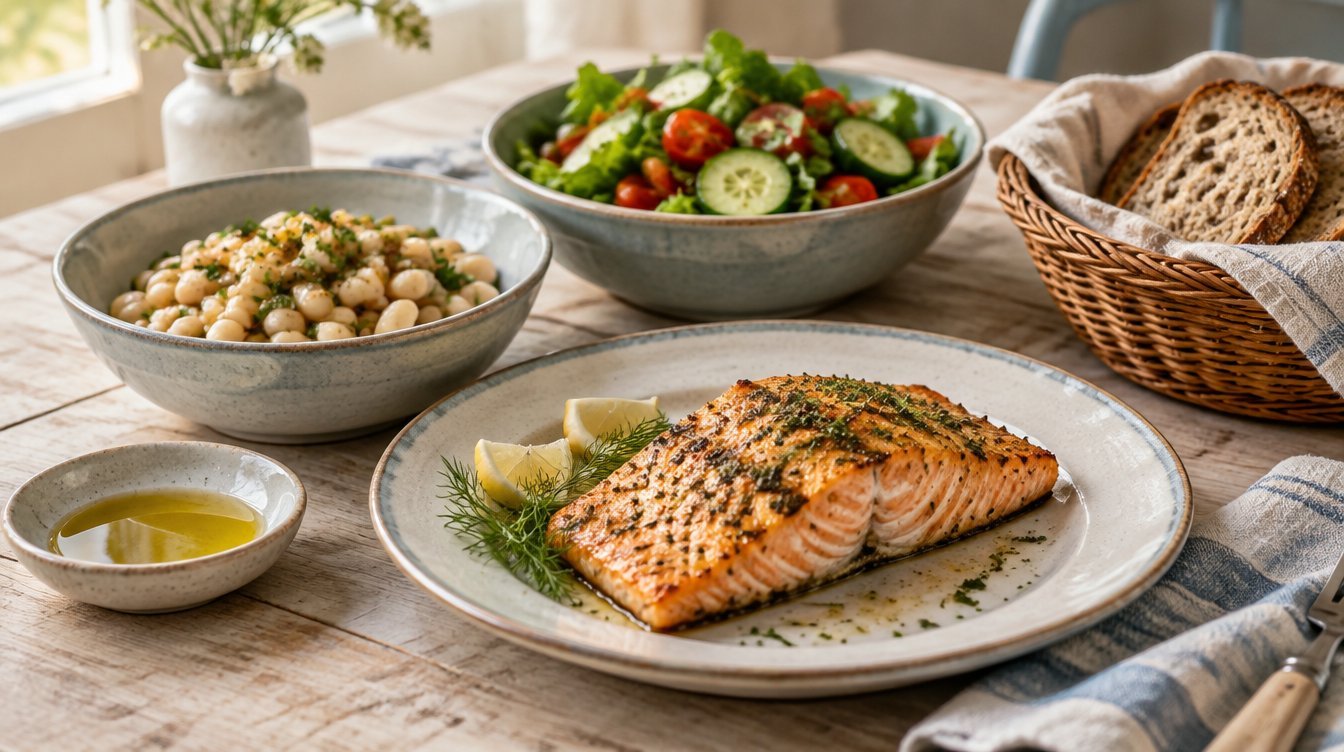
- Build meals around vegetables, fruit, whole grains, beans, fish and olive oil. Our gut health diet plan shows how this looks day to day.
When to see a doctor
The NHS advises seeing a doctor if you have symptoms of psoriasis, if your treatment is not working or causes side effects, or if you have psoriasis and joint pain, stiffness and swelling that keeps coming back (NHS). Get emergency care if your skin quickly turns red and white pus-filled bumps appear and join together, or if pus-filled patches appear on your feet or on your fingertips and toes (NHS).
Because psoriasis is linked with IBD, mention ongoing belly pain, diarrhea or weight loss to your doctor (Fu et al., 2018). Seek help right away for black or tarry stool or blood mixed with stool (NIDDK).
Related topics
- Gut Health and Skin: What You Need to Know: the wider gut-skin research.
- Eczema and Gut Health: What You Need to Know: a related inflammatory skin condition.
- Rosacea and Gut Health: What You Need to Know: another skin and gut link.
- Gut Health and Inflammation: What You Need to Know: how gut bacteria and immunity interact.
- Best Probiotic: how to read strain names and doses on labels.
Sources
- Psoriasis (National Institute of Arthritis and Musculoskeletal and Skin Diseases)
- Psoriasis (NHS)
- Probiotics: Usefulness and Safety (NCCIH)
- Symptoms & Causes of GI Bleeding (NIDDK)
- Fu Y, et al. Association of Psoriasis With Inflammatory Bowel Disease: A Systematic Review and Meta-analysis (JAMA Dermatology, 2018)
- Hueber W, et al. Secukinumab, a human anti-IL-17A monoclonal antibody, for moderate to severe Crohn’s disease: unexpected results of a randomised, double-blind placebo-controlled trial (Gut, 2012)
- Ungprasert P, et al. Psoriasis and Risk of Celiac Disease: A Systematic Review and Meta-analysis (Indian Journal of Dermatology, 2017)
- Michaëlsson G, et al. Psoriasis patients with antibodies to gliadin can be improved by a gluten-free diet (British Journal of Dermatology, 2000)
- Hidalgo-Cantabrana C, et al. Gut microbiota dysbiosis in a cohort of patients with psoriasis (British Journal of Dermatology, 2019)
- Ford AR, et al. Dietary Recommendations for Adults With Psoriasis or Psoriatic Arthritis From the Medical Board of the National Psoriasis Foundation: A Systematic Review (JAMA Dermatology, 2018)
- Jensen P, et al. Effect of weight loss on the severity of psoriasis: a randomized clinical study (JAMA Dermatology, 2013)
- Phan C, et al. Association Between Mediterranean Anti-inflammatory Dietary Profile and Severity of Psoriasis: Results From the NutriNet-Santé Cohort (JAMA Dermatology, 2018)
- Navarro-López V, et al. Efficacy and Safety of Oral Administration of a Mixture of Probiotic Strains in Patients with Psoriasis: A Randomized Controlled Clinical Trial (Acta Dermato-Venereologica, 2019)
- Zhu L, et al. Efficacy and safety of gut microbiota-targeted therapy in patients with psoriasis: a systematic review and meta-analysis of randomized controlled trials (BMC Immunology, 2025)
This article is for general information and is not medical advice. Talk to your doctor or a registered dietitian before changing your diet, supplements or medication, especially if you have a health condition.