Lower Intestine: What You Need to Know
What the lower intestine is
The lower intestine is the last stretch of your digestive tract, the part food reaches after the stomach and most of the small intestine have done their work. In everyday speech it usually means the large intestine: the cecum, colon and rectum. Some people also include the ileum, the final section of the small intestine, because it sits low in the belly and hands its contents straight to the colon.
Doctors draw the line in a similar place. When NIDDK sorts bleeding in the gut by location, it calls bleeding in the large intestine or anus “lower GI bleeding” and treats the jejunum and ileum as a separate “small bowel” zone (NIDDK). This article covers both, with most of the focus on the large intestine. It is general information, not medical advice.
The parts, from top to bottom
NIDDK lists the small intestine as the duodenum, jejunum and ileum, and the large intestine as the appendix, cecum, colon and rectum (NIDDK). The small intestine is about 22 feet long, and the ileum is its last and longest section (Cleveland Clinic). The large intestine is shorter but wider, about 6 feet long and about 3 inches across, and it loops around the small intestine from the lower right side of the belly, up, across and down the left side (Cleveland Clinic).
| Part | Where it sits | Main job |
|---|---|---|
| Ileum (end of the small intestine) | Lower belly, joining the cecum on the right | Absorbs nutrients, including vitamin B12 (NIH ODS) |
| Cecum and appendix | Lower right belly | Receives waste from the small intestine and starts it along the colon (Cleveland Clinic) |
| Colon (ascending, transverse, descending, sigmoid) | Up the right side, across, down the left | Absorbs water and salts and turns liquid waste into stool (Cleveland Clinic) |
| Rectum | End of the large intestine | Stores stool until a bowel movement (NIDDK) |
Our guide to the large intestine goes section by section through the colon if you want more anatomy.
What the lower intestine does
By the time food leaves the ileum, the small intestine has absorbed most of its nutrients (NIDDK). The ileum has one job the rest of the gut cannot cover: vitamin B12, bound to a protein made in the stomach, is absorbed in the far end of the ileum (NIH Office of Dietary Supplements). That is why surgery or disease in this area can affect B12 levels.
What reaches the large intestine is a mix of undigested food, fluid and old cells shed from the gut lining. The large intestine pulls more water into the bloodstream and turns that liquid into stool, and muscle contractions called peristalsis push the stool toward the rectum (NIDDK). How quickly this happens depends partly on gut motility, the coordinated squeezing of the gut wall.
The large intestine is also where most of your gut bacteria live. A 2016 analysis estimated that a typical adult carries about 38 trillion bacteria, roughly as many as human cells, and that the vast majority of them reside in the colon (Sender et al., PLoS Biology, 2016). NIDDK notes that these bacteria help break down leftover nutrients and make vitamin K (NIDDK).
Why it matters for gut health
Much of what people mean by “gut health” happens in the lower intestine. Fiber that your own enzymes cannot digest arrives in the colon intact, and bacteria there ferment it. One of the main products is a group of compounds called short-chain fatty acids. A 2016 review in Cell described them as key bacterial products that serve as an energy source and as signals that act on the body’s own cells, with possible effects on health and disease (Koh et al., Cell, 2016). Much of this research comes from animal and lab studies, so the details for people are still being worked out.
Fiber also matters in a simpler, mechanical way. Mayo Clinic explains that it increases the weight and size of stool and softens it, which makes it easier to pass, and that it can firm up loose stools too (Mayo Clinic). Our list of the best foods for gut health covers good sources.
Common problems in the lower intestine
A few conditions show up often in this part of the gut. Knowing their names helps you make sense of what a doctor might say.
- Diverticulosis: small pouches that push outward through weak spots in the colon wall, mostly in the sigmoid colon. More than 30% of US adults aged 50 to 59 and more than 70% of those over 80 have it, and most never get symptoms. When the pouches become inflamed, it is called diverticulitis (NIDDK).
- Crohn’s disease: an inflammatory bowel disease that most often affects the small intestine and the beginning of the large intestine, though it can involve any part of the digestive tract (NIDDK).
- Ulcerative colitis: an inflammatory bowel disease that causes inflammation and ulcers on the inner lining of the large intestine (NIDDK).
- Constipation and diarrhea: common changes in how the colon handles water and movement. Cleveland Clinic notes that problems here range from these everyday issues to more serious conditions like colorectal cancer (Cleveland Clinic). Our guide to constipation relief covers the basics.
- Colorectal cancer: the US Preventive Services Task Force recommends that adults aged 45 to 75 be screened (CDC).
How to look after your lower intestine

There is no special cleanse or product the lower intestine needs. The habits with the best support are ordinary ones.
- Eat enough fiber, and add it slowly: Mayo Clinic gives 25 grams a day for women 50 and younger, 21 grams for women over 50, 38 grams for men 50 and younger and 30 grams for men over 50. Increase over a few weeks to limit gas and bloating (Mayo Clinic). If food falls short, our guide to fiber supplements compares the main types.
- Drink plenty of water: fiber works best when it absorbs water (Mayo Clinic).
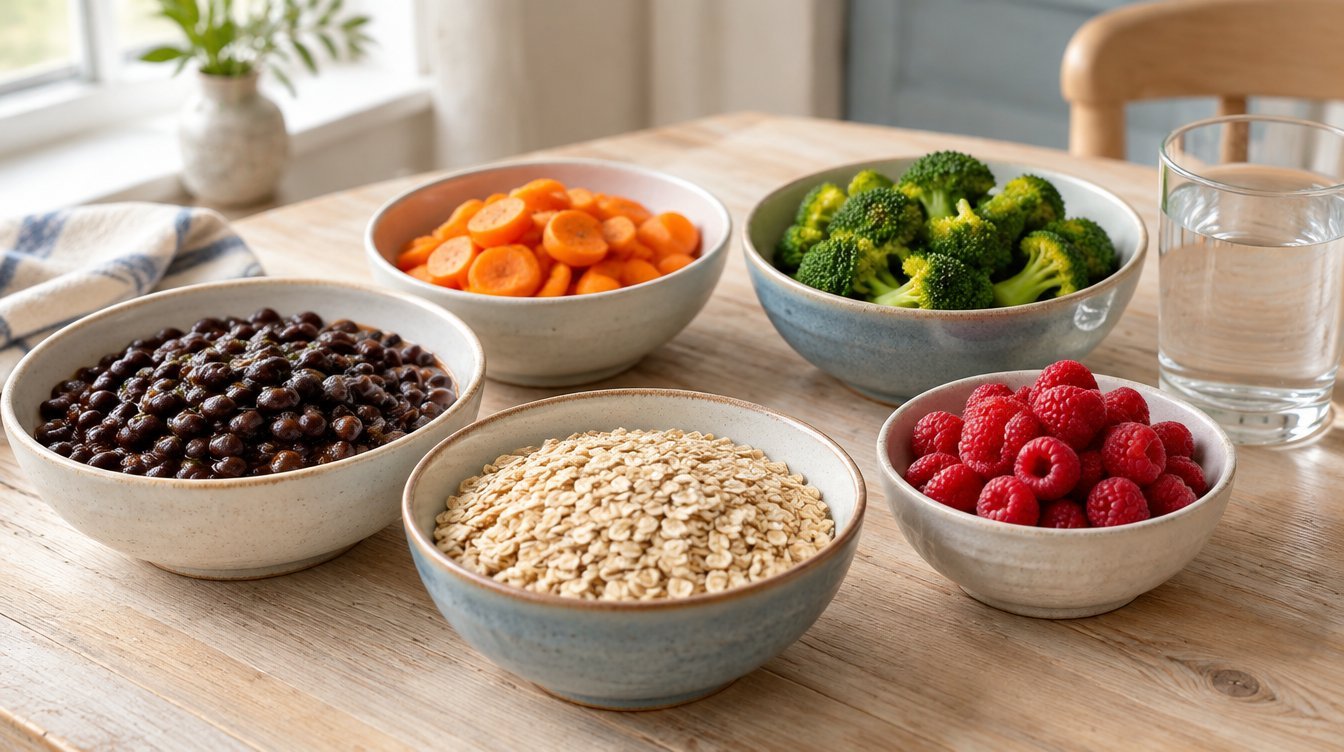
- Include a range of plant foods: Mayo Clinic lists whole grains, fruits, vegetables, beans and other legumes, and nuts and seeds as good fiber sources (Mayo Clinic). Variety gives colon bacteria a mix of fibers to ferment.
- Consider fermented foods: yogurt, kefir and sauerkraut add live microbes to a varied diet. Our guide to fermented foods for gut health explains what the research does and does not show.
- Get screened on time: colorectal cancer screening from age 45 is one of the most useful things you can do for this part of the body (CDC).
- Notice changes: a lasting change in your bowel habits is worth mentioning to a doctor, even if it seems minor (NHS).
When to see a doctor
The NHS advises seeing a doctor if you have changes in your poo that are not usual for you, such as softer stools, diarrhea or constipation, or if you need to go more or less often than usual. Other symptoms to get checked include (NHS):
- Blood in your stool, which may look red or black, or bleeding from your bottom.
- Often feeling you need to have a bowel movement, even right after going.
- Belly pain, bloating or a lump in your belly.
- Losing weight without trying, or feeling very tired or short of breath.
Seek medical help right away for black or tarry stool, dark or bright red blood mixed with stool, fainting or feeling dizzy, or cramping belly pain with any of these (NIDDK). The NHS advises calling emergency services if bleeding from your bottom will not stop or you pass a lot of blood or large clots (NHS).
Related topics
- Large Intestine: What You Need to Know: a closer look at each part of the colon.
- Motility: What You Need to Know: how the gut moves food along.
- Constipation Relief: practical steps when things slow down.
- Best Foods for Gut Health: fiber-rich foods your colon bacteria use.
- Gut Health: The Complete Guide: the bigger picture of digestion and the microbiome.
Sources
- Your Digestive System & How It Works (NIDDK)
- Definition & Facts of Gastrointestinal Bleeding (NIDDK)
- Symptoms & Causes of GI Bleeding (NIDDK)
- Definition & Facts for Diverticular Disease (NIDDK)
- Definition & Facts for Crohn’s Disease (NIDDK)
- Definition & Facts of Ulcerative Colitis (NIDDK)
- Large Intestine & Colon: Function, Anatomy & Location (Cleveland Clinic)
- Small Intestine: Function, Parts, Length & Location (Cleveland Clinic)
- Vitamin B12: Fact Sheet for Health Professionals (NIH Office of Dietary Supplements)
- Dietary fiber: Essential for a healthy diet (Mayo Clinic)
- Screening for Colorectal Cancer (CDC)
- Symptoms of bowel cancer (NHS)
- Sender R, et al. Revised Estimates for the Number of Human and Bacteria Cells in the Body (PLoS Biology, 2016)
- Koh A, et al. From Dietary Fiber to Host Physiology: Short-Chain Fatty Acids as Key Bacterial Metabolites (Cell, 2016)
This article is for general information and is not medical advice. Talk to your doctor or a registered dietitian before changing your diet, supplements or medication, especially if you have a health condition.