
Gut Health and Autoimmune Disease: What You Need to Know
The short answer
Autoimmune diseases happen when the immune system attacks the body’s own tissues, and they likely come from a mix of genes and environment (NIEHS). The gut is one of the most studied parts of that environment. People with type 1 diabetes, rheumatoid arthritis, multiple sclerosis and lupus tend to carry somewhat different gut bacteria than people without these conditions, but most of this research shows links, not proof that gut bacteria cause the disease.
No diet, probiotic or “gut protocol” has been shown to prevent or reverse an autoimmune disease. Eating well for your gut is still a sensible habit, and it works best alongside medical care, not instead of it. This article is general information, not medical advice.
What autoimmune disease is
A healthy immune system tells the difference between “self” and invaders such as germs. In autoimmune disease that system misfires and damages healthy cells, tissues or organs (Office on Women’s Health). Scientists know of more than 80 autoimmune diseases, including type 1 diabetes, multiple sclerosis, lupus and rheumatoid arthritis, and most can’t be reversed, though treatment can ease symptoms (NIEHS).
These conditions affect more than 23.5 million Americans and are more common in women than men (Office on Women’s Health). Common shared symptoms include tiredness, fever, a general ill feeling, joint pain and rash (MedlinePlus). The exact cause is unknown. One theory is that some bacteria, viruses or medicines trigger changes that confuse the immune system, especially in people with certain genes (MedlinePlus).
Why the gut comes up so often
Your intestines are lined with immune tissue and are home to trillions of microbes, so they are a natural place to look for triggers. Two digestive conditions show how close the link can be.
- Celiac disease: eating gluten triggers an abnormal immune response that damages the small intestine. It almost always occurs in people with the DQ2 or DQ8 gene variants, yet only about 3 percent of people with those variants develop it (NIDDK).
- Crohn’s disease: one likely cause is an abnormal immune reaction to bacteria that normally live in the intestines, which may be triggered by environment, genes or the microbiome (NIDDK).
You will also see “leaky gut” blamed for autoimmune disease online. Cleveland Clinic calls leaky gut syndrome a hypothetical condition that is not a recognized medical diagnosis. Increased intestinal permeability is a real feature of diseases such as celiac disease and inflammatory bowel disease, but scientists generally see it as a result of those diseases, not the cause (Cleveland Clinic). Harvard Health notes that links between leaky gut and conditions such as lupus and multiple sclerosis are still only associations (Harvard Health).
What the research shows
Type 1 diabetes
The TEDDY study analyzed 10,913 stool samples collected monthly from 783 young children. Children who stayed healthy had more microbial genes for fermentation and for making short-chain fatty acids, but no single bacterium consistently marked who would develop the disease (Vatanen and colleagues, 2018).
In a small trial of 20 young adults with newly diagnosed type 1 diabetes, those given a fecal transplant of their own stool kept more of their insulin production over 12 months than those given stool from healthy donors (de Groot and colleagues, 2021). That surprising result is a reminder that “healthy” bacteria from someone else are not automatically helpful.
Rheumatoid arthritis
In a study of 114 stool samples, the bacterium Prevotella copri was strongly linked with new, untreated rheumatoid arthritis. In mice, the same bacterium made the gut more sensitive to inflammation (Scher and colleagues, 2013). This points to a possible role, not a proven cause.
Multiple sclerosis
An international study compared 576 people with multiple sclerosis with healthy people from the same households, 1,152 people in all. Several types of bacteria were more or less common in people with the disease, and the differences also shifted with treatment (iMSMS Consortium, 2022). Comparing people who share a home helps rule out diet and surroundings as the only explanation.
Lupus
In 61 women with lupus, a gut bacterium called Ruminococcus gnavus was about five times more common than in healthy controls, and higher amounts tracked with more active disease (Azzouz and colleagues, 2019).
Probiotic trials
A 2026 meta-analysis pooled 12 randomized trials with 703 people who already had an autoimmune disease. Probiotics lowered some blood markers of inflammation, but the authors called for longer studies to see whether that means real long-term benefit (Chiou and colleagues, 2026). For rheumatoid arthritis specifically, an overview of seven reviews rated the overall quality of evidence as low or very low (Li and colleagues, 2024). Lower lab markers are not the same as fewer flares or less joint damage.
What this means for everyday eating

The research does not support a special “autoimmune gut diet” for most people. What it does support is ordinary, gut-friendly eating that you can keep up for years.
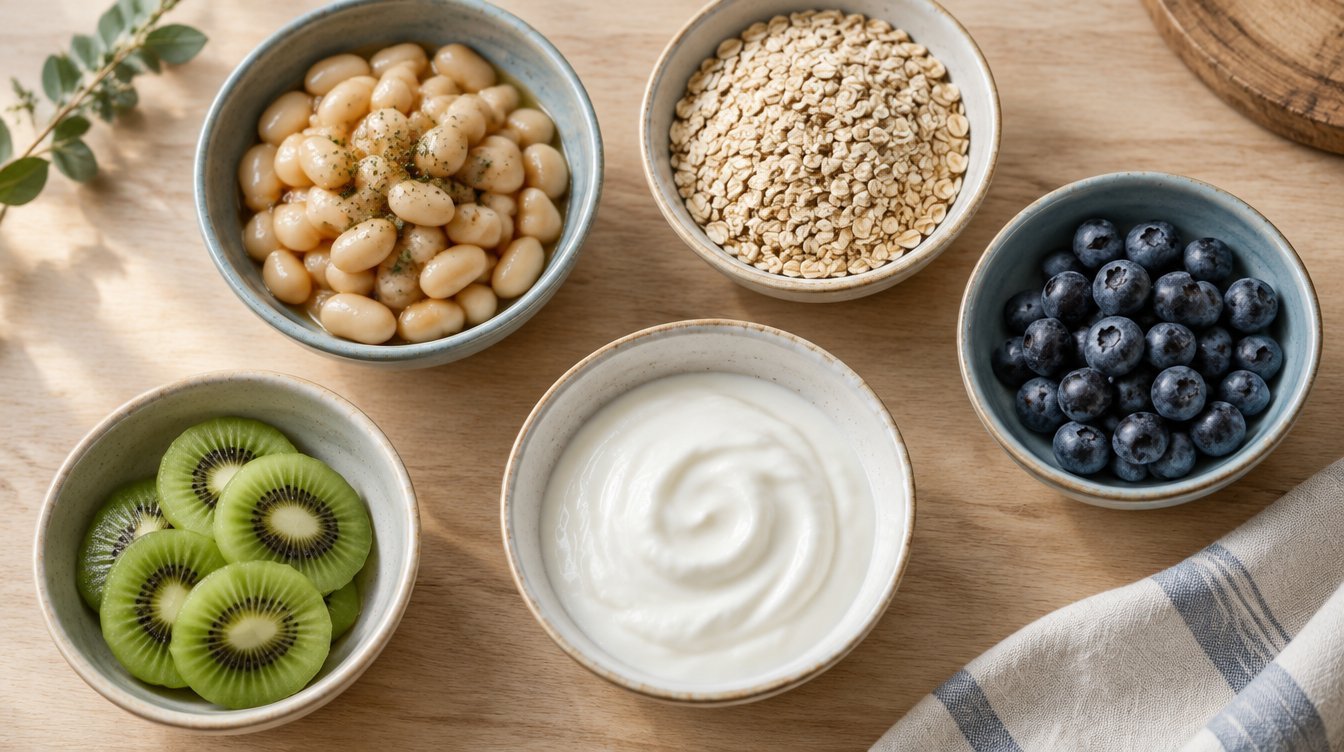
- Eat a variety of fiber: adults are advised to get 22 to 34 grams a day from foods such as beans, fruit, oats, whole grains and vegetables (NIDDK). Our best foods for gut health list is a practical starting point.
- Add fermented foods: in a 17-week trial of healthy adults (18 per group), a diet high in fermented foods increased gut microbe diversity and lowered inflammatory markers (Wastyk and colleagues, 2021). See fermented foods for gut health.
- Don’t go gluten-free before testing: if you suspect celiac disease, doctors advise against starting a gluten-free diet before tests, because it can affect the results (NIDDK).
- Be careful with supplements: supplements do not need FDA approval for safety or effectiveness before they are sold (FDA). The risk of harm from probiotics is greater in people with severe illness or a weakened immune system, which includes some people on immune-suppressing drugs (NCCIH). Ask your doctor first.
If you want to read more on supplements, our guide to probiotics for immune support covers what the trials looked at. For a broader plan, see how to improve gut health.
When to see a doctor
Autoimmune diseases are often hard to diagnose because their symptoms overlap with many other problems. Keep a record of your symptoms and family health history, and ask to see a specialist for your main symptom, such as a gastroenterologist for bowel problems (Office on Women’s Health). Contact a health care provider if you develop symptoms of an autoimmune disease (MedlinePlus).
Get care soon for any of these digestive warning signs (Mayo Clinic):
- Diarrhea that won’t stop, or signs of dehydration
- Severe belly pain
- Blood in the stool that doesn’t go away
- Fever or signs of infection
- Weight loss without trying
If you already have an autoimmune disease, talk with your care team before changing your diet in a big way or adding supplements, and don’t stop prescribed treatment in favor of a gut plan.
Related topics
- Gut Healing Protocol: what popular gut plans include and which parts have evidence.
- Fermented Foods for Gut Health: how to add yogurt, kefir and other fermented foods.
- Probiotics for Immune Support: what probiotic trials on immunity found.
- Eczema and Gut Health: another immune-related condition with gut links.
- 10 Signs of an Unhealthy Gut: common gut symptoms and what they may mean.
Sources
- Autoimmune Diseases (National Institute of Environmental Health Sciences)
- Autoimmune diseases (Office on Women’s Health, HHS)
- Autoimmune disorders (MedlinePlus, National Library of Medicine)
- Symptoms & Causes of Celiac Disease (NIDDK)
- Diagnosis of Celiac Disease (NIDDK)
- Symptoms & Causes of Crohn’s Disease (NIDDK)
- Eating, Diet, & Nutrition for Irritable Bowel Syndrome (NIDDK)
- Leaky Gut Syndrome (Cleveland Clinic)
- Putting a stop to leaky gut (Harvard Health Publishing)
- Probiotics: Usefulness and Safety (NCCIH)
- Dietary Supplements (U.S. Food and Drug Administration)
- Inflammatory bowel disease (IBD): Symptoms and causes (Mayo Clinic)
- Vatanen T, et al. The human gut microbiome in early-onset type 1 diabetes from the TEDDY study (Nature, 2018)
- de Groot P, et al. Faecal microbiota transplantation halts progression of human new-onset type 1 diabetes in a randomised controlled trial (Gut, 2021)
- Scher JU, et al. Expansion of intestinal Prevotella copri correlates with enhanced susceptibility to arthritis (eLife, 2013)
- iMSMS Consortium. Gut microbiome of multiple sclerosis patients and paired household healthy controls reveal associations with disease risk and course (Cell, 2022)
- Azzouz D, et al. Lupus nephritis is linked to disease-activity associated expansions and immunity to a gut commensal (Annals of the Rheumatic Diseases, 2019)
- Chiou YY, et al. Effect of probiotic and synbiotic oral supplementation in autoimmune diseases: an updated systematic review and meta-analysis of randomized controlled trials (Nutrients, 2026)
- Li W, et al. Quality of evidence supporting the role of probiotics for rheumatoid arthritis: an overview of systematic reviews (Frontiers in Immunology, 2024)
- Wastyk HC, et al. Gut-microbiota-targeted diets modulate human immune status (Cell, 2021)
This article is for general information and is not medical advice. Talk to your doctor or a registered dietitian before changing your diet, supplements or medication, especially if you have a health condition.


