Gut Reset: What You Need to Know
What “gut reset” means, and what it doesn’t
“Gut reset” is a marketing phrase, not a medical term. There is no medical definition, no test that shows your gut has been “reset,” and no agreed protocol. When people use it, they usually mean a few weeks of changing what they eat and how they live, in the hope of changing their gut microbes and how their digestion feels.
That goal is reasonable, and part of it has research behind it. Diet does change the gut microbiome, sometimes within days. What the research does not support is the idea that a cleanse, a juice fast or a detox tea wipes the slate clean. Below: what the evidence shows, what doesn’t hold up, and a food-first plan for two to four weeks.
What the evidence says about changing your gut microbes
Diet shifts gut bacteria within days
In a well-known 2014 study in Nature, 10 American volunteers ate either an all-plant diet or an almost all-animal diet for five days. The makeup of their gut bacteria changed about one day after the new food reached the gut. On the animal-based diet, bile-tolerant microbes rose and some fiber-digesting groups fell.
The same study found that people’s gut bacteria went back to their original structure about two days after the animal-based diet ended. Microbes respond quickly to food and drift back just as quickly when old habits return, so a short “reset” followed by your usual diet is unlikely to leave much behind. The study was small and used extreme diets.
Fermented foods and fiber in a 10-week trial
A Stanford trial published in Cell in 2021 randomly assigned 36 healthy adults to a high-fiber diet or a high-fermented-food diet for 10 weeks, inside a 17-week study. People in the fermented-food group went from about 0.4 to 6.3 servings a day of foods like yogurt, kefir, kombucha, kimchi and vegetable brine drinks. Their gut microbiome diversity rose steadily, and 19 of 93 inflammatory proteins measured in blood went down, including interleukin-6 (IL-6).
The high-fiber group raised fiber from about 21.5 to 45.1 grams a day. Their microbiome diversity stayed stable, though their microbes showed more fiber-digesting enzymes. The study’s main immune outcome did not change in either group. It was a small trial in healthy adults, so treat it as promising, not proven. Participants also ramped up over four weeks, and the fermented-food group reported more bloating early on that later eased.
How much fiber to aim for
Most adults fall short. The Dietary Guidelines for Americans, 2020-2025 reported that more than 90 percent of women and 97 percent of men do not meet recommended fiber intakes. Its goal is 14 grams per 1,000 calories, which works out to about 22 to 28 grams a day for adult women and 28 to 34 grams a day for adult men, depending on age.
The newer Dietary Guidelines for Americans, 2025-2030 does not give a gram target in its main document. It tells readers to prioritize fiber-rich whole grains and states that vegetables, fruits, high-fiber foods and fermented foods such as sauerkraut, kimchi, kefir and miso support a diverse microbiome, while highly processed foods can disrupt that balance.
Exercise, alcohol and sleep
Exercise has some early evidence. In a 2018 study of 32 previously inactive adults, six weeks of supervised endurance exercise changed gut microbes, with different results in lean and obese participants. Most of those changes reversed after six weeks of going back to being inactive. Like diet, it seems to work only while you keep doing it.
For alcohol, the 2025-2030 Dietary Guidelines advise people to drink less alcohol for better overall health. Our guide on restoring gut health after alcohol covers that topic in more depth. We did not find a strong human trial on sleep and gut microbes to cite, so this guide makes no sleep-specific claims.
What doesn’t hold up
- Juice cleanses: The National Center for Complementary and Integrative Health (NCCIH) says research on detox and cleanse programs is limited and low quality, and that juicing and detox diets tend to cause weight regain once normal eating resumes. Juices high in oxalate, such as leafy green and beet juices, are a concern for people prone to kidney stones, and unpasteurized juice can cause serious illness. Juicing also strips out most of the fiber that gut microbes feed on; our guide to juice for inflammation compares juice and whole fruit.
- Detox teas: Many detox products work as laxatives. NCCIH notes that laxatives can cause diarrhea, which can lead to dehydration, and that the FDA and FTC have acted against detox and cleansing products with hidden ingredients or false disease claims.
- Colon cleanses: Mayo Clinic states there is no evidence colon cleansing offers its claimed benefits, that the body does not hold on to toxins from regular diet, and that cleansing can cause cramping, dehydration, electrolyte changes, infection and a tear in the rectum. See our colon cleanse guide for the details.
A practical 2 to 4 week food-first plan

This plan uses ordinary food. Go at a pace your gut tolerates; adding fiber or fermented foods quickly can bring gas and bloating.
Week 1: Take stock and add one thing
- Write down what you eat for three days, and estimate your fiber from Nutrition Facts labels.
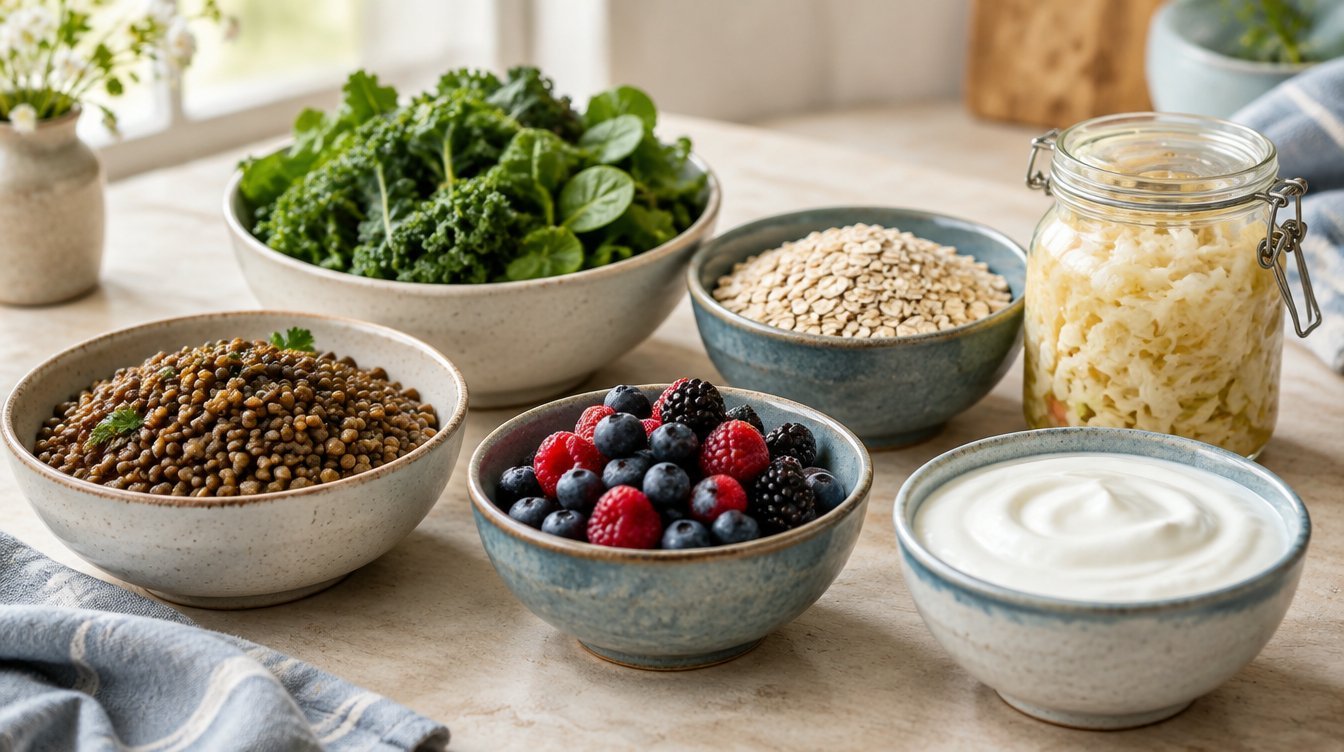
- Add one serving of beans, lentils, oats, berries or vegetables to one meal each day.
- Swap one highly processed snack a day for fruit, nuts or plain yogurt.
Week 2: Build fiber gradually
- Add a little more fiber each day than in week 1, for example a half cup of cooked beans, a cup of berries or a bowl of oatmeal.
- Make at least one grain choice a day a whole grain, such as oats, brown rice or whole-wheat bread.
- Aim for several different plant foods across the week rather than the same one every day.
Week 3: Add fermented foods
- Start with one serving a day of a fermented food: plain yogurt or kefir with live cultures, sauerkraut, kimchi or miso.
- If that sits well, move toward two servings a day. The Stanford group reached about six, but built up over four weeks.
- Read labels: heat-treated products may not contain live cultures, which is why canned sauerkraut differs from refrigerated raw sauerkraut.
Week 4: Keep what works
- Keep the changes your gut tolerated and that fit your routine.
- Plan regular movement you can maintain, since the exercise study found changes faded when people stopped.
- Treat this as your new baseline, not a four-week event with an end date.
Adding homemade fermented foods
Yogurt and kefir were among the foods eaten in the Stanford trial. Making yogurt at home lets you choose the milk, skip added sugar and eat it fresh. Our step-by-step guide on how to make yogurt at home covers the basics, and how long to incubate yogurt explains how time changes tartness and texture.
Store-bought yogurt can work too, but not all yogurt has probiotics, so look for “live and active cultures” on the label. For more options beyond yogurt, see our guide to fermented foods for gut health.
When to see a doctor
A diet change is not a fix for ongoing or severe symptoms. Contact a doctor if you notice any of the following:
- Diarrhea lasting more than 2 days, six or more loose stools a day, frequent vomiting or signs of dehydration (NIDDK).
- High fever, severe pain in the abdomen or rectum, or black, tarry stools or stools with blood or pus (NIDDK).
- Changes in your poo or bowel habits that are not usual for you, bleeding from your bottom, a lump in your tummy or losing weight without trying (NHS).
- Feeling very tired or short of breath, which the NHS lists as possible signs of anemia.
This article is general information, not medical advice. If you have a digestive condition, take medicines or are pregnant, talk with your doctor before making big changes to your diet.
Related topics
- How to Improve Gut Health: broader habits beyond a short plan.
- Gut Health Diet Plan: a meal-by-meal approach to the same ideas.
- Best Foods for Gut Health: what to put on your shopping list.
- Signs your Gut is Healing: what changes people commonly notice.
Sources
- David LA, et al. Diet rapidly and reproducibly alters the human gut microbiome (Nature, 2014)
- Wastyk HC, et al. Gut-microbiota-targeted diets modulate human immune status (Cell, 2021)
- Allen JM, et al. Exercise alters gut microbiota composition and function in lean and obese humans (Medicine & Science in Sports & Exercise, 2018)
- Dietary Guidelines for Americans, 2025-2030 (U.S. Department of Agriculture and U.S. Department of Health and Human Services)
- Dietary Guidelines for Americans, 2020-2025 (U.S. Department of Agriculture and U.S. Department of Health and Human Services)
- Detoxes and Cleanses: What You Need To Know (National Center for Complementary and Integrative Health)
- Colon cleansing: Is it helpful or harmful? (Mayo Clinic)
- Symptoms & Causes of Diarrhea (National Institute of Diabetes and Digestive and Kidney Diseases)
- Symptoms of bowel cancer (NHS)
This article is for general information and is not medical advice. Talk to your doctor or a registered dietitian before changing your diet, supplements or medication, especially if you have a health condition.