How Long Does It Take to Heal Your Gut? The Complete Answer
How long does it take to heal your gut?
There is no single number. The surface cells of your gut lining are replaced every three to four days, and gut bacteria shift within a day or two of a change in diet. Recovery after antibiotics often takes one to two months, sometimes longer, and healing from a diagnosed condition such as celiac disease can take months to years.
A stomach bug, a course of antibiotics, months of poor eating and a chronic disease each recover on their own clock. Below are the timelines the research supports, drawn from published studies and from the National Institute of Diabetes and Digestive and Kidney Diseases (NIDDK). This is general information, not medical advice.
Why there is no single timeline
The gut lining renews in days
The cells lining your intestines wear out and are replaced constantly. A meta-analysis that pooled 85 studies found that in humans, the cells of the gastrointestinal lining turn over in about 3.5 days on average (Darwich and colleagues, 2014). That helps the lining recover from a minor upset, but it cannot outpace an ongoing cause such as untreated celiac disease.
Gut bacteria respond within a day or two
In a well-known Harvard study, 10 adults ate either an all-plant or a mostly animal-based diet for five days. Their gut bacteria changed one day after the new food reached the colon, and returned to their original makeup within two days of going back to their usual diet (David and colleagues, 2014).
A few good days are undone just as fast. Lasting change comes from habits you keep.
Deeper changes take weeks to months
Bigger shifts, such as a more diverse mix of microbes, build slowly. In a 17-week Stanford trial of 36 healthy adults, those assigned to eat more fermented foods saw microbiome diversity rise steadily over the weeks of the diet, along with lower levels of several inflammatory markers (Wastyk and colleagues, 2021). It was a small study in healthy people.
Typical recovery times by situation
These ranges are rough guides from studies and health agencies, and individual recovery varies.
| Situation | Typical timeline | Source |
|---|---|---|
| Changing your diet (more fiber, more plants) | Bacteria shift in 1 to 2 days; diversity gains build over weeks | David et al., 2014; Wastyk et al., 2021 |
| Stomach flu (viral gastroenteritis) | Symptoms usually last 1 to 3 days for norovirus, up to 1 to 2 weeks for adenovirus; trouble digesting lactose can last a month or more | NIDDK; NIDDK |
| After a course of antibiotics | Close to baseline in about 6 weeks in one small study, with some species still missing after 6 months | Palleja et al., 2018; Dethlefsen and Relman, 2011 |
| Lingering symptoms after a gut infection | About 1 in 10 people still had irritable bowel syndrome (IBS) a year later | Klem et al., 2017 |
| Celiac disease on a gluten-free diet | Symptoms often improve within days to weeks; the lining can take years to recover in adults | NIDDK; Rubio-Tapia et al., 2010 |
After antibiotics
In a Danish study, 12 healthy men took a four-day course of three strong antibiotics. Their gut bacteria came back to near their starting makeup within about six weeks, but nine common species were still undetectable in most of the men after six months (Palleja and colleagues, 2018). A Stanford study of three people taking ciprofloxacin found a similar pattern: recovery began within a week but was often incomplete (Dethlefsen and Relman, 2011). See restoring gut health after antibiotics.
After a stomach bug
Most people feel better within a few days. Some take longer: a meta-analysis of 45 studies covering 21,421 people found that about 10% had IBS 12 months after a gut infection, with higher risk in women and after more severe illness (Klem and colleagues, 2017). See how to restore gut health after stomach flu for a step-by-step plan.
With a diagnosed condition
Celiac disease runs on a longer clock. Many people feel better within days to weeks of going gluten-free (NIDDK), but the lining heals more slowly: in a Mayo Clinic group of 241 adults, follow-up biopsies confirmed recovery in 34% at two years and 66% at five years (Rubio-Tapia and colleagues, 2010).
Habits that support recovery
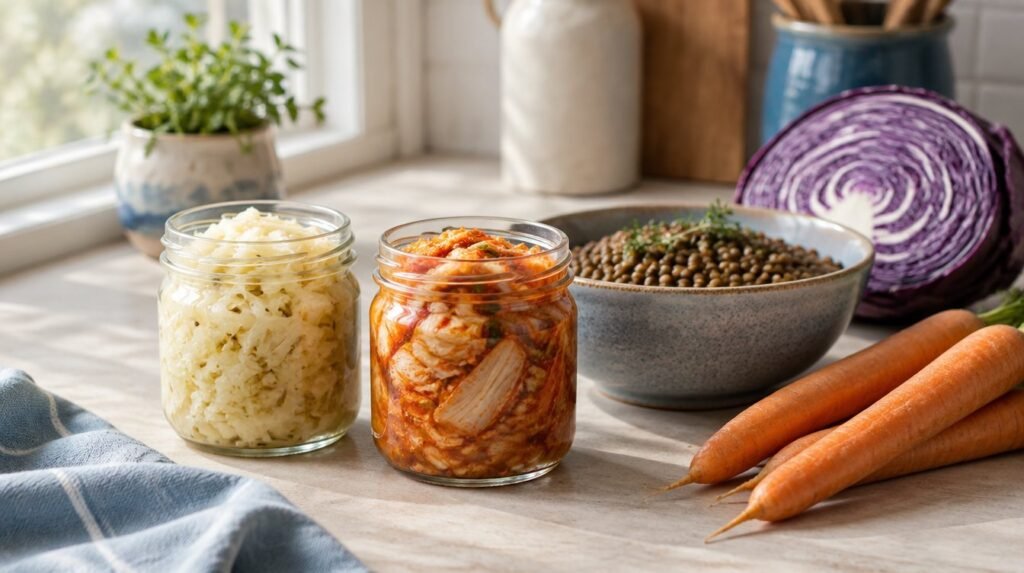
- Add fiber slowly: the Mayo Clinic suggests increasing fiber over a few weeks so your gut bacteria can adjust. The NIDDK puts adult needs at 22 to 34 grams a day.
- Drink enough fluids: fiber works best with plenty of water (Mayo Clinic).
- Include fermented foods: foods like yogurt, kefir and sauerkraut raised microbiome diversity in the Stanford trial (Wastyk et al.). See fermented foods for gut health.
- Go easy on dairy after a stomach bug: some people have trouble with lactose for a month or more after viral gastroenteritis (NIDDK).
- Be wary of quick-fix protocols: the Cleveland Clinic notes that “leaky gut syndrome” is not a recognized medical diagnosis, and that treating the underlying condition is what helps.
- Track your symptoms: a short daily note of bowel habits and bloating shows progress. Here are the signs your gut is healing.
When to see a doctor
Get medical advice rather than waiting it out if you notice any of these, drawn from the NIDDK, the NIDDK diarrhea guidance and the NHS:
- Blood in your stool, black or tarry stools, or bleeding from the rectum
- Losing weight without trying
- Constant or severe pain in your abdomen
- Vomiting, fever or signs of dehydration
- Diarrhea lasting more than 2 days in an adult
- A change in bowel habits that does not settle, or symptoms that do not improve with self-care
Frequently asked questions
Can you heal your gut in 3 days?
Your lining and bacteria change within days, but those changes fade just as fast if your habits slip. Lasting improvement usually takes weeks.
How long does it take gut bacteria to recover after antibiotics?
In one small study of 12 healthy men, gut bacteria were close to baseline in about six weeks, though some species were still missing after six months (Palleja et al., 2018).
Why do I still have stomach trouble weeks after a stomach bug?
Temporary lactose intolerance is common for a month or more after viral gastroenteritis (NIDDK). Symptoms lasting months can be post-infection IBS, which is worth raising with a doctor.
Do gut healing supplements speed things up?
There is little evidence that they do. The Cleveland Clinic notes that “leaky gut syndrome” is not a recognized diagnosis and that treating the underlying cause is what helps (Cleveland Clinic).
Related topics
- Gut Reset: what a short reset can and cannot do.
- How to Improve Gut Health: everyday habits with the best evidence.
- Gut Healing Protocol: a closer look at popular protocols.
- 10 Signs of an Unhealthy Gut: symptoms worth paying attention to.
- Best Foods for Gut Health: foods to build your meals around.
Sources
- Darwich AS, et al. Meta-analysis of the turnover of intestinal epithelia in preclinical animal species and humans (Drug Metab Dispos, 2014)
- David LA, et al. Diet rapidly and reproducibly alters the human gut microbiome (Nature, 2014)
- Wastyk HC, et al. Gut-microbiota-targeted diets modulate human immune status (Cell, 2021)
- Palleja A, et al. Recovery of gut microbiota of healthy adults following antibiotic exposure (Nat Microbiol, 2018)
- Dethlefsen L, Relman DA. Incomplete recovery and individualized responses of the human distal gut microbiota to repeated antibiotic perturbation (Proc Natl Acad Sci U S A, 2011)
- Klem F, et al. Prevalence, risk factors, and outcomes of irritable bowel syndrome after infectious enteritis: a systematic review and meta-analysis (Gastroenterology, 2017)
- Rubio-Tapia A, et al. Mucosal recovery and mortality in adults with celiac disease after treatment with a gluten-free diet (Am J Gastroenterol, 2010)
- Symptoms and Causes of Viral Gastroenteritis (National Institute of Diabetes and Digestive and Kidney Diseases)
- Eating, Diet, and Nutrition for Viral Gastroenteritis (National Institute of Diabetes and Digestive and Kidney Diseases)
- Treatment for Celiac Disease (National Institute of Diabetes and Digestive and Kidney Diseases)
- Eating, Diet, and Nutrition for Constipation (National Institute of Diabetes and Digestive and Kidney Diseases)
- Symptoms and Causes of Constipation (National Institute of Diabetes and Digestive and Kidney Diseases)
- Symptoms and Causes of Diarrhea (National Institute of Diabetes and Digestive and Kidney Diseases)
- Dietary fiber: Essential for a healthy diet (Mayo Clinic)
- Leaky Gut Syndrome (Cleveland Clinic)
- Symptoms of bowel cancer (NHS)
This article is for general information and is not medical advice. Talk to your doctor or a registered dietitian before changing your diet, supplements or medication, especially if you have a health condition.