Gut Healthy Snacks: What You Need to Know
What makes a snack gut healthy
Gut healthy snacks are small, mostly whole foods that give your gut bacteria something to work with: fiber from fruit, nuts, seeds, legumes or whole grains, or live microbes from fermented foods like plain yogurt and kefir. The best ones are low in added sugar and keep you full until your next meal.
The Dietary Guidelines for Americans, 2025–2030 back this up. They say vegetables, fruits, fermented foods and high-fiber foods support a diverse microbiome, and they tell readers to avoid highly processed packaged snacks that are salty or sweet, such as chips, cookies and candy.
Why snacks matter for gut health
Snacks are an easy place to add fiber
Mayo Clinic gives daily fiber targets of 25 grams for women 50 or younger and 38 grams for men 50 or younger, a little less after 50. A pear and a 1-ounce handful of almonds together give you about 9 grams of fiber, based on the USDA numbers below. Mayo Clinic itself names a handful of nuts, or dried fruit without added sugar, as a healthy high-fiber snack, while noting that both are high in calories.
Almonds as a snack swap: one trial
A King’s College London trial gave 87 healthy adults 56 grams of almonds a day (about 2 ounces), either whole or ground, or a control snack, in place of their usual snacks for 4 weeks. Almond eaters had higher levels of butyrate, a short-chain fatty acid made by gut bacteria. There was no change in bifidobacteria, overall microbe diversity, transit time or gut symptoms (Creedon et al., 2022). It is one small, short study, but it suggests almonds can add fiber without causing gut symptoms in healthy adults.
Fermented snacks add live microbes
In a Stanford trial of 36 healthy adults, those randomized to eat more fermented foods, such as yogurt, kefir, kimchi and kombucha, during a 10-week diet period showed a steady rise in gut microbe diversity and lower inflammatory markers (Wastyk et al., 2021; Stanford Medicine). A cup of plain yogurt or kefir is one of the simplest ways to fit a fermented food into your day.
How to choose gut healthy snacks
- Look for fiber or live cultures: a good snack usually has at least one. Whole fruit, nuts, popcorn and chickpeas bring fiber; plain yogurt, kefir and refrigerated sauerkraut bring microbes.
- Check added sugars: the Dietary Guidelines say yogurt and other dairy snacks should have no more than 2.5 grams of added sugar per ⅔ cup, and grain snacks such as crackers no more than 5 grams per ¾ ounce whole-grain equivalent. Many flavored yogurts and bars exceed that.
- Read the sweetener list: the NIDDK notes that sweeteners ending in “-ol,” such as sorbitol, xylitol, erythritol and maltitol, can cause gas. They are common in low-sugar bars and gummies.
- Prefer whole foods to “gut health” packaging: an apple and a few nuts give you fiber without the marketing.
- Mind the portion: nuts and seeds are calorie-dense, so a 1-ounce handful is a sensible serving.
Fiber and protein in common snack foods
Values are calculated from USDA FoodData Central for the serving sizes shown. Packaged versions can differ, so check the label on what you buy.
| Snack | Serving | Fiber | Protein | Calories |
|---|---|---|---|---|
| Raspberries, raw | 1 cup (123 g) | 8.0 g | 1.5 g | 64 |
| Chickpeas, cooked | ½ cup (82 g) | 6.2 g | 7.3 g | 134 |
| Pear, raw | 1 medium (178 g) | 5.5 g | 0.6 g | 101 |
| Apple, raw, with skin | 1 medium (182 g) | 4.4 g | 0.5 g | 95 |
| Almonds | 1 oz, about 23 nuts (28 g) | 3.5 g | 6.0 g | 164 |
| Popcorn, air-popped | 3 cups (24 g) | 3.5 g | 3.1 g | 93 |
| Pistachios, raw | 1 oz, about 49 nuts (28 g) | 3.0 g | 5.7 g | 159 |
| Carrot, raw | 1 medium (61 g) | 1.7 g | 0.6 g | 25 |
| Hummus | 2 tablespoons (30 g) | 1.6 g | 2.3 g | 71 |
| Greek yogurt, plain, nonfat | 1 container (170 g) | 0 g | 17.3 g | 100 |
| Yogurt, plain, whole milk | 6 oz (170 g) | 0 g | 5.9 g | 104 |
Fruit, legumes, nuts and popcorn carry the fiber. Yogurt carries protein and, if it has live cultures, microbes, but no fiber. Pairing the two, such as yogurt with raspberries, covers both.
Gut healthy snack ideas
- Yogurt and berries: plain Greek yogurt with a cup of raspberries gives about 19 grams of protein and 8 grams of fiber. Our Greek yogurt snacks have more ideas.
- Fruit and nuts: a pear or apple with a 1-ounce handful of almonds or pistachios.
- Popcorn: 3 cups of air-popped popcorn, seasoned with a little olive oil and salt or spices.
- Roasted chickpeas: toss drained cooked chickpeas with oil and spices and roast at 400°F for 25 to 35 minutes, shaking the pan halfway, until crisp.
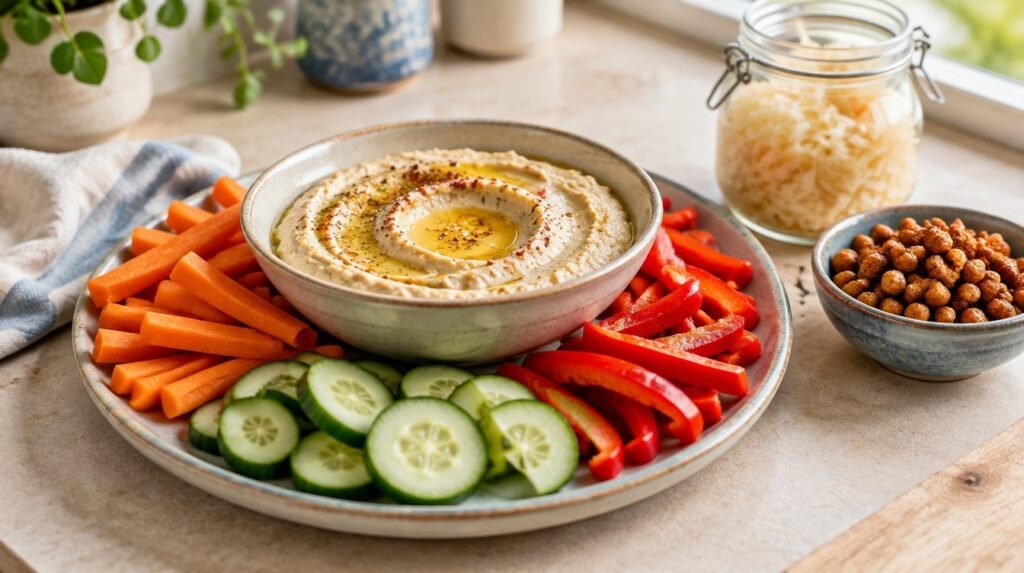
- Hummus and vegetables: carrots, cucumber and bell pepper with hummus or a Greek yogurt dip.
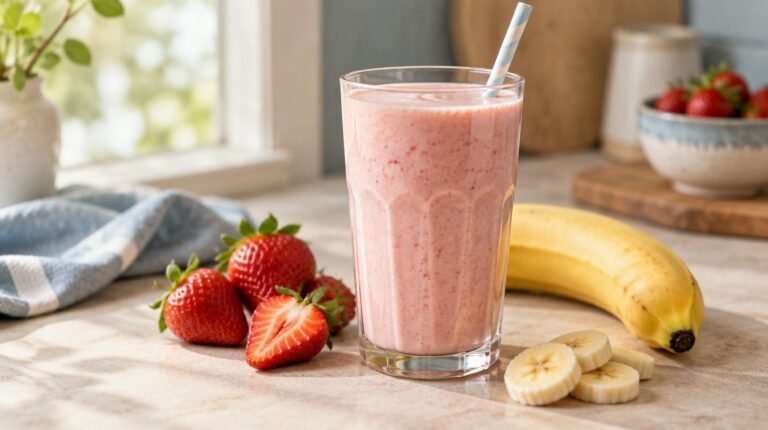
- Kefir: a small glass on its own or blended into a kefir smoothie.
- Fermented vegetables: a forkful of refrigerated sauerkraut or kimchi on a whole-grain cracker. Shelf-stable versions are usually heat-treated, which we explain in does canned sauerkraut have probiotics.
If you make yogurt at home, portioning it into small jars on the day you make it turns it into a grab-and-go snack. Our guide to how long homemade yogurt lasts covers fridge times.
Making snacks easier on your stomach
More fiber is a good goal, but going from almost none to a lot in one week can backfire. Mayo Clinic advises adding fiber slowly over a few weeks and drinking plenty of water, since too much too fast can cause gas, bloating and cramping. The NIDDK also lists apples, pears, beans and other legumes, whole wheat and dairy products among foods that give some people gas.
- Add one new high-fiber snack at a time and give it a week.
- Try smaller portions of beans and chickpeas at first.
- If milk bothers you, yogurt may sit better: its live bacteria carry their own lactase, which helps break down lactose (Savaiano, 2014). See is yogurt good for an upset stomach for more.
This article is general information, not medical advice. If you have ongoing digestive symptoms, talk with your doctor before making big changes to your diet.
Related topics
- Gut Healthy Breakfast: the same principles for the first meal of the day.
- Best Foods for Gut Health: the full list of foods with the best evidence.
- Probiotic Foods: which foods still contain live cultures when you buy them.
- Do Pickles Have Probiotics?: how to tell fermented pickles from vinegar pickles.
- Worst Foods for Gut Health: snacks worth cutting back on.
Sources
- Dietary Guidelines for Americans, 2025–2030 (US Department of Agriculture and US Department of Health and Human Services)
- Dietary fiber: Essential for a healthy diet (Mayo Clinic)
- Creedon AC, et al. The impact of almonds and almond processing on gastrointestinal physiology, luminal microbiology, and gastrointestinal symptoms: a randomized controlled trial and mastication study (American Journal of Clinical Nutrition, 2022)
- Wastyk HC, et al. Gut-microbiota-targeted diets modulate human immune status (Cell, 2021)
- Fermented-food diet increases microbiome diversity, decreases inflammatory proteins, study finds (Stanford Medicine, 2021)
- Savaiano DA. Lactose digestion from yogurt: mechanism and relevance (American Journal of Clinical Nutrition, 2014)
- Eating, Diet, & Nutrition for Gas in the Digestive Tract (National Institute of Diabetes and Digestive and Kidney Diseases)
- Raspberries, raw (USDA FoodData Central)
- Chickpeas (garbanzo beans, bengal gram), mature seeds, cooked, boiled, without salt (USDA FoodData Central)
- Pears, raw (USDA FoodData Central)
- Apples, raw, with skin (USDA FoodData Central)
- Nuts, almonds (USDA FoodData Central)
- Snacks, popcorn, air-popped (USDA FoodData Central)
- Nuts, pistachio nuts, raw (USDA FoodData Central)
- Carrots, raw (USDA FoodData Central)
- Hummus, commercial (USDA FoodData Central)
- Yogurt, Greek, plain, nonfat (USDA FoodData Central)
- Yogurt, plain, whole milk (USDA FoodData Central)