Yogurt Smoothie: What You Need to Know
What a yogurt smoothie is
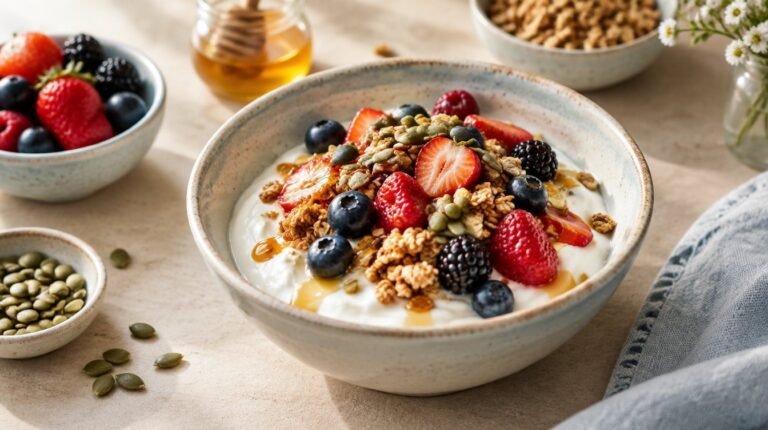
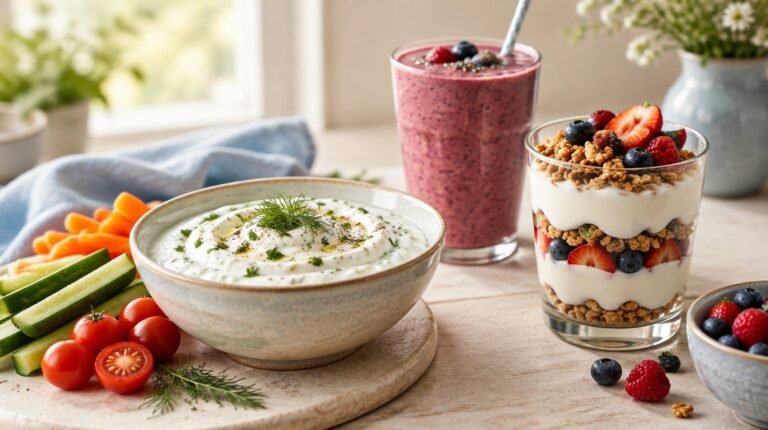
A yogurt smoothie is yogurt blended with a liquid, fruit and a few optional extras until it is thick enough to drink. The yogurt adds body, protein and a little tang, so you need less ice or banana to get a creamy texture.
This guide covers every kind of yogurt: regular plain, Greek, drinkable kefir-style yogurts and plant-based yogurts made from soy, almond, oat or coconut. If you only use Greek yogurt, our Greek yogurt smoothie guide goes deeper on that one style, and kefir smoothie covers kefir on its own.
The base formula
For one large smoothie of about 16 to 20 ounces, use this ratio and adjust from there:
- Yogurt: 3/4 cup.
- Liquid: 1/2 cup milk, plant milk, water or 100% juice.
- Fruit: 1 1/2 to 2 cups, at least half of it frozen.
- Extras: 1 to 2 tablespoons, such as nut butter, rolled oats, chia or ground flaxseed, or a handful of spinach.
Put the liquid in the blender first, then the yogurt, then the fruit and extras. This helps the blades catch. Frozen fruit replaces ice, so the flavor stays strong as it melts.
Different yogurts need different amounts of liquid:
| Yogurt type | In a smoothie | Liquid adjustment |
|---|---|---|
| Regular plain | Creamy, mild tang | Use the base 1/2 cup |
| Greek or strained | Very thick, higher protein | Add 2 to 4 tbsp more liquid |
| Drinkable or kefir-style | Thin and pourable | Cut the liquid to 1/4 cup or skip it |
| Plant-based | Varies by base; protein and sugar vary widely | Start with 1/2 cup and check the label for protein and added sugars |
Five yogurt smoothie combinations

1. Strawberry banana
- 3/4 cup plain low-fat yogurt
- 1/2 cup nonfat milk
- 1 medium banana
- 1 cup strawberries, fresh or frozen
2. Blueberry oat
- 3/4 cup plain yogurt
- 1/2 cup milk
- 1 cup frozen blueberries
- 1/2 banana
- 1/4 cup rolled oats
3. Green pineapple
- 3/4 cup plain yogurt
- 1/2 cup water or coconut water
- 1 cup baby spinach
- 1 cup frozen pineapple
- 1/2 banana
4. Peach ginger
- 3/4 cup plain drinkable or kefir-style yogurt
- 1 1/2 cups frozen peaches
- 1/2 tsp grated fresh ginger
- 2 to 4 tbsp water, only if needed
5. Cocoa peanut, dairy-free
- 3/4 cup plain unsweetened soy or almond yogurt
- 1/2 cup unsweetened soy milk
- 1 frozen banana
- 1 tbsp unsweetened cocoa powder
- 1 tbsp peanut butter or 2 tbsp peanut butter powder
For a lower-fat way to get peanut flavor, see Greek yogurt and peanut butter powder.
Nutrition of the strawberry banana smoothie
We worked out the first combination from USDA FoodData Central entries for plain low-fat yogurt (3/4 cup, 184 g), nonfat milk (1/2 cup, 123 g), a medium raw banana (118 g) and raw strawberries (1 cup halves, 152 g). It makes about 2 1/2 cups. These totals are our arithmetic from USDA data, not a lab analysis:
| Whole smoothie | Amount |
|---|---|
| Calories | About 310 |
| Protein | 16 g |
| Fat | 4 g |
| Carbohydrates | 58 g |
| Fiber | 6 g |
| Total sugars | 41 g (none added) |
| Calcium | About 520 mg |
All of the sugar here comes from the fruit, milk and yogurt. Split it into two glasses for a snack-size serving.
Plain vs flavored yogurt: the added sugar gap
The yogurt you start with makes the biggest difference to sugar. By USDA figures, 6 ounces (170 g) of plain low-fat yogurt has about 12 grams of total sugars, all naturally occurring milk sugar. The same amount of vanilla low-fat yogurt has about 23 grams, and fruit low-fat yogurt about 32 grams. Most of that difference is sugar added during manufacturing.
The Dietary Guidelines for Americans, 2025-2030 state that no amount of added sugars is recommended, and that one meal should contain no more than 10 grams of added sugars. A smoothie built on a cup of fruit yogurt can pass that before any fruit goes in. Start with plain yogurt, let ripe or frozen fruit do the sweetening, and check the “Includes added sugars” line on any flavored or plant-based yogurt you buy.
Do live cultures survive blending?
Blending is a short, mechanical step, not a heat treatment. Under the federal yogurt standard, yogurt that has been treated after culturing to inactivate viable microorganisms must say “does not contain live and active cultures,” and products may say “contains live and active cultures” only if they meet a minimum count at manufacture. So the first thing that decides whether your smoothie has live cultures is the yogurt you start with. Does all yogurt have probiotics? explains how to read those labels.
We did not find research on home blending itself. Lab studies on stored smoothies give some clues. In a study of sheep milk yogurt smoothies kept in the fridge for 28 days, counts of the two yogurt cultures fell by roughly 1 to 3 log units over that time. In another lab study, a specific added strain, Lactobacillus acidophilus LA-3, stayed at high counts in açaí and mango smoothies across 28 days of refrigeration.
Both are small lab studies of specific products and strains, and neither measured any health effect. The practical takeaways are modest: use a yogurt labeled with live cultures, use frozen fruit rather than long blending to keep the mix cold, never add hot liquid, and drink it fresh.
How long a yogurt smoothie keeps
USDA has no smoothie-specific rule, so treat a smoothie like any other perishable leftover. The USDA Food Safety and Inspection Service says to refrigerate perishable food within 2 hours (1 hour above 90°F), keep the fridge at 40°F or below, and use leftovers within 3 to 4 days or freeze them for 3 to 4 months.
Quality fades faster than safety. Expect separation and some browning of fruit within a day, so shake or reblend before drinking. To prep ahead, freeze portions in jars or ice cube trays and blend the cubes with a splash of liquid.
Using homemade yogurt
Homemade yogurt is plain by default, so you control the sugar from the start. The University of Illinois Extension basic method heats milk to 180-185°F, cools it to 108-115°F, adds starter and incubates at 108-115°F for 6 to 10 hours, then refrigerates it at 40°F or below. The guide says to eat it within 14 days.
The same guide gives a drinkable version that suits smoothies: heat milk to 175-180°F, cool to 112-114°F, incubate for 3 hours and test, adding another 2 hours if it is still as thin as milk. For the full method, see how to make yogurt at home and how long homemade yogurt lasts.
Related topics
- Gut Health Smoothie: smoothies built around fiber and fermented foods.
- Can you Make a Smoothie without Yogurt?: substitutes when you are out of yogurt.
- Coconut Yogurt: a common plant-based base.
- Yogurt Recipes You Can Make at Home: more ways to use a batch.
Sources
- Yogurt, plain, low fat (FDC ID 170886) (USDA FoodData Central, SR Legacy)
- Milk, nonfat, fluid, with added vitamin A and vitamin D (FDC ID 171269) (USDA FoodData Central, SR Legacy)
- Bananas, raw (FDC ID 173944) (USDA FoodData Central, SR Legacy)
- Strawberries, raw (FDC ID 167762) (USDA FoodData Central, SR Legacy)
- Yogurt, vanilla, low fat (FDC ID 170888) (USDA FoodData Central, SR Legacy)
- Yogurt, fruit, low fat, 9 g protein/8 oz (FDC ID 170889) (USDA FoodData Central, SR Legacy)
- Dietary Guidelines for Americans, 2025-2030 (U.S. Department of Agriculture and U.S. Department of Health and Human Services)
- 21 CFR 131.200: Yogurt (Electronic Code of Federal Regulations)
- Balthazar CF, et al. Physicochemical evaluation of sheep milk yogurts containing different levels of inulin (Journal of Dairy Science, 2016)
- Luciano WA, et al. Effects of Lactobacillus acidophilus LA-3 on physicochemical and sensory parameters of açaí and mango based smoothies and its survival following simulated gastrointestinal conditions (Food Research International, 2018)
- Leftovers and Food Safety (USDA Food Safety and Inspection Service)
- Making Yogurt at Home (University of Illinois Extension)