Overnight Oats with Yogurt: What You Need to Know
What overnight oats with yogurt are
Overnight oats are raw rolled oats soaked in liquid in the fridge for several hours, usually overnight. The oats soak up the liquid and soften, so you get a cold, spoonable breakfast with no cooking. Adding yogurt to the jar makes the mix thicker and tangier, and it adds protein and calcium that oats and milk alone fall short on.
A typical jar is equal parts oats, yogurt and milk, plus fruit or seeds. You stir it together in the evening and eat it in the morning, straight from the jar. It is one of the easiest ways to put a whole grain and a cultured food in the same meal, which is why it shows up so often in a gut-healthy breakfast.
Why the combination matters for gut health
Oats bring fiber, and a good share of it is beta-glucan, a soluble fiber that gut bacteria can ferment. USDA analysis of old-fashioned rolled oats lists about 7.5 g of beta-glucan per 100 g, which works out to roughly 3 g in a half-cup (40 g) serving. A half cup of regular oats also carries about 4 g of total fiber. For more on the fiber side, see do overnight oats have fiber.
Research on oats and gut bacteria is encouraging but still limited. A 2021 systematic review in the Journal of Nutrition pooled 84 studies, including 23 randomized trials, and found that eating oats was linked with higher counts of Lactobacillus and Bifidobacterium in people without gut disease. Most of the studies found no change in digestive symptoms. In one small crossover trial, 32 adults at risk of heart and metabolic disease ate 45 g of whole-grain oat granola daily for six weeks, and their stool showed more bifidobacteria and lactobacilli than when they ate a non-whole-grain cereal.
Yogurt brings the cultured side. Under the federal yogurt standard of identity, yogurt is made with Lactobacillus delbrueckii subsp. bulgaricus and Streptococcus thermophilus, and a yogurt heat-treated after culturing must say it does not contain live and active cultures. In a 17-week Stanford study with 18 healthy adults per group, a diet high in fermented foods such as yogurt steadily increased gut microbiome diversity and lowered several inflammation markers. That was a small trial of whole diets, not of overnight oats, so it shows a direction rather than a promise.
Because nothing in overnight oats is cooked, the yogurt goes into the jar the way it came out of the tub. Whether a given yogurt has live cultures depends on the product, which is covered in does all yogurt have probiotics.
A basic ratio and method
This makes one jar. It scales up easily if you want to prep several mornings at once.
- Oats: 1/2 cup old-fashioned rolled oats (about 40 g).
- Yogurt: 1/2 cup plain yogurt, regular or Greek.
- Milk: 1/2 cup milk or an unsweetened plant milk. Use a little more with Greek yogurt, which is thicker.
- Optional: 1 tablespoon chia seeds, a pinch of cinnamon, and fruit.
- Stir the oats, yogurt, milk and any seeds together in a jar or bowl until no dry oats remain.
- Cover and refrigerate for at least 4 hours, or overnight.
- In the morning, stir, loosen with a splash of milk if it is too thick, and add fresh fruit or nuts.
Using USDA FoodData Central values for oats, whole-milk plain Greek yogurt and whole milk, that base jar comes to about 335 calories, 19 g of protein and 4 g of fiber. Stirring in a half cup of raspberries brings the fiber to about 8 g. These are our calculations from USDA data, not lab measurements.
How to choose your oats
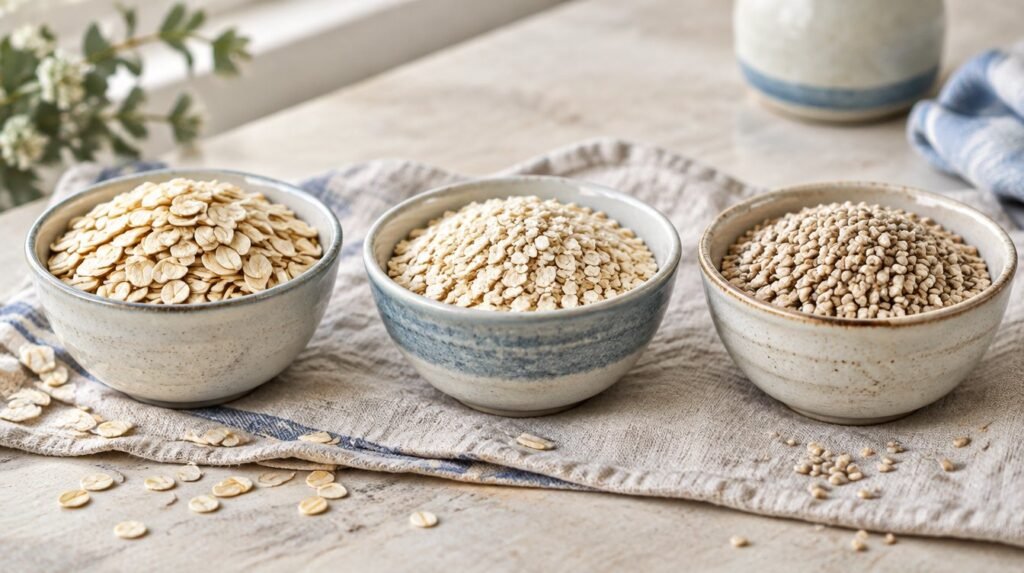
Any plain oat works, but the cut changes the texture more than the nutrition.
| Oat type | Overnight texture | Beta-glucan per 40 g (USDA) |
|---|---|---|
| Old-fashioned rolled | Soft but still holds its shape. The usual choice. | About 3.0 g |
| Quick or instant (plain) | Very soft, close to porridge. Fine if you like it smooth. | Not listed separately |
| Steel-cut | Stays chewy after one night. Some people soak it longer. | About 2.2 g |
The beta-glucan figures come from USDA Foundation Foods entries for rolled oats and steel-cut oats. Skip flavored instant packets for overnight oats. Most add sugar, and you can control sweetness better with fruit.
How to choose your yogurt
Plain yogurt gives you the most control over sugar. The style you pick mainly changes protein and thickness. Here is what a half cup (113 g) adds, based on USDA data:
| Yogurt (1/2 cup, 113 g) | Calories | Protein | Sugars (naturally present) |
|---|---|---|---|
| Plain, whole milk | About 69 | About 4 g | About 5 g |
| Greek, plain, whole milk | About 110 | About 10 g | About 4.5 g |
| Greek, plain, nonfat | About 67 | About 11.5 g | About 4 g |
- For a thick, high-protein jar: use Greek yogurt and add a bit more milk. See what Greek yogurt is for how straining changes it.
- For a looser, tangier jar: use regular plain yogurt.
- For live cultures: look for wording such as “contains live and active cultures” on the label. If it says the yogurt does not contain live and active cultures, it was treated after culturing.
- For full control: make your own. A batch from homemade yogurt lets you choose the milk, the starter and how tart it gets.
Add-ins that help, and the ones to watch
Fruit, seeds and nuts are where overnight oats get most of their extra fiber and flavor. Good choices include berries, sliced banana, grated apple, chia or ground flax, and chopped nuts added in the morning so they stay crunchy.
Sweeteners are the main thing to watch. The Dietary Guidelines for Americans, 2025-2030 say no amount of added sugar is recommended, and that one meal should contain no more than 10 g of added sugars. A flavored yogurt plus a drizzle of syrup can pass that quickly. If you want it sweeter, mashed ripe banana or a few chopped dates usually do the job.
For more topping ideas that work with yogurt, see yogurt bowl ideas and the yogurt parfait recipe.
How long overnight oats keep
Overnight oats are made to sit in the fridge, but not forever. USDA guidance is to keep the fridge at 40°F or below and to use leftovers within 3 to 4 days. Treat a prepared jar the same way, and toss it sooner if it smells off or shows mold. Do not leave a jar out at room temperature for more than 2 hours.
In practice, most people find the texture best on day one or two. Oats keep softening, so a jar made for day four will be close to pudding. Small lidded jars make it easy to prep a few days at a time and grab one on the way out. Plain yogurt itself keeps longer than a mixed jar; see how long homemade yogurt lasts.
Who should go easy
- People with celiac disease: NIDDK says most people with celiac disease can safely eat moderate amounts of oats, but cross-contact with wheat, barley or rye is common. Choose oats labeled gluten-free and check with your doctor or dietitian.
- People new to fiber: a jar with chia and berries can carry 8 g of fiber or more. NIDDK suggests adding fiber slowly, by 2 to 3 g a day, to help prevent gas and bloating, and Mayo Clinic advises drinking plenty of water as fiber goes up.
- People avoiding dairy: a plant-based yogurt works in the same ratio, though protein and cultures vary by product.
Oats themselves are a gut-friendly food for most people. If you want the longer answer, read is oatmeal bad for your gut. This article is general information, not medical advice.
Related topics
- Do Overnight Oats Have Fiber?: the fiber numbers in more detail.
- Is Oatmeal Bad for Your Gut?: what the research says about oats and digestion.
- Gut Healthy Breakfast: more morning options built around fiber and fermented foods.
- Greek Yogurt Breakfast: other ways to use Greek yogurt in the morning.
- How to Make Yogurt at Home: make the plain yogurt for your jars yourself.
Sources
- Valido E, et al. Systematic Review of the Effects of Oat Intake on Gastrointestinal Health (Journal of Nutrition, 2021)
- Connolly ML, et al. Hypocholesterolemic and Prebiotic Effects of a Whole-Grain Oat-Based Granola Breakfast Cereal in a Cardio-Metabolic “At Risk” Population (Frontiers in Microbiology, 2016)
- Wastyk HC, et al. Gut-microbiota-targeted diets modulate human immune status (Cell, 2021)
- 21 CFR 131.200, Yogurt (eCFR, U.S. Food and Drug Administration)
- Dietary Guidelines for Americans, 2025-2030 (U.S. Departments of Agriculture and Health and Human Services)
- Leftovers and Food Safety (USDA Food Safety and Inspection Service)
- Eating, Diet, and Nutrition for Celiac Disease (NIDDK)
- Eating, Diet, and Nutrition for Irritable Bowel Syndrome (NIDDK)
- Dietary fiber: Essential for a healthy diet (Mayo Clinic)
- Oats, whole grain, rolled, old fashioned (USDA FoodData Central)
- Oats, whole grain, steel cut (USDA FoodData Central)
- Cereals, oats, regular and quick, not fortified, dry (USDA FoodData Central)
- Yogurt, plain, whole milk (USDA FoodData Central)
- Yogurt, Greek, plain, whole milk (USDA FoodData Central)
- Yogurt, Greek, plain, nonfat (USDA FoodData Central)
- Milk, whole, 3.25% milkfat (USDA FoodData Central)
- Raspberries, raw (USDA FoodData Central)