Gut Healthy Breakfast: What You Need to Know
What a gut healthy breakfast is
A gut healthy breakfast is a morning meal built from whole foods that feed your gut bacteria: fiber from oats, fruit, seeds or whole grains, often a fermented food such as plain yogurt or kefir, plus some protein to keep you full. It is low in added sugar and does not need special products.
That matches the current Dietary Guidelines for Americans, 2025–2030, which say vegetables, fruits, fermented foods and high-fiber foods support a diverse microbiome, while highly processed foods can disrupt it. The same guidelines single out ready-to-eat and packaged breakfast options as refined carbohydrates to cut back on.
Why breakfast matters for gut health
It is the easiest meal to load with fiber
Mayo Clinic lists daily fiber targets of 25 grams for women 50 or younger and 38 grams for men 50 or younger, with slightly lower targets after 50. Hitting those numbers is hard if breakfast is white toast or a sweet pastry. A bowl of oats with raspberries and chia can supply 20 grams or more on its own, as the table below shows.
Fiber matters because your own enzymes cannot digest most of it. It travels to the large intestine, where gut bacteria ferment it. Mayo Clinic also notes that soluble fiber, found in oats, apples, bananas and barley, forms a gel that slows digestion, while insoluble fiber, found in whole wheat, bran and nuts, adds bulk to stool.
Fermented foods fit naturally in the morning
Yogurt and kefir are breakfast staples, and they carry live microbes. In a Stanford trial, 36 healthy adults were randomized to a high-fermented-food diet or a high-fiber diet, with a 10-week diet period inside a 17-week study. The fermented-food group, eating foods like yogurt, kefir, kimchi and kombucha (Stanford Medicine), showed a steady rise in gut microbe diversity and lower levels of inflammatory markers (Wastyk et al., 2021). It was a small study in healthy people, so it shows a direction rather than a promise.
Variety adds up across the week
In the American Gut Project, a large citizen-science study, people who reported eating more than 30 types of plants a week had more diverse gut bacteria than people who ate 10 or fewer (McDonald et al., 2018). That is an association from self-selected volunteers, not proof of cause, but rotating fruits, seeds and grains at breakfast is an easy way to raise your count.
Some breakfast fruits have trial data
In a 4-week trial of 79 US adults with chronic constipation, two green kiwifruit a day worked about as well as prunes or psyllium for bowel movement frequency, with the fewest side effects (Chey et al., 2021). It was a small, partly randomized study, but kiwifruit is an easy fruit to slice into a yogurt bowl.
How to build a gut healthy breakfast
- Start with a fiber base: oats, whole-grain bread, or a fruit-heavy bowl. Mayo Clinic suggests a cereal with at least 5 grams of fiber per serving if you buy one.
- Add a fermented food: plain yogurt, Greek yogurt or kefir. Look for “live and active cultures” on the label, or make your own with our guide to making yogurt at home.
- Include protein: Greek yogurt, eggs, nuts or seeds keep you full until lunch.
- Keep added sugar low: the Dietary Guidelines say a single meal should contain no more than 10 grams of added sugars. Flavored yogurts and granola can pass that quickly, so start with plain and add fruit.
- Rotate your plants: switch berries, seeds and grains from day to day rather than eating the same bowl all week.
Fiber and protein in common breakfast foods
Values below are calculated from USDA FoodData Central for the serving sizes shown. Brands and recipes vary, so check your own labels.
| Food | Serving | Fiber | Protein |
|---|---|---|---|
| Rolled oats, dry | ½ cup (40 g) | 4.1 g | 5.3 g |
| Raspberries, raw | 1 cup (123 g) | 8.0 g | 1.5 g |
| Blueberries, raw | 1 cup (148 g) | 3.6 g | 1.1 g |
| Chia seeds, dried | 1 oz (28 g) | 9.8 g | 4.7 g |
| Flaxseed, ground | 1 tablespoon (7 g) | 1.9 g | 1.3 g |
| Green kiwifruit | 2 fruits (138 g) | 4.1 g | 1.6 g |
| Banana | 1 medium (118 g) | 3.1 g | 1.3 g |
| Avocado | ½ fruit (100 g) | 6.7 g | 2.0 g |
| Whole-wheat bread | 1 slice (32 g) | 1.9 g | 4.0 g |
| Greek yogurt, plain, nonfat | 1 container (170 g) | 0 g | 17.3 g |
| Yogurt, plain, whole milk | 1 cup (245 g) | 0 g | 8.5 g |
| Egg | 1 large (50 g) | 0 g | 6.3 g |
Yogurt and eggs bring protein but no fiber, and fruit and seeds bring fiber but little protein. That is why the best breakfasts usually pair the two.
Gut healthy breakfast ideas
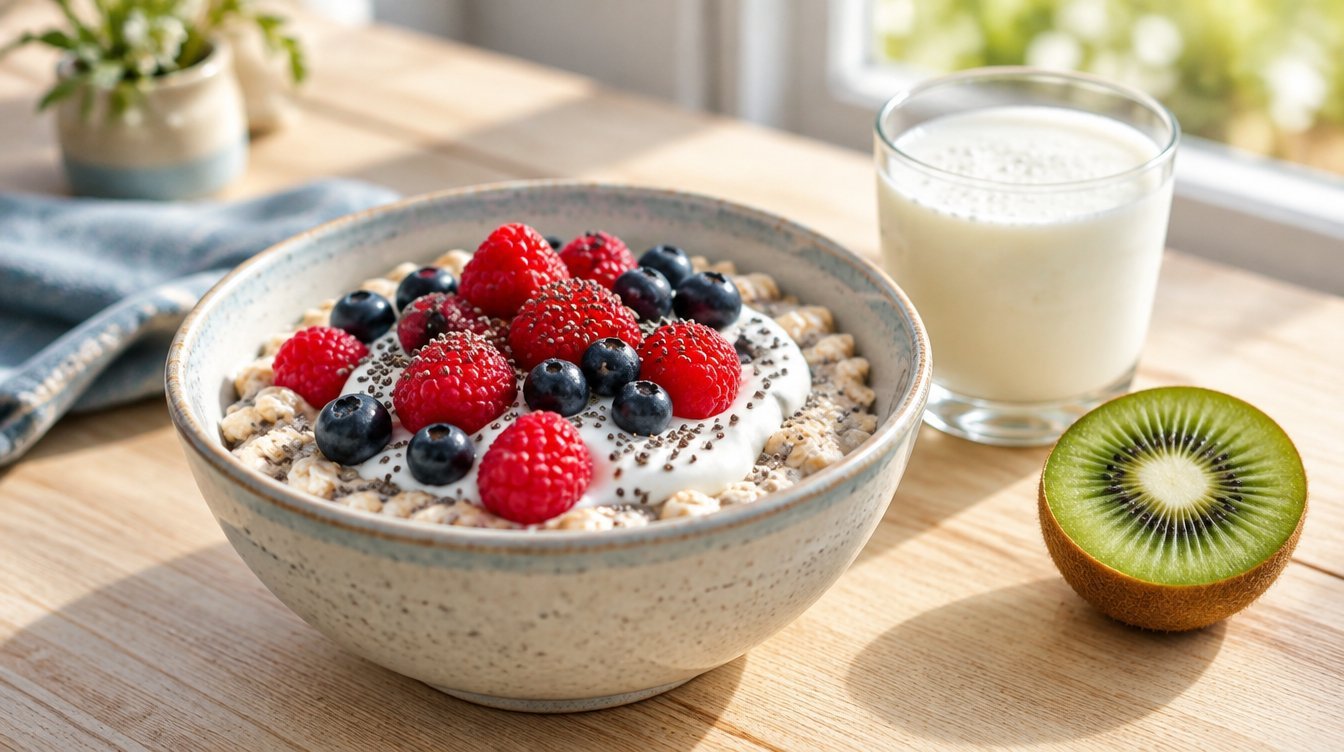
- Overnight oats: ½ cup rolled oats, ¾ cup plain yogurt or kefir, 1 ounce of chia seeds and a cup of raspberries, soaked in the fridge overnight. By the USDA figures above, that is about 22 grams of fiber.
- Yogurt bowl: plain Greek yogurt with sliced kiwifruit, blueberries and ground flaxseed. Our yogurt bowl ideas have more combinations.
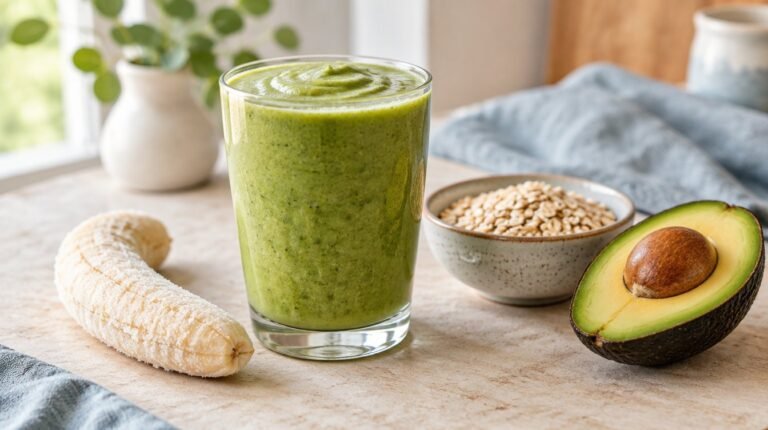
- Kefir or yogurt smoothie: blend kefir with frozen berries, a banana and a spoonful of oats. See our gut health smoothie for ratios.
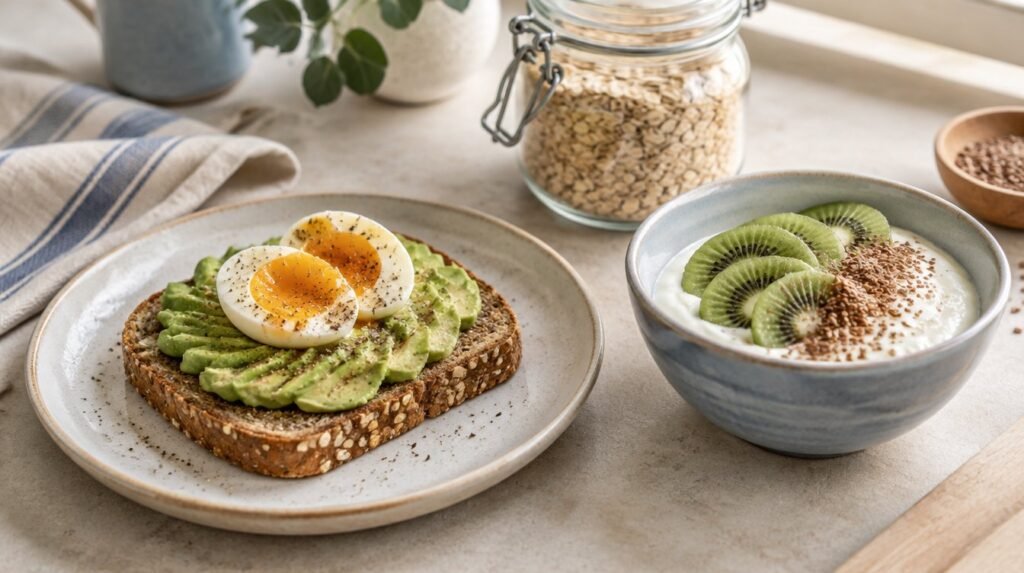
- Savory toast: whole-wheat toast with half an avocado and an egg, with a spoonful of plain yogurt on the side.
- Savory yogurt bowl: Greek yogurt topped with cucumber, tomato, olive oil and seeds, a good fit if you do not like sweet breakfasts. More in our Greek yogurt breakfast guide.
Making yogurt at home lets you choose the milk and the culture, and skip added sugar entirely. Our homemade yogurt guide walks through it.
How to start without bloating
If your current breakfast is low in fiber, do not jump straight to a 20-gram bowl. Mayo Clinic advises adding fiber slowly over a few weeks and drinking plenty of water, because too much too fast can cause gas, bloating and cramping. The NIDDK lists apples, pears, whole wheat and dairy products, including yogurt, among foods that cause gas in some people.
- Add one change at a time, such as berries one week and chia the next.
- Start with a few spoonfuls of yogurt or kefir if fermented foods are new to you.
- Drink a glass of water with high-fiber breakfasts.
Live-culture foods are safe for most people, but NCCIH notes that the risk of harmful effects from probiotics is greater in people with severe illnesses or weakened immune systems. If that applies to you, ask your care team first. This article is general information, not medical advice.
Related topics
- Best Foods for Gut Health: the wider list beyond breakfast.
- Gut Health Diet Plan: how breakfast fits a full day of eating.
- Gut Healthy Snacks: fiber and fermented options between meals.
- Best Time to Eat Yogurt: whether morning yogurt makes a difference.
- Fermented Foods for Gut Health: what the research says about yogurt, kefir and more.
Sources
- Dietary Guidelines for Americans, 2025–2030 (US Department of Agriculture and US Department of Health and Human Services)
- Dietary fiber: Essential for a healthy diet (Mayo Clinic)
- Wastyk HC, et al. Gut-microbiota-targeted diets modulate human immune status (Cell, 2021)
- Fermented-food diet increases microbiome diversity, decreases inflammatory proteins, study finds (Stanford Medicine, 2021)
- McDonald D, et al. American Gut: an Open Platform for Citizen Science Microbiome Research (mSystems, 2018)
- Chey SW, et al. Exploratory Comparative Effectiveness Trial of Green Kiwifruit, Psyllium, or Prunes in US Patients With Chronic Constipation (American Journal of Gastroenterology, 2021)
- Eating, Diet, & Nutrition for Gas in the Digestive Tract (National Institute of Diabetes and Digestive and Kidney Diseases)
- Probiotics: Usefulness and Safety (National Center for Complementary and Integrative Health)
- Cereals, oats, regular and quick, not fortified, dry (USDA FoodData Central)
- Raspberries, raw (USDA FoodData Central)
- Blueberries, raw (USDA FoodData Central)
- Seeds, chia seeds, dried (USDA FoodData Central)
- Seeds, flaxseed (USDA FoodData Central)
- Kiwifruit, green, raw (USDA FoodData Central)
- Bananas, raw (USDA FoodData Central)
- Avocados, raw, all commercial varieties (USDA FoodData Central)
- Bread, whole-wheat, commercially prepared (USDA FoodData Central)
- Yogurt, Greek, plain, nonfat (USDA FoodData Central)
- Yogurt, plain, whole milk (USDA FoodData Central)
- Egg, whole, raw, fresh (USDA FoodData Central)