Gut Healthy Meals: What You Need to Know
What makes a meal gut healthy
A gut healthy meal is built around plants with plenty of fiber, includes a variety of different plant foods across the week, and often adds a fermented food such as yogurt, kefir, sauerkraut or kimchi. It does not need special products. Beans, whole grains, vegetables, fruit, nuts and a spoonful of something fermented cover most of it.
The reason is simple. Your own enzymes cannot digest most fiber, so it travels to the large intestine, where gut bacteria ferment it into short-chain fatty acids such as acetate, propionate and butyrate (Holscher, Gut Microbes, 2017). A review in Cell Host and Microbe describes fiber as one of the main ways diet shapes which microbes thrive and what they produce (Makki et al., 2018).
Most people eat far less of it than they need. According to the Harvard T.H. Chan School of Public Health, adults need at least 25 to 35 grams of fiber a day, but most Americans get only about 15.
Why it matters for gut health
Fermented foods and fiber in a Stanford trial
In a 17-week randomized study, 36 healthy adults were split into a high-fiber diet or a high-fermented-food diet, 18 per group. The fiber group raised its intake from about 21.5 to 45 grams a day. The fermented-food group went from less than one serving a day to about six, from foods such as yogurt, kefir, fermented vegetables, vegetable brine drinks and kombucha (Wastyk et al., Cell, 2021).
The fermented-food diet steadily increased the diversity of gut microbes and lowered several inflammatory markers. The high-fiber diet did not change diversity over the study period, though it did change what the microbes could do. It was a small trial in healthy people, so it shows a direction, not a guarantee.
Plant variety
Data from the American Gut Project, a citizen-science study with samples from more than 10,000 people, found that participants who reported eating more than 30 types of plants a week had more diverse gut bacteria than those eating 10 or fewer (McDonald et al., mSystems, 2018). The participants were self-selected and the data are observational, so this shows a link, not cause and effect.
Mediterranean-style eating
In the NU-AGE trial, 612 older adults in five European countries followed a Mediterranean-style diet for a year. Those who stuck to it more closely showed gut microbe changes that were linked with markers of lower frailty and lower inflammation (Ghosh et al., Gut, 2020). That pattern of vegetables, legumes, whole grains, fish and olive oil is a useful template for everyday meals.
How to build a gut healthy meal
You do not need a new recipe for every meal. A simple formula works for breakfast, lunch and dinner:
- Start with a fiber anchor. Beans, lentils, chickpeas, oats, barley or another whole grain.
- Add two or more vegetables or fruits. Different colors usually mean different plants, which helps with variety.
- Include a fermented food. A spoonful of yogurt or kefir, or a small side of sauerkraut or kimchi.
- Finish with nuts, seeds, herbs or spices. Each one counts as another plant type for the week.
Go slowly if you eat little fiber now. The Mayo Clinic advises adding fiber gradually over a few weeks to avoid gas, bloating and cramping, and drinking plenty of water. It lists about 25 grams a day for women 50 and younger and 38 grams for men 50 and younger, with slightly less after 50. For more food ideas, see best foods for gut health.
Gut healthy meal ideas with fiber counts

These examples use common foods and standard portions. Fiber is calculated from USDA FoodData Central values, so treat the totals as close estimates.
| Meal | What goes in it | Fiber (approx.) |
|---|---|---|
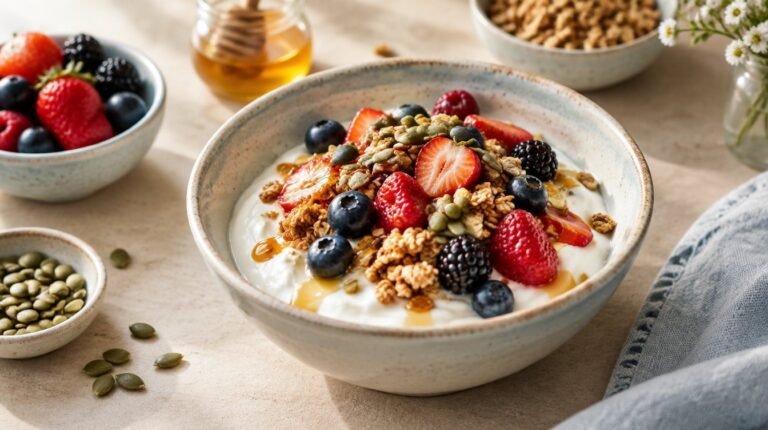
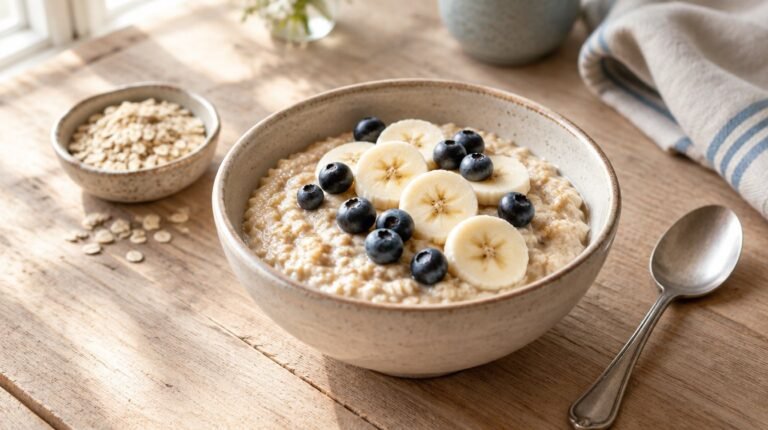
| Breakfast: berry oat bowl | 1/2 cup dry rolled oats (4.1 g), 1 cup raspberries (8.0 g), a spoonful of plain yogurt | About 12 g |
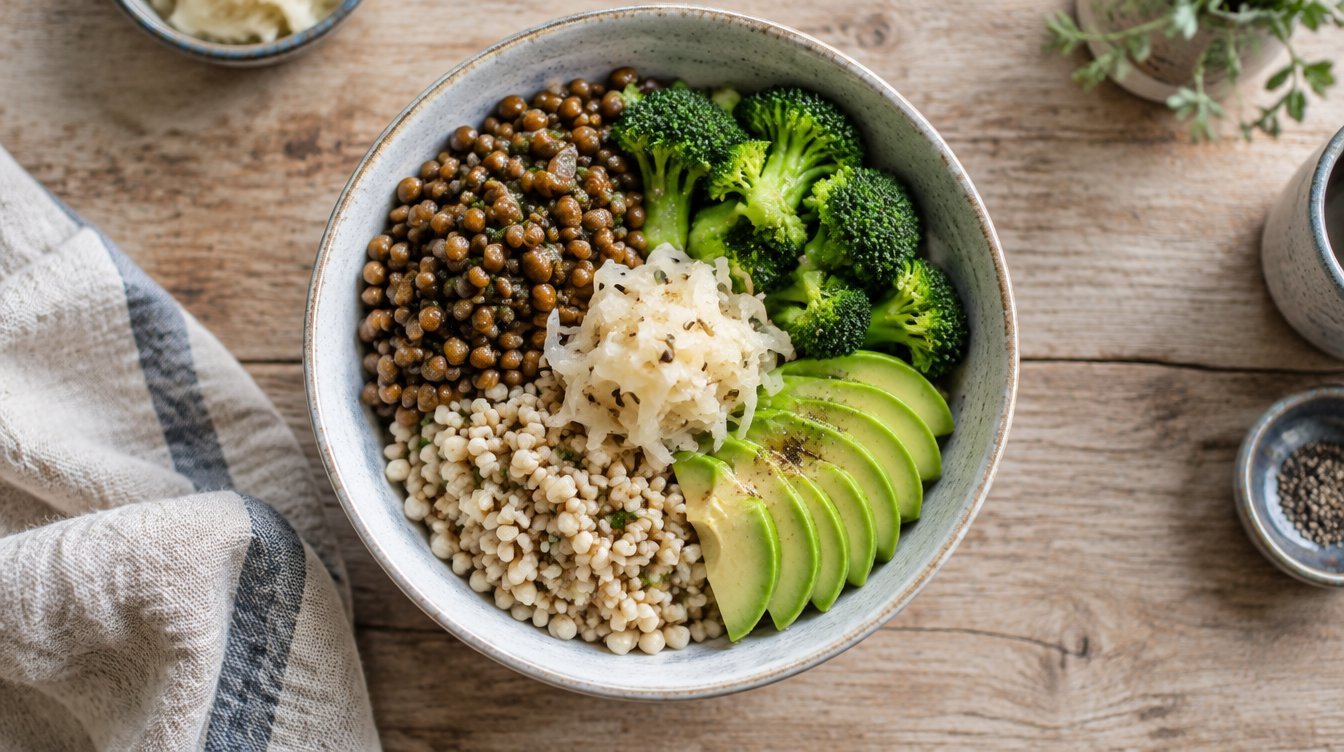
| Lunch: lentil and barley bowl | 1/2 cup cooked lentils (7.8 g), 1/2 cup cooked pearled barley (3.0 g), 1/2 cup cooked broccoli (2.6 g) | About 13 g |
| Dinner: black bean rice bowl | 1/2 cup cooked black beans (7.5 g), 1/2 cup cooked brown rice (1.6 g), 1/4 avocado (3.4 g), 1/4 cup sauerkraut (1.0 g) | About 13.5 g |
| Snack: pear and almonds | 1 medium pear (5.5 g), 1 ounce almonds (3.5 g) | About 9 g |
All four together come to about 48 grams, more than most people need, so mix and match rather than eating every one in a single day. For whole-day menus, see our gut health diet plan, and for lighter options, gut healthy breakfast and gut healthy snacks ideas.
Adding fermented foods to everyday meals
Fermented foods are easy to fold into meals you already make. Stir plain yogurt into a sauce for grain bowls, use it in place of sour cream on tacos, or add a forkful of sauerkraut or kimchi beside eggs or a sandwich. Our guide to fermented foods for gut health compares the options.
Heat matters if live cultures are the goal. In a small trial, pasteurizing yogurt after fermentation cut its bacteria count a hundredfold (Savaiano et al., American Journal of Clinical Nutrition, 1984). Add yogurt or kefir after cooking rather than simmering it, and note that shelf-stable canned sauerkraut is heat-treated; see does canned sauerkraut have probiotics?.
Plain yogurt is one of the simplest fermented foods to make yourself, and a batch covers sauces, breakfasts and snacks for a week. Our how to make yogurt at home guide walks through it.
Meal prep and leftovers
Beans, grains and roasted vegetables keep well, which makes gut healthy meals easy to batch cook. Follow the basic rules from the USDA Food Safety and Inspection Service:
- Refrigerate cooked food within 2 hours, or within 1 hour if it is above 90°F.
- Use refrigerated leftovers within 3 to 4 days, or freeze them for 3 to 4 months.
- Reheat leftovers to 165°F, checked with a food thermometer.
- Add yogurt, kefir and raw fermented vegetables after reheating, not before.
If your stomach is sensitive
More fiber and fermented food is not comfortable for everyone. If beans or raw vegetables cause gas or pain, start with smaller portions, choose cooked vegetables, and build up slowly. Our diet for a sensitive stomach guide has gentler options. This article is general information, not medical advice. If digestive symptoms keep coming back, talk with a doctor.
Related topics
- Gut Health Diet Plan: a full week built on the same principles.
- Gut Healthy Breakfast: quick morning meals with fiber and cultures.
- Gut Healthy Snacks: small bites between meals.
- Fermented Foods for Gut Health: which ones carry live cultures.
- Plain Yogurt Recipes You Can Make at Home: sauces and dips for meals.
- Is Kimchi Good for Gut Health?: what the evidence says.
Sources
- Holscher HD. Dietary fiber and prebiotics and the gastrointestinal microbiota (Gut Microbes, 2017)
- Makki K, et al. The Impact of Dietary Fiber on Gut Microbiota in Host Health and Disease (Cell Host and Microbe, 2018)
- Wastyk HC, et al. Gut-microbiota-targeted diets modulate human immune status (Cell, 2021)
- McDonald D, et al. American Gut: an Open Platform for Citizen Science Microbiome Research (mSystems, 2018)
- Ghosh TS, et al. Mediterranean diet intervention alters the gut microbiome in older people reducing frailty and improving health status: the NU-AGE 1-year dietary intervention across five European countries (Gut, 2020)
- Savaiano DA, et al. Lactose malabsorption from yogurt, pasteurized yogurt, sweet acidophilus milk, and cultured milk in lactase-deficient individuals (American Journal of Clinical Nutrition, 1984)
- Fiber (The Nutrition Source, Harvard T.H. Chan School of Public Health)
- Dietary fiber: Essential for a healthy diet (Mayo Clinic)
- Leftovers and Food Safety (USDA Food Safety and Inspection Service)
- Cereals, oats, regular and quick, not fortified, dry (USDA FoodData Central)
- Raspberries, raw (USDA FoodData Central)
- Lentils, mature seeds, cooked, boiled, without salt (USDA FoodData Central)
- Barley, pearled, cooked (USDA FoodData Central)
- Broccoli, cooked, boiled, drained, without salt (USDA FoodData Central)
- Beans, black, mature seeds, cooked, boiled, without salt (USDA FoodData Central)
- Rice, brown, long-grain, cooked (USDA FoodData Central)
- Avocados, raw, all commercial varieties (USDA FoodData Central)
- Sauerkraut, canned, solids and liquids (USDA FoodData Central)
- Pears, raw (USDA FoodData Central)
- Nuts, almonds (USDA FoodData Central)