Olive Oil for Gut Health: What You Need to Know
What olive oil is
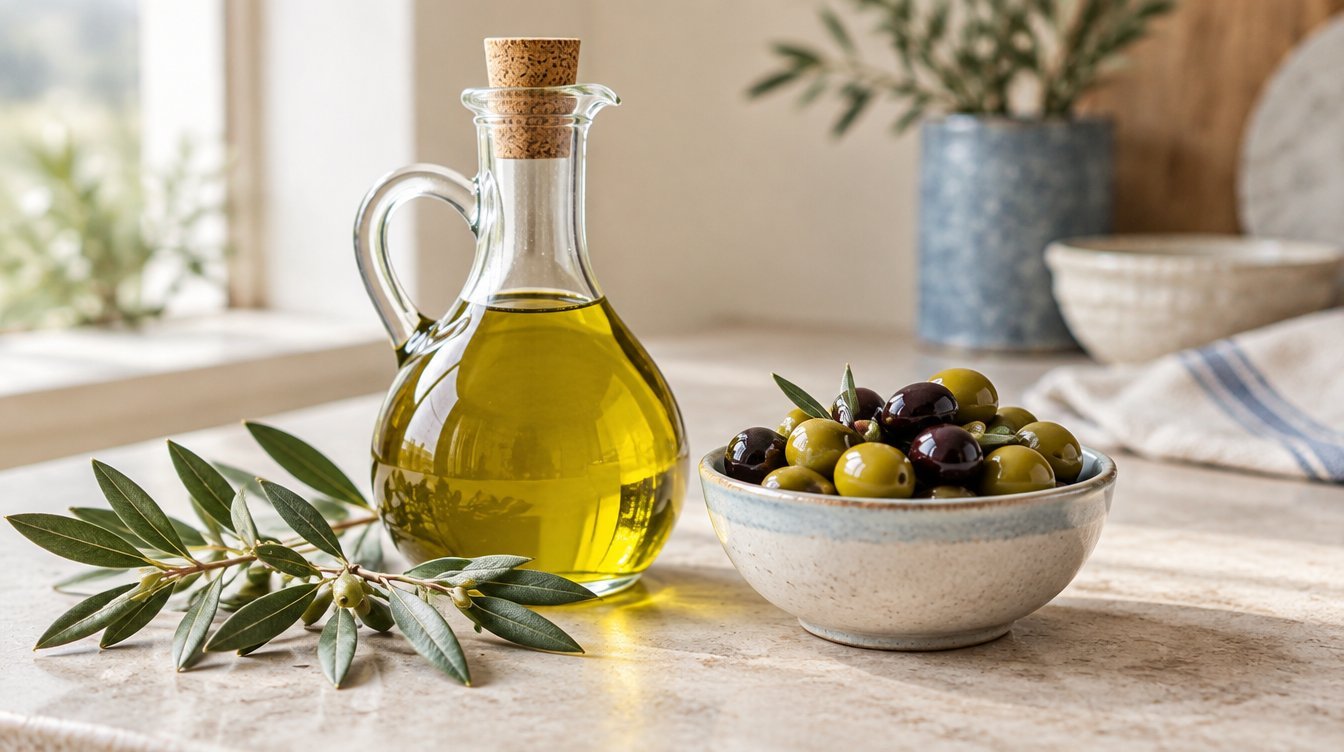
Olive oil is the fat pressed from olives. It is the main fat in the Mediterranean way of eating, which Mayo Clinic describes as built on vegetables, fruits, whole grains, beans, nuts and fish, with extra virgin olive oil as the main source of fat (Mayo Clinic).
U.S. grade standards sort the oils you see on the shelf. Extra virgin olive oil is a virgin oil with excellent flavor and odor and very low free fatty acids. Virgin olive oil has reasonably good flavor. Refined olive oil is made flavorless and odorless by refining, and plain “olive oil” is a blend of refined and virgin oils (USDA Agricultural Marketing Service).
The difference matters for gut research because virgin oils keep more of the olive’s natural plant compounds called polyphenols. Most studies of olive oil and gut bacteria focus on virgin and extra virgin oils for this reason (Barrera-Chamorro et al., 2026).
Nutritionally, all olive oil is almost pure fat, and most of that fat is monounsaturated. Here is what one tablespoon contains, based on USDA data (USDA FoodData Central):
| Per 1 tablespoon (13.5 g) | Amount |
|---|---|
| Calories | About 119 |
| Total fat | 13.5 g |
| Monounsaturated fat (mostly oleic acid) | About 9.9 g |
| Polyunsaturated fat | About 1.4 g |
| Saturated fat | About 1.9 g |
| Vitamin E | About 1.9 mg |
| Fiber | 0 g |
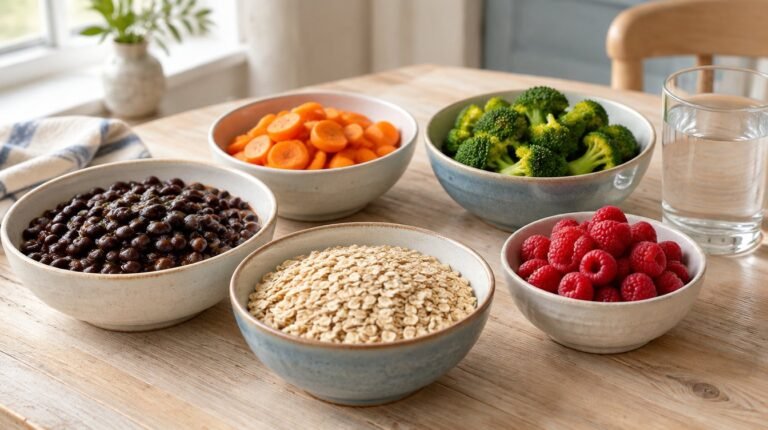
Olive oil has no fiber, so it does not feed gut bacteria the way beans, oats or vegetables do.
Why it matters for gut health
- Polyphenols reach your gut bacteria: compounds such as hydroxytyrosol, tyrosol and oleocanthal can be broken down and changed by gut microbes, and may influence bile acids, the gut lining and inflammation signals. A 2026 review notes that most of this evidence comes from lab and animal work, and that human results are mixed and depend on oil quality and what it is compared with (Barrera-Chamorro et al., 2026).
- It replaces other fats: using olive oil instead of butter is one of the simple swaps Mayo Clinic suggests for a Mediterranean-style diet (Mayo Clinic). Some of any benefit may come from what the oil pushes off your plate, and from the vegetables and beans it is usually eaten with.
That second point is easy to miss. In a 1-year trial of 612 older adults in five European countries, people who stuck more closely to a Mediterranean-style diet showed gut microbiome changes that were linked with lower frailty and inflammation markers (Ghosh et al., Gut, 2020). That study tested a whole eating pattern, not olive oil alone.
What the research shows
Human studies of olive oil itself and the gut are small and short. Here are the ones most relevant to everyday eating.
| Study | Who and what | What happened | Main limits |
|---|---|---|---|
| Martín-Peláez et al., 2017 | 12 adults with high cholesterol; 25 mL (about 1.7 tablespoons) of different virgin olive oils daily for 3 weeks each | An oil enriched with olive plus thyme polyphenols raised bifidobacteria compared with regular virgin olive oil; olive-polyphenol enrichment alone did not change the bacteria measured | Very small; enriched oils are not what you buy |
| Netto Cândido et al., 2021 | 52 overweight women on a calorie-reduced diet; 25 mL soybean, extra virgin olive or coconut oil daily for 9 weeks | No change in gut bacterial diversity with any oil; gut permeability tests rose after olive and coconut oil, with no rise in a blood marker of bacterial toxins | Small; one group of women; short |
| Olivo et al., 2026 | Systematic review of 37 animal and human studies on foods rich in monounsaturated fat | Olive oil studies showed variable shifts, with some helpful groups rising and others falling; nuts gave more consistent results | Mixed study types; hard to separate the fat from other compounds |
| Joukar et al., 2025 | 140 adults with chronic constipation; 2 tablespoons of extra virgin or refined olive oil daily for 4 weeks | Both groups improved; the extra virgin group improved more on symptom and stool-form scores | Single trial at one center; no non-oil comparison group |
| Ramos et al., 2015 | 50 people on kidney dialysis with constipation; olive, flaxseed or mineral oil, starting at 4 mL daily, for 4 weeks | Olive oil improved constipation scores about as much as mineral oil | Small, special population; no placebo |
Gut bacteria
The bacteria results do not add up to a clear story yet. The best-designed small trial found that everyday amounts of olive oil, extra virgin included, did not change gut bacterial diversity over 9 weeks (Netto Cândido et al., Food Research International, 2021). The review of 37 studies describes olive oil’s effects on gut microbes as “more variable” than those of nuts (Olivo et al., Nutrition Reviews, 2026).
Constipation
The constipation trials are more encouraging, but still early. In the largest, 140 adults took 2 tablespoons a day for 4 weeks, and the extra virgin group had larger gains than the refined group (Joukar et al., Caspian Journal of Internal Medicine, 2025). Because there was no group that skipped the oil, it is hard to know how much of the gain in either group came from the oil itself. Our guide to constipation relief covers fiber, fluids and other steps with stronger support.
How to choose and use olive oil

If you like the taste, olive oil is a reasonable everyday fat. These habits make the most of it:
- Pick extra virgin: it keeps the polyphenols that most of the gut research focuses on, and it was the type that did better in the constipation trial (Joukar et al., 2025).
- Use it as a swap, not an add-on: replace butter or other solid fats rather than adding oil on top of your usual meals (Mayo Clinic). At about 119 calories per tablespoon, extra oil adds up quickly (USDA).
- Pair it with fiber: drizzle it on vegetables, beans, lentils and whole grains, the foods that feed gut bacteria. Our list of the best foods for gut health has more ideas, and our guide to cooking for your gut health covers everyday cooking habits.
- Go easy if fat bothers you: the NHS advises people with IBS not to eat lots of fatty foods (NHS). If oily meals set off cramps or loose stools, use smaller amounts. Our diet for a sensitive stomach guide has gentler options.
Using it in place of other fats in a fiber-rich diet is the simplest approach. For another cooking fat, see our look at coconut oil for gut health.
When to see a doctor
This article is general information, not medical advice. If you are using olive oil to manage constipation, see a doctor right away if constipation comes with any of these (NIDDK):
- Bleeding from the rectum or blood in your stool.
- Constant belly pain, vomiting or fever.
- Being unable to pass gas, or lower back pain.
- Losing weight without trying.
Anemia and black or tarry stools are also warning signs that point to something other than everyday gut trouble (NIDDK).
Is extra virgin olive oil better for your gut than regular olive oil?
It may be. It keeps more polyphenols, and in one 4-week trial of 140 adults with constipation it worked better than refined olive oil (Joukar et al., 2025).
Does olive oil feed good gut bacteria?
Not directly, since it has no fiber. Its polyphenols can be processed by gut microbes, but human studies show mixed effects on gut bacteria (Olivo et al., 2026).
How much olive oil per day is used in studies?
Most gut studies used about 25 mL (roughly 1.7 tablespoons) to 2 tablespoons a day. Each tablespoon has about 119 calories (USDA).
Related topics
- Coconut Oil for Gut Health: how the other popular cooking oil compares.
- Cook for Your Gut Health: everyday cooking habits that support digestion.
- Best Foods for Gut Health: fiber-rich foods to pair with olive oil.
- Constipation Relief: steps with stronger evidence than oil alone.
- Gut Health Diet Plan: a week of meals built around plants.
- Gut Health and Inflammation: what diet can and cannot do.
Sources
- Oil, olive, salad or cooking (SR Legacy 171413) (USDA FoodData Central)
- Mediterranean diet for heart health (Mayo Clinic)
- Olive Oil and Olive-Pomace Oil Grades and Standards (USDA Agricultural Marketing Service)
- Diet, lifestyle and medicines for IBS (irritable bowel syndrome) (NHS)
- Symptoms and Causes of Constipation (National Institute of Diabetes and Digestive and Kidney Diseases)
- Diagnosis of Irritable Bowel Syndrome (National Institute of Diabetes and Digestive and Kidney Diseases)
- Martín-Peláez S, et al. Effect of virgin olive oil and thyme phenolic compounds on blood lipid profile: implications of human gut microbiota (European Journal of Nutrition, 2017)
- Netto Cândido TL, et al. Effect of the ingestion of vegetable oils associated with energy-restricted normofat diet on intestinal microbiota and permeability in overweight women (Food Research International, 2021)
- Olivo NK, et al. Monounsaturated Fatty Acid-Rich Foods and Gut Microbiota Composition: A Systematic Review of In Vivo Studies and Randomized Clinical Trials (Nutrition Reviews, 2026)
- Barrera-Chamorro L, et al. Olive Oil as a Modulator of Gut Microbiota and Intestinal Health: A Narrative Review from Microbial Metabolism to Host Responses (Nutrients, 2026)
- Joukar F, et al. Comparative efficacy of extra virgin olive oil versus refined olive oil in the treatment of individuals suffering from constipation: A double-blind randomized clinical trial study (Caspian Journal of Internal Medicine, 2025)
- Ramos CI, et al. The short-term effects of olive oil and flaxseed oil for the treatment of constipation in hemodialysis patients (Journal of Renal Nutrition, 2015)
- Ghosh TS, et al. Mediterranean diet intervention alters the gut microbiome in older people reducing frailty and improving health status: the NU-AGE 1-year dietary intervention across five European countries (Gut, 2020)
This article is for general information and is not medical advice. Talk to your doctor or a registered dietitian before changing your diet, supplements or medication, especially if you have a health condition.